

Official CBSE Study Materials for Class 8 Science
Access comprehensive study materials and useful resources for Chapter 10 Reaching the Age of Adolescence using the Class 8 Science Reaching at the Age of Adolescence Exam Notes. Designed to align with the 2026-27 CBSE academic guidelines, these advanced resources help Class 8 Science students reinforce core concepts beyond standard textbooks.
Advanced Resources for Science
View or download the dedicated Class 8 Science Reaching at the Age of Adolescence Exam Notes resource below. Engaging with these advanced study guides under focused conditions ensures continuous academic progress and mastery of the 2026-27 curriculum for Chapter 10 Reaching the Age of Adolescence.
Class 8 Science Reaching at the Age of Adolescence Exam Notes. Please refer to the examination notes which you can use for preparing and revising for exams. These notes will help you to revise the concepts quickly and get good marks.
Covers the following topics:
1.Adolescence
2.Puberty
3.Changes at puberty
4.Secondary sexual characters
5.Endocrine system & hormones
6.Menstrual cycle
7.Sex determination in human
Adolescence
The period of transition from childhood to adulthood is called adolescence.
Puberty
The age at which the sex hormones and gamets begin to be produced and the boy and the girl become sexually matured, is called puberty. Generally boys
Change In Puberty
(1)Increase in Height : There is a sudden increase in the height of both boys and girls during puberty. This occurs due to increase in the length of bones of arms and legs.
(2)Change in body shape : In girls hips become broader and the pelvic region widens. Deposition of fat takes place around the hips.In boys shoulders broaden and the body muscles grow more than that of the girls.
(3)Change in voice : At puberty the voice box or the larynx begins to grow. The larynx in boys is larger than that in girls. In boys, the voice becomes deep and harsh whereas girls have high pitched voice.
(4)Increased activity of sweat and sebaceous glands : The secretion of sweat glands and sebaceous glands (oil glands) increases during puberty. This causes acne and pimples on the face of boys and girls at this time.
(5)Development of sex organs : In boys, the male sex organs like the testes and penis develop completely. In girls, the ovary enlarges and eggs begin to mature. Ovaries start releasing matured eggs. Only one egg is released per month.
(6) Production of hormones : The testes produce the male sex hormone called testosterone. The ovaries produce the female sex hormone called estrogen.
SECONDARY SEXUAL CHARACTERS
Some of the secondary sexual characteristics that develop in girls and boys are as follows :
◊ In Males (boys) :
(1) Facial hairs such as beard and moustaches develop.
(2) Hairs develop under the arm pit, under chest and in the pubic regions.
(3) Voice becomes deeper (low pitches voice).
(4) Muscles develop and shoulder becomes broad.
(5) Increase in weight.
◊In Females (girls) :
(1) Development and enlargement of breast (mammary glands).
(2) Hairs develop under arm pit and in the pubic regions.
(3) Hips broaden and pelvic region widens.
(4) Initiation of menstrual cycle.
(5) Deposition of fat around hips
(6) Have high pitched voice (shrill voice).
These changes which occur at adolescence are controlled by hormones.
ENDOCRINE SYSTEM & HORMONES
A group of endocrine glands which produces various hormones constitutes the endocrine system.
◊ Hormones :
Hormones are chemical substances secreted by ductless glands in the body. These glands release hormones directly into the blood of person, and with the circulation of blood these hormones are carried to target sites.
◊ Example of Some Endocrines Glands Are :
Some Endocrine Glands and their functions
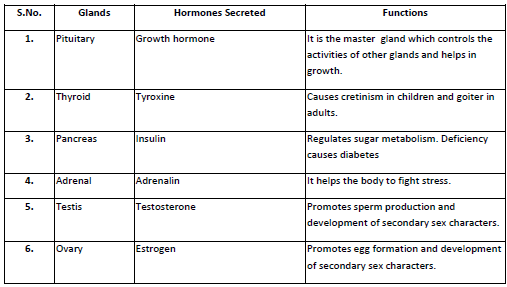
(1) Pituitary Gland : The pituitary gland is located just below the brain. It secretes growth hormone. Growth hormone controls the development of bones and muscles.
(2) Thyroid Gland : The thyroid glands is located in the throat region. It makes a hormone called thyroxine which contains iodine. The function of thyroxine hormone is to control the rate of metabolism, growth and respiration.
(3) Pancreas : It secretes insulin along with some other hormones. The function of insulin hormone is to control sugar metabolism in the body. Deficiency of insulin in the body causes a disease known as diabetes.
(4) Adrenal Gland : The adrenal gland secretes adrenalin hormone. This hormone is produced under stress. It regulates heartbeat, breathing rate, blood pressure, carbohydrate metabolism and mineral balance.
MENSTRUAL CYCLE
The beginning of the menstrual cycle (menarche) marks the onset of puberty (at the age of 12–13 years) in human females and it lasts upto 40–50 years (menopause) when the reproductive capacity of the female is arrested.
• Menstrual phase (Bleeding phase) : This phase is also called the stage of menstrual flow and lasts about 4 days. During this phase, uterus endometrial lining is sloughed off and bleeding also takes place due to rupture of blood vessels.
•Proliferactive phase : This phase is also called follicular phase or stage of repair and proliferation. This is mainly influenced by estrogens.
• Ovulatory phase : During this phase, no conspicuous changes occur in the uterus endometrium. It occurs midway between two menstrual periods.
•Secretory phase : This phase is under the control of progesterone and estrogens. If pregancy does not retain it is followed by menstruation and so it is called premenstrual phase. This phase lests for about 13
to 14 days.
SEX DETERMINATION
The body cells of every human individual, whether male or female, possess 23 pair of chromosomes. Of these 23 pairs of chromosomes are similar in all respects. However 23rd pair is different. The chromosomes of 23rd pair are called sex chromosomes. In females these chromosomes are 22 + XX pairs of chromosomes and in males they are 22 + XY pairs of chromosomes. When female gametes (eggs) are produced, each egg contains 22 + X and 22 + X chromosomes. The males on the other hand produce male gametes (sperms) having 22 + X and other having 22 + Y chromosomes. During fertilization, the sex of the unborn gets decided as shown in the figure
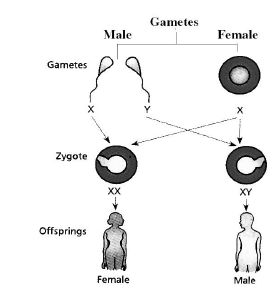
From the above it is clear that all children will inherit an X chromosome from their mother regardless of whether they are boys or girls. Thus the sex of the children will be determined by what they inherit from their father. A child inheriting an X chromosome from the father will be a girl and the one who inherits Y from the father will be a boy. In our society it is often the mother who is blamed for giving birth to a girl child which is incorrect scientifically and medically.
Please click on below link to download pdf file for Class 8 Science Reaching at the Age of Adolescence Exam Notes.
Free study material for Science
Science Class 8 Exam Resources: Chapter 10 Reaching the Age of Adolescence
Quick Revision Material for Chapter 10 Reaching the Age of Adolescence
Access comprehensive study material for Chapter 10 Reaching the Age of Adolescence, including revision notes, concept maps, and high-probability questions. These resources are designed in alignment with the latest 2026 CBSE syllabus for Class 8 Science to support effective exam preparation.
Expert Notes and Solved Exam Questions
Built using official NCERT guidelines for Class 8 Science, these materials provide reliable academic support. Integrating past examination questions and step-by-step solutions helps students understand official CBSE grading criteria.
Additional Study Resources for Class 8
Wrap up your chapter revision by testing your knowledge against standard objective question formats. Explore our full library of free, up-to-date sample papers and online assessments to secure top grades in your CBSE examinations.
FAQs
Our advanced study package for Chapter 10 Reaching the Age of Adolescence includes detailed concepts, diagrams, Mind Maps, and explanation of complex topics to ensure Class 8 students learn as per syllabus for 2026 exams.
The Mind Maps provided for Chapter 10 Reaching the Age of Adolescence act as visual anchors which will help faster recall during high-pressure exams.
Yes, teachers use our Class 8 Science resources for lesson planning as they are in simple language and have lot of solved examples.
Yes, You can download the complete, mobile-friendly PDF of the Science Chapter 10 Reaching the Age of Adolescence advanced resources for free.
Yes, our subject matter experts have updated the Chapter 10 Reaching the Age of Adolescence material to align with the rationalized NCERT textbooks and have removed deleted topics and added new competency-based questions.