Class 8 Science Cell Exam Notes

Read and download the Class 8 Science Cell Exam Notes. Designed for 2025-26, this advanced study material provides Class 8 Science students with detailed revision notes, sure-shot questions, and detailed answers. Prepared by expert teachers and they follow the latest CBSE, NCERT, and KVS guidelines to ensure you get best scores.

Advanced Study Material for Class 8 Science Chapter 8 Cell Structure and Functions

To achieve a high score in Science, students must go beyond standard textbooks. This Class 8 Chapter 8 Cell Structure and Functions study material includes conceptual summaries and solved practice questions to improve you understanding.

Class 8 Science Chapter 8 Cell Structure and Functions Notes and Questions


Class 8 Science Cell Exam Notes. Please refer to the examination notes which you can use for preparing and revising for exams. These notes will help you to revise the concepts quickly and get good marks.

The Cell

Cell is the functional & structural unit of life as all the metabolic activity takes place in a cell.

The study of structure & composition of cell is known as cytology.  

History

Robert Hooke used a primitive compound 
class_8_science_useful_1

microscope to examine thin slices of cork from the bark of an oak tree.

He observed the hollow box like structure similar  to honey comb for which he coined the term 'cell'.

Unicellular Organisms :

In these organisms, all the function like nutrition, respiration, excretion & reproduction are carried out by the single cell.

Example → Amoeba.
 Multicellular Organisms :
 
 Organisms which are made up of a few to billions of cells.
 
Example →Plants & Animals.
 
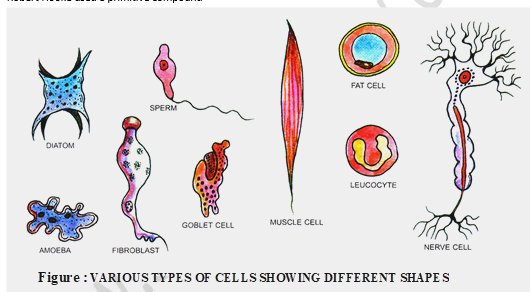
 Shape of Cell :
 
 The Cells of animals & plants may be oval, spherical, cuboidal, columnar, polygonal or spindle-like. Neuron is the longest cell in animal body.
 
 Size of Cell :
 
• The cell of animal & plants show variation in their size.
 
For example - The largest living cell is egg of an ostrich which is about 170 mm in diameter. The smallest cell is PPLO which is 1μ small
 
STRUCTURE OF CELL 
 
 Cell Membrane :
 
 Cell membrane is also called the plasma membrane. In an animal cell, it is the outermost layer, where as in a plant cell, it is protected by the cell wall. It is a living structure and controls the entry and exist of some substances in and out of the cell. It also protects the internal components of the cell. It gives shape to the cell.
 
 Cell Wall :
 
 In addition to the cell membrane, plant cells have an outer thick layer called cell wall. It is non-living and it mainly composed of cellulose. It is protective in function and mainly determines the shape of the cell. It is absent in animal cells.
 
 Cytoplasm :
 
 It is a transparent , jelly-like living substance which fills the interior of an animal and plant cell. It is present between the cell membrane and the nucleus. It contains a number of minute living structures known as the cell organelles and many non-living substances known as cell inclusions.
 
 Nucleus :
 
 Nucleus is the most important part of a cell. It is usually spherical or oval in shape. It controls all the vital functions of the cell. It is made up of the nuclear membrane, nuceloplasm, nucleolus and hromosomes. The nuclear membrane surrounds the nucleus and separates it from the cytoplasm. It is permeable and controls the passage of materials through and from the nucleus.
 
 The nucleoplasm or nuclear sap makes up the body of the nucleus. It is deser than the cytoplasm.
 
 The nucleolus is a spherical body in the nucleus. It is composed of the nucleoprotein RNA (ribonucleic acid). It is responsible for protein synthesis.
 
 Nucleus also contains thread-like structures called chromosomes, which are composed of nucleoprotein DNA (deoxyribonucleic acid). The hereditary units of chromosomes are the genes. They are responsible or the transmission of characters from the prarents to the offspring. 
 
 Those organisms which do not have well defined nucleus and nuclear membrane are called prokaryotes. For example, bacteria, and some blue green algae.
 
 Those organisms which have well organized nucleus with the nuclear membrane are called eukaryotes. For example man, elephant, onion and cheek cells.
 
CELL ORGANELLES
 
These are active, living, permanent small structure present in cytoplasm & concerned with cell function.
 
◊ Vacuoles :
 
 The central part of most plant cells is occupied by a large vacuole. It is a sac like structure filled with fluid. Food, wastes pigments and other substances are dissolved in the fluid. Some plant cells have a number of large vacuoles.
 
Vaculoes are not so common in animal cells.
 
 When they occur, they are much smaller in size.
 
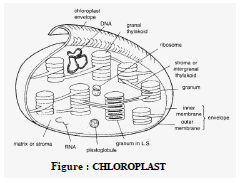
◊ Plastids :
 
 These organelles are not present in animal cells. Chloroplasts (a type of plastid) contain the green pigment chlorophyll and are responsible for photosynthesis. Only green parts of plants have chloroplasts.
 
 There are two other types of plastids called chromoplasts and leucoplasts. Chromoplasts contain pigments which give fruits and flowers their colours. Leucoplasts store food and are found in the storage organs of plants.
Class 8 Science Cell Exam Notes
 
◊ Endoplasmic reticulum (ER) :
 
 The endoplasmic reticulum is a network of tube-like structures running through the cytoplasm. If ribosomes are attached to it, the reticulm is rough, otherwise it is smooth.
 
 Function - It gives internal support to the colloidal matrix (cytoplasm).
 
 Rough endoplamic reticulum (RER) is associated with the synthesis of proteins.
 
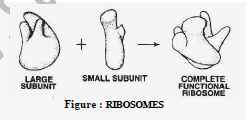
◊ Ribosomes :
 
 Ribosomes are extremely Small, round bodies found either in the state in the cytoplasm or attached to the surface of the ER. They are composed of ribonucleoprotein (ribonucleic acid and protein).
 
 Functions - The main function of ribosomes is to act as a platform or work place for the synthesis of proteins.
Class 8 Science Cell Exam Notes
 
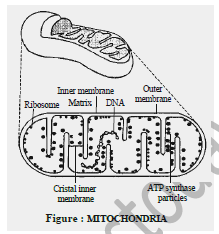
◊ Mitochondria :
 
• Mitochondria are small, rod-shaped organelles found in large numbers. Each mitochondria is bounded by two membranes-outer and inner. The outer membrane is smooth and the inner membrane is pushed inwards at intervals forming crests called cristae. The cristae lie in a ground substane called matrix. Mitochondria process enzymes necessary for the oxidation of carbohydrates. This process releases energy in the form of ATP.
 
This is why mitochondria are known as the powerhouses of the cell. Mitochondria have their own DNA and ribosomes. They can synthesize their own proteins.
 
 Function- Mitochondria provide energy for the vital activities of living cells.
Class 8 Science Cell Exam Notes
 
 Golgi Body :
 
 These are small, hollow, plate-like or cup-shaped bodies found in animal cells. They synthesise, store and secrete enzymes and proteins. The Golgi apparatus in plants is known as dictyosome.
 
◊ Lysosome :
 
 They are present in animal cells only. They contain enzymes for cellular digestion. If they burst, the cell may get damaged or destroyged. Hence, they are called the suicidal bags of the cell.
 
◊ Centrosome :
 
 It is a star-like structure found mostly in animal cells. It consists of cenrioles. It helps in cell division.


Please click on below link to download pdf file for Class 8 Science Cell Exam Notes.

Worksheets for Class 8 Science
CBSE Class 8 Science Heat Chapter Notes
~ Class 8 Science (Old Chapters)
CBSE Class 8 Science Current Electricity and its Effects Chapter Notes
CBSE Class 8 Science Force and Pressure Chapter Notes
CBSE Class 8 Science Friction Chapter Notes
CBSE Class 8 Science Light Chapter Notes
CBSE Class 8 Science Light Solved Examples
CBSE Class 8 Science Some Natural Phenomena Chapter Notes
CBSE Class 8 Science Sound Chapter Notes
CBSE Class 8 Science Sound Solved Examples
CBSE Class 8 Science Stars and Solar System Cross Word A
CBSE Class 8 Science Stars and Solar System Cross Word B
CBSE Class 8 Science Stars and Solar System Cross Word C
CBSE Class 8 Science Stars and Solar System Cross Word D
CBSE Class 8 Science Stars and the Solar System Chapter Notes
Class 8 Science Cell Exam Notes
Class 8 Science Chemical Effects of Electric Current Exam Notes
Class 8 Science Coal and Petroleum Exam Notes
Class 8 Science Combustion and Flame Exam Notes
Class 8 Science Conservation of Plants and Animals Exam Notes
Class 8 Science Crop Production and Management Exam Notes
Class 8 Science Force and Pressure Exam Notes
Class 8 Science Friction Exam Notes
Class 8 Science Light Exam Notes
Class 8 Science Materials Exam Notes
Class 8 Science Metals and Non Metals Exam Notes
Class 8 Science Microorganisms Exam Notes
Class 8 Science Pollution of Air and Water Exam Notes
Class 8 Science Reaching at the Age of Adolescence Exam Notes
Class 8 Science Reproduction Exam Notes
Class 8 Science Some Natural Phenomena Exam Notes
Class 8 Science Sound Exam Notes
Class 8 Science Stars and the Solar System Exam Notes

CBSE Class 8 Science Chapter 8 Cell Structure and Functions Study Material

Students can find all the important study material for Chapter 8 Cell Structure and Functions on this page. This collection includes detailed notes, Mind Maps for quick revision, and Sure Shot Questions that will come in your CBSE exams. This material has been strictly prepared on the latest 2026 syllabus for Class 8 Science. Our expert teachers always suggest you to use these tools daily to make your learning easier and faster.

Chapter 8 Cell Structure and Functions Expert Notes & Solved Exam Questions

Our teachers have used the latest official NCERT book for Class 8 Science to prepare these study material. We have included previous year examination questions and also step-by-step solutions to help you understand the marking scheme too. After reading the above chapter notes and solved questions also solve the practice problems and then compare your work with our NCERT solutions for Class 8 Science.

Complete Revision for Science

To get the best marks in your Class 8 exams you should use Science Sample Papers along with these chapter notes. Daily practicing with our online MCQ Tests for Chapter 8 Cell Structure and Functions will also help you improve your speed and accuracy. All the study material provided on studiestoday.com is free and updated regularly to help Class 8 students stay ahead in their studies and feel confident during their school tests.

What is included in the advanced study material for Class 8 Science Chapter Chapter 8 Cell Structure and Functions?

Our advanced study package for Chapter Chapter 8 Cell Structure and Functions includes detailed concepts, diagrams, Mind Maps, and explanation of complex topics to ensure Class 8 students learn as per syllabus for 2026 exams.

How do Mind Maps for Science Chapter Chapter 8 Cell Structure and Functions help in revision?

The Mind Maps provided for Chapter Chapter 8 Cell Structure and Functions act as visual anchors which will help faster recall during high-pressure exams.

Are these Science resources suitable for both classroom teaching and self-study?

Yes, teachers use our Class 8 Science resources for lesson planning as they are in simple language and have lot of solved examples.

Is this advanced study material for Chapter Chapter 8 Cell Structure and Functions free to download in PDF?

Yes, You can download the complete, mobile-friendly PDF of the Science Chapter Chapter 8 Cell Structure and Functions advanced resources for free.

Does this material cover rationalized content for the 2025-26 CBSE session?

Yes, our subject matter experts have updated the Chapter Chapter 8 Cell Structure and Functions material to align with the rationalized NCERT textbooks and have removed deleted topics and added new competency-based questions.