

Download CBSE Class 8 Science Useful Resources
Review targeted academic resources with the CBSE Class 8 Science Sound Solved Examples. Built according to official CBSE standards for the 2026-27 term, these downloadable Class 8 Science study materials support effective daily practice and deeper conceptual understanding for Chapter 13 Sound.
Access CBSE Study Guides and Summaries
View or download the dedicated CBSE Class 8 Science Sound Solved Examples resource below. Engaging with these advanced study guides under focused conditions ensures continuous academic progress and mastery of the 2026-27 curriculum for Chapter 13 Sound.
CBSE Class 8 Science Sound Solved Examples. There are many more useful educational material which the students can download in pdf format and use them for studies. Study material like concept maps, important and sure shot question banks, quick to learn flash cards, flow charts, mind maps, teacher notes, important formulas, past examinations question bank, important concepts taught by teachers. Students can download these useful educational material free and use them to get better marks in examinations. Also refer to other worksheets for the same chapter and other subjects too. Use them for better understanding of the subjects.
Solved Examples
Ex.1: Figure shows the mean position A and the extreme positions B and C of the bob of an oscillating pendulum. Identify which of the following distances represent a quarter oscillation and which represent half an oscillation
(a) BA (b) AC (c) BAC (d) CAB (e) AB (f) ABA
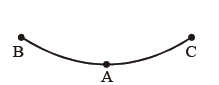
Sol.: BAC + CAB is a complete oscillation. Thus each of BAC and CAB is half an oscillation. Each of BA, AC and AB is half of BAC. So these three are quarter oscillation. ABA = AB + BA. As AB = BA = quarter oscillation, ABA is also half an oscillation.
Ex.2: The frequency of a source of sound is 100 Hz. How many time does it vibrate in a minute?
Sol.: Here, v = 100 Hz.
1 minute = 60 seconds
\ No of vibrations = 100 × 60 = 6000
Ex.3: Figure shows the displacement of a particle with distance in a periodic wave moving along a string.
(a) Find the wavelength (b) If the wave travels at a speed of 10 cm/s, find the time period and the frequency of the wave.
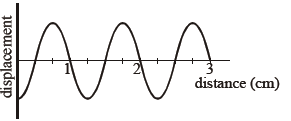
Sol.: (a) We see from the figure that the distance between consecutive crests is 1 cm. Hence, the wavelength is 1 cm.
Ex.5: An oil-tanker explodes at sea. At that instant an aircraft and a submarine were present vertically above and below the oil-tanker respectively, at equal distances from it. Find the ratio of the times taken by sound waves to reach them. (Speed of sound in air = 340 m/s, speed of sound in sea water = 1,520 m/s.)
Sol.: Let the aircraft and the submarine be x m above and below the tanker respectively Time taken by sound to reach the aircraft
Ex.6: A person clapped his hands near a cliff and heard the echo after 5 s. What is the distance of the cliff from the person if the speed of the sound, v is taken as 346 ms–1?
Sol.: Given, Speed of sound, v = 346 ms–1
Time taken for hearing the echo, t = 5 s
Distance travelled by the sound
= v × t = 346 ms–1 × 5 s = 1730 m
In 5 s sound has to travel twice the distance between the cliff and the person. Hence, the distance between the cliff and the person
= 1730 m/2 = 865 m.
Basic Level Assignment
1. What is sound and how is it produced?
2. Why is sound wave called a mechanical wave?
3. How does the sound produced by a vibrating object in a medium reach your ear?
4. Give two practical applications of reflection of sound waveS.
5. Distinguish between periodic motion and oscillatory motion. Is the motion of an electric fan periodic or oscillatory?
6. What do you understand by the equilibrium position of a pendulum?
7. Explain with a diagram what you understand by a complete oscillation?
8. When a wave propagates in a medium, what is transferred from one place to other, matter or energy?
9. Give three examples of transverse waves.
10. A longitudinal wave travels from east to west in air. In which direction do the particles of air move?
11. A sitar player plucks the wire of a sitar to a side and releases it. After a short time, each part of the wire starts vibrating in a direction perpendicular to the wire. Is the propagation of this disturbance a longitudinal or a transverse wave?
12. A long spring is fixed at one end. A person holding the other end compresses the spring with a jerk. The compression travels along the length of the spring. Is it an example of longitudinal wave or transverse wave?
13. Is sound wave longitudinal or transverse?
14. Name two quantities that vary periodically at a place in air as a sound wave travels through it.
15. In which of the three media, air, water or steel, does sound travels the fastest?
16. Which has larger frequency-infrasonic sound or ultrasonic sound?
17. What is reverberation? How can it be reduced?
18. What is loudness of sound? on What factors does it depend?
19. Explain how bats use ultrasound to catch a prey.
20. How is ultrasound used for cleaning?
21. Explain how defects in a metal block can be detected using ultrasound.
22. Explain how the human ear works.
Choose the correct option(s) in the following:
1. If a wave completes 20 vibrations in 2.5 sec, its frequency is
(A) 20 Hz (B) 8 Hz
(C) 200 Hz (D) 50 Hz
2. An observer standing at the sea coast observes 54 waves reaching the coast per minute. If the wavelength of wave is 10 m, the velocity of the wave will be
(A) 4.5 m/sec (B) 9 m/sec
(C) 18 m/sec (D) 27 m/sec
3. Sound waves cannot pass through
(A) a solid-liquid mixture (B) an ideal gas
(C) a liquid gas mixture (D) perfect vacuum
4. If five waves are produced in one second, then time period of one wave is
(A) 0.20s (B) 0.25 s
(C) 0.10 s (D) 0.05 s
5. The distance between two successive rarefactions is called
(A) frequency (B) wavelength
(C) wave velocity (D) amplitude
Please click the link below to download CBSE Class 8 Science Sound Solved Examples
Free study material for Science
Useful Resources and Notes for Class 8 Science Chapter 13 Sound
Comprehensive Study Resources for Chapter 13 Sound
Review targeted study resources for Chapter 13 Sound tailored for Class 8 learners. Utilizing these structured notes and quick-revision tools ensures complete alignment with current CBSE evaluation standards.
Understanding Marking Schemes
Designed around the official curriculum, these study guides guarantee standard compliance. Reviewing step-by-step solutions clarifies complex sub-topics within Chapter 13 Sound and demystifies standard marking schemes for Science evaluations.
Complete Revision for Science
Maximize your grade potential by utilizing Class 8 Science practice papers in tandem with these structured notes. All printable assignments and interactive mock tests on our platform are updated for the 2026 session and available free of charge.
FAQs
Our advanced study package for Chapter 13 Sound includes detailed concepts, diagrams, Mind Maps, and explanation of complex topics to ensure Class 8 students learn as per syllabus for 2026 exams.
The Mind Maps provided for Chapter 13 Sound act as visual anchors which will help faster recall during high-pressure exams.
Yes, teachers use our Class 8 Science resources for lesson planning as they are in simple language and have lot of solved examples.
Yes, You can download the complete, mobile-friendly PDF of the Science Chapter 13 Sound advanced resources for free.
Yes, our subject matter experts have updated the Chapter 13 Sound material to align with the rationalized NCERT textbooks and have removed deleted topics and added new competency-based questions.