

Advanced Study Material for Class 8 Science: Chapter 17 Stars and the Solar System
Access comprehensive study materials and useful resources for Chapter 17 Stars and the Solar System using the CBSE Class 8 Science Stars and Solar System Cross Word Set 03. Designed to align with the 2026-27 CBSE academic guidelines, these advanced resources help Class 8 Science students reinforce core concepts beyond standard textbooks.
Practice Class 8 Science Resources: Chapter 17 Stars and the Solar System
View or download the dedicated CBSE Class 8 Science Stars and Solar System Cross Word Set 03 resource below. Engaging with these advanced study guides under focused conditions ensures continuous academic progress and mastery of the 2026-27 curriculum for Chapter 17 Stars and the Solar System.
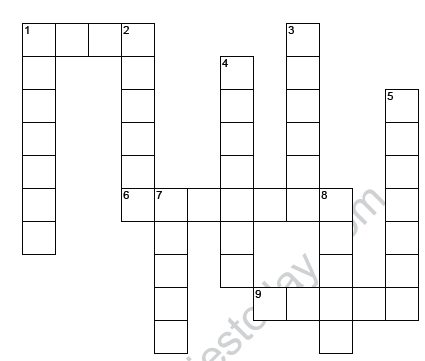
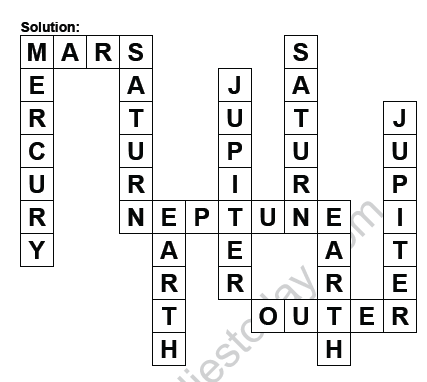
ACROSS
1 red planet
6 the farthest planet from sun
9 these planets have large number of moons
DOWN
1 the planet mostly hidden in the glare of sun
2 least dense among all planets
3 it has good rings but not visible with naked eyes
4 with a telescope we can see its
4 moons
5 its mass is around 318 times as that of earth
7 it has blanket of ozone
8 its this of rotation is not perpendicular to the plane of its orbit
Question. August 11, 1999 was a bright, clear day. But in the evening in the town of Dholka in western India, it gradually became very dark for a few minutes and then became bright again. What could have caused this incident?
(a) A comet
(b) A lunar eclipse
(c) A solar eclipse
(d) A power cut
Answer : C
Question. At any given time, different parts of the earth experience different seasons. Apart from the earth's revolution around the sun, which of these is the reason for this?
(a) the earth's rotation
(b) the elliptical shape of the earth's orbit
(c) the presence of the moon
(d) The tilt of the earth's axis of rotation.
Answer : D
Question. What is common to Venus and the moon?
(a) Both are planets.
(b) Both are luminous.
(c) Both reflect the sun's light.
(d) Both are satellites of the earth.
Answer : C
Question. The lowest and highest temperatures anywhere on the earth every year are around:
(a) 0 & deg;C and 100 & deg;C.
(b) -10 & deg;C and 40 & deg;C.
(c) -50 & deg;C and 50 & deg;C
(d) -20 & deg;C and 60 & deg;C
Answer : D
Question. The axis of the earth's rotation is tilted with respect to the plane of its revolution.
What would be the MAIN difference if the axis were NOT tilted but perfectly upright?
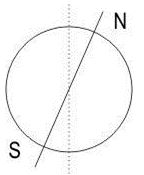
(a) We would not have day and night
(b) The weather would be similar throughout the world.
(c) The weather would be similar throughout the year.
(d) There would be no change.
Answer : C
Question. The earth takes 1 year to make a complete revolution around the sun whereas Pluto takes nearly 248 of our earth years to orbit the sun; what is the main reason for this?
(a) Pluto being small in size is slower than the earth.
(b) Pluto being more massive moves more slowly.
(c) Strong winds on the Earth makes it move faster.
(d) Pluto being far from the Sun has to travel more distance than the earth.
Answer : D
Question. According to Kepler's Law, the speed of the earth's revolution around the sun is greater when the earth is closer to the sun. See the figure and identify the month in which the speed of the earth's revolution is least?
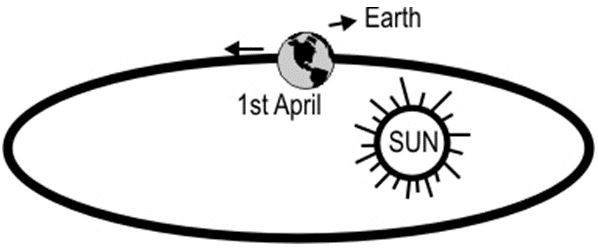
(a) March
(b) June
(c) September
(d) December.
Answer : B
Question. What is the colour of the sky as seen from the moon?
(a) Blue in the day" and black in the "night""
(b) Blue in the day" and "night""
(c) Black in the day "and "night""
(d) Red in the day" and black in the "night""
Answer : C
Question. Which BEST describes the surface of the Earth over billions of years?
(a) A flat surface is gradually pushed up into higher and higher mountains until it is covered with mountains.
(b) High mountains gradually wear down until most of the Earth is at sea level.
(c) High mountains gradually wear down as new mountains are continuously being formed, over and over again.
(d) High mountains and flat plains stay side by side for billions of years with little change.
Answer : C
Question. A solar eclipse occurs when the moon comes between the sun and the earth. During a solar eclipse, the sun would be completely blocked in some parts of the world Mercury came between the sun and the earth. The sun could be seen from everywhere unlike during a solar eclipse due to the moon. Why?
(a) Mercury is further away from the earth than the moon.
(b) Mercury is much smaller than the moon.
(c) Mercury's orbit is in a different plane than earth's.
(d) (Both A and B)
Answer : A
Question. In a movie, a spaceship explodes and continues to burn as it moves through space. This can NOT happen because
(a) space does not have oxygen.
(b) gases expand in a vacuum.
(c) spaceships are made of metals that cannot explode.
(d) the carbon dioxide in space would have extinguished the fire.
Answer : A
Question. What would happen if the axis of the earth were NOT tilted with reference to the plane of its revolution as shown in the second figure below?
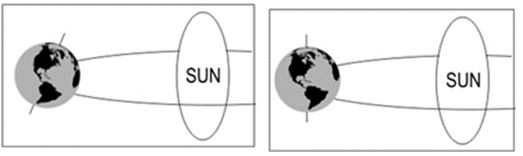
(a) There would be no difference at all.
(b) The sun would rise in the west and set in the east.
(c) In any place, the weather will be more uniform throughout the year.
(d) At any time, the weather will be almost the same throughout the world.
Answer : C
Question. Waste can be classified based on its source as 1. Domestic 2. Industrial 3. Hospital 4. Agricultural or based on its nature as
1. waste [may contain harmful chemicals or radioactive material
2. Pathogenic waste [may contain disease producing virus and bacteria
3. Non toxic waste [neither toxic nor pathogenic] Pieces of brick that are too small to be used can be classified as
Source Nature
A Domestic Taxic waste
B Agricultural Non toxic
C Industrial Non toxic
D Hospital Pathogenic waste
(a) A
(b) B
(c) C
(d) D
Answer : C
Question. What is acid rain?
(a) Rain which is acidic
(b) Burns caused by acid
(c) Acid leakage from factories
(d) A rare phenomenon that occurs in the arctic regions
Answer : A
Question. Osmansagar lake near Hyderabad, is a source of drinking water for the city. If the water is tested for bacterial content and found to have an elevated count, this might mean that
(a) the water is safe to drink.
(b) the food chain has been extended to the microscopic level.
(c) sewage may be entering the water.
(d) the oxygen level is below normal.
Answer : C
Free study material for Science
Science Class 8 Exam Resources: Chapter 17 Stars and the Solar System
Comprehensive Study Resources for Chapter 17 Stars and the Solar System
Review targeted study resources for Chapter 17 Stars and the Solar System tailored for Class 8 learners. Utilizing these structured notes and quick-revision tools ensures complete alignment with current CBSE evaluation standards.
Understanding Marking Schemes
Designed around the official curriculum, these study guides guarantee standard compliance. Reviewing step-by-step solutions clarifies complex sub-topics within Chapter 17 Stars and the Solar System and demystifies standard marking schemes for Science evaluations.
Complete Revision for Science
For peak performance in upcoming evaluations, integrate official Science sample papers directly into your study schedule. Follow up your revision by attempting online MCQ tests for Chapter 17 Stars and the Solar System to refine calculation speed and precision.
FAQs
Our advanced study package for Chapter 17 Stars and the Solar System includes detailed concepts, diagrams, Mind Maps, and explanation of complex topics to ensure Class 8 students learn as per syllabus for 2026 exams.
The Mind Maps provided for Chapter 17 Stars and the Solar System act as visual anchors which will help faster recall during high-pressure exams.
Yes, teachers use our Class 8 Science resources for lesson planning as they are in simple language and have lot of solved examples.
Yes, You can download the complete, mobile-friendly PDF of the Science Chapter 17 Stars and the Solar System advanced resources for free.
Yes, our subject matter experts have updated the Chapter 17 Stars and the Solar System material to align with the rationalized NCERT textbooks and have removed deleted topics and added new competency-based questions.