

Download CBSE Class 8 Science Useful Resources
Access comprehensive study materials and useful resources for Chapter 16 Light using the CBSE Class 8 Science Light Chapter Notes. Designed to align with the 2026-27 CBSE academic guidelines, these advanced resources help Class 8 Science students reinforce core concepts beyond standard textbooks.
Access CBSE Study Guides and Summaries
Navigate directly to the advanced Science study materials using the digital viewer below. Each resource pack includes detailed conceptual summaries and solved practice questions, allowing students to instantly reinforce their learning.
CBSE Class 8 Science Light Chapter Notes. There are many more useful educational material which the students can download in pdf format and use them for studies. Study material like concept maps, important and sure shot question banks, quick to learn flash cards, flow charts, mind maps, teacher notes, important formulas, past examinations question bank, important concepts taught by teachers. Students can download these useful educational material free and use them to get better marks in examinations. Also refer to other worksheets for the same chapter and other subjects too. Use them for better understanding of the subjects.
Light
Light
Light is a form of energy which produces the sensation of sight. Light is electromagnetic wave which does not require any material medium for its propagation. The speed of light waves depend on the nature of the medium through which they pass.
Reflection of Light
The process of bouncing back of the light to the same medium after striking the surface of another medium is called reflection.
A surface which reflects the light is called reflector. Silver metal is one of the best reflectors of light. A highly polished surface, such as a mirror, reflects most of the light falling on it.
Types of reflection: There are two types of reflection
Regular Reflection: When a parallel beam of light falls on a smooth and highly polished surface, then the reflected beam is also parallel and directed in a fixed direction. Such type of reflection is called regular reflection. For example, light reflected from search light, automobile head lights, etc.
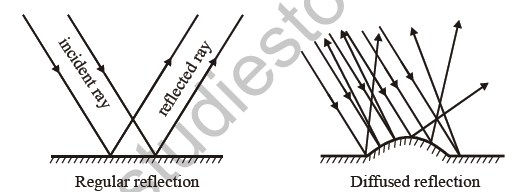
Diffused Reflection: When a parallel beam of light falls on a rough surface, then the reflected light is not parallel but spreads in all directions, such type of reflection of light is called irregular or diffused reflection. For example, light reflected from the wooden surface.
Laws of Reflection
The reflection of light from a plane surface or from a spherical surface takes place according to two laws which are:
i) The incident ray, the normal to the mirror at the point of incidence and the reflected ray, all lie in the same plane.
ii)The angle of incidence is equal to the angle of reflection (i.e., Ði = Ðr).
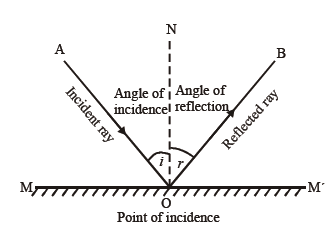
These laws of reflection are applicable to all types of reflecting surfaces such as plane surface, spherical surfaces or any irregular surface.
Formation of Image by Plane Mirror
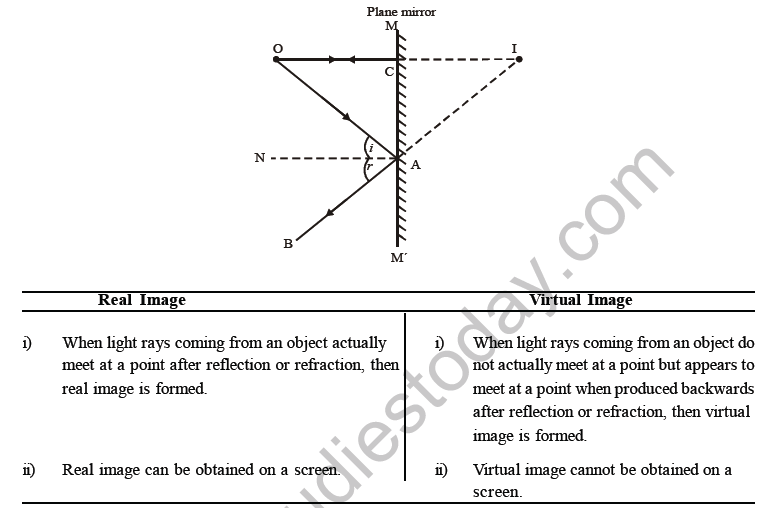
Consider a point object O placed infront of a plane mirror MM´. The mirror will form an image I of the object O. Here, two reflected rays AB and CO when produced backward, they meet at a point behind the mirror and hence form the virtual image I at that point
Properties of Images formed by a Plane Mirror
i) The image formed by a plane mirror is virtual and erect.
ii) The distance of the object from the mirror is equal to the distance of the image from the mirror.
iii) The size of the image is equal to the size of the object.
iv) The linear magnification produced by a plane mirror is unity. i.e., m = v/u= h'/h=1
v) The image formed is laterally inverted, i.e., the left side of the image appears to the right side and viceversa.
Uses of Plane Mirror
i) Plane mirror is used as a looking glass.
ii) Plane mirror is used in solar cooker to reflect the sun light.
iii) Plane mirrors are used in periscopes usually used in submarines.
iv) Plane mirros are used in barber’s shop to see the back portion of the head.
In the following videos we have explained you about the concept of Light and its properties. Watch this video to understand the concepts and also post your questions and comments in the comments section
Part 1
Part 2
Please click the link below to download CBSE Class 8 Science Light Chapter Notes
Free study material for Science
Free CBSE Study Guides: Class 8 Science Chapter 16 Light
Comprehensive Study Resources for Chapter 16 Light
Explore essential learning tools for Class 8 Science Chapter 16 Light. This curated collection features in-depth notes and targeted practice questions built around the active 2026 curriculum to streamline your daily revision.
Understanding Marking Schemes
Built using official NCERT guidelines for Class 8 Science, these materials provide reliable academic support. Integrating past examination questions and step-by-step solutions helps students understand official CBSE grading criteria.
Complete Revision for Science
For peak performance in upcoming evaluations, integrate official Science sample papers directly into your study schedule. Follow up your revision by attempting online MCQ tests for Chapter 16 Light to refine calculation speed and precision.
FAQs
Our advanced study package for Chapter 16 Light includes detailed concepts, diagrams, Mind Maps, and explanation of complex topics to ensure Class 8 students learn as per syllabus for 2026 exams.
The Mind Maps provided for Chapter 16 Light act as visual anchors which will help faster recall during high-pressure exams.
Yes, teachers use our Class 8 Science resources for lesson planning as they are in simple language and have lot of solved examples.
Yes, You can download the complete, mobile-friendly PDF of the Science Chapter 16 Light advanced resources for free.
Yes, our subject matter experts have updated the Chapter 16 Light material to align with the rationalized NCERT textbooks and have removed deleted topics and added new competency-based questions.