

Chapter-wise Worksheets for Class 7 Social Science: Our Environment Chapter 01 Environment
Access comprehensive chapter-wise worksheets for Our Environment Chapter 01 Environment using the CBSE Class 7 Geography Environment Worksheet. Designed to align with the 2026-27 academic syllabus for Class 7 Social Science, these printable practice sets help students reinforce key concepts and improve their overall exam readiness.
Practice Class 7 Social Science Worksheets: Our Environment Chapter 01 Environment
Navigate directly to the solved Social Science worksheets using the digital viewer below. Each practice set includes detailed step-by-step solutions, allowing students to instantly cross-check their work and identify areas requiring further revision.
Tick the correct Answer.
(i) Which is not a natural ecosystem?
(a) Desert
(b) Aquarium
(c) Forest
Answer : B
(ii) Which is not a component of human environment?
(a) Land
(b) Religion
(c) Community
Answer : A
(iii) Which is a human made environment?
(a) Mountain
(b) Sea
(c) Road
Answer : C
(iv) Which is a threat to environment?
(a) Growing plant
(b) Growing population
(c) Growing crops
Answer : B
Match the following:
(i) Biosphere (a) blanket of air which surrounds the earth
(ii) Atmosphere (b) domain of water
(iii) Hydrosphere (c) gravitational force of the earth
(iv) Environment (d) our surroundings
(e) narrow zone where the land water and the air interacts
(f) relation between the organisms and their surroundings
Answer :
(i) Biosphere (e) narrow zone where the land water and the air interacts
(ii) Atmosphere (a) blanket of air which surrounds the earth
(iii) Hydrosphere (b) domain of water
(iv) Environment (d) our surroundings
Short answer question
Question.What is an Ecosystem?
Answer : The system formed by the interaction of all living organisms with each other and with the physical and chemical factors of the environment in which they live, all linked by the transfer of energy and material is called an ecosystem.
Question. What do you mean by natural environment?
Answer : The basic components and organisms that are naturally present in the environment without any human involvement, like the land, water, air, plants and animals comprise the natural environment.
Question. Which are the major components of the environment?
Answer : Components of the environment include
Natural Components (Air, Water, Land & Living things)
1. Human Made Components (components created by human beings)
2. Human Components (human populations)
Question. Give four examples of a human-made environment.
Answer : Four examples of the human-made environment are buildings, parks, industries and bridges.
Question. What is lithosphere?
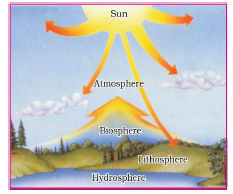
Answer : The solid crust or the hard top layer of the earth is called the lithosphere. It is made up of rocks and minerals and is covered by a thin layer of soil. It is an irregular surface with various landforms like mountains, plateaus, plains, etc.
Question. Which are the two major components of the biotic environment?
Answer : Plants and animals are the two major components of the biotic environment.
Question. What is Biosphere?
Answer : Biosphere or the living world is the narrow zone of earth where land, water and air interact with each other to support life. The plant and animal kingdom together form the biosphere.
Short Answer
Question. How do humans beings modify natural environment ?
Answer : Man modifies his environment to fulfill his basic needs, as it is the basic life support system. He builds houses to live in and industries to work in which modifies the environment and also its mineral wealth. Humans have used the fossils for their own development, disturbing the ecological system and animal habitats.
Question. How do Plants and animals depend on each other?
Answer : The interdependence of plants and animals can be illustrated by the following points:
Plants provide food to animals.
Forests provide shelter to wild life.
Wildlife adds beauty to forests.
Animal dung provides manure for the growth of plants.
The decay of dead animals provides nutrition to soil which in turn helps in the growth of plants and trees
LONG ANSWER QUESTION:-
Question. Give an account of various domains of the environment?
Answer : Various domains of the environment are:
(a)LithosphereThe solid portion of the earth is called the Lithosphere.It comprises the rocks of the earth’s crust and the thin layers oFsoil that contain nutrient elements which sustain organisms.
(b)Atmosphere The Atmosphere is a domain that consists of layers which are the troposphere, stratosphere, mesosphere, thermosphere as well as the exosphere. Lifeform sustains on troposphere which is the first layer of the atmosphere. The density of Atmosphere is maximum at sea level and decreases with increasing height. The atmosphere consists of 78% Nitrogen, 21% oxygen and other gases like Argon, Carbon dioxide as well as some other gases comprise 1% of the volume.
(c)Hydrosphere Hydrosphere is a domain that contains water or water bodies. If we take the earth into consideration. Only 1/4th (29%) of the earth is covered in soil/land while the rest 3/4th (71%) portion is covered in water. 97% of the earth’s water is found in oceans and is not suitable for use as it is saltwater.
(d)Biosphere – The Domain of Life
• The biosphere is the narrow zone of contact between the land, water and air.
• It is the zone where life exists that makes this planet unique.
Fill in the Blanks
More question-
Fill in the blanks:
1. The solid crust or the hard top layer of the earth is ______________________.
2. The domain of water is referred to as __________________________.
3. A thin layer of air that surrounds the earth is __________________________.
4. ___________________________ is a trade in which goods are exchanged without the use of money.
5. ______________________ is a narrow zone of the earth where land, water and air interact with each other to support life.
6. The world of non-living elements are called ________________________.
7. The world of living organisms are called ___________________________.
8. __________________________ is our basic life support system.
9. The place, people, things and nature that surround any living organisms is called _____________________________.
10. _____________ , ______________ , _________, ______________ and _________________ comprise the natural environment.
11. _______________________ is made up of rocks and minerals and covered by a thin layer of soil.
12. ____________________ are found over the continents and also on the ocean floors.
13. ______________________ is also a source of mineral wealth.
14. The ________________________________ of the earth holds the atmosphere around it.
15. ______________________________ means neighbourhood.
16. Plants and animal kingdom together makes _________________________________.
17. On ____________________ every year World Environment Day is celebrated.
MCQ Questions on Hydrosphere Class 7 Social Science
Question. What might happen to the river basin system in your community if a factory continuously dumps toxins into the local river?
(a) Mutations will occur.
(b) The turbidity level will be low.
(c) Dissolved oxygen levels would be high.
(d) Thermal pollution will cause the temperature to increase.
Answer: A
Question. What process accounts for the fact that the water on Earth now is the same water that has been on Earth for 4 billion years?
(a) Nitrogen Cycle
(b) Water Cycle
(c) Kreb’s Cycle
(d) Life Cycle
Answer: B
Question. What is the basis of open ocean food webs and provides the majority of the world’s oxygen supply?
(a) whales
(b) ocean reefs
(c) phytoplankton
(d) sea turtles
Answer: C
Question. High concentration of anaerobic bacteria (biologic water pollutants) are often caused by a decrease in the
(a) temperature of ground water
(b) growth of aerobic bacteria in the water
(c) amount of organic wastes in the water
(d) amount of oxygen dissolved in the water
Answer: C
Question. Which statement BEST explains the difference between point and non-point sources of water?
(a) point sources can’t be traced
(b) non-point sources can’t be traced
(c) point sources have a single origin
(d) non-point sources have a single origin
Answer: C
ortant for living organisms?
(a) It is odorless.
(b) It does not conduct electricity.
(c) It is tasteless.
(d) It is a liquid at most temperatures on Earth.
Answer: D
Question. Which method of water treatment is MOST environmentally friendly?
(a) draining lakes
(b) dumping chemicals into the water
(c) water treatment plants
(d) building dams
Answer: C
Question. There is recent evidence shows that lakes are being affected by acid rain. Acid rain results in
(a) an increase in game fish population levels
(b) the stimulation of a rapid rate of evolution
(c) the elimination of many species of aquatic life
(d) an increase in agricultural productivity
Answer: C
Question. Which of the following technologies would be the most effective means of monitoring water availability over a large area?
(a) satellite imagery
(b) water witching
(c) GPS
(d) ground truthing
Answer: A
Question What explanation can be used to describe the situation in the test tube shown above? Use the following diagram
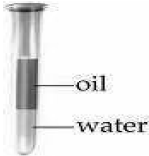
(a) Water is polar and oil is polar therefore the two substances will not mix.
(b) Water is nonpolar and oil is nonpolar therefore the two substances will not mix.
(c) Water is nonpolar and oil is polar therefore the two substances will not mix.
(d) Water is polar and oil is nonpolar therefore the two substances will not mix.
Answer: D
Question. What can be inferred about the density of the cork? Use the following diagram

(a) The density of the cork is between that of Liquid A and Liquid B.
(b) The density of the cork is between that of Liquid B and Liquid C.
(c) The density of the cork is between that of Liquid C and Liquid D.
(d) No inference can be made.
Answer: B
Question. Which process is used in sewage treatment to kill infectious bacteria?
(a) sedimentation
(c) filtration
(b) chlorination
(d) flotation
Answer: B
Question. How do bio-indicators determine the health of a water system?
(a) A few species of macro-invertebrates will be present in a healthy body of water.
(b) Many different species of macro-invertebrates will be present in a healthy body of water.
(c) No species of macro-invertebrates will be present in a healthy body of water.
(d) There is no relationship between the number of species of bio-indicators and the health of a body of water.
Answer: B
Question Which 2 sources of freshwater are used by municipalities for drinking water?
(a) oceans and icebergs
(b) groundwater and oceans
(c) rivers and groundwater
(d) icebergs and rivers
Answer: C
Question. What could be the main reason for strengthening water quality standards?
(a) human health issues
(b) natural animal issues
(c) industrial issues
(d) all of the above
Answer: A
Question. What is the main effect of excess nutrients in North Carolina waters?
(a) Algae growth does not change.
(b) Algae growth is low.
(c) Algae growth is high.
(d) Algae does not grow at all.
Answer: C
Question. What type of technology would be used to look at algae blooms?
(a) submersible
(b) satellite imagery
(c) SCUBA
(d) SONAR
Answer: B
Question. A landfill is most likely to directly pollute
(a) water vapor over the landfill
(b) precipitation about to fall on the landfill
(c) surface streams flowing to the landfill
(d) ground water under the landfill
Answer: D
Question. What is the relationship between dissolved oxygen and temperature?
(a) high temperature=low oxygen level
(b) high temperature=high oxygen level
(c) low temperature=low oxygen level
(d) low temperature=high oxygen level
Answer: A
Question. How are estuaries connected to oceanic organisms?
(a) Estuaries provide a nursery grounds for oceanic organisms.
(b) Estuaries provide sunlight for oceanic organisms.
(c) Estuaries provide primary food for oceanic organisms.
(d) Estuaries provide excess dissolved oxygen for oceanic organisms.
Answer: A
Question. How does pH negatively affect water sources?
(a) low pH is harmful
(b) high pH is harmful
(c) neutral pH is harmful
(d) both low and high pH is harmful
Answer: D
Question. Which is an example of water condensing?
(a) A puddle disappearing on a hot summer afternoon
(b) Sweat forming on your forehead after you do a lot of exercise
(c) Ice cubes melting when you put them out in the sun
(d) Dew forming on plants during a cold night
Answer: D
Question. Which layer of the ocean allows for photosynthesis to occur because of sunlight penetration?
(a) Buffer zone
(b) Surface zone
(c) Bathyl zone
(d) Abyssal zone
Answer: C
Question. How does this satellite image show the variations in temperature associated with an upwelling? Use the following diagram
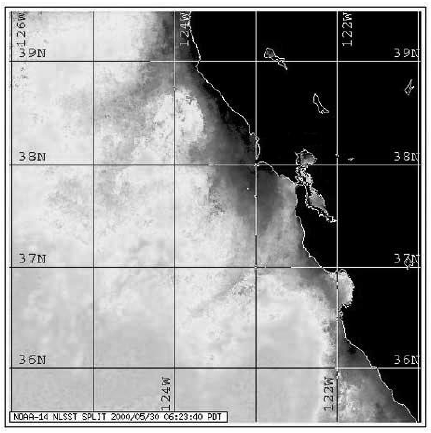
(a) Darker gray areas represent colder water rising from the ocean floor.
(b) Darker gray areas represent warmer water rising from the ocean floor.
(c) Darker gray areas represent colder water sinking to the ocean floor.
(d) Darker gray areas represent warmer water sinking to the ocean floor.
Answer: A
Question. Which zone of the ocean extends from the low tide line to the edge of the continental shelf?
(a) neritic zone
(b) open ocean zone
(c) intertidal zone
(d) abyssal zone
Answer: C
Question. Looking at the diagram, where would a fisherman have the largest catch? Use the following diagram
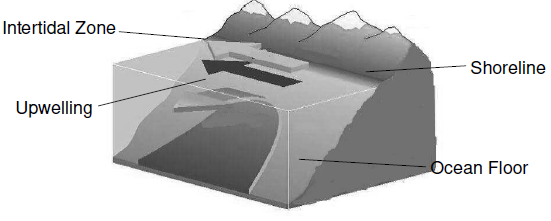
(a) the shoreline
(b) the intertidal zone
(c) the ocean floor
(d) the area of upwelling
Answer: D
Question. Which of the following would scientists use as the BEST indicator of the health of a water system?
(a) temperature and turbidity
(b) water currents and turbidity
(c) convolution and turbidity
(d) submersion and turbidity
Answer: A
Question. Which statement is not a description of oceans?
(a) Oceans absorb and hold large quantities of solar heat.
(b) Oceans provide the least stable aquatic environment.
(c) Oceans contain a relatively constant supply of nutrient materials and dissolved gases.
(d) Oceans serve as a habitat for a large number of diverse organisms.
Answer: B
Question. Which of the following is the BEST example of a non-point source of water pollution?
(a) septic systems
(b) landfills
(c) illegal dumping
(d) industrial discharges
Answer: C
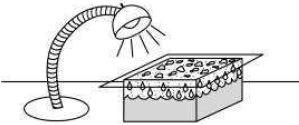
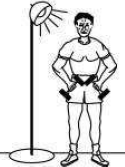
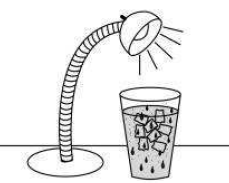
Question. Which of the following would be the best model to show the interactions between water and the Sun's heat energy in cycles of precipitation?
(a) A light shines on an aquarium covered with glass, and water droplets form on the inside of the glass.
(b) A light shines on a closed cardboard box containing a plant.

(c) A light shines on a man's face. Droplets of sweat form on his face as he exercises.
(d) A light shines on a glass of iced tea Water droplets form on the outside of the glass.
Answer: A
Question. Why is ocean water more dense that fresh water?
(a) Ocean water contains more salt than fresh water.
(b) Ocean water is deeper that most bodies of fresh water.
(c) Ocean water has waves that move the water around.
(d) Ocean water contains more organisms than fresh water.
Answer: A
Question. If your community was planning to build a new sanitary landfill, what would be the most important aspect for the environment to consider in locating the landfill?
(a) the cost of the land
(b) the location of the groundwater
(c) the proximity to an industrial park
(d) the accessibility to a major highway
Answer: B
Question. Which of the following would be best used to study the drought conditions in a region?
(a) satellite imagery
(b) water witching
(c) GPS
(d) ground truthing
Answer: A
Question. Which of the following correctly describes the connection between estuarian terrestrial and aquatic food web ? Use the following diagram
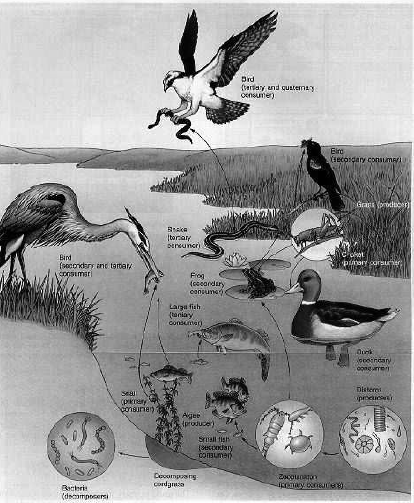
(a) The zooplankton is consumed by the small fish.
(b) The small fish is consumed by the large fish.
(c) The bird consumes the small fish.
(d) The bird consumes the cricket.
Answer: C
Question. What is the MAIN purpose in monitoring the hydrosphere?
(a) Even though the Earth is mainly covered in water, only a small percentage is usable.
(b) The Earth is ¾ covered with water so we need to know where the water is located.
(c) Water is a life sustaining force and we need to keep track of all the water on Earth.
(d) Both a and b
Answer: A
Question. What phenomenon would produce the darker areas moving away from the shore in the satellite image? Use the following diagram
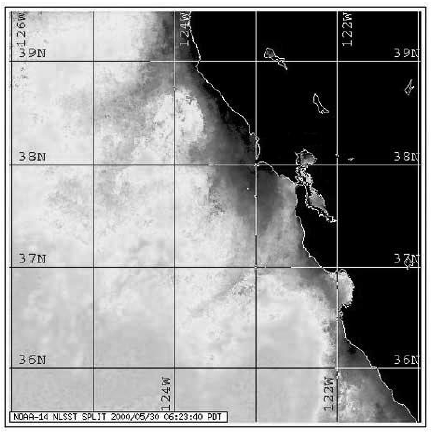
(a) turbidity
(b) density
(c) salinity
(d) upwelling
Answer: D
Question. What can you infer about an organism that lives in the rocky Intertidal zone?
(a) They are able to withstand changes in tides.
(b) They are able to withstand changes in salinity.
(c) They are able to withstand changes in water temperature.
(d) They are able to withstand changes in air temperature.
Answer: A
Q1. Define Environment.
Q2. What is biotic and abiotic environment?
Q 3.What is meant by hydrosphere?
Q4. Define lithosphere.
Q5. Define biosphere.
Q6. How does the human environment affect biosphere?
Q7. What are the different components of physical environment?
Q8. The earth would have been a barren planet without the atmosphere. Do you agree with the statement? Why?
Q9. Suppose you are on an outing with your parents and you buy an ice cream, and a
packet of chips. After you eat them, what would you do with the packet in the following cases:
A) If there is a dustbin kept at distance of about 20 meters from where you are standing.
B) If there is no dust bin at all.
Free study material for Social Science
CBSE Class 7 Social Science Worksheets for Our Environment Chapter 01 Environment
Mastering Our Environment Chapter 01 Environment with Printable Worksheets
Explore reliable practice questions for Our Environment Chapter 01 Environment tailored for Class 7 Social Science learners. Use these structured worksheets to evaluate exam preparedness and strengthen problem-solving skills throughout the 2026 academic session.
Verified Solutions and NCERT Alignment
Built using official NCERT guidelines for Class 7 Social Science, these practice sheets provide reliable academic support. Cross-reference your completed work with our detailed solutions to learn standard answer-writing formats for CBSE exams.
Additional Study Resources for Class 7 Social Science
Wrap up your chapter revision by testing your knowledge against standard objective question formats. Explore our full library of free, up-to-date printable assignments to maximize your academic results in upcoming CBSE evaluations.
FAQs
You can download the latest chapter-wise printable worksheets for Class 7 Social Science Our Environment Chapter 01 Environment for free from StudiesToday.com. These have been made as per the latest CBSE curriculum for this academic year.
Yes, Class 7 Social Science worksheets for Our Environment Chapter 01 Environment focus on activity-based learning and also competency-style questions. This helps students to apply theoretical knowledge to practical scenarios.
Yes, we have provided solved worksheets for Class 7 Social Science Our Environment Chapter 01 Environment to help students verify their answers instantly.
Yes, our Class 7 Social Science test sheets are mobile-friendly PDFs and can be printed by teachers for classroom.
For Our Environment Chapter 01 Environment, regular practice with our worksheets will improve question-handling speed and help students understand all technical terms and diagrams.