CBSE Class 12 Psychology Social Influence And Group Processes Worksheet Set A

Access the latest CBSE Class 12 Psychology Social Influence And Group Processes Worksheet Set A. We have provided free printable Class 12 Psychology worksheets in PDF format, specifically designed for Chapter 7 Social Influence and Group Processes. These practice sets are prepared by expert teachers following the 2025-26 syllabus and exam patterns issued by CBSE, NCERT, and KVS.

Chapter 7 Social Influence and Group Processes Psychology Practice Worksheet for Class 12

Students should use these Class 12 Psychology chapter-wise worksheets for daily practice to improve their conceptual understanding. This detailed test papers include important questions and solutions for Chapter 7 Social Influence and Group Processes, to help you prepare for school tests and final examination. Regular practice of these Class 12 Psychology questions will help improve your problem-solving speed and exam accuracy for the 2026 session.

Download Class 12 Psychology Chapter 7 Social Influence and Group Processes Worksheet PDF

Social Influence and Group
 
A Group may be defined as an organized system of two or more individuals, who are interacting and interdependent, who have common motives, have a set of role relationships among its members, and have norms that regulate the behaviour of its members. They have the following salient characteristics:
 
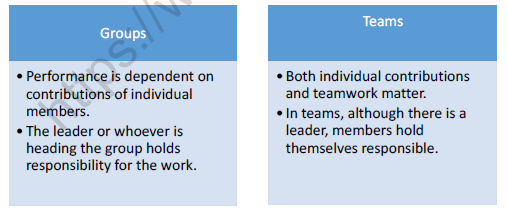
A crowd is a collection of people who may be present at a place/situation by chance. Teams are groups where members often have complementary skills and are committed to a common goal or purpose. Members are mutually accountable for their activities,and there is a positive synergy attained through the coordinated efforts of the members.
CBSE Class 12 Psychology Social Influence And Group Processes Worksheet Set A 1
An audience is a collection of people who have assembled for a specific purpose. They are generally passive but sometimes go into a frenzy and become mobs. In mobs, there is a definite sense of purpose. There is polarization in attention, and actions of persons Groups
 
are in a common direction. Mob behaviour is characterized by homogeneity of thought and behaviour as well as impulsivity.
 
People join groups for the following reasons:
 
• Security – Groups reduce the insecurity we feel when we are alone, as being with people gives a sense of comfort and protection. As a result, people feel stronger and are less vulnerable to threats.
 
• Status – When we are members of a group that is perceived to be important by others, we feel recognized and experience a sense of power.
 
• Self-esteem – Groups provide feelings of self-worth and establish a positive social identity. Being a member of a prestigious group enhances one’s self-concept.
 
• Satisfaction of one’s Psychological and Social Needs – Groups satisfy needs such as sense of belongingness, giving and receiving attention, etc.
 
• Goal Achievement – Groups help in achieving such goals which cannot be attained individually.
 
• Provide knowledge and information – As individuals, we may not have required information, which is supplemented by the group.
 
Group forming stages
 
Groups usually go through different stages of formation, conflict, stabilization,performance and dismissal. Tuckman suggested that groups pass through five developmental sequences: forming, storming, norming, performing and adjourning.
 
Forming – When group members first meet, there is a great deal of uncertainty about the group, the goal and how it is to be achieved. People try to know each other and assess whether they will fit in.
 
Storming – In this stage, there is conflict among members about how the target of the group is to be achieved, who is to control the group and its resources, and who is to perform what task. When this stage is complete, some sort of hierarchy of leadership in the group and a clear vision as to how to achieve the group goal develops.
 
Norming – Group members by this time develop norms related to group behaviour. This leads to development of a positive group identity.
 
Performing – The structure of the group has evolved and is accepted by group members. The group moves towards achieving the group goal.
 
Adjourning – Not necessary for all groups, once the function is over, at this stage the group may be disbanded. Group structure develops as the members interact. Over time this interaction shows regularities in distribution of tasks to be performed, responsibilities assigned to members, and the prestige or relative status of members. Four important elements of group structure are:
 
Roles – Socially defined expectations that individuals in a given situation are expected to fulfill. Roles refer to the typical behaviour that depicts a person in a given social context. Along with this, there are certain role expectations, i.e. the behaviour expected of someone in a particular role.
 
• Norms – Expected standards of behaviour and beliefs established, agreed upon and enforced by group members. They may be considered as a group’s ‘unspoken rules’.

Please click on below link to download CBSE Class 12 Psychology Social Influence And Group Processes Worksheet Set A

Chapter 7 Social Influence and Group Processes CBSE Class 12 Psychology Worksheet

Students can use the Chapter 7 Social Influence and Group Processes practice sheet provided above to prepare for their upcoming school tests. This solved questions and answers follow the latest CBSE syllabus for Class 12 Psychology. You can easily download the PDF format and solve these questions every day to improve your marks. Our expert teachers have made these from the most important topics that are always asked in your exams to help you get more marks in exams.

NCERT Based Questions and Solutions for Chapter 7 Social Influence and Group Processes

Our expert team has used the official NCERT book for Class 12 Psychology to create this practice material for students. After solving the questions our teachers have also suggested to study the NCERT solutions  which will help you to understand the best way to solve problems in Psychology. You can get all this study material for free on studiestoday.com.

Extra Practice for Psychology

To get the best results in Class 12, students should try the Psychology MCQ Test for this chapter. We have also provided printable assignments for Class 12 Psychology on our website. Regular practice will help you feel more confident and get higher marks in CBSE examinations.

Where can I download the latest PDF for CBSE Class 12 Psychology Social Influence And Group Processes Worksheet Set A?

You can download the teacher-verified PDF for CBSE Class 12 Psychology Social Influence And Group Processes Worksheet Set A from StudiesToday.com. These practice sheets for Class 12 Psychology are designed as per the latest CBSE academic session.

Are these Psychology Class 12 worksheets based on the 2026 competency-based pattern?

Yes, our CBSE Class 12 Psychology Social Influence And Group Processes Worksheet Set A includes a variety of questions like Case-based studies, Assertion-Reasoning, and MCQs as per the 50% competency-based weightage in the latest curriculum for Class 12.

Do you provide solved answers for CBSE Class 12 Psychology Social Influence And Group Processes Worksheet Set A?

Yes, we have provided detailed solutions for CBSE Class 12 Psychology Social Influence And Group Processes Worksheet Set A to help Class 12 and follow the official CBSE marking scheme.

How does solving CBSE Class 12 Psychology Social Influence And Group Processes Worksheet Set A help in exam preparation?

Daily practice with these Psychology worksheets helps in identifying understanding gaps. It also improves question solving speed and ensures that Class 12 students get more marks in CBSE exams.

Is there any charge for the Class 12 Psychology practice test papers?

All our Class 12 Psychology practice test papers and worksheets are available for free download in mobile-friendly PDF format. You can access CBSE Class 12 Psychology Social Influence And Group Processes Worksheet Set A without any registration.