

Download Class 11 Biology Worksheets for Chapter 04 Animal Kingdom
Access printable practice worksheets for Chapter 04 Animal Kingdom designed to align with the 2026-27 academic syllabus for Class 11 Biology. These structured exercises help students evaluate their conceptual understanding and improve exam readiness.
Access Chapter 04 Animal Kingdom Questions and Exercises
Navigate directly to the printable exercises for Chapter 04 Animal Kingdom using the digital viewer below. Each practice set allows students to isolate specific topics for thorough review and uninterrupted practice alongside standard textbooks.
Download free printable worksheets for your students. All worksheets are in pdf format with the answers on the next page. Please give the questions to the child and then compare answers with the suggested answers provided by us. Free worksheets with questions and answers are available for all subjects. Use the worksheets to get better marks in tests and exams.
MULTIPLE CHOICE QUESTIONS
Question. Aristotle’s lantern is found in
(a) Asteroidea
(b) Echinoidea
(c) Holothuroidea
(d) Ophiuroidea
Answer. B
Question. Sympathetic nerves in mammals arise from
(a) sacral region
(b) cervical region
(c) 3rd, 7th, 9th, 10th cranial nerves
(d) thoracico-lumbar region
Answer. D
Question. Which of the following is correctly matched?
(a) Human -Renal portal system
(b) Earthworm - Closed circulatory system
(c) Cockroach - Nephridia
(d) None of the above
Answer. B
Question. Which one of the following features is common in silverfish, scorpion, dragonfly and prawn?
(a) Three pairs of legs and segmented body.
(b) Chitinous cuticle and two pairs of antennae.
(c) Jointed appendages and chitinous exoskeleton.
(d) Cephalothorax and trachae.
Answer. C
Question.Which one of the following animals is correctly matched with its one characteristic and the taxon?
Animal Characteristic Taxon
(a) Millipede Ventral nerve Arachnida cord
(b) Duckbill Oviparous Mammalia platypus
(c) Silverfish Pectoral & Chordata Pelvic fins
(d) Sea anemone Triploblastic Cnidaria
Answer. B
Question. Which set of terms would most likely be used in a description of the nervous system of chordates?
(a) Brain, dorsal nerve cord, highly developed receptors
(b) Brain, fused ganglia, ventral nerve cord
(c) No brain, fused ganglia, tympana
(d) No brain, nerve net, modified neurons
Answer. A
Question. Gemmule formation in sponges are useful in
(a) asexual reproduction
(b) sexual reproduction
(c) parthenogenesis
(d) parthenocarpy
Answer. A
Question. Pouched mammals are known as
(a) prototherians
(b) metatherians
(c) eutherians
(d) therians
Answer. B
Question. Which one of the following statements is correct with respect to salt water balance inside the body of living organisms?
(a) When water is not available camels do not produce urine but store urea in tissues.
(b) Salmon fish excretes lot of stored salt through gill membrane in fresh water.
(c) Paramecium discharges concentrated salt solution by contractile vacuoles.
(d) The body fluids of fresh water animals are generally hypotonic to surrounding water.
Answer. A
Question. Which one of the following groups of structures/organs have similar function?
(a) Typhlosole in earthworm, intestinal villi in rat and contractile vacuole in Amoeba.
(b) Nephridia in earthworm, Malpighian tubules in cockroach and urinary tubules in rat.
(c) Antennae of cockroach, tympanum of frog and clitellum of earthworm.
(d) Incisors of rat, gizzard (proventriculus) of cockroach and tube feet of starfish.
Answer. B
Question. Aquatic reptiles are
(a) ureotelic
(b) ureotelic on land
(c) ammonotelic
(d) uricotelic in water
Answer. C
Question. Water current in Leucosolenia is produced by
(a) pinacocytes
(b) choanocytes
(c) archaeocytes
(d) collencytes
Answer. B
Question. Which is the example of platyhelminthes ?
(a) Entamoeba
(b) Plasmodium
(c) Wuchereria
(d) Schistosoma
Answer. D
Question. Paired spermathecae occur in Pheretima in which of the following segments ?
(a) 4, 5, 6, 7
(b) 5, 6, 7, 8
(c) 6, 7, 8, 9
(d) 3, 4, 5, 6
Answer. C
Question. Larva of house-fly lacks
(a) eyes
(b) wings
(c) spiracles
(d) none of these
Answer. B
Question. Single filament of Nostoc without mucilage sheath is called as
(a) colony
(b) mycelium
(c) trichome
(d) hyphae
Answer. C
Question. Which of the following statements are true/false?
(i) In Torpedo, the electric organs are capable of generating strong electric shock to paralyze the prey.
(ii) Bony fishes use pectoral, pelvic, dorsal anal and caudal fins in swimming.
(iii) Amphibian skin is moist and has thick scales.
(iv) Birds are poikilothermic animals.
(v) The most unique mammalian characteristic is the presence of milk producing mammary glands by which the young ones are nourished.
(a) (i), (ii) and (iii) are true; (iv), (v) are false
(b) (i), (ii) and (v) are true; (iii) and (iv) are false
(c) (i), (iv) and (v) are true; (ii) and (iii) are false
(d) (i), (ii) and (iv) are false; (iii) and (v) are true
Answer. C
Question. Which of the following are uricotelic animals?
(a) Rohu, Frog
(b) Camel, Frog
(c) Lizard, Crow
(d) Eagles, Earthworm
Answer. C
Question. In Entamoeba histolytica, the presence of chromatid bodies is characteristic of
(a) precystic stage
(b) trophozoite stage
(c) mature binucleate stage
(d) both (a) and (b)
Answer. A
Question. Given below are pie diagrams A, B and C related to proportionate number of species of major taxa of invertebrates, vertebrates and plants respectively. Critically study and fill in the blanks I, II, III and IV
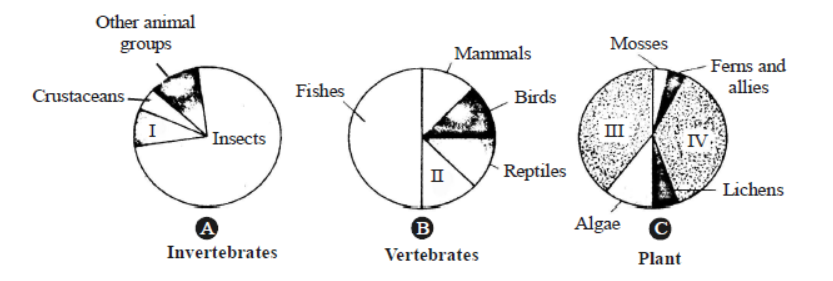
(a) I- Molluscs, II-Amphibians, III-Fungi, IV-Angiosperms
(b) I- Molluscs, II-Amphibians, III-Angiosperms, IV-Fungi
(c) I- Hexapoda, II-Amphibians, III-Fungi, IV-Angiosperms
(d) I- Turtles, II-Amphibians, III-Fungi, IV-Angiosperms
Answer. A
ASSERTION REASON QUESTIONS
Directions : These questions consist of two statements, each printed as Assertion and Reason. While answering these questions, you are required to choose any one of the following five responses.
(a) If both Assertion and Reason are correct and the Reason is a correct explanation of the Assertion.
(b) If both Assertion and Reason are correct but Reason is not a correct explanation of the Assertion.
(c) If the Assertion is correct but Reason is incorrect.
(d) If both the Assertion and Reason are incorrect.
(e) If the Assertion is incorrect but the Reason is correct.
Question. Assertion : Cold blooded animals do not have fat layer.
Reason : Cold blooded animals use their fat for metabolic process during hibernation.
Answer. A
Question. Assertion : Birds have one ovary.
Reason : This reduces the body weight for flight.
Answer. A
Question. Assertion: Lateral line system is found in fishes and aquatic larval amphibians.
Reason: Lateral line system has receptor of sensory cells derived from ectoderm.
Answer. B
Question. Assertion : Bats and whales are classified as mammals.
Reason : Bats and whales have four-chambered heart.
Answer. B
Question. Assertion : Holoblastic cleavage with almost equal sized blastomeres is a characteristic of placental animals.
Reason : Eggs of most mammals, including humans, are of centrolecithal type.
Answer. C
Question. Assertion : All birds, except the ones like koel (cuckoo) build nests for retiring and taking rest during night time (day time for nocturnal).
Reason : Koel lays its eggs in the nests of tailor bird.
Answer. C
Question. Assertion : The honey bee queen copulates only ones in her life time.
Reason : The honey bee queen can lay fertilized as well as unfertilized eggs.
Answer. A
Question. Assertion : Torsion can be seen in ctendium.
Reason : Ctenidium acts as the respiratory organ.
Answer. B
Question. Assertion : Tapeworm, roundworm and pinworm are endoparasites of human intestine.
Reason : Improperly cooked food is the source of intestinal infections.
Answer. B
1. Name an example of egg- laying mammals
2. What is polymorphism
3. Which animal is popularly called ploughman of nature & why ?
4. List any four identifying features of arthopoda & give examples.
5. Distinguish between diploblastic & triploblastic animals
6. What is protochordates? How is it classified.
7. “All vertebrates are chordates but all chordates are not vertebrates” justify the statement.
8. “Mammals are the most successful & dominant animals today” Give evidence
9. How are non chordates different from chordates. Write the major phyla of non- chordate & give examples.
Click on link below to download CBSE Class 11 Animal Kingdom Worksheet A.
Free study material for Biology
Download CBSE Practice Material: Class 11 Biology Chapter 04 Animal Kingdom
Chapter 04 Animal Kingdom Printable Worksheet for Class 11 Biology
Access structured practice worksheets for Chapter 04 Animal Kingdom designed in alignment with the latest CBSE curriculum for Class 11 Biology. These printable problem sets help students build accuracy and prepare effectively for school tests.
How to Use These Practice Sheets
Built using the official NCERT book for Class 11 Biology, these practice materials provide reliable academic guidance. Pair your practice with our recommended NCERT solutions to master optimal problem-solving approaches.
Enhance Speed with Online Practice
Wrap up your chapter revision by testing your knowledge against standard question formats. Everything on our platform is provided free of charge.
FAQs
You can download the teacher-verified PDF for CBSE Class 11 Animal Kingdom Worksheet Set 01 from StudiesToday.com. These practice sheets for Class 11 Biology are designed as per the latest CBSE academic session.
Yes, our CBSE Class 11 Animal Kingdom Worksheet Set 01 includes a variety of questions like Case-based studies, Assertion-Reasoning, and MCQs as per the 50% competency-based weightage in the latest curriculum for Class 11.
Yes, we have provided detailed solutions for CBSE Class 11 Animal Kingdom Worksheet Set 01 to help Class 11 and follow the official CBSE marking scheme.
Daily practice with these Biology worksheets helps in identifying understanding gaps. It also improves question solving speed and ensures that Class 11 students get more marks in CBSE exams.
All our Class 11 Biology practice test papers and worksheets are available for free download in mobile-friendly PDF format. You can access CBSE Class 11 Animal Kingdom Worksheet Set 01 without any registration.