

Official Class 11 Biology Worksheets: Chapter 15 Body Fluids and Circulation
Explore reliable practice materials for Chapter 15 Body Fluids and Circulation tailored for Class 11 learners. Utilizing these Biology worksheets ensures thorough preparation and strengthens problem-solving speed for upcoming school assessments.
Chapter-wise Practice Material: Chapter 15 Body Fluids and Circulation
View or download the dedicated Chapter 15 Body Fluids and Circulation practice resource below. Engaging with these objective and subjective questions daily ensures continuous academic progress and mastery of the 2026-27 curriculum.
Download free printable worksheets for your students. All worksheets are in pdf format with the answers on the next page. Please give the questions to the child and then compare answers with the suggested answers provided by us. Free worksheets with questions and answers are available for all subjects. Use the worksheets to get better marks in tests and exams.
MULTIPLE CHOICE QUESTIONS
Question. Anti-serum contains
(a) antigens
(b) antibodies
(c) leucocytes
(d) RBCs
Answer. B
Question. Which enzyme induces lysis of fibrinogen to fibrin during fibrinolysis ?
(a) Plasmin
(b) Thrombin
(c) Fibrin
(d) Trypsin
Answer. B
Question. In which of the following pairs the two items mean one and the same thing?
(a) Malleus - Anvil
(b) SA node - Pace maker
(c) Leucocytes - Lymphocytes
(d) Haemophilia - Blood cancer
Answer. B
Question. An artificial pace maker is implanted subcutaneously and connected to the heart in patients
(a) having 90% blockage of the three main coronary arteries.
(b) having a very high blood pressure.
(c) with irregularity in the heart rhythm.
(d) suffering from arteriosclerosis.
Answer. C
Question. Hirudin is
(a) A protein produced by Hordeum vulgare,which is rich in lysine.
(b) A toxic molecule isolated from Gossypium hirusutum, which reduces human fertility.
(c) A protein produced from transgenic Brassica napus, which prevents blood clotting.
(d) An antibiotic produced by a genetically engineered bacterium, Escherichia coli.
Answer. C
Question. The component of blood which prevents its coagulation in the blood vessels is
(a) haemoglobin
(b) plasma
(c) thrombin
(d) heparin
Answer. D
Question. A malfunction of the lymph nodes would most likely interfere with the
(a) release of carbon dioxide into the lymph
(b) filtering of glucose from the lymph
(c) release of oxygen into the lymph
(d) filtering of bacteria from the lymph
Answer. D
Question. Arteries supplying blood to the heart are called
(a) carotid arteries
(b) hepatic arteries
(c) coronary arteries
(d) pulmonary arteries
Answer. C
Question. A man whose blood group is not known meets with a serious accident and needs blood transfusion immediately, which one of the blood groups readily available in the hospital will be safe for transfusion?
(a) O, Rh–
(b) O, Rh+
(c) AB, Rh–
(d) AB, Rh+
Answer. B
Question. With reference to the blood in a normal person, which one of the following statements is correct?
(a) Compared to arteries, veins are less numerous and hold less of the body’s blood at any given time.
(b) Blood cells constitute about 70 percent of the total volume of the blood.
(c) White blood cells (WBC) are made by lymph nodes only.
(d) The blood has more platelets than WBC.
Answer. D
Question. Given below is the ECG of a normal human.Which one of its components is correctly interpreted below?
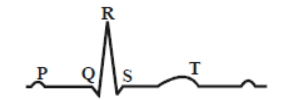
(a) Peak P and Peak R together - systolic and diastolic blood pressures
(b) Peak P - Initiation of left atrial contraction only
(c) Complex QRS - One complete pulse
(d) Peak T - Initiation of total cardiac contraction
Answer. C
Question. Which of the following statements are wrong?
(i) Leucocytes disintegrate in the spleen and liver.
(ii) RBC, WBC and blood platelets are produced by bone marrow.
(iii) Neutrophils bring about destruction and detoxification of toxins of protein origin.
(iv) The important function of lymphocytes is to produce antibodies.
(a) (i) and (ii) only
(b) (i) and (iv) only
(c) (i) and (iii) only
(d) (ii) and (iii) only
Answer. C
Question. The diagram given here is the standard ECG of a normal person, the P-wave represents the :
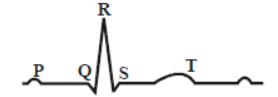
(a) Initiation of the ventricular contraction
(b) Beginning of the systole
(c) End of systole
(d) Contraction of both the atria
Answer. D
ASSERTION REASON QUESTIONS
Directions : These questions consist of two statements, each printed as Assertion and Reason. While answering these questions, you are required to choose any one of the following five responses.
(a) If both Assertion and Reason are correct and the Reason is a correct explanation of the Assertion.
(b) If both Assertion and Reason are correct but Reason is not a correct explanation of the Assertion.
(c) If the Assertion is correct but Reason is incorrect.
(d) If both the Assertion and Reason are incorrect.
(e) If the Assertion is incorrect but the Reason is correct.
Question. Assertion : Muscle fibres of SA node possess the lowest rhythmicity among all cardiac muscles.
Reason : Due to this fact, it can initiate excitatory waves at the highest rate.
Answer. E
Question. Assertion : Saline water is not given to patients of hypertension.
Reason : Saline water can cause vomiting and may drop blood pressure suddenly causing cardiac arrest.
Answer. C
Question. Assertion : Blood pressure is arterial blood pressure.
Reason : Blood pressure is measured by sphygmomanometer.
Answer. B
Question. Assertion: WBCs accumulate at site of wounds by diapedesis.
Reason: It is squeezing of leucocytes from endothelium.
Answer. B
Question. Assertion : Persons suffering from haemophilia fail to produce blood clotting factor VIII.
Reason : Prothrombin producing platelets in such persons are found in very low concentration.
Answer. A
Question. Assertion (A) : Blood coagulates in uninjured blood vessels.
Reason (R) : Uninjured blood vessels release an anticoagulant heparin.
Answer. D
Question. Assertion : Smaller the organism higher is the rate of metabolism per gram weight.
Reason : The heart rate of a six month old baby is much higher than that of an old person.
Answer. B
1. Which of the four chambers of the human heart has the thickest muscular wall?
2. Where are RBCs formed from in an adult human?
3. What is ECG technique?
4. Distinguish between mitral and tricuspid value?
5. Why does the fish heart pump only deoxygenated blood?
6. How is heart failure different from heart attack?
7. What is cardiac cycle?
8. Differentiate between right ventricle and left ventricle.
9. Describe the structure of human heart.
Click on link below to download CBSE Class 11 Body Fluids and Circulation Worksheet A.
Free study material for Biology
Exam Preparation Worksheet for Class 11 Biology Chapter 15 Body Fluids and Circulation
Chapter 15 Body Fluids and Circulation Printable Worksheet for Class 11 Biology
Explore reliable practice questions for Chapter 15 Body Fluids and Circulation tailored for Class 11 Biology learners. Use these structured worksheets to evaluate preparedness and strengthen problem-solving skills.
How to Use These Practice Sheets
Each worksheet is structured around standard CBSE textbooks, allowing students to check their working steps and correct mistakes early in their revision.
Enhance Speed with Online Practice
Explore our broader library of printable assignments, chapter notes, and mock tests designed to support continuous revision and secure higher marks in CBSE assessments.
FAQs
You can download the teacher-verified PDF for CBSE Class 11 Body Fluids and Circulation Worksheet Set 01 from StudiesToday.com. These practice sheets for Class 11 Biology are designed as per the latest CBSE academic session.
Yes, our CBSE Class 11 Body Fluids and Circulation Worksheet Set 01 includes a variety of questions like Case-based studies, Assertion-Reasoning, and MCQs as per the 50% competency-based weightage in the latest curriculum for Class 11.
Yes, we have provided detailed solutions for CBSE Class 11 Body Fluids and Circulation Worksheet Set 01 to help Class 11 and follow the official CBSE marking scheme.
Daily practice with these Biology worksheets helps in identifying understanding gaps. It also improves question solving speed and ensures that Class 11 students get more marks in CBSE exams.
All our Class 11 Biology practice test papers and worksheets are available for free download in mobile-friendly PDF format. You can access CBSE Class 11 Body Fluids and Circulation Worksheet Set 01 without any registration.