

Official Class 11 Biology Worksheets: Chapter 07 Structural Organisation in Animals
Explore reliable practice materials for Chapter 07 Structural Organisation in Animals tailored for Class 11 learners. Utilizing these Biology worksheets ensures thorough preparation and strengthens problem-solving speed for upcoming school assessments.
Chapter-wise Practice Material: Chapter 07 Structural Organisation in Animals
Navigate directly to the printable exercises for Chapter 07 Structural Organisation in Animals using the digital viewer below. Each practice set allows students to isolate specific topics for thorough review and uninterrupted practice alongside standard textbooks.
Download free printable worksheets for your students. All worksheets are in pdf format with the answers on the next page. Please give the questions to the child and then compare answers with the suggested answers provided by us. Free worksheets with questions and answers are available for all subjects. Use the worksheets to get better marks in tests and exams.
Structural Organisation in Animals
MULTIPLE CHOICE QUESTIONS
Question. Tadpoles of frog can be made to grow as giant sized tadpoles, if they are
(a) administered antithyroid substance like thiourea.
(b) administered large amounts of thyroxine.
(c) reared on a diet rich in egg yolk.
(d) reared on a diet rich in both egg yolk and glucose.
Answer. B
Question. Outer covering of cartilage is called
(a) perichondrium
(b) periosteum
(c) endosternum
(d) peritoneum
Answer. A
Question. The protoplasmic segment of a striated muscle fibre is termed as
(a) sarcoplasm
(b) sarcomere
(c) neuromere
(d) metamere
Answer. B
Question. Sharpey’s perforating fibres are related with
(a) heart contraction
(b) muscle relaxation
(c) fixing of teeth
(d) none of these
Answer. C
Question. Male cockroach can be identified from the female by the presence of
(a) long antennae
(b) wingless body
(c) elongated abdomen
(d) anal styles
Answer. D
Question. Which of the following type of cell junction is not found in animal tissues ?
(a) Adhering junction
(b) Tight junction
(c) Gap junction
(d) Plasmodesmata
Answer. D
Question. Identify the figure with its correct function
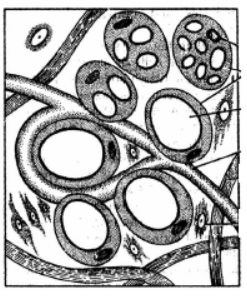
(a) Areolar connective tissue – Serves as a support framework for epithelium
(b) Adipose tissue – Store fats and act as heat insulators
(c) Dense regular tissue – Provide flexibility
(d) Dense irregular tissue – Provide strength and elasticity
Answer. B
Question. Which of the following statement about cell junctions is false?
(i) All the cells of the epithelium are held together with little intercellular materials.
(ii) In almost all animal tissues specialized junction provide both structural and functional link between its individual cells.
(iii) Tight junctions help to stop substances from leaking across a tissue.
(iv) Adhering junctions provide cementing to keep neighbouring cells together.
(v) Gap junctions provide cytoplasmic channels between cells for passage of ions, small molecules and sometimes big molecules.
(a) (ii) and (iii)
(b) (i) and (ii)
(c) Only (v)
(d) None of these
Answer. D
Question. i. The shape of the cells may vary with the function they perform
ii. Human RBC is about 7.0 m in diameter
iii. Cytoplasm is the main arena of cellular activities
iv. Various chemical reactions occur in cytoplasm to keep the cell in the living state
(a) All are correct
(b) Only I and II are correct
(c) Only IV is correct
(d) All are wrong
Answer. A
Question. Male cockroach can be identified from the female by the presence of
(a) long antennae
(b) wingless body
(c) elongated abdomen
(d) anal styles
Answer. D
Question. The sensory papillae in frogs are associated with
(a) smell
(b) hearing
(c) respiration
(d) touch
Answer. D
Question. In earthworms, setae are present in all segments except
(a) first and the last segments
(b) first segment and the clitellum
(c) first segment
(d) clitellum and last segments
Answer. D
ASSERTION REASON QUESTIONS
Directions : These questions consist of two statements, each printed as Assertion and Reason. While answering these questions, you are required to choose any one of the following five responses.
(a) If both Assertion and Reason are correct and the Reason is a correct explanation of the Assertion.
(b) If both Assertion and Reason are correct but Reason is not a correct explanation of the Assertion.
(c) If the Assertion is correct but Reason is incorrect.
(d) If both the Assertion and Reason are incorrect.
(e) If the Assertion is incorrect but the Reason is correct.
Question. Assertion : Cartilage and bone are rigid connective tissues.
Reason : Blood is a connective tissue
Answer. E
Directions : Each of these questions contains an Assertion followed by Reason. Read them carefully and answer the question on the basis of following options. You have to select the one that best describes the two statements.
(a) If both Assertion and Reason are correct and Reason is the correct explanation of Assertion.
(b) If both Assertion and Reason are correct, but Reason is not the correct explanation of Assertion.
(c) If Assertion is correct but Reason is incorrect.
(d) If both the Assertion and Reason are incorrect.
Question. Assertion : The squamous epithelium is made of a single thin layer of flattened cells with irregular boundaries.
Reason : They are found in walls of blood vessels and air sacs of wings.
Answer. B
1. Name the proteins which constitute muscle fibres.
2. Which type of epithelium is found in urinary bladder
3. From which germ layers do the following organs originate
a) kidney b) urinary bladder.
4. What are neuroglia cells?
5. How does saltatory conduction takes place along a nerve fibre.
6. What is mucosa?
7. Write short note on gaseous exchange in cockroach.
8. Draw a well labelled diagram of a nerve cell.
9. Distinguish between tendon & ligament
10. Name the various fibres of connective tissue & compare them
11. Give an account of alimentary canal of frog.
Click on link below to download CBSE Class 11 Structural Organization in Animals Worksheet A.
Free study material for Biology
Exam Preparation Worksheet for Class 11 Biology Chapter 07 Structural Organisation in Animals
Chapter Practice Questions for Class 11 Biology
Access structured practice worksheets for Chapter 07 Structural Organisation in Animals designed in alignment with the latest CBSE curriculum for Class 11 Biology. These printable problem sets help students build accuracy and prepare effectively for school tests.
Expert Practice Material for Class 11 Biology
Cross-reference your completed exercises with comprehensive NCERT solutions for Class 11 Biology to ensure absolute clarity across all sub-topics in this chapter.
Complete Your Chapter Revision
Follow up your worksheet practice by attempting the interactive online Biology MCQ test for this chapter to evaluate your execution speed. All platform resources are free to access.
FAQs
You can download the teacher-verified PDF for CBSE Class 11 Structural Organization in Animals Worksheet Set 01 from StudiesToday.com. These practice sheets for Class 11 Biology are designed as per the latest CBSE academic session.
Yes, our CBSE Class 11 Structural Organization in Animals Worksheet Set 01 includes a variety of questions like Case-based studies, Assertion-Reasoning, and MCQs as per the 50% competency-based weightage in the latest curriculum for Class 11.
Yes, we have provided detailed solutions for CBSE Class 11 Structural Organization in Animals Worksheet Set 01 to help Class 11 and follow the official CBSE marking scheme.
Daily practice with these Biology worksheets helps in identifying understanding gaps. It also improves question solving speed and ensures that Class 11 students get more marks in CBSE exams.
All our Class 11 Biology practice test papers and worksheets are available for free download in mobile-friendly PDF format. You can access CBSE Class 11 Structural Organization in Animals Worksheet Set 01 without any registration.