

Official Class 11 Biology Worksheets: Chapter 06 Anatomy of Flowering Plants
Access printable practice worksheets for Chapter 06 Anatomy of Flowering Plants designed to align with the 2026-27 academic syllabus for Class 11 Biology. These structured exercises help students evaluate their conceptual understanding and improve exam readiness.
Chapter-wise Practice Material: Chapter 06 Anatomy of Flowering Plants
Access the complete worksheet PDF for Chapter 06 Anatomy of Flowering Plants below. Regular practice with these targeted questions builds familiarity with standard exam patterns and helps secure higher marks in final Biology evaluations.
MULTIPLE CHOICE QUESTIONS
Question. The quiescent centre in root meristem serves as a
(a) site for storage of food which is utilized during maturation.
(b) reservoir of growth hormones.
(c) reserve for replenishment of damaged cells of the meristem.
(d) region for absorption of water.
Answer. C
Question. In a plant organ which is covered by periderm and in which the stomata are absent, some gaseous exchange still takes place through
(a) aerenchyma
(b) trichomes
(c) pneumatophores
(d) lenticels
Answer. D
Question. Porous wood contains
(a) vessels
(b) tracheids
(c) fibres
(d) parenchyma
Answer. A
Question. In the sieve elements, which one of the following is the most likely function of P-proteins?[2006]
(a) Deposition of callose on sieve plates.
(b) Providing energy for active translocation.
(c) Autolytic enzymes.
(d) Sealing mechanism on wounding.
Answer. A
Question. Two cross-sections of stem and root appear simple, when viewed by naked eye. But under microscope, they can be differentiated by
(a) exarch condition of root and stem
(b) endarch condition of stem and root
(c) endarch condition of root and exarch condition of stem
(d) endarch condition of stem and exarch condition of root
Answer. D
Question. Passage cells are found in
(a) endodermis
(b) pericycle
(c) cortex
(d) epiblema
Answer. A
Question. Companion cells in plants are associated with
(a) vessels
(b) sperms
(c) sieve elements
(d) guard cells
Answer. C
Question. Contractile tissues have the following features
(i) Mesodermal in origin
(ii) They contain stretch receptors.
(iii) Rhythmic contractions are seen in them
(iv) They do not fatigue during the life of the animal Which of the above are characteristics of sphincters?
(a) All the four
(b) Only (i), (ii) and (iii)
(c) Only (i), (ii) and (iv)
(d) Only (i), (iii) and (iv)
Answer. B
Question. T.S. of dicot leaf passing through the midrib is given below, certain parts have been indicated by alphabets. Choose the correct option.
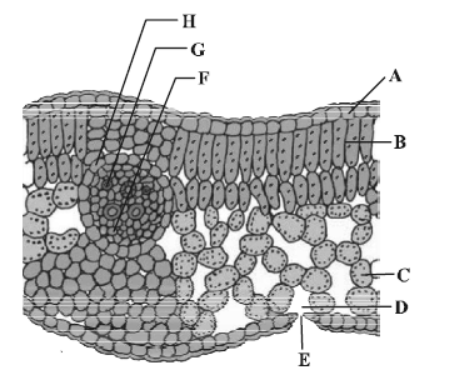
(a) A – Epidermis, B – Spongy parenchyma,C – Palisade parenchyma, D – Stomata, E –Guard cells, F – Phloem, G – Metaxylem, H– Protoxylem
(b) A – Epidermis, B – Palisade parenchyma,C – Spongy parenchyma, D – Sub-stomatalcavity, E – Stoma, F – Phloem, G –Metaxylem, H – Bundle sheath
(c) A – Epidermis, B – Palisade parenchyma,C – Spongy parenchyma, D – Stomata, E –Guard cells, F – Epidermis, G – Xylem, H –Phloem
(d) A – Epidermis, C – Palisade parenchyma,C – Spongy parenchyma, D – Stomata, E –Guard cells, F – Phloem, G – Metaxylem, H– Protoxylem
Answer. B
ASSERTION REASON QUESTIONS
Directions : These questions consist of two statements, each printed as Assertion and Reason. While answering these questions, you are required to choose any one of the following five responses.
(a) If both Assertion and Reason are correct and the Reason is a correct explanation of the Assertion.
(b) If both Assertion and Reason are correct but Reason is not a correct explanation of the Assertion.
(c) If the Assertion is correct but Reason is incorrect.
(d) If both the Assertion and Reason are incorrect.
(e) If the Assertion is incorrect but the Reason is correct.
Question. Assertion : Thick cuticle is mostly present in disease resistant plants.
Reason : Disease causing agents cannot grow on cuticle and cannot invade the cuticle.
Answer. E
Question. Assertion: Cambium is a lateral meristem and cause growth in width.
Reason: Cambium is made up of fusiform and ray initials in stem.
Answer. B
Question. Assertion : Higher plants have meristematic regions for indefinite growth.
Reason : Higher plants have root and shoot apices.
Answer. A
Question.Assertion : In collateral vascular bundles, phloem is situated towards inner side.
Reason : In monocot stem, cambium is present.
Answer. D
Question. Assertion : Collenchyma is thick walled dead tissue.
Reason : Collenchymatous cells show thickenings of pectin.
Answer. E
Question. Assertion: The two cotyledons in seed are embryonic leaves.
Reason: The embryo contains radicle and plumule.
Answer. B
Question. Assertion : In angiosperms, the conduction of water is more efficient because their xylem has vessels.
Reason : Conduction of water by vessel elements is an active process with energy supplied by xylem parenchyma rich in mitochondria.
Answer. D
Question. Assertion : In woody stems, the amount of heart wood continues to increase year after year.
Reason : The cambial activity continues uninterrupted.
Answer. A
Question. Assertion : Petroplants produce large amount of latex.
Reason : The latex contains long chain hydrocarbons.
Answer. A
Free study material for Biology
Download CBSE Practice Material: Class 11 Biology Chapter 06 Anatomy of Flowering Plants
Download Practice Sheet: Chapter 06 Anatomy of Flowering Plants (Class 11 Biology)
Review targeted practice exercises for Class 11 Biology Chapter 06 Anatomy of Flowering Plants. Curated to match official CBSE guidelines, these downloadable PDF sheets support daily revision and core concept reinforcement.
Concept Clarification for Chapter 06 Anatomy of Flowering Plants
Cross-reference your completed exercises with comprehensive NCERT solutions for Class 11 Biology to ensure absolute clarity across all sub-topics in this chapter.
Additional Study Resources for Class 11 Biology
Wrap up your chapter revision by testing your knowledge against standard question formats. Everything on our platform is provided free of charge.
FAQs
You can download the teacher-verified PDF for CBSE Class 11 Biology Anatomy of Flowering Plants Worksheet Set 01 from StudiesToday.com. These practice sheets for Class 11 Biology are designed as per the latest CBSE academic session.
Yes, our CBSE Class 11 Biology Anatomy of Flowering Plants Worksheet Set 01 includes a variety of questions like Case-based studies, Assertion-Reasoning, and MCQs as per the 50% competency-based weightage in the latest curriculum for Class 11.
Yes, we have provided detailed solutions for CBSE Class 11 Biology Anatomy of Flowering Plants Worksheet Set 01 to help Class 11 and follow the official CBSE marking scheme.
Daily practice with these Biology worksheets helps in identifying understanding gaps. It also improves question solving speed and ensures that Class 11 students get more marks in CBSE exams.
All our Class 11 Biology practice test papers and worksheets are available for free download in mobile-friendly PDF format. You can access CBSE Class 11 Biology Anatomy of Flowering Plants Worksheet Set 01 without any registration.