

Download Class 11 Biology Worksheets for Chapter 18 Neural Control and Coordination
Access printable practice worksheets for Chapter 18 Neural Control and Coordination designed to align with the 2026-27 academic syllabus for Class 11 Biology. These structured exercises help students evaluate their conceptual understanding and improve exam readiness.
Access Chapter 18 Neural Control and Coordination Questions and Exercises
Access the complete worksheet PDF for Chapter 18 Neural Control and Coordination below. Regular practice with these targeted questions builds familiarity with standard exam patterns and helps secure higher marks in final Biology evaluations.
MULTIPLE CHOICE QUESTIONS
Question. Sensation of stomach pain is due to
(a) interoceptors
(b) exteroceptors
(c) teloreceptors
(d) all of these
Answer. A
Question. Which is the example of conditioned reflex ?
(a) Eyes closed when anything enter into it.
(b) Hand took up when piercing with needle.
(c) Salivation in a hungry dog in response to ringing of a bell.
(d) Digestion food goes forward in alimentary canal.
Answer. C
Question. Excessive stimulation of vagus nerve in humans may lead to
(a) hoarse voice
(b) peptic ulcers
(c) efficient digestion of proteins
(d) irregular contraction of diaphragm
Answer. D
Question. A person is wearing spectacles with concave lenses for correcting vision. While not using the glasses, the image of a distant object in his case will be formed
(a) on the blind spot
(b) behind the retina
(c) in front of the retina
(d) on the yellow spot
Answer. C
Question.Unidirectional transmission of a nerve impulse through nerve fibre is due to the fact that
(a) nerve fibre is insulated by a medullary sheath.
(b) sodium pump starts operating only at the cyton and then continues into the nerve fibre.
(c) neurotransmitters are released by dendrites and not by axon endings.
(d) neurotransmitters are released by the axon endings and not by dendrites.
Answer. D
Question. Examine the diagram of the two cell types A and B given below and select the correct option:
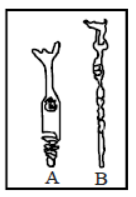
(a) Cell A is the rod cell found evenly all over retina.
(b) Cell A is the cone cell more concentrated in the fovea centralis.
(c) Cell B is concerned with colour vision in bright light.
(d) Cell A is sensitive to low light intensities.
Answer. B
Question. A person, who shows unpredictable moods, outbursts of emotion, quarrelsome behaviour and conflicts with others, is suffering from
(a) borderline personality disorder (BPD)
(b) mood disorder
(c) addictive disorder
(d) schizophrenia
Answer. A
Question. Which of the following is an eye disease?
(a) hepatitis
(b) measles
(c) glaucoma
(d) bronchitis
Answer. C
Question. Given below is a table comparing the effects of sympathetic and parasympathetic nervous system for four features (1-4).
Which one feature is correctly described?
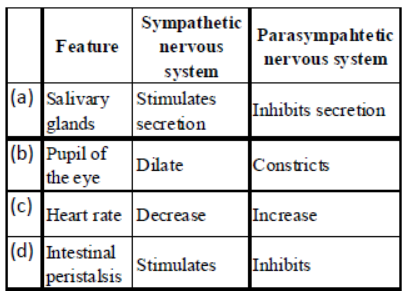
Answer. B
Question. The black pigment in the eye which reduces the internal reflection is located in
(a) retina
(b) iris
(c) cornea
(d) sclerotic
Answer. A
Question. Bipolar nerve cells are present in
(a) Skin tactile corpuscles
(b) Spinal cord
(c) Retina of eye
(d) All the above
Answer. C
Question. Which of the following ions are required for nerve conduction ?
(a) Ca++, Na+ and K+
(b) Ca++ and Mg++
(c) Mg++ and K+
(d) Na+ and K+
Answer. A
Question. The following diagram indicates the reflex arc.
Identify the parts labelled as A, B, C, D, E, F and G. Choose the correct option
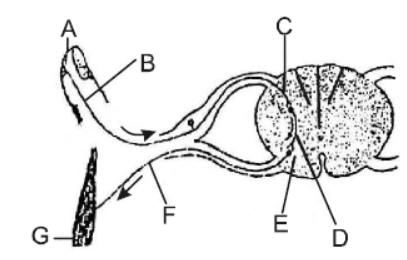
(a) A = sense organ; B = sensory nerve;
C = dorsal horn;
D = interneuron; E = ventral horn;
F = motor nerve; G = effector
(b) A = sense organ; B = sensory nerve;
C = ventral horn;
D = interneuron; E = dorsal horn;
F = motor nerve; G = effector
(c) A = effector; B = motor nerve;
C = dorsal horn;
D = interneuron; E = ventral horn;
F = sensory nerve; G = effector
(d) A = effector; B = motor nerve;
C = ventral horn; D = interneuron;
E = dorsal horn; F = sensory nerve;
G = sense organ.
Answer. A
ASSERTION REASON QUESTIONS
Directions : Each of these questions contains an Assertion followed by Reason. Read them carefully and answer the question on the basis of following options. You have to select the one that best describes the two statements.
(a) If both Assertion and Reason are correct and Reason is the correct explanation of Assertion.
(b) If both Assertion and Reason are correct, but Reason is not the correct explanation of Assertion.
(c) If Assertion is correct but Reason is incorrect.
(d) If both the Assertion and Reason are incorrect.
Question. Assertion : The brain stem contains centres for controlling activities.
Reason : Brain stem is very sensitive.
Answer. B
Question. Assertion : The chemical stored in the synaptic vesicles are termed as neurotransmitters.
Reason : Synaptic vesicles release these chemicals in the synaptic cleft.
Answer. B
Question. Assertion: The imbalance in concentration of Na+, K+ and proteins generates resting potential.
Reason: To maintain the unequal distribution of Na+ & K+, the neurons use electrical energy.
Answer. C
Question. Assertion : The axonal membrane of the neuron is more permeable to sodium ion (Na+) and nearly impermeable to potassium (K+).
Reason : In a resting state neuron does not conduct any impulse.
Answer. D
Question. Assertion : A cerebellum is related with skillful voluntary movement and involuntary activity like body balance, equilibrium, etc.
Reason : It is part of hind brain and it is situated behind the pons.
Answer. B
Please click the link below to download CBSE Class 11 Biology Neural Control and Coordination Worksheet Set A
Free study material for Biology
Exam Preparation Worksheet for Class 11 Biology Chapter 18 Neural Control and Coordination
CBSE Practice Material: Class 11 Biology Chapter 18 Neural Control and Coordination
Access structured practice worksheets for Chapter 18 Neural Control and Coordination designed in alignment with the latest CBSE curriculum for Class 11 Biology. These printable problem sets help students build accuracy and prepare effectively for school tests.
NCERT-Aligned Questions and Solutions
Each worksheet is structured around standard CBSE textbooks, allowing students to check their working steps and correct mistakes early in their revision.
Next Steps in Your Exam Preparation
Explore our broader library of printable assignments, chapter notes, and mock tests designed to support continuous revision and secure higher marks in CBSE assessments.
FAQs
You can download the teacher-verified PDF for CBSE Class 11 Biology Neural Control and Coordination Worksheet Set 01 from StudiesToday.com. These practice sheets for Class 11 Biology are designed as per the latest CBSE academic session.
Yes, our CBSE Class 11 Biology Neural Control and Coordination Worksheet Set 01 includes a variety of questions like Case-based studies, Assertion-Reasoning, and MCQs as per the 50% competency-based weightage in the latest curriculum for Class 11.
Yes, we have provided detailed solutions for CBSE Class 11 Biology Neural Control and Coordination Worksheet Set 01 to help Class 11 and follow the official CBSE marking scheme.
Daily practice with these Biology worksheets helps in identifying understanding gaps. It also improves question solving speed and ensures that Class 11 students get more marks in CBSE exams.
All our Class 11 Biology practice test papers and worksheets are available for free download in mobile-friendly PDF format. You can access CBSE Class 11 Biology Neural Control and Coordination Worksheet Set 01 without any registration.