

Practice Worksheets for Class 11 Biology: Chapter 09 Biomolecules
Explore reliable practice materials for Chapter 09 Biomolecules tailored for Class 11 learners. Utilizing these Biology worksheets ensures thorough preparation and strengthens problem-solving speed for upcoming school assessments.
Practice Chapter 09 Biomolecules Worksheets for Class 11 Biology
Access the complete worksheet PDF for Chapter 09 Biomolecules below. Regular practice with these targeted questions builds familiarity with standard exam patterns and helps secure higher marks in final Biology evaluations.
MULTIPLE CHOICE QUESTIONS
Question. High energy bond of ATP are present in between
(a) C – C
(b) C – O
(c) C – N
(d) O – P
Answer. D
Question. Proteins are
(a) polysaccharides
(b) polyamides
(c) polynucleotides
(d) polyglycol
Answer. B
Question. Which of the following gives Fehling’s test?
(a) Pectin
(b) Sucrose
(c) Cellulose
(d) Glucose
Answer. D
Question.The nicotinamide is synthesized in our body from
(a) tryptophan
(b) tryosine
(c) valine
(d) alanine
Answer. A
Question. An example of competitive inhibition of an enzyme is the inhibition of
(a) succinic dehydrogenase by malonic acid
(b) cytochrome oxidase by cyanide
(c) hexokinase by glucose-6-phosphate
(d) carbonic anhydrase by carbon dioxide
Answer. A
Question. Which of the following set of three items are not true as each set belongs to the category mentioned against them
(a) Lysine, glycine, thiamine - Amino acids
(b) Myosin, oxytocin and gastrin - Hormones
(c) Rennin, helicase and hyaluronidase - Enzyme
(d) Optic nerve, occulomotor, vagus - Sensory nerves
Answer. C
Question. Which of the following contain -l, 4 linkage?
(a) Maltose
(b) Sucrose
(c) Lactose
(d) Fructose
Answer. C
Question. Which statement is true?
(a) Adenine has 4 nitrogen atoms.
(b) Cytosine has 3 nitrogen atoms.
(c) Guanosine has 3 nitrogen atoms.
(d) Uracil has 5 nitrogen atoms.
Answer. A
Question. Alpha-keratin is a protein present in
(a) blood
(b) skin
(c) lymph
(d) eggs
Answer. B
Question. The diagram illustrates energy changes in an enzyme controlled reaction.
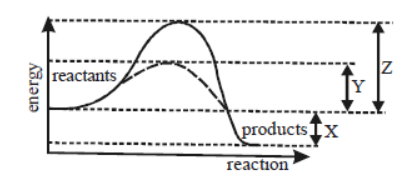
Which of the following represents the lowering of the activation energy?
(a) X
(b) Y
(c) Z
(d) Z – Y
Answer. D
Question. Which one of the following is a non - reducing carbohydrate?
(a) Maltose
(b) Sucrose
(c) Lactose
(d) Ribose 5 - phosphate
Answer. B
Question. The Km value of the enzyme is the value of the substrate concentration at which the reaction reaches to
(a) Zero
(b) 2 Vmax
(c) ½ Vmax
(d) ¼ Vmax
Answer. C
Question. The following diagrams represent the nitrogenous bases of nucleic acid molecules.Identify the correct combination
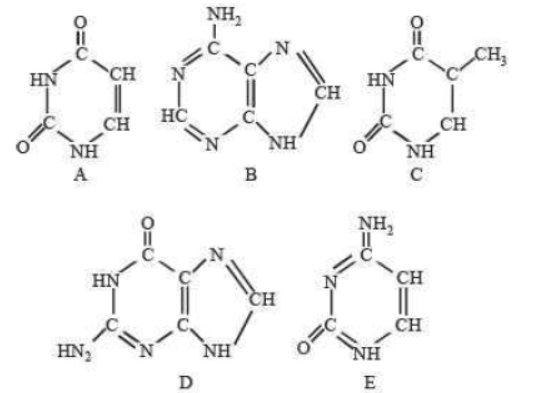
(a) A-uracil, B-adenine, C-thymine, D-guanine,E- cytosine
(b) A - uracil, B-guanine, C-cytosine,D-adenine, E-thymine
(c) A-uracil, B - guanine, C-thymine,D-adenine, E-cytosine
(d) A-thymine, B-guanine, C-uracil, D-adenine,E-cytosine.
Answer. A
Question. The given graph shows the effect of substrate concentration on the rate of reaction of the enzyme green -gram -phosphatase. What does the graph indicate ?
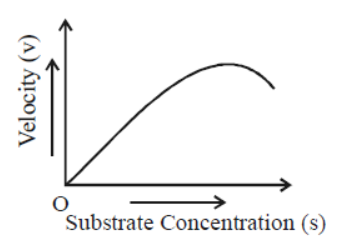
(a) The rate of enzyme reaction is directly proportional to the substrate concentration
(b) Presence of an enzyme inhibitor in the reaction mixture
(c) Formation of an enzyme-substrate complex
(d) At higher substrate-concentration the pH increases.
Answer. B
Question. Inorganic catalyst work efficiently at________temperature and ________ pressure.
(a) high, low
(b) low, low
(c) low, high
(d) high, high
Answer. D
Question. Nucleotides are building blocks of nucleic acids. Each nucleotide is a composite molecule formed by
(a) base-sugar-phosphate.
(b) base-sugar-OH.
(c) (base-sugar-phosphate)n.
(d) sugar-phosphate.
Answer. A
ASSERTION REASON QUESTIONS
Directions : Each of these questions contains an Assertion followed by Reason. Read them carefully and answer the question on the basis of following options. You have to select the one that best describes the two statements.
(a) If both Assertion and Reason are correct and Reason is the correct explanation of Assertion.
(b) If both Assertion and Reason are correct, but Reason is not the correct explanation of Assertion.
(c) If Assertion is correct but Reason is incorrect.
(d) If both the Assertion and Reason are incorrect.
Question. Assertion : Human diet should compulsorily contain glycine, serine and tyrosine.
Reason : Essential amino acids can not be synthesized in the human body.
Answer. D
Question. Assertion : Unsaturated fats are more reactive compared with the saturated fats.
Reason : Unsaturated fats have only single bonds in their structure.
Answer. C
Question. Assertion : The amino acid glycine comes under the category of nonessential amino acids.
Reason : This is due to the fact that it can not be synthesised in the body.
Answer. C
Question. Assertion : Allosteric enzymes show feed back inhibition.
Reason : The inhibitor is competitive
Answer. C
Question. Assertion : Coenzymes serve as co-factors in a number of different enzyme catalyzed reactions.
Reason : Coenzymes and prosthetic groups are cofactors.
Answer. B
Question. Assertion : Enzymes lower the activation energy.
Reason : A substrate molecule can be acted upon by a particular enzyme.
Answer. B
Question. Assertion : Comparative biochemistry provides a strong evidence in favour of common ancestory of living beings.
Reason : Genetic code is universal.
Answer. B
Question. Assertion : A co-enzymes or metal ions that is very tightly bound to enzyme protein is called prosthetic group.
Reason : A complete, catalytically active enzyme together with its bound prosthetic group is called apoenzyme.
Answer. C
Question. Assertion : Glycosidic bonds are formed by dehydration.
Reason : In polysaccharides, individual monosaccharide is linked by glycosidic bond.
Answer. B
Question. Assertion : In a DNA molecule, A–T rich parts melt before G–C rich parts.
Reason: In between A and T there are three H–bond, whereas in between G and C there are two H-bonds.
Answer. C
Please click the link below to download CBSE Class 11 Biology Biomolecules Worksheet Set A
Free study material for Biology
Chapter 09 Biomolecules Practice Sheet and Solutions for Class 11 Biology
Download Practice Sheet: Chapter 09 Biomolecules (Class 11 Biology)
Review targeted practice exercises for Class 11 Biology Chapter 09 Biomolecules. Curated to match official CBSE guidelines, these downloadable PDF sheets support daily revision and core concept reinforcement.
Concept Clarification for Chapter 09 Biomolecules
Cross-reference your completed exercises with comprehensive NCERT solutions for Class 11 Biology to ensure absolute clarity across all sub-topics in this chapter.
Additional Study Resources for Class 11 Biology
Explore our broader library of printable assignments, chapter notes, and mock tests designed to support continuous revision and secure higher marks in CBSE assessments.
FAQs
You can download the teacher-verified PDF for CBSE Class 11 Biology Biomolecules Worksheet Set 01 from StudiesToday.com. These practice sheets for Class 11 Biology are designed as per the latest CBSE academic session.
Yes, our CBSE Class 11 Biology Biomolecules Worksheet Set 01 includes a variety of questions like Case-based studies, Assertion-Reasoning, and MCQs as per the 50% competency-based weightage in the latest curriculum for Class 11.
Yes, we have provided detailed solutions for CBSE Class 11 Biology Biomolecules Worksheet Set 01 to help Class 11 and follow the official CBSE marking scheme.
Daily practice with these Biology worksheets helps in identifying understanding gaps. It also improves question solving speed and ensures that Class 11 students get more marks in CBSE exams.
All our Class 11 Biology practice test papers and worksheets are available for free download in mobile-friendly PDF format. You can access CBSE Class 11 Biology Biomolecules Worksheet Set 01 without any registration.