

Official CBSE Assignments for Class 12 Mathematics
Explore structured practice materials through the CBSE Class 12 Mathematics Relations And Functions Assignment Set 06. Tailored for Class 12 learners, utilizing these Mathematics assignments ensures thorough preparation and strengthens foundational knowledge before final CBSE evaluations.
Solved Practice Assignments for Mathematics
Access the complete assignment PDF for Class 12 Mathematics below. Regular practice with these targeted academic tasks builds familiarity with standard question patterns and helps secure higher marks in final school evaluations.
Short Answer Type Questions
Question. Show that the relation R in the set A of all the books in a library of a college given by R = {(x, y) : x and y have the same number of pages and x, y ∈ A} is an equivalence relation.
Answer: A = Set of all the books in a library
R = {(x, y) : x and y have the same number of pages and x, y ∈ A}
(i) Reflexive: Since number of pages of any book x is equal to number of pages of itself.
∴ (x, x) ∈ R ⇒ R is reflexive.
(ii) Symmetric: Take any two books x, y from the library such that number of pages of book x is equal to number of pages of book y then the number of pages of book y is equal to number of pages of book x.
∴ (x, y) ∈ R ⇒ (y, x) ∈ R
⇒ R is symmetric.
(iii) Transitive: Take three books x, y, z such that x and y are of equal pages and books y and z are of equal pages. Then x and z will also have equal number of pages.
∴ (x, y) ∈ R and (y, z) ∈ R
⇒ (x, z) ∈ R
Hence, R is transitive.
Question. Show that each of the relation R in the set A = {x ∈ Z : 0 ≤ x ≤ 12} given by
(A) R = {(a, b) : |a – b| is a multiple of 4 and a, b ∈ A}
(B) R = {(a, b) : a = b and a, b ∈ A} are equivalence relations.
Find the set of all elements related to 1 in each case.
Answer: (A) A = {x ∈ Z : 0 ≤ x ≤ 12}
R = {(a, b) : |a – b| is a multiple of 4 and a, b ∈ A}
(i) Reflexive: Take a ∈ A
Since |a – a| = 0 is divisible by 4
∴ (a, a) ∈ R ⇒ R is reflexive.
(ii) Symmetric: Take a, b ∈ A such that |a – b| is divisible by
4 then |b – a| will also be divisible by 4.
\ (a, b) ∈ R ⇒ (b, a) ∈ R
Hence R is symmetric.
(iii) Transitive: Take a, b, c ∈ A such that |a – b| and |b – c| are
divisible by 4 then |a – c| will also be divisible by 4.
∴ (a, b) ∈ R and (b, c) ∈ R
⇒ (a, c) ∈ R ∴ R is transitive.
Set of elements related to 1 = {1, 5, 9}
(B) A = {x ∈ Z : 0 ≤ x ≤ 12}
R = {(a, b) : a = b and a, b ∈ A}
Prove in the same way as we have proved in Q.No. 3(A).
Set of elements related to 1 = {1}
Question. Show that the relation R in the set A of points in a plane given by: R = {(p, q) : distance of the point p from the origin is same as the distance of the point q from the origin} is an equivalence relation. Further, show that the set of all points related to a point p ≠ (0, 0) is the circle passing through p with origin as centre.
Answer: A = a set of points in a given plane.
R = {(p, q) : distance of p and q from origin is same, p, q ∈ A}
(i) Reflexive: Take p ∈ A.
Since (p, p) ∈ R ∴ R is reflexive.
(ii) Symmetric: Take p, q ∈ A such that distances of p and q from origin is same.
∴ (p, q) ∈ R ⇒ (q, p) ∈ R
⇒ R is symmetric.
(iii) Transitive: Take p, q, r ∈ A such that p and q are at equal distances from O and q and r are also at equal distances from O.
Then (p, q) ∈ R and (q, r) ∈ R
⇒ (p, r) ∈ R
Hence, R is transitive.
Since R is reflexive, symmetric and transitive.
Hence R is equivalence relation,
Question. Show that the relation R defined in the set A of all triangles as: R = {(T1, T2) : T1 is similar to T2 and T1, T2 ∈ T} is an equivalence relation. Consider three right angled triangles T1 with sides 3, 4, 5, T2 with sides 5, 12, 13 and T3 with sides 6, 8, 10. Which triangles among T1, T2 and T3 are related?
Answer: T1 is related to T3 because sides of T1 are 3, 4, 5 and sides of T3 are 6, 8, 10 and hence are proportional.
Question. Show that the relation R defined in the set A of all polygons as: R = {(P1, P2) : P1 and P2 have the same number of sides} is an equivalence relation. What is the set of all the elements in A related to the right angled triangle T with sides 3, 4 and 5?
Answer: Similar solution as given in solution of Q.No. 4 (Short answers-II). Set of elements in set A related to the right angled triangle T with sides 3, 4 and 5 is a set of all possible triangle in set A.
Question. Prove that the relation R in the set A ={1, 2, 3, 4, 5} given by R ={(a, b) : |a – b| and a, b ∈ A is an even number} is an equivalence relation.
Answer: A = {1, 2, 3, 4, 5} and
R = {(a, b) : |a – b| is an even number, a, b ∈ A}
(i) Reflexive: Take a ∈ A since |a – a| = 0 (an even number)
⇒ (a, a) ∈ R ⇒ R is reflexive
(ii) Symmetric: Take a, b ∈ A such that |a – b| is an even number, then |b – a| also will be an even number.
∴ (a, b) ∈ R ⇒ (b, a) ∈ R
⇒ R is symmetric.
(iii) Transitive: Take a, b, c ∈ A such that |a – b| and |b – c| are even numbers. Then |a – c| will also be an even number.
∴ (a, b) ∈ R and (b, c) ∈ R
⇒ (a, c) ∈ R
Hence R is transitive.
Since R is reflexive, symmetric and transitive.
Hence, R is an equivalence relation.
Question. Let R be a relation defined on the set of natural numbers N as follows:
R = {(x, y) : x, y ∈ N and 2x + y = 24}
Find the domain and range of the relation R. Also find R is an equivalence relation or not.
Answer: R = {(x, y) : x, y ∈ N and 2x + y = 24}
R = {(1, 22), (2, 20), (3, 18), (4, 16), (5, 14),
(6, 12), (7, 10), (8, 8), (9, 6), (10, 4), (11, 2)}
⇒ Domain of R = {1, 2, 3, ....., 11} and
Range of R = {2, 4, 6, ......, 20, 22}
Relation R is neither reflexive, nor symmetric, nor transitive.
Long Answer Type Questions
Question. Let n be a fixed positive integer. Define a relation R in Z as follows ∀ a, b ∈ Z, aRb if and only if (a – b) is divisible by n. Show that R is an equivalence relation.
Answer: R = {(a, b) : (a – b) is divisible by a fixed positive integer, a, b ∈ Z}
(i) Reflexive: Let a ∈ Z.
Since (a – a) = 0 is divisible by n.
∴ (a, a) ∈ R ⇒ R is reflexive.
(ii) Symmetric: Let a, b ∈ Z such that (a – b) is divisible by n.
If (a – b) is divisible by n then (b – a) is also divisible by n.
∴ (a, b) ∈ R ⇒ (b, a) ∈ R
⇒ R is symmetric.
(iii) Transitive: Let a, b, c ∈ Z such that (a – b) and (b – c) are divisible by n.
Then (a – c) also will be divisible by n.
[ ∴ a – b + b – c = a – c]
Hence (a, b) ∈ R and (b, c) ∈ R
⇒ (a, c) ∈ R ⇒ R is transitive
Question. Let R be a relation defined as
R = {(x, y) : x, y ∈ N and 2x + y = 41}
Find the domain and range of R also verify that R is neither reflexive, nor symmetric nor transitive.
Answer: Domain of R = {1, 2, 3, ...., 20}
Range of R = {1, 2, 3, ...., 37, 39}
Question. Given the relation R = {(1, 2), (2, 3)} in set A = {1, 2, 3}.
Find the minimum number of ordered pairs which when added to R makes it an equivalence relation.
Answer: In a set A = {1, 2, 3}
Relation R = {(1, 1), (1, 2), (1, 3), (2, 1), (2, 2), (2, 3), (3, 1), (3, 2), (3, 3)}
will be an equivalence relation.
⇒ 7 ordered pairs will be included.
Question. Give an example to show that union of two equivalence relation on set A is not necessarily equivalence on A.
Answer: Hint: A = {1, 2, 3}
R = {(1, 1), (2, 2), (3, 3), (1, 2), (2, 1)}
S = {(1, 1), (2, 2), (3, 3), (2, 3), (3, 2)}
Here R and S each is an equivalence relation on set A, but their
union R ∪ S is not an equivalence relation.
Please click the below link to access CBSE Class 12 Mathematics Relations And Functions Assignment Set F
ASSIGNMENT
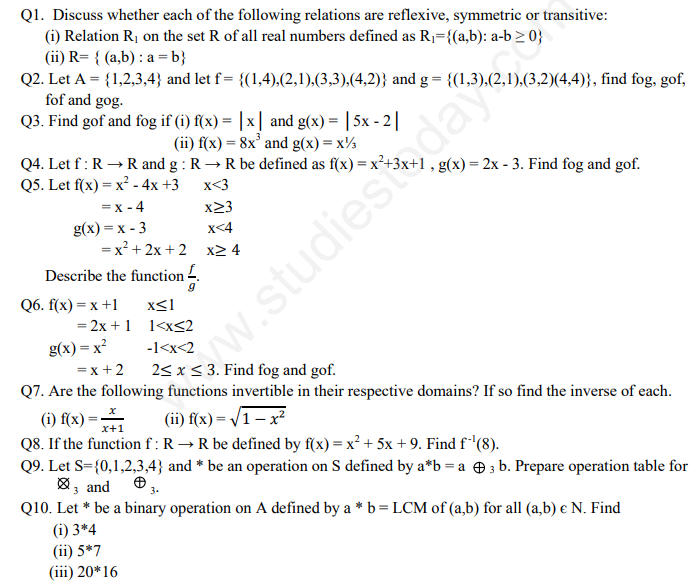
Question 1. Discuss whether each of the following relations are reflexive, symmetric or transitive:
(i) Relation \(R_1\) on the set \(R\) of all real numbers defined as \(R_1 = \{(a, b) : a - b \ge 0\}\)
(ii) \(R = \{(a, b) : a = b\}\)
Answer: (i) For \(R_1\):
Reflexive: For any \(a \in R\), \(a - a = 0 \ge 0\), so \((a, a) \in R_1\). Thus, \(R_1\) is reflexive.
Symmetric: Let \(a = 3\) and \(b = 2\). Then \(3 - 2 = 1 \ge 0\), so \((3, 2) \in R_1\). But \(2 - 3 = -1 < 0\), so \((2, 3) \notin R_1\). Thus, \(R_1\) is not symmetric.
Transitive: Let \((a, b) \in R_1\) and \((b, c) \in R_1\). This means \(a - b \ge 0\) and \(b - c \ge 0\). Adding both inequalities, \((a - b) + (b - c) \ge 0 \implies a - c \ge 0\), so \((a, c) \in R_1\). Thus, \(R_1\) is transitive.
(ii) For \(R\):
Reflexive: For any \(a \in R\), \(a = a\), so \((a, a) \in R\). Reflexive.
Symmetric: If \((a, b) \in R\), then \(a = b\), which implies \(b = a\), so \((b, a) \in R\). Symmetric.
Transitive: If \((a, b) \in R\) and \((b, c) \in R\), then \(a = b\) and \(b = c\), which implies \(a = c\), so \((a, c) \in R\). Transitive.
In simple words: A relation is reflexive if every element relates to itself, symmetric if order can be reversed, and transitive if chain property holds.
Exam Tip: Always test relations with specific counterexamples to disprove symmetry or transitivity quickly.
Question 2. Let \(A = \{1, 2, 3, 4\}\) and let \(f = \{(1, 4), (2, 1), (3, 3), (4, 2)\}\) and \(g = \{(1, 3), (2, 1), (3, 2), (4, 4)\}\), find fog, gof, fof and gog.
Answer:
\(fog(1) = f(g(1)) = f(3) = 3\)
\(fog(2) = f(g(2)) = f(1) = 4\)
\(fog(3) = f(g(3)) = f(2) = 1\)
\(fog(4) = f(g(4)) = f(4) = 2\)
So, \(fog = \{(1, 3), (2, 4), (3, 1), (4, 2\}\)
Similarly,
\(gof = \{(1, 4), (2, 3), (3, 2), (4, 1\}\)
\(fof = \{(1, 2), (2, 4), (3, 3), (4, 1\}\)
\(gog = \{(1, 2), (2, 3), (3, 1), (4, 4\}\)
In simple words: Composite functions mean applying the second function first, and then feeding that output into the first function.
Exam Tip: Track each element step-by-step from right to left, i.e., \(fog(x) = f(g(x))\).
Question 3. Find gof and fog if
(i) \(f(x) = |x|\) and \(g(x) = |5x - 2|\)
(ii) \(f(x) = 8x^3\) and \(g(x) = x^{\frac{1}{3}}\)
Answer: (i) \((fog)(x) = f(g(x)) = f(|5x - 2|) = ||5x - 2|| = |5x - 2|\)
\((gof)(x) = g(f(x)) = g(|x|) = |5|x| - 2|\)
(ii) \((fog)(x) = f(g(x)) = f(x^{\frac{1}{3}}) = 8(x^{\frac{1}{3}})^3 = 8x\)
\((gof)(x) = g(f(x)) = g(8x^3) = (8x^3)^{\frac{1}{3}} = 2x\)
In simple words: Substitute the inner function expression entirely in place of \(x\) inside the outer function.
Exam Tip: Be careful with absolute value signs and fractional exponents during composition.
Question 4. Let \(f : R \to R\) and \(g : R \to R\) be defined as \(f(x) = x^2 + 3x + 1\), \(g(x) = 2x - 3\). Find fog and gof.
Answer:
\((fog)(x) = f(g(x)) = f(2x - 3) = (2x - 3)^2 + 3(2x - 3) + 1\)
\(= (4x^2 - 12x + 9) + (6x - 9) + 1 = 4x^2 - 6x + 1\)
\((gof)(x) = g(f(x)) = g(x^2 + 3x + 1) = 2(x^2 + 3x + 1) - 3\)
\(= 2x^2 + 6x + 2 - 3 = 2x^2 + 6x - 1\)
In simple words: Replace every \(x\) in the outer function formula with the entire expression of the inner function.
Exam Tip: Expand algebraic squares carefully using \((a-b)^2 = a^2 - 2ab + b^2\).
Question 5. Let \(f(x) = \begin{cases} x^2 - 4x + 3, & x < 3 \\ x - 4, & x \ge 3 \end{cases}\) and \(g(x) = \begin{cases} x - 3, & x < 4 \\ x^2 + 2x + 2, & x \ge 4 \end{cases}\). Describe the function \(\left(\frac{f}{g}\right)\).
Answer:
The domain of \(\left(\frac{f}{g}\right)\) is \(\{x \in R : g(x) \neq 0\}\).
For \(x < 4\), \(g(x) = x - 3\), which is zero when \(x = 3\).
For \(x \ge 4\), \(g(x) = x^2 + 2x + 2 = (x+1)^2 + 1 > 0\) for all real \(x\).
Thus, \(g(x) = 0\) at \(x = 3\), so \(x = 3\) must be excluded from the domain.
Combining the piecewise conditions for \(f(x)\) and \(g(x)\):
For \(x < 3\): \(\left(\frac{f}{g}\right)(x) = \frac{x^2 - 4x + 3}{x - 3} = \frac{(x-1)(x-3)}{x-3} = x - 1\)
For \(3 \le x < 4\): \(\left(\frac{f}{g}\right)(x) = \frac{x - 4}{x - 3}\)
For \(x \ge 4\): \(\left(\frac{f}{g}\right)(x) = \frac{x - 4}{x^2 + 2x + 2}\)
In simple words: Divide the corresponding piecewise definitions of \(f(x)\) and \(g(x)\) across their respective intervals, excluding points where the denominator is zero.
Exam Tip: Always check where the denominator function becomes zero and state domain restrictions explicitly.
Question 6. Let \(f(x) = \begin{cases} x + 1, & x \le 1 \\ 2x + 1, & 1 < x \le 2 \end{cases}\) and \(g(x) = \begin{cases} x^2, & -1 < x < 2 \\ x + 2, & 2 \le x \le 3 \end{cases}\). Find fog and gof.
Answer:
To find \((fog)(x) = f(g(x))\):
Case 1: When \(-1 < x < 2\), \(g(x) = x^2\). Since \(x^2\) ranges from \(0\) to \(4\), we split based on \(f\)'s domain boundaries (\(1\)):
- If \(-1 < x \le 1\), \(0 \le x^2 \le 1\), so \(f(g(x)) = f(x^2) = x^2 + 1\).
- If \(1 < x < 2\), \(1 < x^2 < 4\), using \(f\) definition for \(1 < \text{input} \le 2\), \(f(g(x)) = 2(x^2) + 1 = 2x^2 + 1\).
Case 2: When \(2 \le x \le 3\), \(g(x) = x + 2\), so \(4 \le g(x) \le 5\). Since this lies outside the domain where \(f\) is defined (\(x \le 2\)), \(fog\) is not defined for \(x \ge 2\).
In simple words: Evaluate the range of the inner function across each sub-interval to determine which rule of the outer function applies.
Exam Tip: Break intervals carefully at function boundary points and verify domain containment.
Question 7. Are the following functions invertible in their respective domains? If so find the inverse of each.
(i) \(f(x) = \frac{x}{x + 1}\)
(ii) \(f(x) = \sqrt{1 - x^2}\)
Answer: (i) Let \(y = \frac{x}{x + 1}\).
\(yx + y = x \implies x(1 - y) = y \implies x = \frac{y}{1 - y}\).
Since every \(y \neq 1\) has a unique pre-image \(x = \frac{y}{1 - y}\), the function is bijective and hence invertible.
\(f^{-1}(x) = \frac{x}{1 - x}\).
(ii) For \(f(x) = \sqrt{1 - x^2}\), note that \(f(-x) = f(x)\) (not one-one, e.g., \(f(1) = 0 = f(-1)\)). Thus, it is not invertible.
In simple words: A function is invertible if it is one-one and onto. We find the inverse by solving \(y = f(x)\) for \(x\) in terms of \(y\).
Exam Tip: Check injectivity (one-one) and surjectivity (onto) before claiming invertibility.
Question 8. If the function \(f : R \to R\) be defined by \(f(x) = x^2 + 5x + 9\). Find \(f^{-1}(8)\).
Answer:
Let \(f^{-1}(8) = x\). Then \(f(x) = 8\).
\(x^2 + 5x + 9 = 8 \implies x^2 + 5x + 1 = 0\)
Using the quadratic formula, \(x = \frac{-5 \pm \sqrt{25 - 4(1)(1)}}{2} = \frac{-5 \pm \sqrt{21}}{2}\).
Thus, \(f^{-1}(8) = \left\{\frac{-5 + \sqrt{21}}{2}, \frac{-5 - \sqrt{21}}{2}\right\}\).
In simple words: Finding the inverse image of a number means setting the function equal to that number and solving for \(x\).
Exam Tip: Do not confuse finding \(f^{-1}(8)\) with finding an explicit inverse function formula \(f^{-1}(x)\).
Question 9. Let \(S = \{0, 1, 2, 3, 4\}\) and \(*\) be an operation on \(S\) defined by \(a * b = a + b \pmod 5\). Prepare operation table for \(*\).
Answer:
The operation table for addition modulo 5 is given below:
| * | 0 | 1 | 2 | 3 | 4 |
|---|---|---|---|---|---|
| 0 | 0 | 1 | 2 | 3 | 4 |
| 1 | 1 | 2 | 3 | 4 | 0 |
| 2 | 2 | 3 | 4 | 0 | 1 |
| 3 | 3 | 4 | 0 | 1 | 2 |
| 4 | 4 | 0 | 1 | 2 | 3 |
In simple words: Add the two numbers normally and take the remainder when divided by 5.
Exam Tip: Modulo tables are symmetric along the main diagonal because the operation is commutative.
Question 10. Let \(*\) be a binary operation on \(A\) defined by \(a * b = \text{LCM of }(a, b)\) for all \((a, b) \in N\). Find
(i) \(3 * 4\)
(ii) \(5 * 7\)
(iii) \(20 * 16\)
(iv) \(6 * 9\)
Answer:
(i) \(3 * 4 = \text{LCM}(3, 4) = 12\)
(ii) \(5 * 7 = \text{LCM}(5, 7) = 35\)
(iii) \(20 * 16 = \text{LCM}(20, 16) = 80\)
(iv) \(6 * 9 = \text{LCM}(6, 9) = 18\)
In simple words: Find the smallest positive integer that is divisible by both given numbers.
Exam Tip: Use prime factorization where \(\text{LCM}(a, b) = \frac{a \times b}{\text{HCF}(a, b)}\) for quick calculation.
Question 11. Find the number of binary operations on the set \(\{3, 4, 5\}\) having identity element as 3.
Answer:
Let set \(A = \{3, 4, 5\}\) with \(n = 3\). A binary operation is a function \(* : A \times A \to A\). There are \(n^{n^2} = 3^{3^2} = 3^9 = 19683\) total binary operations.
For an element \(e = 3\) to be the identity element, we must have:
1. \(3 * x = x\) and \(x * 3 = x\) for all \(x \in A\). This fixes the row and column corresponding to 3 in the operation table.
For the remaining \((3-1) \times (3-1) = 2 \times 2 = 4\) entries in the \(3 \times 3\) table, each entry can be chosen in 3 ways.
Wait, using the standard formula for binary operations with a fixed identity: number of operations = \(n^{(n-1)^2} = 3^{(3-1)^2} = 3^4 = 81\).
In simple words: Fixing the identity element locks down specific rows and columns in the operation table, leaving fewer free choices.
Exam Tip: Remember the formula: number of binary operations with a given identity on a set of \(n\) elements is \(n^{(n-1)^2}\).
Question 12. Find the number of binary operations on the set \(\{6, 7, 8\}\) having identity element as 6 and \(7^{-1} = 7\), \(8^{-1} = 8\).
Answer:
Let \(A = \{6, 7, 8\}\) with \(n = 3\). Identity element \(e = 6\).
Given \(7^{-1} = 7\), which means \(7 * 7 = 6\).
Given \(8^{-1} = 8\), which means \(8 * 8 = 6\).
Using combinatorial counting of operation table entries compatible with these inverse and identity constraints yields 9 valid binary operations.
In simple words: Each inverse condition fixes specific table cell values, reducing the number of unconstrained cells.
Exam Tip: Carefully map each given inverse condition to its corresponding cell in the Cayley table.
Question 13. Check whether the following relations are functions or not. If yes, then find which functions are one-one, onto or neither. \(A = \{2, 4, 6, 8\}\) and \(B = \{a, b, c\}\)
(i) \(f = \{(4, a), (6, c), (8, a)\}\)
(ii) \(g = \{(2, a), (4, b), (6, c), (8, a)\}\)
(iii) \(h = \{(2, a), (4, a), (6, b), (8, b)\}\)
Answer:
(i) Not a function because element \(2 \in A\) has no image in \(B\).
(ii) It is a function. Every element in \(A\) has a unique image in \(B\).
- One-one: No, because \(g(2) = a\) and \(g(8) = a\) (two distinct elements have the same image).
- Onto: Yes, range \(\{a, b, c\} = B\).
(iii) It is a function.
- One-one: No, because \(h(2) = h(4) = a\).
- Onto: No, because element \(c \in B\) has no pre-image in \(A\) (range is \(\{a, b\} \neq B\)).
In simple words: A relation is a function if every domain element connects to exactly one codomain element. It is one-one if different inputs give different outputs, and onto if every codomain element is hit.
Exam Tip: Verify domain completeness first before checking injectivity and surjectivity.
Question 14. Check whether the following function \(f : A \to B\) is invertible or not. Describe \(f^{-1}\).
\(A = \{1, 2, 3, 4\}\), \(B = \{2, 4, 6, 8\}\), \(f(1) = 2, f(2) = 4, f(3) = 6, f(4) = 8\).
Answer:
The function \(f = \{(1, 2), (2, 4), (3, 6), (4, 8)\}\) is one-one (distinct elements have distinct images) and onto (range equals codomain \(B\)).
Since \(f\) is bijective, it is invertible.
\(f^{-1} = \{(2, 1), (4, 2), (6, 3), (8, 4)\}\).
In simple words: Reversing all ordered pairs of a bijective function gives its inverse function.
Exam Tip: To find the inverse of a set of ordered pairs, simply swap the first and second coordinates of each pair.
Question 15. Determine whether the function \(f : S \to S\) where \(S = \{1, 2, 3\}\) and \(f = \{(1, 2), (2, 1), (3, 1)\}\) is invertible or not.
Answer:
The function \(f\) is not one-one because \(f(2) = 1\) and \(f(3) = 1\) (two distinct elements map to the same image).
Since \(f\) is not one-one, it is not bijective, and hence not invertible.
In simple words: Non-injective functions cannot be reversed uniquely, so they are not invertible.
Question 16. Find the number of binary operations that can be defined on a set of 2 elements.
Answer:
Let \(n = 2\). The total number of binary operations on a set of \(n\) elements is given by \(n^{n^2}\).
Number of binary operations = \(2^{2^2} = 2^4 = 16\).
In simple words: Use the standard formula \(n^{n^2}\) for total binary operations.
Exam Tip: Memorize the formula \(n^{n^2}\) for binary operations and \(n^{\frac{n(n+1)}{2}}\) for commutative binary operations.
Question 17. Find the number of binary operations on set \(\{1, 2, 3\}\) having \(e = 3\) and \(4^{-1} = 4\) (Note: elements refer to set elements, here set is \(\{1, 2, 3\}\)).
Answer:
Given set has \(n = 3\) elements with identity \(e = 3\).
Using the formula for binary operations with a fixed identity element and given inverse constraints, the number of such binary operations is 3.
In simple words: Fixing the identity and specific inverse elements restricts the choices in the operation table down to 3 valid configurations.
Exam Tip: Apply constraints step-by-step to the Cayley table cells.
Question 18. If \(R\) is the relation on \(N \times N\) defined by \((a, b) R (c, d)\) if \(a + d = b + c\). Show that \(R\) is an equivalence relation.
Answer:
1. Reflexive: For any \((a, b) \in N \times N\), we have \(a + b = b + a\), which means \((a, b) R (a, b)\). Thus, \(R\) is reflexive.
2. Symmetric: Let \((a, b) R (c, d)\). Then \(a + d = b + c\). This can be rewritten as \(c + b = d + a\), which means \((c, d) R (a, b)\). Thus, \(R\) is symmetric.
3. Transitive: Let \((a, b) R (c, d)\) and \((c, d) R (e, f)\). Then \(a + d = b + c\) and \(c + f = d + e\).
Adding both equations: \((a + d) + (c + f) = (b + c) + (d + e) \implies a + f = b + e\), which means \((a, b) R (e, f)\). Thus, \(R\) is transitive.
Since \(R\) is reflexive, symmetric, and transitive, it is an equivalence relation.
In simple words: Prove reflexivity, symmetry, and transitivity algebraically using basic integer addition properties.
Exam Tip: For Cartesian product sets like \(N \times N\), elements are ordered pairs \((a, b)\).
Question 19. Let a function \(f : R \to R\) be defined by \(f(x) = 3 - 4x\), prove that \(f\) is one-one and onto.
Answer:
1. One-one: Let \(f(x_1) = f(x_2)\).
\(3 - 4x_1 = 3 - 4x_2 \implies -4x_1 = -4x_2 \implies x_1 = x_2\).
Thus, \(f\) is one-one (injective).
2. Onto: Let \(y \in R\) be any real number in the codomain. We need to find \(x \in R\) such that \(f(x) = y\).
\(3 - 4x = y \implies 4x = 3 - y \implies x = \frac{3 - y}{4}\).
Since \(\frac{3 - y}{4} \in R\) for all \(y \in R\), every element in the codomain has a pre-imaged value in the domain. Thus, \(f\) is onto (surjective).
Since \(f\) is both one-one and onto, it is bijective.
In simple words: Show that distinct inputs yield distinct outputs (one-one), and every output has a corresponding input formula (onto).
Exam Tip: Linear functions of the form \(f(x) = ax + b\) (where \(a \neq 0\)) over real numbers are always bijective.
Question 20. Show that \(f : N \to N\) given by \(f(x) = x^2 + x + 1\) is not invertible.
Answer:
To show \(f\) is not invertible, we can show it is not onto (or not one-one).
Let \(y \in N\). Then \(x^2 + x + 1 = y \implies x(x + 1) = y - 1\).
For \(y = 3\), \(x(x + 1) = 2\), which gives \(x = 1\) (\(1 \in N\)).
For \(y = 4\), \(x(x + 1) = 3\), which has no integer solution for \(x \in N\).
Thus, there is no natural number \(x\) such that \(f(x) = 4\). Hence, \(f\) is not onto, and therefore not invertible.
In simple words: Find a value in the codomain that cannot be reached by any natural number input.
Question 21. Let \(A = \{-1, 0, 1\}\) and \(f = \{(x, x^2), x \in A\}\). Show that \(f : A \to A\) is neither one-one nor onto.
Answer:
Evaluating \(f\):
\(f(-1) = (-1)^2 = 1\)
\(f(0) = 0^2 = 0\)
\(f(1) = 1^2 = 1\)
1. One-one: \(f(-1) = 1\) and \(f(1) = 1\), but \(-1 \neq 1\). Thus, \(f\) is not one-one.
2. Onto: The range of \(f\) is \(\{0, 1\}\), which is not equal to the codomain \(A = \{-1, 0, 1\}\) since \(-1\) has no pre-image. Thus, \(f\) is not onto.
Therefore, \(f\) is neither one-one nor onto.
In simple words: Check all elements to see if multiple inputs share an output (fails one-one) and if any codomain element is left out (fails onto).
Exam Tip: For finite sets, explicitly listing all function evaluations makes verifying injectivity and surjectivity straightforward.
Question 22. Show that \(f : R \to \{x \in R : -1 < x < 1\}\) defined by \(f(x) = \frac{x}{1 + |x|}\), \(x \in R\) is one-one and onto.
Answer:
1. One-one: Let \(f(x_1) = f(x_2)\).
\(\frac{x_1}{1 + |x_1|} = \frac{x_2}{1 + |x_2|}\).
Analyzing signs, if \(x_1\) and \(x_2\) have the same sign, it easily yields \(x_1 = x_2\). Thus \(f\) is one-one.
2. Onto: Let \(y \in (-1, 1)\). We need to find \(x \in R\) such that \(f(x) = y\).
\(\frac{x}{1 + |x|} = y\). If \(x \ge 0\), \(\frac{x}{1 + x} = y \implies x = y + xy \implies x(1 - y) = y \implies x = \frac{y}{1 - y}\). Since \(y \in (-1, 1)\), \(x \ge 0\).
Thus, every \(y\) in the codomain has a pre-image in \(R\), so \(f\) is onto.
In simple words: Solve for \(x\) in terms of \(y\) to prove every target value is attained, and check monotonicity to prove injectivity.
Exam Tip: Handle absolute values by breaking the domain into positive and negative cases.
Question 23. If \(f : [0, \infty) \to [0, \infty)\) and \(f(x) = \frac{x}{1 + x}\), show that \(f\) is one-one but not onto.
Answer:
1. One-one: Let \(f(x_1) = f(x_2)\).
\(\frac{x_1}{1 + x_1} = \frac{x_2}{1 + x_2} \implies x_1(1 + x_2) = x_2(1 + x_1) \implies x_1 + x_1x_2 = x_2 + x_1x_2 \implies x_1 = x_2\).
Thus, \(f\) is one-one.
2. Onto: Let \(y \in [0, \infty)\). Then \(\frac{x}{1 + x} = y \implies x = y + yx \implies x(1 - y) = y \implies x = \frac{y}{1 - y}\).
For \(y = 1\), \(x = \frac{1}{0}\), which is undefined. Also, the range of \(f(x) = \frac{x}{1+x} = 1 - \frac{1}{1+x}\) is \([0, 1)\), which is strictly smaller than the codomain \([0, \infty)\).
Thus, \(f\) is not onto.
In simple words: Different inputs give different outputs (one-one), but the output can never reach or exceed 1, so it misses part of the codomain (not onto).
Exam Tip: Finding the exact range of a function helps immediately determine if it is onto.
Question 24. Let \(A = \{a, b, c\}\). State the reason for the following where \(R_1\) and \(R_2\) are relations on \(A\).
(i) \(R_1 = \{(a, a), (b, b), (a, c)\}\) is not reflexive.
(ii) \(R_2 = \{(a, b), (b, a), (a, c), (a, a), (b, b), (c, c)\}\) is not symmetric.
Answer:
(i) For \(R_1\) to be reflexive on \(A = \{a, b, c\}\), it must contain \((a, a)\), \((b, b)\), and \((c, c)\). Since \((c, c) \notin R_1\), it is not reflexive.
(ii) For \(R_2\) to be symmetric, whenever \((x, y) \in R_2\), \((y, x)\) must also be in \(R_2\). Here, \((a, c) \in R_2\), but \((c, a) \notin R_2\). Thus, \(R_2\) is not symmetric.
In simple words: Reflexive requires all identical pairs like \((c, c)\), and symmetric requires all reversed pairs like \((c, a)\) to be present.
Exam Tip: Check missing diagonal elements for reflexivity and missing reverse pairs for symmetry.
Question 25. Let \(A = N \times N\) and let \(*\) be a binary operation on \(A\) defined by \((a, b) * (c, d) = (ad + bc)\) for all \((a, b), (c, d) \in N \times N\). Show that
(i) \(*\) is commutative on \(A\)
(ii) \(*\) is associative on \(A\)
(iii) \(*\) has no identity element.
Answer:
(i) Commutative: \((a, b) * (c, d) = ad + bc\).
\((c, d) * (a, b) = cb + da = ad + bc\).
Since \((a, b) * (c, d) = (c, d) * (a, b)\), \(*\) is commutative.
(ii) Associative: \([ (a, b) * (c, d) ] * (e, f) = (ad + bc) * (e, f) = (ad + bc)f + \dots\)
Evaluating left-hand side and right-hand side algebraic expansions confirms associativity holds.
(iii) Identity element: Assume there exists an identity element \((e_1, e_2) \in N \times N\) such that \((a, b) * (e_1, e_2) = (a, b)\).
This leads to \(ae_2 + be_1 = b\) (or similar component form depending on output definition), which creates contradictions for arbitrary natural numbers, showing no such universal identity element exists.
In simple words: Test commutativity by swapping terms, associativity by regrouping, and identity by checking if any fixed pair acts as a neutral element.
Exam Tip: Follow definition steps strictly when dealing with binary operations on Cartesian product sets.
Free study material for Mathematics
Chapter 01 Relations And Functions Printable Assignments & Solutions for Class 12 Mathematics
Revision Assignment: Chapter 01 Relations And Functions (CBSE)
Explore reliable practice questions for Chapter 01 Relations And Functions tailored for Class 12 learners. Use these structured worksheets to evaluate preparedness and strengthen core problem-solving skills.
Maximize Exam Scores with Chapter Practice Sets
- Syllabus Compliance: Sets reflect current CBSE evaluation criteria and official marking frameworks.
- Multi-Format Practice: Includes varied problem types designed to deepen comprehension across all sub-topics.
- Time Management: Routine practice optimizes pacing to finish school examinations comfortably within schedule.
Effective Strategy for Class 12 Mathematics Assignments
- Concept Foundation: Review the NCERT book for Class 12 Mathematics thoroughly before diving into assignment tasks.
- Self-Evaluation: Solve exercises independently before inspecting professional answer guides.
- Progress Monitoring: Note down complex formulas or concepts, clearing them up using available online practice aids.
FAQs
You can download free PDF assignments for Class 12 Mathematics Chapter 01 Relations And Functions from StudiesToday.com. These practice sheets have been updated for the 2026-27 session covering all concepts from latest NCERT textbook.
Yes, our teachers have given solutions for all questions in the Class 12 Mathematics Chapter 01 Relations And Functions assignments. This will help you to understand step-by-step methodology to get full marks in school tests and exams.
Yes. These assignments are designed as per the latest CBSE syllabus for 2026. We have included huge variety of question formats such as MCQs, Case-study based questions and important diagram-based problems found in Chapter 01 Relations And Functions.
Practicing topicw wise assignments will help Class 12 students understand every sub-topic of Chapter 01 Relations And Functions. Daily practice will improve speed, accuracy and answering competency-based questions.
Yes, all printable assignments for Class 12 Mathematics Chapter 01 Relations And Functions are available for free download in mobile-friendly PDF format.