

Official CBSE Assignments for Class 12 Mathematics
Review targeted academic assignments with the CBSE Class 12 Mathematics Applications Of Derivatives Assignment Set 04. Built according to official CBSE standards for the 2026-27 term, these downloadable Class 12 Mathematics worksheets support effective daily practice for Chapter 06 Applications Of Derivatives.
Solved Practice Assignments for Mathematics
View or download the dedicated CBSE Class 12 Mathematics Applications Of Derivatives Assignment Set 04 resource below. Engaging with these assignments under focused study conditions ensures continuous academic progress and mastery of the 2026-27 curriculum.
Question. The position of a point in time 't' is given by x = a + bt − ct2 , y = at + bt2 . Its acceleration at time 't' is:
a. b − c
b. (b + c)
c. 2b − 2c
d. 2√b2 + c2
Answer : D
Question. If the volume of a spherical balloon is increasing at the rate of 900 cm2/sec. then the rate of change of radius of balloon at instant when radius is 15 cm: [in cm/sec]
a. 22/7
b. 22
c. 7/22
d. None of these
Answer : C
Question. The equations of motion of two stones thrown vertically upwards simultaneously are 2 s =19.6t − 4.9t2 and s = 9.8t − 4.9t2 respectively and the maximum height attained by the first one is h. When the height of the first stone is maximum, the height of the second stone will be:
a. h/3
b. 2h
c. h
d. 0
Answer : D
Question. The slope of the tangent to the curve x2 + y2 = 2c2 at point (c, c) is:
a. 1
b. – 1
c. 0
d. 2
Answer : B
Question. The tangent to the curve y = 2x2 − x + 1 at a point P is parallel to y = 3x + 4, the co-ordinate of P are:
a. (2, 1)
b. (1, 2)
c. (– 1, 2)
d. (2, – 1)
Answer : B
Question. The radius of a sphere is measured to be 20 cm with a possible error of 0.02 of a cm. The consequent error in the surface of the sphere is:
a. 10.5 sq cm
b. 5.025 sq cm
c. 10.05 sq cm
d.None of these
Answer : C
Question. If the path of a moving point is the curve x = at y = bsin at, then its acceleration at any instant:
a. Is constant
b. Varies as the distance from the axis of x
c. Varies as the distance from the axis of y
d. Varies as the of the point from the origin
Answer : C
Question. A stone thrown vertically upwards from the surface of the moon at velocity of 24 m/sec. reaches a height of s = 24t − 0.8t2 m after t sec. The acceleration due to gravity in m/sec2 at the surface of the moon is:
a. 0.8
b. 1.6
c. 2.4
d. 4.9
Answer : B
Question. The equation of motion of a particle is given by s = 2t3 − 9t2 + 12t + 1, where s and t are measured in cm and sec. The time when the particle stops momentarily i:s
a. 1 sec
b. 2 sec
c. 1, 2 sec
d.None of these
Answer : C
Question. The equation of motion of a stone thrown vertically upward from the surface of a planet is given by s = 10t − 3t2 , and the units of s and t are cm and sec respectively. The stone will return to the surface of the planet after:
a. 10/3 sec
b. 5/3 sec
c. 20/3 sec
d. 5/6 sec
Answer : A
Question. A man of height 1.8 m is moving away from a lamp post at the rate of 1.2 m/sec. If the height of the lamp post be 4.5 meter, then the rate at which the shadow of the man is lengthening:
a. 0.4 m/sec
b. 0.8 m/sec.
c. 1.2 m/sec.
d. None of these
Answer : B
Question. A 10 cm long rod AB moves with its ends on two mutually perpendicular straight lines OX and OY. If the end A be moving at the rate of 2 cm/sec. then when the distance of A from O is 8 cm, the rate at which the end B is moving, is:
a. 8/3 cm/sec
b. 4/3 cm/sec
c. 2/9 cm/ sec.
d. None of these
Answer : A
Question. For the curve yn = an-1 x , the sub-normal at any point is constant, the value of n must be:
a. 2
b. 3
c. 0
d. 1
Answer : A
Question. The sum of intercepts on co-ordinate axes made by tangent to the curve √x + √y = √a is:
a. a
b. 2a
c. 2√a
d. None of these
Answer : A
Question. The length of perpendicular from (0, 0) to the tangent drawn to the curve 2 y = 4(x + 2) at point (2, 4) is:
a. 1/√2
b. 3/√5
c. 6/√5
d. 1
Answer : C
Question. The equation of the tangent at (−4,− 4) on the curve x2 = −4y :
a. 2x + y + 4 = 0
b. 2x − y −12 = 0
c. 2x + y − 4 = 0
d. 2x − y + 4 = 0
Answer : D
Question. A particle moves in a straight line in such a way that its velocity at any point is given by v2 = 2 - 3x, where x is measured from a fixed point. The acceleration is:
a. Uniform
b. Zero
c. Non-uniform
d. Indeterminate
Answer : A
Question. At which point the line x/a + y/b = 1 touches the curve y = be−x / a:
a. (0, 0)
b. (0, a)
c. (0, b)
d. (b, 0)
Answer : C
Question. The abscissa of the point, where the tangent to curve y3 = x2 −3x −9x +5 is parallel to x-axis are:
a. 0 and 0
b. x =1 and −1
c. x = 1 and–3
d. x = −1 and 3
Answer : D
Question. The angle of intersection between curve xy = 6 and x2 y = 12 ?
a. tan−1 (3/4)
b. tan−1 (3/11)
c. tan−1 (11/3)
d. 0°
Answer : B
Question. The tangent drawn at the point (0, 1) on the curve y = e2x meets x-axis at the point:
a. (1 / 2,0)
b. (−1/ 2, 0)
c. (2, 0)
d. (0, 0)
Answer : B
Question. The equation of the tangent to the curve x = 2 cos3 θ and y = 3 sin3 θ at the point θ = π / 4 is :
a. 2x + 3y = 3√2
b. 2x − 3y = 3√2
c. 3x + 2y = 3√2
d. 3x − 2y = 3√2
Answer : C
Question. On the interval (1,3) the function f (x) 3x + 2/x is:
a. Strictly decreasing
b. Strictly increasing
c. Decreasing in (2, 3) only
d. Neither increasing nor decreasing
Answer : B
Question. The function f (x) = cos x − 2px is monotonically decreasing for:
a p < 1/2
b. p > 1/2
c. p < 2
d. p > 2
Answer : B
Question. If f (x) = x5 − 20x3 + 240x , then f (x) satisfies which of the following:
a. It is monotonically decreasing everywhere
b. It is monotonically decreasing only in (0,∞)
c. It is monotonically increasing everywhere
d. It is monotonically increasing only in (−∞,0)
Answer : C
Question. The equation of the normal to the curve sin πx/2 at (1, 1) is:
a. y = 1
b. x = 1
c. y = x
d.y - 1 = -2/π (x 1)
Answer : B
Question. The point (s) on the curve y3 + 3x2 = 12y where the tangent is vertical (parallel to y-axis), is are:
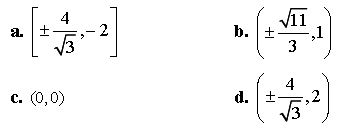
Answer : D
Question. The normal of the curve x = a(cos θ + θ sinθ ) y = a(sinθ −θ cosθ ) at any θ is such that:
a. It makes a constant angle with x-axis
b. It passes through the origin
c. It is at a constant distance from the origin
d. None of these
Answer : C
Question. The value of a for which the function (a + 2)x3 − 3ax2 + 9ax −1 decrease monotonically throughout for all real x, are:
a. a < −2
b. a > −2
c. −3 < a < 0
d. −∞ < a ≤ −3
Answer : D
Question. 2x3 + 18x2 − 96x + 45 = 0 is an increasing function:
a. x ≤ −8, x ≥ 2
b. x < −2, x ≥ 8
c. x ≤ −2, x ≥ 8
d. 0 < x ≤ −2
Answer : A
Question. f (x) = xex(1-x) then f (x) is:
a. Increasing on [-1/2, 1]
b. Decreasing on R
c. Increasing on R
d. Decreasing on [-1/2, 1]
Answer : A
Question. For which value of x, the function f (x) = x2 − 2x is decreasing:
a. x > 1
b. x > 2
c. x < 1
d. x < 2
Answer : C
Question. The equation of tangent to the curve y = 2 cos x at x = π/4 is:
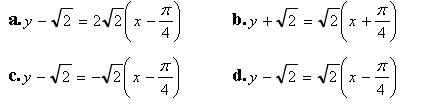
Answer : C
Question. For the curve by2 = (x + a)3 the square of subtangent is proportional to:
a. (Subnormal )1 / 2
b. Subnormal
c. (Subnormal )3/ 2
d. None of these
Answer : A
Question. x tends 0 to π then the given function f (x) = x sin x + cos x + cos2 x is:
a. Increasing
b. Decreasing
c. Neither increasing nor decreasing
d. None of these
Answer : B
Question. The maximum and minimum values of x3 − 18x2 + 96 in interval (0, 9) are:
a. 160, 0
b. 60, 0
c. 160, 128
d. 120, 28
Answer : C
Question. The minimum value of the function 2 cos 2x − cos 4x in 0 ≤ x ≤ π is:
a. 0
b. 1
c. 3/2
d. – 3
Answer : D
Question. Function f(x) λsinx + 6cos x / 2sin x + 3cos x is monotonic increasing if:
a. λ > 1
b. λ < 1
c. λ < 4
d. λ > 4
Answer : D
Question. The function f (x) = ln(π + x) / In(e + x) is:
a. Increasing on [0, ∞)
b. Decreasing on [0, ∞)
c. Decreasing on [0, π/e) and increasing on [π/e, ∞)
d. Increasing on [0, π/e) and decreasing on [π/e, ∞)
Answer : B
Question. The sum of intercepts on co-ordinate axes made by tangent to the curve √x + √y = √a is:
a. a
b. 2a
c. 2√a
d. None of these
Answer : A
Question. x and y be two variables such that x > 0 and xy = 1. Then the minimum value of x + y is:
a. 2
b. 3
c. 4
d. 0
Answer : A
Question. The real number which most exceeds its cube:
a. 1/2
b. 1/√3
c. 1/√2
d. None of these
Answer : B
Question. The adjacent sides of a rectangle with given perimeter as 100 cm and enclosing maximum area are:
a. 10 cm and 40 cm
b. 20 cm and 30 cm
c. 25 cm and 25 cm
d. 15 cm and 35 cm
Answer : C
Question. The function 4 4 sin x + cos x increase if:
a. 0 < x < π/8
b. π/4 < x < 3π/8
c. 3π/8 < x < 5π/8
d. 5π/8 < x < 3π/4
Answer : B
Question. Maximum value of (1/x) is:
a. (e)e
b. (e)1/e
c. (e)−e
d. (1/e)e
Answer : B
Question. Maximum slope of the curve y = − x3 + 3x2 + 9x − 27 is:
a. 0
b. 12
c. 16
d. 32
Answer : B
Question. The function x x is increasing, when:
a. x > 1/e
b. x < 1/e
c. x < 0
d. For all real x
Answer : A
Question. Which of the following is not a decreasing function on the interval [0, π/2)
a. cos x
b. cos2x
c. cos3x
d. cot x
Answer : C
Question. The interval of increase of the function f (x) = x - ex + tan (2π/7) is:
a. (0,∞)
b. (−∞,0)
c. (1,∞)
d. (−∞,−1)
Answer : B, D
Question. The function f (x) = ∫xe t(et − 1) (t − 1) (t − 2)3 (t −3)5 dt has a local minimum at x = ?
a. 0
b. 1
c. 2
d. 3
Answer : B, D
Please refer to attached file for CBSE Class 12 Mathematics Applications Of Derivatives Assignment Set D
Free study material for Mathematics
Download Practice Assignments: Class 12 Mathematics Chapter 06 Applications Of Derivatives
Chapter Practice Questions for Class 12 Mathematics
Access structured practice assignments for Chapter 06 Applications Of Derivatives designed in alignment with the latest CBSE curriculum for Class 12 Mathematics. These printable sets cover objective and descriptive problem types to support thorough revision.
Why Practice Class 12 Mathematics Assignments?
- Curriculum Standards: Assignments match modern CBSE sample formats to ensure relevant preparation.
- Thorough Revision: Detailed problem sets reinforce core concepts and eliminate conceptual weak spots.
- Execution Speed: Timed practice with assignment sets sharpens overall response timing.
Steps to Complete Chapter 06 Applications Of Derivatives Assignments Successfully
- Concept Foundation: Review the NCERT book for Class 12 Mathematics thoroughly before diving into assignment tasks.
- Self-Evaluation: Solve exercises independently before inspecting professional answer guides.
- Progress Monitoring: Note down complex formulas or concepts, clearing them up using available online practice aids.
FAQs
You can download free PDF assignments for Class 12 Mathematics Chapter 06 Applications Of Derivatives from StudiesToday.com. These practice sheets have been updated for the 2026-27 session covering all concepts from latest NCERT textbook.
Yes, our teachers have given solutions for all questions in the Class 12 Mathematics Chapter 06 Applications Of Derivatives assignments. This will help you to understand step-by-step methodology to get full marks in school tests and exams.
Yes. These assignments are designed as per the latest CBSE syllabus for 2026. We have included huge variety of question formats such as MCQs, Case-study based questions and important diagram-based problems found in Chapter 06 Applications Of Derivatives.
Practicing topicw wise assignments will help Class 12 students understand every sub-topic of Chapter 06 Applications Of Derivatives. Daily practice will improve speed, accuracy and answering competency-based questions.
Yes, all printable assignments for Class 12 Mathematics Chapter 06 Applications Of Derivatives are available for free download in mobile-friendly PDF format.