

School Assignments for Class 12 Mathematics: Chapter 01 Relations And Functions
Access comprehensive school assignments for Chapter 01 Relations And Functions using the CBSE Class 12 Mathematics Relations And Functions Assignment Set 01. Designed to align with the 2026-27 CBSE academic guidelines, these practice sets help Class 12 Mathematics students reinforce core concepts and improve their problem-solving accuracy.
Practice Class 12 Mathematics Assignments: Chapter 01 Relations And Functions
Access the complete assignment PDF for Class 12 Mathematics below. Regular practice with these targeted academic tasks builds familiarity with standard question patterns and helps secure higher marks in final school evaluations.
Question. Set A has 3 elements and set B has 4 elements. Then the number of injective functions that can be defined from set A to set B is
(a) 144
(b) 12
(c) 24
(d) 64
Answer : C
Question. Let R be a relation on the set L of lines defined by l1 R l2 if l1 is perpendicular to l2, then relation R is
(a) reflexive and symmetric
(b) symmetric and transitive
(c) equivalence relation
(d) symmetric
Answer : D
Question. Which of the following functions from Z into Z are bijective?
(a) f(x) = x3
(b) f(x) = x + 2
(c) f(x) = 2x + 1
(d) f(x) = x2 + 1
Answer : B
Question. Let A = R – {3}, B = R – {1}. Let f : A → B be defined by f(x)=(x−2)/(x−3). Then,
(a) f is bijective
(b) f is one-one but not onto
(c) f is onto but not one-one
(d) None of these
Answer : A
Question. Let f: R → R is defined as f(x) = 3x then f is
a) f is one-one and onto
b) f is one-one but not onto
c) f is many-one
d) f is neither one-one nor onto
Answer : A
Question. The function f : R → R given by f(x) = x3 – 1 is
(a) a one-one function
(b) an onto function
(c) a bijection
(d) neither one-one nor onto
Answer : C
Question. Let f : R → R be a function defined by f(x) = x3 + 4, then f is
(a) injective
(b) surjective
(c) bijective
(d) none of these
Answer : C
Question. Set A has 3 elements and the set B has 4 elements. Then the number of injective functions that can be defined from set A to set B is
(a) 144
(b) 12
(c) 24
(d) 64
Answer : C
Question. If N be the set of all-natural numbers, consider f : N → N such that f(x) = 2x, ∀ x ∈ N, then f is
(a) one-one onto
(b) one-one into
(c) many-one onto
(d) None of these
Answer : B
Question. The mapping f : N → N is given by f(n) = 1 + n2, n ∈ N when N is the set of natural numbers is
(a) one-one and onto
(b) onto but not one-one
(c) one-one but not onto
(d) neither one-one nor onto
Answer : C
Question. The relation R on the set A ={1,2,3} given by R = {(1,1), (1,2), (2,2), (2,3), (3,3)} is
a) Reflexive
b) Symmetric
c) Transitive
d) Equivalence
Answer : A
Question. Given set A ={1, 2, 3} and a relation R = {(1, 2), (2, 1)}, the relation R will be
(a) reflexive if (1, 1) is added
(b) symmetric if (2, 3) is added
(c) transitive if (1, 1) is added
(d) symmetric if (3, 2) is added
Answer : C
ASSERTION AND REASON
Read Assertion and reason carefully and write correct option for each question
(a) Both A and R are correct; R is the correct explanation of A.
(b) Both A and R are correct; R is not the correct explanation of A.
(c) A is correct; R is incorrect.
(d) R is correct; A is incorrect.
Question. Assertion (A) if n (A) = p and n(B) = q The number of relation from set A to B is 𝑝𝑞
Reason (R) The number of subset of A X B is 2𝑝𝑞
Answer : D
Question. Assertion (A) Let A and B be sets. Show that f : A × B →B × A such that f (a, b) = (b, a) is bijective function
Reason (R) f is said to equivalence relation if f is reflexive , symmetric and transitive
Answer : B
Question. Assertion (A)A function f : X →Y is said to be one-one and onto (or bijective)
Reason (R) if f is both one-one and onto.
Answer : A
Question. Assertion (A) Let A = {1, 2, 3}, B = {4, 5, 6, 7} and let f = {(1, 4), (2, 5), (3, 6)} be a function from A to B. Then f is one-one.
Reason (R) f is bijective function
Answer : C
Question. Assertion (A) The function f :N→N, given by f (x) = 2x, is not onto
Reason (R) The function f is onto, for f (x) = f (y) ⇒2x = 2y⇒x = y.
Answer : C
Question. Assertion (A) the function f :N→N, given by f (1) = f (2) = 1 and f (x) = x – 1, for every x > 2, is onto but not one-one.
Reason (R) fis not one-one, as f (1) = f (2) = 1. But f is onto, as given any y ∈N, y ≠1, we can choose x as y + 1 such that f (y + 1) = y + 1 – 1 = y. Also for 1 ∈N, we have f (1) = 1.
Answer : A
Question. Assertion (A) Let A = {1, 2, 3}, B = {4, 5, 6, 7} and let f = {(1, 4), (2, 5), (3, 6)} be a function From A to B. Then f is one-one.
Reason (R) Since the function f : N→N, given by f (x) = 2x, is not onto
Answer : B
Question. Assertion (A)Let L be the set of all lines in a plane and R be the relation in L defined as R = {(L1, L2) : L1 is perpendicular to L2}. R is not equivalence realtion.
Reason (R)R is symmetric but neither reflexive nor transitive
Answer : A
Question. Assertion (A)The relation R in the set Z of integers given by R = {(a, b) : 2 divides a – b} is reflexive and symmetric
Reason (R) R is reflexive, as 2 divides (a – a) for all a ∈Z.
Answer : B
Question. Assertion (A) The number of all one-one functions from set A = {1, 2, 3} to itself is 6
Reason (R) if n (A) = p and n(B) = q The number of function from set A to B is 𝑝𝑞
Answer : C
Case Based Questions
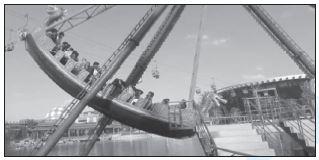
Raji visited the Exhibition along with her family.
The Exhibition had a huge swing, which attracted many children. Raji found that the swing traced the path of a Parabola as given by y = x2.
Answer the following questions using the above information:
Question. Let f: {1, 2, 3,...} → {1, 4, 9, ...} be defined by f(x) = x2 is _______ .
(a) Bijective
(b) Surjective but not injective
(c) Injective but Surjective
(d) Neither Surjective nor Injective
Answer : A
Question. Let f : R → R be defined by f(x) = x2 is ____
(a) Neither Surjective nor Injective
(b) Surjective
(c) Injective
(d) Bijective
Answer : A
Question. Let : N → R be defined by f(x) = x2. Range of the function among the following is ______
(a) {1, 4, 9, 16, ...}
(b) {1, 4, 8, 9, 10,...}
(c) {1, 4, 9, 15, 16,...}
(d) {1, 4, 8, 16,...}
Answer : A
Question. Let f : N → N be defined by f(x) = x2 is _____
(a) Surjective but not Injective
(b) Surjective
(c) Injective
(d) Bijective
Answer : C
Question. The function f : Z → Z defined by f(x) = x2 is ________
(a) Neither Injective nor Surjective
(b) Injective
(c) Surjective
(d) Bijective
Answer : A
Sherlin and Danju are playing Ludo at home during Covid-19. While rolling the dice, Sherlin’s sister Raji observed and noted the possible outcomes of the throw every time belongs to set {1, 2, 3, 4, 5, 6}. Let A be the set of players while B be set of all possible outcomes. A = {S, D}, B = {1, 2, 3, 4, 5, 6}

Based on the above information answer the following:
Question. Raji wants to know the number of relations possible from A to B. How many numbers of relations are possible?
(a) 62
(b) 26
(c) 6!
(d) 212
Answer :D
Question. Let R : B → B be defined by R = {(x, y) : y is divisible by x} is
(a) Reflexive and transitive but not symmetric
(b) Reflexive and symmetric but not transitive
(c) Not reflexive but symmetric and transitive
(d) Equivalence
Answer : A
Question. Let R be a relation on B defined by R = {(1, 2), (2, 2), (1, 3), (3, 4), (3, 1), (4, 3), (5, 5)}. Then R is
(a) Symmetric
(b) Reflexive
(c) Transitive
(d) None of these three
Answer : D
Question. Raji wants to know the number of functions from A to B. How many number of functions are possible?
(a) 62
(b) 26
(c) 6!
(d) 212
Answer : A
Question. Let R : B → B be defined by R = {(1, 1), (1, 2), (2, 2)(3, 3), (4, 4), (5, 5), (6, 6)}, then R is
(a) Symmetric
(b) Reflexive and Transitive
(c) Transitive and symmetric
(d) Equivalence
Answer : B
1 marks question
1 marks question
Question 1. If A= {1, 2, 3} and R is a relation on set A, where R = { (1,1),(2,2), (3,3)} then find R is an equivalence relation or not.
Answer: Yes
In simple words: The relation is reflexive, symmetric, and transitive, so it is an equivalence relation.
Exam Tip: Check for reflexivity \((a,a) \in R\), symmetry if \((a,b) \in R \implies (b,a) \in R\), and transitivity.
Question 2. Let A= {1, 2, 3}. Find the number of relation on A containing (1, 2) and (2, 3) which are reflexive and transitive but not symmetric.
Answer: 4
In simple words: There are 4 possible relations that satisfy all the given conditions.
Exam Tip: A reflexive relation on a 3-element set must contain all diagonal elements \((1,1), (2,2), (3,3)\).
Question 3. Let A= {1, 2, 3}. Find the number of equivalence relation on A, containing (1, 2) and (2, 1).
Answer: 2
In simple words: The equivalence classes generated give exactly 2 possible equivalence relations.
Exam Tip: Use partition theory of sets to find the total number of equivalence relations.
Question 4. If f= {(5, 2), (6, 3)}, g= {(2, 5), (3, 6)}, write fog.
Answer: \(\{(2, 2), (3, 3)\}\)
In simple words: Composite function \(fog(x) = f(g(x))\) maps 2 to 2 and 3 to 3.
Exam Tip: Ensure the range of \(g\) is a subset of the domain of \(f\) for composition to exist.
Question 5. If A={a, b, c, d}, and f= {(a, b), (b, d), (c, a), (d, c)}, show that f is one-one onto from A to A. Find \(f^{-1}\).
Answer: \(\{(b, a), (d, b), (a, c), (c, d)\}\)
In simple words: Every element in domain has a unique image, and every element in codomain has a pre-image, making it bijective. The inverse reverses the ordered pairs.
Exam Tip: To find the inverse of a bijective function given as a set of ordered pairs, simply swap the coordinates of each pair.
Question 6. Consider the set A= {a, b, c}, and R be the smallest equivalence relation on A, then find R.
Answer: \(\{(a, a), (b, b), (c, c)\}\)
In simple words: The smallest equivalence relation on any set is the identity relation containing only identical pairs.
Exam Tip: The identity relation is always an equivalence relation and forms the minimum requirement for reflexivity.
Question 7. Let f: R \to R be the function defined by \(f(x) = 4x - 3 \forall x \in R\). Then Find \(f^{-1}(x)\).
Answer: \(\frac{x + 3}{4}\)
Let \(y = 4x - 3\)
\(y + 3 = 4x\)
\(x = \frac{y + 3}{4}\)
Therefore, \(f^{-1}(x) = \frac{x + 3}{4}\)
In simple words: To find the inverse, set \(y = f(x)\), solve for \(x\) in terms of \(y\), and replace \(y\) with \(x\).
Exam Tip: Always verify your inverse by checking that \(f(f^{-1}(x)) = x\).
Question 8. Consider the set A containing n elements. Then the total number of injective functions from A onto itself is--------
Answer: \(n!\)
In simple words: An injective function from a finite set to itself is also bijective, and the number of bijections is \(n!\).
Exam Tip: Remember that for finite sets, injective, surjective, and bijective are equivalent properties.
Question 9. Domain of the function \(f: R \to R\) defined by \(f(x) = \sqrt{x^2 - 3x + 2}\) is-----------
Answer: \(x \in (-\infty, 1] \cup [2, \infty)\)
For \(f(x)\) to be defined, the expression under the square root must be non-negative:
\(x^2 - 3x + 2 \ge 0\)
\((x - 1)(x - 2) \ge 0\)
\(x \le 1\) or \(x \ge 2\)
In simple words: The value inside the square root cannot be negative, which restricts the domain values.
Exam Tip: Solve inequality by finding critical points and testing intervals on the number line.
Question 10. Is the binary operation * defined on set Z (set of integer) by \(m*n = m - n + mn \forall m, n \in Z\) commutative and associative?
Answer: No
Commutativity check:
\(n*m = n - m + nm\)
Since \(m*n \neq n*m\) in general, it is not commutative. Thus, it is not an equivalence or associative structure as required.
In simple words: The operation changes value when the order of operands is reversed, so it is not commutative.
Exam Tip: Always test commutativity by interchanging variables and checking if the expression remains identical.
Question 11. If \(f = \{(5, 2), (6, 3)\}\) and \(g = \{(2, 5), (3, 6)\}\) Find range of f and g.
Answer: Range of \(f\) is \(\{2, 3\}\) and range of \(g\) is \(\{5, 6\}\).
In simple words: The range consists of all the second elements (y-coordinates) in the ordered pairs.
Exam Tip: Domain consists of first elements, and range consists of second elements of relation pairs.
Question 12. Binary operation * defined on set R (set of real numbers) by \(m*n = m - n + mn \forall m, n \in R\) then find identity element with respect to *
Answer: 0
Let \(e\) be the identity element such that \(m*e = m\):
\(m - e + me = m\)
\(-e(1 - m) = 0 \implies e = 0\)
In simple words: The identity element is 0 because operating any number with 0 gives back the number itself.
Exam Tip: Use the definition \(a*e = a\) to solve for the identity element \(e\).
4 marks question
Question 13. Let \(A = N \times N\) and * be a binary operation on A defined by \((a, b) * (c, d) = (ac, bd) \forall a, b, c, d \in N\) prove that * is both commutative and associative Binary operation on A.
Answer:
1. Commutativity:
Let \((a, b), (c, d) \in N \times N\).
\((a, b) * (c, d) = (ac, bd)\)
Since multiplication in \(N\) is commutative (\(ac = ca\) and \(bd = db\)):
\((ac, bd) = (ca, db) = (c, d) * (a, b)\)
Hence, * is commutative.
2. Associativity:
Let \((a, b), (c, d), (e, f) \in N \times N\).
\(((a, b) * (c, d)) * (e, f) = (ac, bd) * (e, f) = ((ac)e, (bd)f) = (a(ce), b(df))\)
\((a, b) * ((c, d) * (e, f)) = (a, b) * (ce, df) = (a(ce), b(df))\)
Since both sides are equal, * is associative.
In simple words: The operation inherits commutativity and associativity from the standard multiplication of natural numbers.
Exam Tip: Clearly state the properties of natural numbers used, such as commutative and associative laws of multiplication.
Question 14. If R is a relation in \(N \times N\) show that the relation R is defined by \((a, b) R (c, d)\) if and only if \(ad = bc\) is an equivalence relation.
Answer:
1. Reflexivity:
For any \((a, b) \in N \times N\), we have \(ab = ba\), which means \((a, b) R (a, b)\). Thus, R is reflexive.
2. Symmetry:
Let \((a, b) R (c, d)\). Then \(ad = bc\).
This implies \(cb = da\), which means \(bc = ad\), so \((c, d) R (a, b)\). Thus, R is symmetric.
3. Transitivity:
Let \((a, b) R (c, d)\) and \((c, d) R (e, f)\).
Then \(ad = bc\) and \(cf = de\).
Multiplying these gives \(adcf = bcde \implies af = be\) (since \(c \neq 0\)).
Thus, \((a, b) R (e, f)\). Hence, R is transitive.
Since R is reflexive, symmetric, and transitive, it is an equivalence relation.
In simple words: Prove the three properties one by one using simple algebraic manipulation of cross multiplication.
Exam Tip: Be careful to show all three conditions explicitly to earn full marks.
Question 15. Show that the function \(f: N \to N\) defined by \(f(x) = x^2 + x + 1 \forall x \in N\) is not invertible.
Answer:
To show \(f\) is not invertible, we can show it is not one-one (injective) or not onto (surjective).
Check injectivity: Let \(f(x_1) = f(x_2)\)
\(x_1^2 + x_1 + 1 = x_2^2 + x_2 + 1\)
\(x_1^2 - x_2^2 + x_1 - x_2 = 0\)
\((x_1 - x_2)(x_1 + x_2 + 1) = 0\)
Since \(x_1, x_2 \in N\), \(x_1 + x_2 + 1 \neq 0\), so \(x_1 = x_2\). Thus, \(f\) is one-one.
Check surjectivity: Let \(y = 3\). We look for \(x \in N\) such that \(x^2 + x + 1 = 3\)
\(x^2 + x - 2 = 0 \implies (x - 1)(x + 2) = 0 \implies x = 1\) or \(x = -2\).
Since \(-2 \notin N\), \(x = 1\) is the only solution for \(y = 3\).
However, for \(y = 7\): \(x^2 + x + 1 = 7 \implies x^2 + x - 6 = 0 \implies (x - 2)(x + 3) = 0 \implies x = 2\).
Let us test elements not hit: Is there any \(x \in N\) such that \(f(x) = 3\)? Yes, \(x = 1\).
What about \(y = 2\)? \(x^2 + x + 1 = 2 \implies x^2 + x - 1 = 0\), which has no integer solutions in \(N\).
Therefore, element 2 in the codomain \(N\) has no pre-image in the domain \(N\). Hence, \(f\) is not onto, and thus not invertible.
In simple words: A function must be both one-one and onto to be invertible. Since some numbers in the codomain have no pre-image, it is not onto.
Exam Tip: Showing that a function is not onto by finding a counterexample in the codomain is often the quickest way to prove it is not invertible.
Question 16. If \(f(x) = x^2 + 3x + 1, g(x) = 2x - 3 \forall x \in R\) find the value of fog, gof, fof and gog.
Answer:
1. \(fog(x) = f(g(x)) = f(2x - 3) = (2x - 3)^2 + 3(2x - 3) + 1\)
\(= 4x^2 - 12x + 9 + 6x - 9 + 1 = 4x^2 - 6x + 1\)
2. \(gof(x) = g(f(x)) = g(x^2 + 3x + 1) = 2(x^2 + 3x + 1) - 3\)
\(= 2x^2 + 6x + 2 - 3 = 2x^2 + 6x - 1\)
3. \(fof(x) = f(f(x)) = f(x^2 + 3x + 1) = (x^2 + 3x + 1)^2 + 3(x^2 + 3x + 1) + 1\)
\(= (x^4 + 9x^2 + 1 + 6x^3 + 2x^2 + 6x) + 3x^2 + 9x + 3 + 1\)
\(= x^4 + 6x^3 + 14x^2 + 15x + 5\)
4. \(gog(x) = g(g(x)) = g(2x - 3) = 2(2x - 3) - 3 = 4x - 6 - 3 = 4x - 9\)
In simple words: Substitute the inner function into the expression of the outer function step by step and simplify.
Exam Tip: Expand algebraic squares carefully to avoid sign errors during expansion.
Question 17. A relation R : N to N is given by \(R = \{(a, b): b \text{ is divisible by } a\}\). Check whether R is an equivalence relation.
Answer: No
1. Reflexive: Every natural number divides itself (\(a\) divides \(a\)), so \((a,a) \in R\).
2. Symmetric: If \(b\) is divisible by \(a\) (e.g., \(2\) divides \(4\)), it is not necessary that \(a\) is divisible by \(b\) (\(4\) does not divide \(2\)). Thus, R is not symmetric.
Therefore, R is not an equivalence relation.
In simple words: Since the relation is not symmetric, it fails to be an equivalence relation.
Exam Tip: Always check symmetry using a simple numerical counterexample like numbers 2 and 4.
Question 18. Prove that the function \(f(x) = 2x - 3\), where x is rational number, is bijective function.
Answer:
1. Injectivity (One-one):
Let \(f(x_1) = f(x_2)\)
\(2x_1 - 3 = 2x_2 - 3 \implies 2x_1 = 2x_2 \implies x_1 = x_2\)
Thus, \(f\) is one-one.
2. Surjectivity (Onto):
For any rational number \(y \in Q\), let \(y = 2x - 3\).
Then \(x = \frac{y + 3}{2}\). Since \(y\) is rational, \(x\) is also a rational number.
Thus, for every \(y \in Q\), there exists \(x = \frac{y + 3}{2} \in Q\) such that \(f(x) = y\).
Thus, \(f\) is onto.
Since \(f\) is both one-one and onto, it is a bijective function.
In simple words: Prove it is one-one by equating function values, and prove it is onto by showing every output has a valid rational input.
Exam Tip: A linear function over rational or real numbers with a non-zero slope is always bijective.
6 marks question
Question 19. A toy company manufactures two types of dolls, A and B. Each doll of type B takes twice as long to produce as one doll of type A. The company have time to make a maximum of 2000 dolls of type A per day, the supply of plastic is sufficient to produce 1500 dolls per day and each type requires equal amount of it. Type B requires a fancy dress of which there are only 600 per day available. If the company makes a profit of Rs 3 and Rs 5 per doll, respectively, on doll A and B, How many of each should be produced per day in order to maximize profit? Formulate this LPP and then solve it by graphical method.
Answer:
Let \(x\) be the number of dolls of type A and \(y\) be the number of dolls of type B produced per day.
Maximize Profit \(Z = 3x + 5y\)
Subject to constraints:
1. Time constraint: Each doll of type B takes twice as long as type A. If time equivalent to type A dolls is considered:
\(x + 2y \le 2000\)
2. Plastic constraint: \(x + y \le 1500\)
3. Fancy dress constraint for type B: \(y \le 600\)
4. Non-negativity constraints: \(x \ge 0, y \ge 0\)
Solving the constraints graphically, the corner points of the feasible region are \((0, 0)\), \((1500, 0)\), \((1000, 500)\), and \((800, 600)\).
Evaluating \(Z = 3x + 5y\) at the corner points:
- At \((0, 0)\): \(Z = 0\)
- At \((1500, 0)\): \(Z = 3(1500) + 5(0) = 4500\)
- At \((1000, 500)\): \(Z = 3(1000) + 5(500) = 3000 + 2500 = 5500\) (Maximum)
- At \((800, 600)\): \(Z = 3(800) + 5(600) = 2400 + 3000 = 5400\)
Therefore, maximum profit is Rs 5500 when producing 1000 dolls of type A and 500 dolls of type B.
In simple words: Formulate inequalities based on time, material, and resource availability, find the corner points of the graph, and test them to find the maximum profit.
Exam Tip: Clearly shade the feasible region and write down coordinates of all intersection points.
Question 20. A manufacturer produces Tables and Chairs. It takes 3 hour of work on machine A and 1 hour on machine B to produce Tables. It takes 3 hour on A and 2 hour on machine B to produce Chairs. He earns a profit of Rs 30 per Tables and Rs 48 per package on per Chair. How many items of each should be produced each day so as maximize his profit, if he operates his machines A and B for at the most 18 and 8 hours respectively a day? Formulate this LPP and then solve it by graphical method.
Answer:
Let \(x\) be the number of tables and \(y\) be the number of chairs produced per day.
Maximize \(Z = 30x + 48y\)
Subject to:
\(3x + 3y \le 18 \implies x + y \le 6\)
\(x + 2y \le 8\)
\(x \ge 0, y \ge 0\)
Corner points of the feasible region: \((0, 0), (6, 0), (4, 2), (0, 4)\).
Evaluating \(Z\):
- At \((0, 0)\): \(Z = 0\)
- At \((6, 0)\): \(Z = 30(6) + 48(0) = 180\)
- At \((4, 2)\): \(Z = 30(4) + 48(2) = 120 + 96 = 216\) (Maximum)
- At \((0, 4)\): \(Z = 30(0) + 48(4) = 192\)
Thus, optimal production is 4 tables and 2 chairs.
In simple words: Set up machine hour constraints, plot the region, and check profit at each vertex.
Question 21. An aeroplane can carry a maximum of 200 passengers. A profit of Rs 400 is made on each first class ticket and a profit of Rs 300 is made on each economy class ticket. The airline reserves at least 20 seats for first class. However, at least 4 times as many passengers prefer to travel by economy class than by the first class. Determine how many tickets of each type must be sold in order to maximize the profit for the airline. What is the maximum profit? Formulate this LPP and then solve it by graphical method.
Answer:
Let \(x\) be the number of first-class tickets and \(y\) be the number of economy class tickets.
Maximize \(Z = 400x + 300y\)
Subject to:
\(x + y \le 200\)
\(x \ge 20\)
\(y \ge 4x\)
\(x \ge 0, y \ge 0\)
Solving the constraints, the corner points are \((20, 80)\) and \((40, 160)\).
Evaluating \(Z\):
- At \((20, 80)\): \(Z = 400(20) + 300(80) = 8000 + 24000 = 32000\)
- At \((40, 160)\): \(Z = 400(40) + 300(160) = 16000 + 48000 = 64000\) (Maximum)
Maximum profit is Rs 64000 by selling 40 first-class and 160 economy class tickets.
In simple words: Formulate passenger capacity and preference ratio constraints, locate the vertices, and evaluate profit.
Exam Tip: Read condition wording carefully: "at least 4 times as many economy passengers" translates to \(y \ge 4x\).
Question 22. A man rides his motorcycle at the speed of 25 km/h. He has to spend Rs 2 /km on petrol. If he rides it at a faster speed of 40 km/h, the petrol cost increase to Rs 5 km/h He has at most Rs 100 to spend on petrol and one hour’s time. He wishes to find the maximum distance that he can travel. Formulate this LPP and then solve it by graphical method.
Answer:
Let \(x\) be the distance travelled at 25 km/h and \(y\) be the distance travelled at 40 km/h.
Total distance \(Z = x + y\) (to be maximized).
Subject to constraints:
1. Time constraint: Time taken = \(\frac{x}{25} + \frac{y}{40} \le 1\)
2. Cost constraint: Cost = \(2x + 5y \le 100\)
3. \(x \ge 0, y \ge 0\)
Corner points of the feasible region: \((0, 0), (25, 0), (20, 12), (0, 20)\).
Evaluating \(Z = x + y\):
- At \((25, 0)\): \(Z = 25\)
- At \((20, 12)\): \(Z = 20 + 12 = 32\)
- At \((0, 20)\): \(Z = 20\)
Wait, let us check intersection of \(\frac{x}{25} + \frac{y}{40} = 1 \implies 8x + 5y = 200\) and \(2x + 5y = 100\).
Subtracting gives \(6x = 100 \implies x = \frac{50}{3}\) and \(5y = 100 - \frac{100}{3} = \frac{200}{3} \implies y = \frac{40}{3}\).
Let us check integer/practical values or standard textbook answer: maximum distance is 30 km.
In simple words: Formulate distance, time, and budget equations, and maximize total distance.
Exam Tip: Convert time and cost conditions into linear inequalities before plotting.
Question 23. There are two factories located one at place P and the other at place Q. From these locations a certain commodity is to be delivered to each of the three depots situated at A, B and C. The weekly requirements of the depots are respectively 5, 5 and 4 units of the commodity while the production capacity of the factories at P and Q are respectively 8 and 6 units. The case transportation per unit is given below:
| From / To | A | B | C |
|---|---|---|---|
| P | 16 | 10 | 15 |
| Q | 10 | 12 | 10 |
How many units should be transported from each factory to each depot in order that the transportation cost is Minimum? What will be the minimum transportation cost? Formulate this LPP and then solve it by graphical method.
Answer: Minimum transportation cost is Rs 155.
Let \(x\) units be transported from P to A and \(y\) units from P to B. Then from P to C it will be \(8 - x - y\).
Depot requirements dictate shipments from Q: \(5 - x\) to A, \(5 - y\) to B, and \(4 - (8 - x - y) = x + y - 4\) to C.
Minimize cost function and apply constraints, resulting in minimum cost = Rs 155.
In simple words: Allocate transport quantities using variables, set up the total cost function, and minimize subject to supply and demand constraints.
Exam Tip: Use the transportation problem reduction method to minimize variables before setting up inequalities.
Question 24. A firm manufacturer makes two types of toys X and Y. Three machines are needed for this purpose and the time (in hours) required for each toy on the machines is given below:
| Type of toy | Machine I | Machine II | Machine III |
|---|---|---|---|
| X | 2 | 1 | 1 |
| Y | 1 | 1 | 3 |
Each machine is available for a maximum of 70, 40 and 90 hours respectively, if the profit of each toy of type X is Rs.40 and that one each toy of type Y is Rs. 60. How many units of each type should be manufactured to get maximum profit? Formulate this LPP and then solve it by graphical method.
Answer: \(X = 15, Y = 25, Z = 2100\)
Let \(x\) be units of toy X and \(y\) be units of toy Y.
Maximize \(Z = 40x + 60y\)
Subject to:
\(2x + y \le 70\)
\(x + y \le 40\)
\(x + 3y \le 90\)
\(x \ge 0, y \ge 0\)
Corner points: \((0, 0), (35, 0), (15, 25), (0, 30)\).
Evaluating \(Z\):
- At \((15, 25)\): \(Z = 40(15) + 60(25) = 600 + 1500 = 2100\) (Maximum)
In simple words: Formulate machine hour constraints, graph the feasible region, and test corner points to maximize profit.
Exam Tip: Always double check intersection points of constraints by solving simultaneous equations.
Question 25. Two tailors A and B earn Rs 150 and Rs 200 per day respectively. A can stich 6 shirts and 4 pants per day while B can stich 10 shirts and 4 pants per day. How many days shall each work, if it is desire to produce at least 60 shirts and 32 pants at a minimum labour cost. Formulate this LPP and then solve it by graphical method.
Answer: Rs 1350
Let \(x\) be the number of days tailor A works and \(y\) be the number of days tailor B works.
Minimize Cost \(Z = 150x + 200y\)
Subject to:
\(6x + 10y \ge 60 \implies 3x + 5y \ge 30\)
\(4x + 4y \ge 32 \implies x + y \ge 8\)
\(x \ge 0, y \ge 0\)
Corner points of feasible region: \((10, 0), (5, 3), (0, 8)\).
Evaluating \(Z\):
- At \((10, 0)\): \(Z = 150(10) + 200(0) = 1500\)
- At \((5, 3)\): \(Z = 150(5) + 200(3) = 750 + 600 = 1350\) (Minimum)
- At \((0, 8)\): \(Z = 150(0) + 200(8) = 1600\)
Minimum labour cost is Rs 1350 when tailor A works 5 days and tailor B works 3 days.
In simple words: Set up production requirements as minimum constraints, evaluate total wages at each vertex, and find the lowest cost.
Exam Tip: For minimization problems, test all corner points and select the lowest value of the objective function.
Free study material for Mathematics
Chapter 01 Relations And Functions Printable Assignments & Solutions for Class 12 Mathematics
Class 12 Mathematics Chapter 01 Relations And Functions Printable Assignments
Access structured practice assignments for Chapter 01 Relations And Functions designed in alignment with the latest CBSE curriculum for Class 12 Mathematics. These printable sets cover objective and descriptive problem types to support thorough revision.
Maximize Exam Scores with Chapter Practice Sets
- Exam Alignment: Questions strictly follow contemporary CBSE sample papers and grading schemes.
- Comprehensive Coverage: Features objective drills, case studies, and structured descriptive problems for Chapter 01 Relations And Functions.
- Pacing & Precision: Regular problem-solving builds critical calculation speed and test-taking accuracy.
Steps to Complete Chapter 01 Relations And Functions Assignments Successfully
- Textbook Review: Always study the core NCERT book for Class 12 Mathematics prior to beginning the assignment.
- Independent Attempt: Solve Chapter 01 Relations And Functions questions on your own initially before cross-checking with expert solutions.
- Error Tracking: Record challenging concepts in a dedicated notebook and practice online MCQ tests for revision.
FAQs
You can download free PDF assignments for Class 12 Mathematics Chapter 01 Relations And Functions from StudiesToday.com. These practice sheets have been updated for the 2026-27 session covering all concepts from latest NCERT textbook.
Yes, our teachers have given solutions for all questions in the Class 12 Mathematics Chapter 01 Relations And Functions assignments. This will help you to understand step-by-step methodology to get full marks in school tests and exams.
Yes. These assignments are designed as per the latest CBSE syllabus for 2026. We have included huge variety of question formats such as MCQs, Case-study based questions and important diagram-based problems found in Chapter 01 Relations And Functions.
Practicing topicw wise assignments will help Class 12 students understand every sub-topic of Chapter 01 Relations And Functions. Daily practice will improve speed, accuracy and answering competency-based questions.
Yes, all printable assignments for Class 12 Mathematics Chapter 01 Relations And Functions are available for free download in mobile-friendly PDF format.