

Download CBSE Class 12 Mathematics Assignments
Access comprehensive school assignments for Chapter 11 Three Dimensional Geometry using the CBSE Class 12 Mathematics Three Dimensional Geometry Assignment Set 01. Designed to align with the 2026-27 CBSE academic guidelines, these practice sets help Class 12 Mathematics students reinforce core concepts and improve their problem-solving accuracy.
Access CBSE School Assignments and Answers
View or download the dedicated CBSE Class 12 Mathematics Three Dimensional Geometry Assignment Set 01 resource below. Engaging with these assignments under focused study conditions ensures continuous academic progress and mastery of the 2026-27 curriculum.
Question. The distance of the point -i + 2 j + 6k from the straight line that passes through the point 2i + 3 j - 4k and is parallel to the vector 6i + 3 j - 4k is
(a) 9
(b) 8
(c) 7
(d) 10
Answer : C
Question. The two lines x = ay + b , z = cy + d and x = a'y + b', z = c'y + d' will be perpendicular, if and only if
(a) aa' + cc' + 1 = 0
(b) aa' + bb' + cc' + 1 = 0
(c) aa' + bb' +cc' = 0
(d) (a + a') (b + b') +(c + c') = 0.
Answer : A
Question. If the equation of a plane P, passing through the intersection of the planes, x + 4y – z + 7 = 0 and 3x + y + 5z = 8 is ax + by + 6z = 15 for some a, bÎR, then the distance of the point (3, 2, –1) from the plane P is ___________.
Answer : (3.00)
Question. If the line x - 2/3 = y + 1/2 = z - 1/-1 intersects the plane 2x + 3y – z + 13 = 0 at a point P and the plane 3x + y + 4z = 16 at a point Q, then PQ is equal to:
(a) 14
(b) √14
(c) 2√7
(d) 2√14
Answer : D
Question. The angle between the lines 2x = 3y = – z and 6x = – y = – 4 is
(a) 0o
(b) 90o
(c) 45o
(d) 30o
Answer : B
Question. A line with direction cosines proportional to 2, 1, 2 meets each of the lines x = y + a = z and x + a = 2y = 2z . The co-ordinates of each of the points of intersection are given by
(a) (2a,3a,3a), (2a,a,a)
(b) (3a, 2a,3a), (a, a, a)
(c) (3a,2a,3a), (a, a, 2a)
(d) (3a,3a,3a), (a,a,a)
Answer : B
Question. A plane which bisects the angle between the two given planes 2x – y + 2z – 4 = 0 and x + 2y + 2z – 2 = 0, passes through the point :
(a) (1, –4, 1)
(b) (1, 4, –1)
(c) (2, 4, 1)
(d) (2, –4, 1)
Answer : D
Question. A plane passing through the points (0, –1, 0) and (0, 0, 1) and making an angle π/4 with the plane y – + 5 = 0, also passes through the point:
(a) (–√2 , 1, –4)
(b) (√2 , –1, 4)
(c) (–√2 , –1, –4)
(d) (√2 , 1, 4)
Answer : D
Question. If Q (0, –1, –3) is the image of the point P in the plane 3x – y + 4 = 2 and R is the point (3, –1, –2), then the area (in sq. units) of ΔPQR is :
(a) 2√13
(b) √91/4
(c) √91/2
(d) √65/2
Answer : C
Question. The foot of the perpendicular drawn from the point (4, 2, 3) to the line oining the points (1, –2, 3) and (1,1, 0) lies on the plane :
(a) 2x + y – z = 1
(b) x – y – 2z = 1
(c) x – 2y + z = 1
(d) x + 2y – z = 1
Answer : A
Question. The plane which bisects the line oining the points (4, – 2, 3) and (2, 4, – 1) at right angles also passes through the point:
(a) (4, 0, 1)
(b) (0, –1, 1)
(c) (4, 0, –1)
(d) (0, 1, –1)
Answer : C
Question. The equation of a plane containing the line of intersection of the planes 2x – y – 4 = 0 and y + 2z – 4 = 0 and passing through the point (1, 1, 0) is :
(a) x – 3y – 2z = –2
(b) 2x – z = 2
(c) x – y – z = 0
(d) x + 3y + z = 4
Answer : C
Question. If the plane 2x – y + 2z + 3 =0 has the distances 1/2 and 2/3 units from the planes 4x – 2y + 4z + l = 0 and 2x – y + 2z + μ = 0, respectively, then the maximum value of λ + μ is equal to :
(a) 9
(b) 15
(c) 5
(d) 13
Answer : D
Question. If the line, x - 1/2 = y + 1/3 = z - 2/4 meets the plane, x + 2y + 3 = 15 at a point P, then the distance of P from the origin is:
(a) √5 / 2
(b) 2√5
(c) 9/2
(d) 7/2
Answer : C
Question. A plane passing through the point (3, 1, 1) contains two lines whose direction ratios are 1, –2, 2 and 2, 3, –1 respectively. If this plane also passes through the point (a, - 3, 5), then a is equal to :
(a) 5
(b) –10
(c) 10
(d) –5
Answer : A
Question. If for some a and b in R, the intersection of the following three planes
x + 4y – 2z = 1
x + 7y – 5z = b
x + 5y + az = 5
is a line in R3, then a + b is equal to:
(a) 0
(b) 10
(c) 2
(d) –10
Answer : B
Question. If L1 is the line of intersection of the planes 2x - 2y + 3 - 2 = 0, x - y + +1= 0 and L2 is the line of intersect ion of the planes x + 2y - - 3 = 0, 3x - y + 2 -1= 0 , then the distance of the origin from the plane, containing the lines L1 and L2, is :
(a) 1/3√2
(b) 1/2√2
(c) 1/√2
(d) 1/4√2
Answer : A
Question. The shortest distance between the –axis and the line x + y + 2z – 3 = 0 = 2x + 3y + 4z – 4, is
(a) 1
(b) 2
(c) 4
(d) 3
Answer : B
Question. The plane passing through the points (1, 2, 1), (2, 1, 2) and parallel to the line, 2x = 3y, z = 1 also through the point :
(a) (0, 6, –2)
(b) (–2, 0, 1)
(c) (0, –6, 2)
(d) (2, 0, –1)
Answer : B
Question. Let P be the plane, which contains the line of intersection of the planes, x + y + – 6 = 0 and 2x + 3y + + 5 = 0 and it is perpendicular to the xy-plane. Then the distance of the point (0, 0, 256) from P is equal to:
(a) 17/√5
(b) 63√5
(c) 205√5
(d) 11/√5
Answer : D
Question. Let P be a plane passing through the points (2, 1, 0), (4, 1, 1) and (5, 0, 1) and R be any point (2, 1, 6). Then the image of R in the plane P is:
(a) (6, 5, 2)
(b) (6, 5, –2)
(c) (4, 3, 2)
(d) (3, 4, –2)
Answer : B
Question. If the image of the point P(1, –2, 3) in the plane, 2x + 3y – 4 + 22 = 0 measured parallel to line, x/1 = y/4 = z/5 is Q, then PQ is equal to :
(a) 6√5
(b) 3√5
(c) 2√42
(d) √42
Answer : C
Question. The plane which bisects the line segment oining the points (– 3, – 3, 4) and (3, 7, 6) at right angles, passes through which one of the following points?
(a) (–2, 3, 5)
(b) (4, – 1, 7)
(c) (2, 1, 3)
(d) (4, 1, – 2)
Answer : D
Question. The plane containing the line x - 3/2 = y + 2/-1 = z - 1/3 and also containing its pro ection on the plane 2x + 3y – = 5, contains which one of the following points?
(a) (2, 2, 0)
(b) (–2, 2, 2)
(c) (0, – 2, 2)
(d) (2, 0, –2)
Answer : D
Question. The distance of the point (1, –2, 3) from the plane x - y + z = 5 measured parallel to the line x/2 = y/3 = z/6 is :
(a) 7/5
(b) 1
(c) 1/7
(d) 7
Answer : B
Question. The length of the perpendicular drawn from the point (2, 1, 4) to the plane containing the lines r = (i + j) + λ(i + 2j - k) r and r = (i + j) + μ(-i + j - 2k) is :
(a) 3
(b) 1/3
(c) 3
(d) 1/√3
Answer : C
Question. The system of linear equations
x + y + z = 2
2x + 3y + 2z = 5
2x + 3y + (a2 – 1)z = a + 1
(a) is inconsistent when a = 4
(b) has a unique solution for |a| = √3
(c) has infinitely many solutions for a = 4
(d) is inconsistent when |a| = √3
Answer : D
Question. The plane through the intersection of the planes x + y + z = 1 and 2x + 3y – z + 4 = 0 and parallel to y-axis also passes through the point:
(a) (– 3, 0, – 1)
(b) (– 3, 1, 1)
(c) (3, 3, – 1)
(d) (3, 2, 1)
Answer : D
Question. The distance of the point (1, 0, 2) from the point of intersection of the line x - 2/3 = y + 1/4 = z - 2/12 and the plane x – y + = 16, is
(a) 3 21
(b) 13
(c) 2 14
(d) 8
Answer : B
Question. The vector equation of the plane through the line of intersection of the planes x + y + z = 1 and 2x + 3y + 4z = 5 which is perpendicular to the plane x – y + z = 0 is :
(a) r x (i – k ) + 2 = 0
(b) r x (i – k ) – 2 = 0
(c) r x (i + k ) + 2 = 0
(d) r x (i – k ) + 2 = 0
Answer : D
Question. Let S be the set of all real values of λ such that a plane passing through the points (–λ2, 1, 1), (1, –λ2, 1) and (1, 1, –λ2) also passes through the point- (–1, –1, 1). Then S is equal to :
(a) {√3}
(b) {√3,-√3}
(c) {1,-1}
(d) {3,-3}
Answer : B
Question. A plane bisects the line segment oining the points (1, 2, 3) and (– 3, 4, 5) at right angles. Then this plane also passes through the point.
(a) (– 3, 2, 1)
(b) (3, 2, 1)
(c) (1, 2, – 3)
(d) (– 1, 2, 3)
Answer : A
Question. The sum of the intercepts on the coordinate axes of the plane passing through the point (– 2, – 2, 2) and containing the line oining the points (1, – 1, 2) and (1, 1, 1) is
(a) 12
(b) – 8
(c) – 4
(d) 4
Answer : C
Question. The direction ratios of normal to the plane through the points (0, –1, 0) and (0, 0, 1) and making an angle π/4 with the plane y – z + 5 = 0 are :
(a) 2, –1, 1
(b) 2,√2,-√2
(c) √2,1, -1
(d) 2√3,1, -1
Answer : B
Question. A plane containing the point (3, 2, 0) and the line x - 1/1 = y - 2/5 = z - 3/4 also contains the point :
(a) (0, 3, 1)
(b) (0, 7, –10)
(c) (0, –3, 1)
(d) 0, 7, 10
Answer : C
Question. The distance of the point (1, –5, 9) from the plane x – y + = 5 measured along the line x = y = is :
(a) 10/√3
(b) 20/3
(c) 3√10
(d) 10√3
Answer : D
Question. The distance of the point (1, –2, 4) from the plane passing through the point (1, 2, 2) and perpendicular to the planes x – y + 2 = 3 and 2x – 2y + + 12 = 0, is :
(a) 2
(b) √2
(c) 2√2
(d) 1/√2
Answer : C
Question. The equation of the plane containing the line 2x – 5y + = 3; x + y + 4 = 5, and parallel to the plane, x + 3y + 6 = 1, is:
(a) x + 3y + 6 = 7
(b) 2x + 6y + 12 = – 13
(c) 2x + 6y + 12 = 13
(d) x + 3y + 6 = –7
Answer : A
Question. If the point (2, a, b) lies on the plane which passes through the points (3, 4, 2) and (7, 0, 6) and is perpendicular to the plane 2x – 5y = 15, then 2a – 3b is equal to :
(a) 12
(b) 7
(c) 5
(d) 17
Answer : B
Question. If the points (1, 1, λ) and (–3, 0, 1) are equidistant from the plane, 3x + 4y – 12 + 13 = 0, then λ satisfies the equation :
(a) 3x2 + 10x – 13 = 0
(b) 3x2 – 10x + 21 = 0
(c) 3x2 – 10x + 7 = 0
(d) 3x2 + 10x – 7 = 0
Answer : C
Question. If the shortest distance between the lines x - 1/a = y + 1/-1 = z/1, (a ≠ - 1) and x + y + + 1 = 0 = 2x – y + + 3 is 1/√3 then a value a is :
(a) - 16/19
(b) - 19/16
(c) 32/19
(d) 19/32
Answer : C
Question. If x = a, y = b, z = c is a solution of the system of linear equations
x + 8y + 7z = 0
9x + 2y + 3z = 0
x + y + z = 0
such that the point (a, b, c) lies on the plane x + 2y + z = 6, then 2a + b + c equals :
(a) –1
(b) 0
(c) 1
(d) 2
Answer : C
Question. If the line, x - 3/2 = y + 2/-1 = z + 4/3 lies in the plane, lx + my – z = 9, then l2 + m2 is equal to :
(a) 5
(b) 2
(c) 26
(d) 18
Answer : B
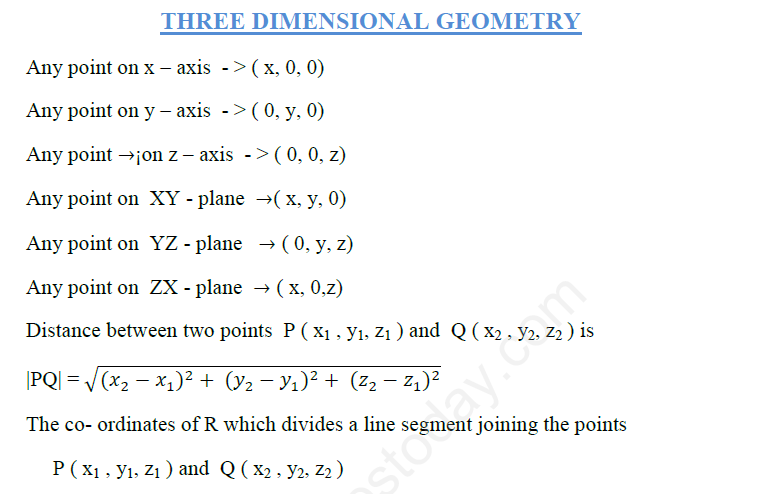
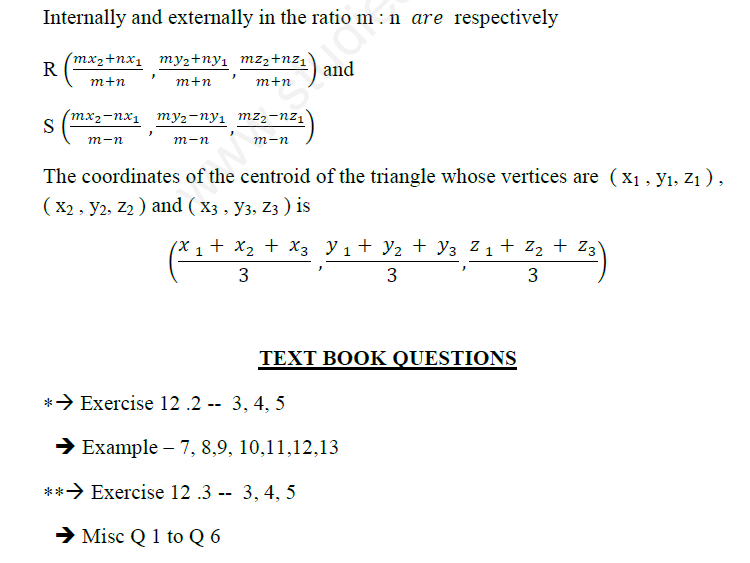
Click on link below to download CBSE Class 12 Mathematics Three Dimensional Geometry Assignment Set A
Free study material for Mathematics
CBSE Class 12 Mathematics Assignments for Chapter 11 Three Dimensional Geometry
Revision Assignment: Chapter 11 Three Dimensional Geometry (CBSE)
Explore reliable practice questions for Chapter 11 Three Dimensional Geometry tailored for Class 12 learners. Use these structured worksheets to evaluate preparedness and strengthen core problem-solving skills.
Key Advantages of Solving Chapter 11 Three Dimensional Geometry Assignments
- Syllabus Compliance: Sets reflect current CBSE evaluation criteria and official marking frameworks.
- Multi-Format Practice: Includes varied problem types designed to deepen comprehension across all sub-topics.
- Time Management: Routine practice optimizes pacing to finish school examinations comfortably within schedule.
Effective Strategy for Class 12 Mathematics Assignments
- Initial Reading: Begin by reading the NCERT book for Class 12 Mathematics to build a baseline understanding.
- Independent Testing: Attempt assignment questions unassisted, then verify work using provided answer keys.
- Supplementary Aids: Leverage revision notes and worksheets whenever you encounter difficult topics.
FAQs
You can download free PDF assignments for Class 12 Mathematics Chapter 11 Three Dimensional Geometry from StudiesToday.com. These practice sheets have been updated for the 2026-27 session covering all concepts from latest NCERT textbook.
Yes, our teachers have given solutions for all questions in the Class 12 Mathematics Chapter 11 Three Dimensional Geometry assignments. This will help you to understand step-by-step methodology to get full marks in school tests and exams.
Yes. These assignments are designed as per the latest CBSE syllabus for 2026. We have included huge variety of question formats such as MCQs, Case-study based questions and important diagram-based problems found in Chapter 11 Three Dimensional Geometry.
Practicing topicw wise assignments will help Class 12 students understand every sub-topic of Chapter 11 Three Dimensional Geometry. Daily practice will improve speed, accuracy and answering competency-based questions.
Yes, all printable assignments for Class 12 Mathematics Chapter 11 Three Dimensional Geometry are available for free download in mobile-friendly PDF format.