

Official CBSE Assignments for Class 12 Mathematics
Review targeted academic assignments with the CBSE Class 12 Mathematics Applications Of Derivatives Assignment Set 01. Built according to official CBSE standards for the 2026-27 term, these downloadable Class 12 Mathematics worksheets support effective daily practice for Chapter 06 Applications Of Derivatives.
Solved Practice Assignments for Mathematics
Access the complete assignment PDF for Class 12 Mathematics below. Regular practice with these targeted academic tasks builds familiarity with standard question patterns and helps secure higher marks in final school evaluations.
Question. The radius of the cylinder of maximum volume, which can be inscribed a sphere of radius R is:
a. 2/3 R
b. √2/3 R
c. 3/4 R
d. √3/4 R
Answer : B
Question. The abscissae of the points of the curve y3 = x in the interval [–2, 2], where the slope of the tangent can be obtained by mean value theorem for the interval [– 2, 2] are:
a. ± 2/√3
b. ± √3/2
c. ± 3
d. 0
Answer : A
Question. If the line ax+by+c = 0 is a normal to the curve xy = 1, then:
a. a > 0,b > 0
b. a > 0,b < 0
c. a < 0,b > 0
d. a < 0,b < 0
Answer : B, C
Question. If f(x) =
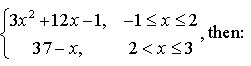
a. f (x) is increasing on[−1,2]
b. f (x) is continuous on[−1,3]
c. f '(2) does not exist
d. f (x) has the maximum value at x = 2
Answer : ALL
Question. Let 2 3 h(x) = f (x) − ( f (x)) + ( f (x)) for every real number x. Then:
a. h is increasing whenever f is increasing
b. h is increasing whenever f is decreasing
c. h is decreasing whenever f is decreasing
d. nothing can be said in general
Answer : A, C
Question. The function f(x) = ∫−1x (et -1) (t - 1) (t - 2)3 (t - 3)5 dt has a local minimum at x equals to:
a. 0
b. 1
c. 2
d. 3
Answer : B, D
Question. In the mean-value theorem f (b) - f(a) / b - a = f(c), if a = 0, b = 1/2 and f (x) = x(x −1)(x − 2), the value of c is:
a. 1 - √15/6
b. 1 + √15
c. 1 - √21/6
d. 1 + √21
Answer : C
Question. If f (x)
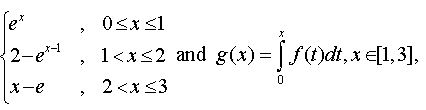
then:
a. g(x) has local maxima at 1 log 2 e x = + and local minima at x = e
b. f (x) has local maxima at x = 1 and local minima x = 2
c. g(x) has no local minima
d. g(x) has no local maxima
Answer : B, C
Question. Let f be a real-valued function defined on the interval (0,∞), by f (x) = Inx + ∫0x √1 + sintdt . Then which of the following statement(s) is(are) true?
a. f ′′(x) exists for all x∈(0,∞)
b. f ′(x) exists for all x∈(0,∞) and f ′ is continuous on (0,∞), but not differentiable on (0,∞)
c. there existsα > 1 such that╿f ′(x)╿< f (x)╿for all x∈(0,∞)
d. there exists β > 0 such that ╿f╿( x) + ╿f '( x)╿≤ β from all x∈(0,∞)
Answer : B, C
Question. If (x) = ∫0x et2 (t - 2) (t - 2) (t - 3) dt ∀x∈ ∞ then:
a. f has a local maximum at x = 2
b. f is decreasing on (2, 3)
c. there exists some c∈(0,∞) such that f ′′(c) = 0
d. f has a local minimum at x = 3
Answer : ALL
Question. A rectangular sheet of fixed perimeter with sides having their lengths in the ratio 8 : 15 is converted into an open rectangular box by folding after removing squares of equal area from all four corners. If the total area of removed squares is 100, the resulting box has maximum volume. The lengths of the sides of the rectangular sheet are:
a. 24
b. 32
c. 45
d. 60
Answer : A, D
Question. The function f ( x) = 2│x│ + │x + 2│ −││x + 2│− 2│x ││has a local minimum or a local maximum at x is equal to:
a. –2
b. −2/3
c. 2
d. 2/3
Answer : A, B
Question. On the ellipse 4x2 + 9y2 = 1, the point at which the tangents are parallel to the line 8x = 9 y, are:
a. (2/5, 1/5)
b. (- 2/5, 1/5)
c. (- 2/5, - 1/5)
d. (2/5, - 1/5)
Answer : B, D
Question. If f (x) is cubic polynomial which has local maximum at x = −1. If f (2) = 18, f (1) = −1 and f ′(x) has local minimum at x = 0, then:
a. the distance between (−1,2) and (a, f (a)) where x = a is the point of local minima, is 2 5.
b. f ( x) is increasing for x∈ [1,2 √5]
c. f ( x) has local minima at x = 1
d. the value of f (0) = 5
Answer : B, C
Question. The function f (x) = x(x + 3)e-1/2x satisfies all the condition of Rolle's theorem in [– 3, 0]. The value of c is:
a. 0
b. 1
c. – 2
d. – 3
Answer : C
Question. Let f : (0,∞) → R be given by
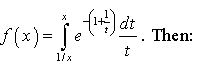
a. f (x) is monotonically increasing on [1,∞)
b. f (x) is monotonically decreasing on [0,1)
c. f (x) + f (1/x) = 0, for all x∈(0,∞)
d. (2 ) x f is an odd function of x on R
Answer : A, C, D
Assertion and Reason
Note: Read the Assertion (A) and Reason (R) carefully to mark the correct option out of the options given below:
a. If both assertion and reason are true and the reason is the
correct explanation of the assertion.
b. If both assertion and reason are true but reason is not the
correct explanation of the assertion.
c. If assertion is true but reason is false.
d. If the assertion and reason both are false.
e. If assertion is false but reason is true.
Question. Let f (x) = 2√x and g(x) = 3 - 1/x , x > 1?
Assertion: f (x) > g(x)(x > 1)
Reason: f (x) − g(x) increases on (1, ∞)
Answer : A
Question. Let f be a function defined by
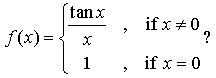
Assertion: x = 0 is point of maxima of f
Reason: f ′(0) = 0
Answer : B
Question. Assertion:│cot x − cot│≤│x − y│for all x,y ∈ (- π/2, π/2)
Reason: If f is differentiable on an open interval and │f ′(x)│≤ M then │f (x) − f (y)│≤ M│x − y
Answer : D
Question. Let f (x) = x4 − 2x2 +5be defined on [−2, 2] ?
Assertion: The rang of f (x) is [2, 13]
Reason: The greatest value of f is attained at x = 2
Answer : D
Question. Let y = x + a2/x (a, > 0) ?
Assertion: ymax = −2a (local mix)
Reason: ymin = 2a (local min)
Answer : B
Question. Assertion: The function f (x) = 2sin x + cos 2x(0 ≤ x ≤ 2π ) has minimum at x = π/3 and maximum at 5π/3
Reason: The function f (x) above decreases on (0, π/3) increases on (π/3, 5π/3) and decreases on (5π/3, 2π)
Answer : A
Question. Let f(x) tan-1 1 - x / 1 + x ?
Assertion: The difference between the greatest and smallest value of f (x) on [0, 1] is π/4
Reason: If a function g decrease on [a, b] then the greatest value of g = g(a) and least value of g is g(b) .
Answer : A
Question. Let a,b ∈ R be such that the function f given by f (x) = log│x│+ bx2 + ax, x ≠ 0 has extreme values at x = −1 and x = 2.
Assertion: f has local maximum at x = −1 and at x = 2.
Reason: a = 1/2 and b = 1/4
Answer : A
Question. Assertion eπ >πe
Reason: The function x-1/x (x > 0) has local maximum at x = e.
Answer : D
Question. Let f(x) = x/logx ?
Assertion: The minimum value of f (x) is e.
Reason: log x >1 for x > e and < 1 for x < e
Answer : .A
Comprehension Based
Paragraph –I
Consider the function f : (−∞,∞)→(−∞,∞) defined by f (x) = x2 - ax + 1 / x2 + ax + 1, 0 < 2
Question. Which of the following is true?
a. (2 + a)2 f "(1) + (2 − a)2 f "(−1) = 0
b. (2 − a)2 f "(1) − (2 + a)2 f "(−1) = 0
c. f '(1) f '(−1) = (2 − a)2
d. f '(1) f '(−1) = −(2 + a)2
Answer : A
Question. Which of the following is true?
a. f (x) is decreasing on (–1, 1) and has a local minimum at x = 1.
b. f (x) is increasing on (–1, 1) and has a local maximum at x = 1.
c. f (x) is increasing on (–1, 1) but has neither a local maximum nor a local minimum at x = 1.
d. f (x) is decreasing on (–1, 1) but has neither a local maximum nor a local minimum at x = 1.
Answer : A
Question. Let f(x) = ∫0ax f"(t) / 1 + t0 dt. Which of the following is true?
a. g '(x) is positive on (−∞,0) and negative on (0,∞)
b. g′(x) is negative on (−∞,0) and positive on (0,∞)
c. g′(x) changes sign on both (−∞,0) and (0,∞)
d. g′(x) does not change sign (−∞,∞)
Answer : B
Paragraph –II
Let f (x) = (1−x)2 sin2 x+x2 for all x∈R and let
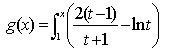
f (t) dt for all x ∈ (1,∞).
Question. Which of the following is true?
a. g is increasing on (1,∞)
b. g is decreasing on (1,∞)
c. g is increasing on (1, 2) and decreasing on (2,∞)
d. g is decreasing on (1, 2) and increasing on (2,∞)
Answer : B
Question. Consider the statements:
A.There exists some x ∈ R such that 2 f (x) + 2x = 2(1+ x )
B. There exists some x ∈ R such that 2 f (x) +1 = 2x(1+ x) Then,
a. Both A and B are true
b. A is true and B is false
c. A is false and B is true
d. Both A and B are false
Answer : C
Paragraph –III
Let f : [0,1]→ R (the set of all real numbers) be a function.
Suppose the function f is twice differentiable, f (0) = f (1) = 0 and satisfies "( ) 2 '( ) ( ) , x f x − f x + f x ≥ e x ∈ [0,1].
Question. Which of the following is true for 0 < x <1?
a. 0 < f (x) < ∞
b. - 1/2 < f (x) < 1/2
c. −1/ 4 < f (x) < 1
d. −∞ < f (x) < 0
Answer : D
Question. If the function e−x f(x) assumes its minimum in the interval [0,1] a x =1/ 4, which of the following is true?
a. f (x) < f (x) 1/4 < x < 3/4
b. f (x) > f (x), 0 < x < 1/4
c. f (x) < f (x) 0 < x < 1/4
d. f (x) < f (x) 3/4 < x < 1
Answer : A
Integer
Question. The curve y = ax3 + bx2 + cx + b touches the x-axis P(−2,0) and cuts the y-axis at a point Q where its gradient is 3, then the value of −10a −100b +1000c must be
Answer : 3080
Question. Tangent at a point P1 (other than (0, 0)) on the curve y = x3 meets the curve again at 2P .The tangent at P2 meets the curve again at P3 and so on, then we get P1, P2, P3, … Pn are is GP, then the ratio area (ΔP1 P2 P3) / area (ΔP2, P3 P4) λ/μ, then the value of 251/2 λ/μ⋅ must be
Answer : 2008
Question. If the value maximum slope of f (x) = x3 + 8x2 − 13x − 18 is λ, then the value of 15λ must be:
Answer : 125
Question. Rolle’s theorem holds for the function f (x) = x3 + bx2 + cx, 1 ≤ x ≤ 2 at the point 4/3 then the value of 100c − 500b must be:
Answer : 3300
Question. If the approximate value of 10 log (4.04) 0 abcdef, It is given that 4 log 4 = 0.6021 and 10 log e = 0.4343, then the value of abcd must be:
Answer : 1
Question. If the greatest and least values of the function f (x) = x3 − 6x2 + 9x + 1 on [0, 2] are λ and μ , then the value of λ4 +μ8must be:
Answer : 626
Question. The three sides of a trapezium are equal each being 6 cm long. If area of trapezium when it is maximum is A, then the value of 4√3 Amust be:
Answer : 324
Question. Let f (x) = x3 + 6x2 + ax + 2. If the largest possible interval in which f (x) is a decreasing function in (−3,−1), then the value of a must be:
Answer : 9
Question. The number of critical points of the function f (x) = │x│e−x must be:
Answer : 2
Question. Let
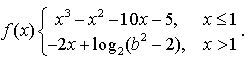
. If f (x) has greatest value at x = 1, then [b2 ∈ (2, λ )]. Then,λ must be:
Answer : 130
Question. The indicated horse power I of an engines is calculated from the formula I = PLAN / 33000 where, A = π/4 d2 Assuming that error of 10% may have been made in measuring P, L, N and d. If the greatest possible in I is λ%then λ must be:
Answer : 50
Question. A balloon is in the form of right circular cylinder of radius 1.5m and length 4m and is surmounted by hemispherical ends. If the radius is increased by 0.01 m and the length by 0.05 m, the percentage change in the volume of the balloon is a. bcd%, then the value of abcd must be:
Answer : 2389
Question. When travelling at x km/ h, a truck burns diesel at the rate of 1/300 (900/x + x) L/km If the diesel oil costs 40 paise/L and driver is paid Rs 1.50 per h, if the steady speed that will minimize the total cost of the trip of 500 km is λ km/ h, then the value of 50λ must be:
Answer : 2250
Question. If f (x) = tan-1 (sin x + cos x)3 is an increasing function, then the value of x in (0, 2π ) is x ∈ (aπ/4, bπ/4) ∪ (cπ/4, dπ/4)
Then, the value of a +10b +100c +1000d must be:
Answer : 8
Question. If f (x) = (x −1)(x − 2)(x −3) and a = 0, b = 4, then c the using LMVT is 2 ±λ. Then value of 450 √2λ must be
Answer : 600
Please click the below link to access CBSE Class 12 Mathematics Applications Of Derivatives Assignment Set A
Free study material for Mathematics
Chapter Assignment & Practice Material for Class 12 Mathematics Chapter 06 Applications Of Derivatives
Revision Assignment: Chapter 06 Applications Of Derivatives (CBSE)
Explore reliable practice questions for Chapter 06 Applications Of Derivatives tailored for Class 12 learners. Use these structured worksheets to evaluate preparedness and strengthen core problem-solving skills.
Key Advantages of Solving Chapter 06 Applications Of Derivatives Assignments
- Curriculum Standards: Assignments match modern CBSE sample formats to ensure relevant preparation.
- Thorough Revision: Detailed problem sets reinforce core concepts and eliminate conceptual weak spots.
- Execution Speed: Timed practice with assignment sets sharpens overall response timing.
Steps to Complete Chapter 06 Applications Of Derivatives Assignments Successfully
- Concept Foundation: Review the NCERT book for Class 12 Mathematics thoroughly before diving into assignment tasks.
- Self-Evaluation: Solve exercises independently before inspecting professional answer guides.
- Progress Monitoring: Note down complex formulas or concepts, clearing them up using available online practice aids.
FAQs
You can download free PDF assignments for Class 12 Mathematics Chapter 06 Applications Of Derivatives from StudiesToday.com. These practice sheets have been updated for the 2026-27 session covering all concepts from latest NCERT textbook.
Yes, our teachers have given solutions for all questions in the Class 12 Mathematics Chapter 06 Applications Of Derivatives assignments. This will help you to understand step-by-step methodology to get full marks in school tests and exams.
Yes. These assignments are designed as per the latest CBSE syllabus for 2026. We have included huge variety of question formats such as MCQs, Case-study based questions and important diagram-based problems found in Chapter 06 Applications Of Derivatives.
Practicing topicw wise assignments will help Class 12 students understand every sub-topic of Chapter 06 Applications Of Derivatives. Daily practice will improve speed, accuracy and answering competency-based questions.
Yes, all printable assignments for Class 12 Mathematics Chapter 06 Applications Of Derivatives are available for free download in mobile-friendly PDF format.