

Class 12 Mathematics Practice Assignments: CBSE Class 12 Mathematics Inverse Trigonometric Functions Assignment Set 02
Access comprehensive school assignments for Chapter 02 Inverse Trigonometric Functions using the CBSE Class 12 Mathematics Inverse Trigonometric Functions Assignment Set 02. Designed to align with the 2026-27 CBSE academic guidelines, these practice sets help Class 12 Mathematics students reinforce core concepts and improve their problem-solving accuracy.
Download Chapter 02 Inverse Trigonometric Functions Assignment PDF with Solutions
Navigate directly to the solved Mathematics assignments using the digital viewer below. Each practice set includes detailed step-by-step solutions, allowing students to instantly cross-check their work and identify areas requiring further revision.
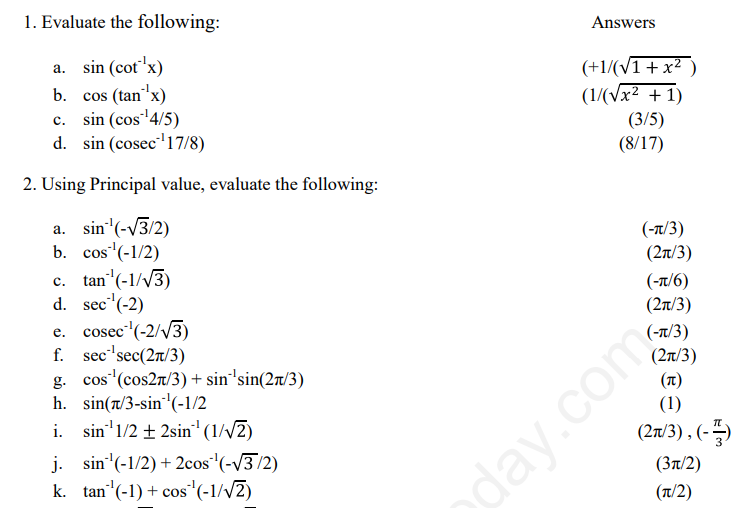
Question. Write the value of \(\cos^{-1}\left(-\frac{1}{2}\right) + 2\sin^{-1}\left(\frac{1}{2}\right)\).
Answer: Given \(\cos^{-1}\left(-\frac{1}{2}\right) + 2\sin^{-1}\left(\frac{1}{2}\right) = \cos^{-1}\left(\cos \frac{2\pi}{3}\right) + 2\sin^{-1}\left(\sin \frac{\pi}{6}\right) = \frac{2\pi}{3} + 2 \times \frac{\pi}{6} = \frac{2\pi}{3} + \frac{\pi}{3} = \pi\).
\([\because \text{Range of } \cos^{-1} \text{ is } [0, \pi] \text{ & of } \sin^{-1} \text{ is } [-\pi/2, \pi/2]]\)
Question. Write the principal value of \(\tan^{-1}\left[\sin\left(-\frac{\pi}{2}\right)\right]\).
Answer: Here, \(\tan^{-1}\left[\sin\left(-\frac{\pi}{2}\right)\right] = \tan^{-1}(-1) = -\frac{\pi}{4}\).
This is the required principal value as it should lie in \(\left(-\frac{\pi}{2}, \frac{\pi}{2}\right)\).
Question. Find the value of the following : \(\cot\left(\frac{\pi}{2} - 2\cot^{-1}\sqrt{3}\right)\).
Answer: \[\cot\left(\frac{\pi}{2} - 2\cot^{-1}\sqrt{3}\right)\] \[= \cot\left(\frac{\pi}{2} - 2\cot^{-1}\left(\cot\frac{\pi}{6}\right)\right) = \cot\left(\frac{\pi}{2} - 2 \cdot \frac{\pi}{6}\right)\] \[= \cot\left(\frac{\pi}{2} - \frac{\pi}{3}\right) = \cot\frac{\pi}{6} = \sqrt{3}\]
Question. Write the principal value of \(\tan^{-1}(1) + \cos^{-1}\left(-\frac{1}{2}\right)\).
Answer: \[\tan^{-1}(1) + \cos^{-1}\left(-\frac{1}{2}\right)\] \[= \tan^{-1}\left(\tan\frac{\pi}{4}\right) + \cos^{-1}\left(\cos\frac{2\pi}{3}\right) = \frac{\pi}{4} + \frac{2\pi}{3} = \frac{11\pi}{12}\]
Question. Write the value of \(\tan^{-1}\left[2\sin\left(2\cos^{-1}\frac{\sqrt{3}}{2}\right)\right]\).
Answer: \[\tan^{-1}\left[2\sin\left(2\cos^{-1}\frac{\sqrt{3}}{2}\right)\right]\] \[= \tan^{-1}\left[2\sin\left(2 \cdot \frac{\pi}{6}\right)\right] = \tan^{-1}\left[2\sin\frac{\pi}{3}\right]\] \[= \tan^{-1}\left[2 \cdot \frac{\sqrt{3}}{2}\right] = \tan^{-1}(\sqrt{3}) = \frac{\pi}{3}\]
Question. Write the principal value of \(\left[\cos^{-1}\frac{\sqrt{3}}{2} + \cos^{-1}\left(-\frac{1}{2}\right)\right]\).
Answer: \[\cos^{-1}\frac{\sqrt{3}}{2} + \cos^{-1}\left(-\frac{1}{2}\right)\] \[= \cos^{-1}\left(\cos\frac{\pi}{6}\right) + \cos^{-1}\left(\cos\frac{2\pi}{3}\right) = \frac{\pi}{6} + \frac{2\pi}{3} = \frac{5\pi}{6}\]
Question. Write the principal value of \([\tan^{-1}(-\sqrt{3}) + \tan^{-1}(1)]\).
Answer: \[\tan^{-1}(-\sqrt{3}) + \tan^{-1}(1)\] \[= \tan^{-1}\left(-\tan\frac{\pi}{3}\right) + \tan^{-1}\left(\tan\frac{\pi}{4}\right)\] \[= \tan^{-1}\left(\tan\left(-\frac{\pi}{3}\right)\right) + \frac{\pi}{4} = -\frac{\pi}{3} + \frac{\pi}{4} = -\frac{\pi}{12}\]
Question. Write the principal value of \(\cos^{-1}\left(\frac{1}{2}\right) - 2\sin^{-1}\left(-\frac{1}{2}\right)\).
Answer: \[\cos^{-1}\left(\frac{1}{2}\right) - 2\sin^{-1}\left(-\frac{1}{2}\right)\] \[= \cos^{-1}\left(\cos\frac{\pi}{3}\right) - 2\sin^{-1}\left(\sin\left(-\frac{\pi}{6}\right)\right) = \frac{\pi}{3} + 2 \cdot \frac{\pi}{6} = \frac{2\pi}{3}\]
Question. Using principal values, write the value of \(\cos^{-1}\left(\frac{1}{2}\right) + 2\sin^{-1}\left(\frac{1}{2}\right)\).
Answer: Principal value of \(\cos^{-1}\left(\frac{1}{2}\right) + 2\sin^{-1}\left(\frac{1}{2}\right) = \frac{\pi}{3} + 2 \cdot \frac{\pi}{6} = \frac{2\pi}{3}\).
Question. Evaluate : \(\sin\left[\frac{\pi}{3} - \sin^{-1}\left(-\frac{1}{2}\right)\right]\).
Answer: \[\sin\left[\frac{\pi}{3} - \sin^{-1}\left(-\frac{1}{2}\right)\right] = \sin\left[\frac{\pi}{3} - \sin^{-1}\left(\sin\left(-\frac{\pi}{6}\right)\right)\right]\] \[= \sin\left[\frac{\pi}{3} + \frac{\pi}{6}\right] = \sin\frac{\pi}{2} = 1\]
Question. Write the principal value of \(\sin^{-1}\left(-\frac{1}{2}\right)\).
Answer: Let \(\sin^{-1}\left(-\frac{1}{2}\right) = \theta\).
Then, \(\sin\theta = -\frac{1}{2} = \sin\left(-\frac{\pi}{6}\right)\), where \(-\frac{\pi}{6} \in \left[-\frac{\pi}{2}, \frac{\pi}{2}\right]\).
Hence, the principal value of \(\sin^{-1}\left(-\frac{1}{2}\right)\) is \(-\frac{\pi}{6}\).
Question. Using principal values, write the value of \(\sin^{-1}\left(-\frac{\sqrt{3}}{2}\right)\).
Answer: The principal value of \(\sin^{-1}\left(-\frac{\sqrt{3}}{2}\right)\)
\[= \sin^{-1}\left(\sin\left(-\frac{\pi}{3}\right)\right) = -\frac{\pi}{3}\], where \(-\frac{\pi}{3} \in \left[-\frac{\pi}{2}, \frac{\pi}{2}\right]\).
Question. Find the principal value of \(\sin^{-1}\left(-\frac{1}{2}\right) + \cos^{-1}\left(-\frac{1}{2}\right)\).
Answer: \[\sin^{-1}\left(-\frac{1}{2}\right) + \cos^{-1}\left(-\frac{1}{2}\right)\] \[= \sin^{-1}\left(\sin\left(-\frac{\pi}{6}\right)\right) + \cos^{-1}\left(\cos\frac{2\pi}{3}\right) = -\frac{\pi}{6} + \frac{2\pi}{3} = \frac{\pi}{2}\]
Question. Find the principal value of \(\sec^{-1}(-2)\).
Answer: Let \(\sec^{-1}(-2) = y\). Then, \(\sec y = -2\).
\(\sec y = -2 = -\sec\frac{\pi}{3} = \sec\left(\pi - \frac{\pi}{3}\right) = \sec\frac{2\pi}{3}\).
We know that the range of principal value branch of \(\sec^{-1}\) is \([0, \pi] - \left\{\frac{\pi}{2}\right\}\) and \(\sec\frac{2\pi}{3} = -2\).
Hence, principal value of \(\sec^{-1}(-2) = \frac{2\pi}{3}\).
Question. Using the principal values, evaluate the following : \(\tan^{-1}(1) + \sin^{-1}\left(-\frac{1}{2}\right)\).
Answer: \[\tan^{-1}(1) + \sin^{-1}\left(-\frac{1}{2}\right)\] \[= \tan^{-1}(1) + \sin^{-1}\left(\sin\left(-\frac{\pi}{6}\right)\right) = \frac{\pi}{4} - \frac{\pi}{6} = \frac{\pi}{12}\]
\(\therefore\) Required principal value is \(\frac{\pi}{12}\).
Question. Find the principal value of \(\tan^{-1}(-1)\).
Answer: Let \(\tan^{-1}(-1) = x \Rightarrow -1 = \tan x\).
We know that the range of principal value branch of \(\tan^{-1}\) is \(\left(-\frac{\pi}{2}, \frac{\pi}{2}\right)\).
Then, \(-1 = \tan\left(-\frac{\pi}{4}\right)\), where \(-\frac{\pi}{4} \in \left(-\frac{\pi}{2}, \frac{\pi}{2}\right)\).
Hence, the principal value of \(\tan^{-1}(-1)\) is \(-\frac{\pi}{4}\).
Question. Find the principal value of \(\cos^{-1}\left(\frac{\sqrt{3}}{2}\right)\).
Answer: Principal value of \(\cos^{-1}\left(\frac{\sqrt{3}}{2}\right) = \cos^{-1}\left(\cos\frac{\pi}{6}\right) = \frac{\pi}{6}\), where \(\frac{\pi}{6} \in [0, \pi]\).
Question. Find the value of the following: \(\tan^{-1}(1) + \cos^{-1}\left(-\frac{1}{2}\right) + \sin^{-1}\left(-\frac{1}{2}\right)\).
Answer: Here, \(\tan^{-1}(1) + \cos^{-1}\left(-\frac{1}{2}\right) + \sin^{-1}\left(-\frac{1}{2}\right)\)
\[= \tan^{-1}\left(\tan\frac{\pi}{4}\right) + \cos^{-1}\left(\cos\frac{2\pi}{3}\right) + \sin^{-1}\left(\sin\left(-\frac{\pi}{6}\right)\right)\] \[= \frac{\pi}{4} + \frac{2\pi}{3} - \frac{\pi}{6} = \frac{3\pi}{4}\]
SA (4 marks)
Question. Prove that \(\cos^{-1}\frac{12}{13} + \cos^{-1}\frac{4}{5} = \tan^{-1}\frac{56}{33}\).
Answer: Let \(x = \cos^{-1}\frac{4}{5}\) and \(y = \cos^{-1}\frac{12}{13}\)
\(\Rightarrow \cos x = \frac{4}{5}\) and \(\cos y = \frac{12}{13}\)
Now, \(\sin x = \sqrt{1 - \cos^2 x}\) and \(\sin y = \sqrt{1 - \cos^2 y}\)
\(\Rightarrow \sin x = \sqrt{1 - \frac{16}{25}} = \frac{3}{5}\) and \(\sin y = \sqrt{1 - \frac{144}{169}} = \frac{5}{13}\)
We know that, \(\cos(x + y) = \cos x \cos y - \sin x \sin y\)
\[= \frac{4}{5} \times \frac{12}{13} - \frac{3}{5} \times \frac{5}{13}\]
\(\Rightarrow \cos(x+y) = \frac{48}{65} - \frac{15}{65} = \frac{33}{65}\)
\(\Rightarrow x+y = \cos^{-1}\frac{33}{65}\)
\(\therefore \cos^{-1}\frac{4}{5} + \cos^{-1}\frac{12}{13} = \cos^{-1}\frac{33}{65}\)
Now, \(\cos^{-1} x = \tan^{-1}\frac{\sqrt{1-x^2}}{x}\)
\(\therefore \cos^{-1}\frac{33}{65} = \tan^{-1}\left(\frac{\sqrt{1-\left(\frac{33}{65}\right)^2}}{\frac{33}{65}}\right) = \tan^{-1}\left(\frac{\frac{56}{65}}{\frac{33}{65}}\right) = \tan^{-1}\left(\frac{56}{33}\right)\)
\(\therefore \cos^{-1}\frac{4}{5} + \cos^{-1}\frac{12}{13} = \tan^{-1}\frac{56}{33}\)
Question. Prove that : \(\cos^{-1}\frac{12}{13} + \sin^{-1}\frac{3}{5} = \sin^{-1}\frac{56}{65}\).
Answer: Let \(x = \cos^{-1}\frac{12}{13}\) and \(y = \sin^{-1}\frac{3}{5}\)
or \(\cos x = \frac{12}{13}\) and \(\sin y = \frac{3}{5}\)
Now, \(\sin x = \sqrt{1 - \cos^2 x}\) and \(\cos y = \sqrt{1 - \sin^2 y}\)
\(\Rightarrow \sin x = \sqrt{1 - \frac{144}{169}} = \frac{5}{13}\) and \(\cos y = \sqrt{1 - \frac{9}{25}} = \frac{4}{5}\)
We know that,
\(\sin(x+y) = \sin x \cos y + \cos x \sin y\)
\[= \frac{5}{13} \times \frac{4}{5} + \frac{12}{13} \times \frac{3}{5} = \frac{20}{65} + \frac{36}{65} = \frac{56}{65}\]
\(\Rightarrow x+y = \sin^{-1}\frac{56}{65}\)
or, \(\cos^{-1}\left(\frac{12}{13}\right) + \sin^{-1}\left(\frac{3}{5}\right) = \sin^{-1}\left(\frac{56}{65}\right)\)
Question. Prove that : \(\sin^{-1}\frac{12}{13} + \cos^{-1}\frac{4}{5} + \tan^{-1}\frac{63}{16} = \pi\).
Answer: Let \(\sin^{-1}\left(\frac{12}{13}\right) = x\), \(\cos^{-1}\left(\frac{4}{5}\right) = y\), \(\tan^{-1}\left(\frac{63}{16}\right) = z\).
Then, \(\sin x = \frac{12}{13}\), \(\cos y = \frac{4}{5}\), \(\tan z = \frac{63}{16}\).
Therefore, \(\cos x = \frac{5}{13}\), \(\sin y = \frac{3}{5}\), \(\tan x = \frac{12}{5}\) and \(\tan y = \frac{3}{4}\).
We have, \(\tan(x+y) = \frac{\tan x + \tan y}{1 - \tan x \tan y}\)
\[= \frac{\frac{12}{5} + \frac{3}{4}}{1 - \frac{12}{5} \times \frac{3}{4}} = -\frac{63}{16}\]
Hence, \(\tan(x + y) = -\tan z\)
i.e., \(\tan(x+y) = \tan(-z)\) or \(\tan(x+y) = \tan(\pi - z)\)
Therefore, \(x + y = -z\) or \(x + y = \pi - z\)
Since, \(x, y\) and \(z\) are positive, \(x+y \neq -z\)
Hence, \(x + y + z = \pi\)
or, \(\sin^{-1}\left(\frac{12}{13}\right) + \cos^{-1}\left(\frac{4}{5}\right) + \tan^{-1}\left(\frac{63}{16}\right) = \pi\).
Please click the below link to access CBSE Class 12 Mathematics Inverse Trigonometric Functions Assignment Set B
Free study material for Mathematics
Download Practice Assignments: Class 12 Mathematics Chapter 02 Inverse Trigonometric Functions
Download Assignment: Chapter 02 Inverse Trigonometric Functions (Class 12 Mathematics)
Explore reliable practice questions for Chapter 02 Inverse Trigonometric Functions tailored for Class 12 learners. Use these structured worksheets to evaluate preparedness and strengthen core problem-solving skills.
Maximize Exam Scores with Chapter Practice Sets
- Exam Alignment: Questions strictly follow contemporary CBSE sample papers and grading schemes.
- Comprehensive Coverage: Features objective drills, case studies, and structured descriptive problems for Chapter 02 Inverse Trigonometric Functions.
- Pacing & Precision: Regular problem-solving builds critical calculation speed and test-taking accuracy.
Steps to Complete Chapter 02 Inverse Trigonometric Functions Assignments Successfully
- Textbook Review: Always study the core NCERT book for Class 12 Mathematics prior to beginning the assignment.
- Independent Attempt: Solve Chapter 02 Inverse Trigonometric Functions questions on your own initially before cross-checking with expert solutions.
- Error Tracking: Record challenging concepts in a dedicated notebook and practice online MCQ tests for revision.
FAQs
You can download free PDF assignments for Class 12 Mathematics Chapter 02 Inverse Trigonometric Functions from StudiesToday.com. These practice sheets have been updated for the 2026-27 session covering all concepts from latest NCERT textbook.
Yes, our teachers have given solutions for all questions in the Class 12 Mathematics Chapter 02 Inverse Trigonometric Functions assignments. This will help you to understand step-by-step methodology to get full marks in school tests and exams.
Yes. These assignments are designed as per the latest CBSE syllabus for 2026. We have included huge variety of question formats such as MCQs, Case-study based questions and important diagram-based problems found in Chapter 02 Inverse Trigonometric Functions.
Practicing topicw wise assignments will help Class 12 students understand every sub-topic of Chapter 02 Inverse Trigonometric Functions. Daily practice will improve speed, accuracy and answering competency-based questions.
Yes, all printable assignments for Class 12 Mathematics Chapter 02 Inverse Trigonometric Functions are available for free download in mobile-friendly PDF format.