

School Assignments for Class 12 Mathematics: Chapter 03 Matrices
Access comprehensive school assignments for Chapter 03 Matrices using the CBSE Class 12 Mathematics Matrices Assignment Set 01. Designed to align with the 2026-27 CBSE academic guidelines, these practice sets help Class 12 Mathematics students reinforce core concepts and improve their problem-solving accuracy.
Practice Class 12 Mathematics Assignments: Chapter 03 Matrices
View or download the dedicated CBSE Class 12 Mathematics Matrices Assignment Set 01 resource below. Engaging with these assignments under focused study conditions ensures continuous academic progress and mastery of the 2026-27 curriculum.
Case Study Question - 1
Read the case study carefully and answer any four out of the following questions:
Three friends Ravi, Raju and Rohit were buying and selling stationery items in a market. The price of per dozen of Pen, notebooks and toys are Rupees x, y and z respectively.Ravi purchases 4 dozen of notebooks and sells 2 dozen pens and 5 dozen toys. Raju purchases 2 dozen toys and sells 3 dozen pens and 1 dozen of notebooks. Rohit purchases one dozen of pens and sells 3 dozen notebooks and one dozen toys.In the process, Ravi, Raju and Rohit earn ₹ 1500, ₹ 100 and ₹400 respectively.

Answer the following questions using the matrix method:
Question. What is the price of one dozen of pens?
1. ₹ 100
2. ₹ 200
3. ₹ 300
4. ₹ 400
Answer : A
Question. What is the total price of one dozen of pens and one dozen of notebooks?
1. ₹ 100
2. ₹ 200
3. ₹ 300
4. ₹ 400
Answer : C
Question. What is the sale amount of Ravi?
1. ₹ 1000
2. ₹ 1100
3. ₹ 1300
4. ₹ 1200
Answer : D
Question. What is the amount of purchases made by all three friends?
1. ₹ 1200
2. ₹ 1500
3. ₹ 1300
4. ₹ 1400
Answer : B
Question. What is the price of sales made by all three friends?
1. ₹ 3000
2. ₹ 2500
3. ₹ 2700
4. ₹ 2400
Answer : C
Case Study Questions Matrices – 2
Read the case study carefully and answer any four out of the following questions:
Once a mathematics teacher drew a triangle ABC on the blackboard. Now he asked Jose,” If I increase AB by 11 cm and decrease the side BC by 11 cm, then what type of triangle it would be?”
Jose said, “It will become an equilateral triangle.”
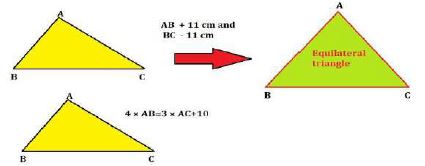
Again teacher asked Suraj,” If I multiply the side AB by 4 then what will be the relation of this with side AC?”
Suraj said it will be 10 cm more than the three times AC.
Find the sides of the triangle using the matrix method and answer the following questions:
Question. What is the length of the smallest side?
1. 54 cm
2. 43 cm
3. 30 cm
4. 35 cm
Answer : B
Question. What is the length of the largest side?
1. 54 cm
2. 43 cm
3. 65 cm
4. 35 cm
Answer : C
Question. What is the perimeter of the triangle?
1. 150 cm
2. 160 cm
3. 165 cm
4. 162cm
Answer : D
Question. What is the side of the equilateral triangle formed?
1. 54 cm
2. 43 cm
3. 30 cm
4. 35 cm
Answer : A
Question. What is the order of the matrix formed?
1. 3 × 3
2. 2 × 3
3. 3 × 2
4. 2 × 2
Answer : A
Case Study Question – 3
Two schools P and Q want to award their selected students on the values of Tolerance, Kindness, and Leadership. The school P wants to award Rs x each, Rs y each and Rs z each for the three respective values to 3, 2 and 1 students respectively with total award money of Rs. 2200. School Q wants to spend Rs 3100 to award its 4, 1 and 3 students on the respective values (by giving the same award money to the three values as school P). If the total amount of award for one prize on each value is Rs1200, using matrices, find the following:

Question. What is award money for Tolerance?
1. 350
2. 300
3. 500
4. 400
Question. What is the award money for Leadership?
1. 300
2. 280
3. 450
4. 500
Question. What is the award money for Kindness?
1. 500
2. 400
3. 300
4. 550
Question. If a matrix A is both symmetric and skew-symmetric, then
1. A is a diagonal matrix
2. A is a scalar matrix
3. A is a zero matrix
4. A is a square matrix
Question. If A and B are two matrices such that AB = B and BA = A, then B2 is equal to
1. B
2. A
3. 1
4. 0
MULTIPLE CHOICE TYPE QUESTIONS:
Question. If 𝑨 is a square matrix of order 3 and |𝑨| = 5 then the value of |𝟑𝑨| is
A) 45
B) 75
C) 135
D) 125
Answer : C
Question. 𝑨 is a matrix of order 4 and |𝑨|=10 then the value of |𝒂𝒅𝒋𝑨| is
A) 40
B) 400
C) 1,000
D) 10,000
Answer : C
Question. The number of possible matrices of order 2x2 with each entry 3 or 5 is
A) 4
B) 8
C) 16
D) 32
Answer : C
Question. If A is a matrix of order 3 and |𝐴| = 2 then the value of |2 𝑎𝑑𝑗 𝐴| is
A) 32
B) 16
C) 8
D) 81
Answer : A
Question. The |𝐴| where matrix A is a scalar matrix of order 4 with every diagonal element equal to 3 is
A) 64
B) 81
C) 12
D) 7
Answer : B
Question. If |𝑎𝑑𝑗𝐴|=|2𝐴| where A is a non-singular matrix of order 3X3, then Value of |𝐴| is
A) 32
B) 16
C) 8
D) 81
Answer : C
ASSERTION REASON TYPE QUESTIONS:
Choose the correct option for the following questions:
(A) Both statements I & II are true and Statement II is the correct Explanation of Statement I.
(B) Both statements I & II are true and Statement II is not the correct Explanation of Statement I.
(C) Statement I is true and Statement II is false.
(D) Statement I is false and Statement II is true.
(E) Both the Statements I & II are false.
Question. Let 𝐴 and 𝐵 be square matrices of same order.|
Statement I: 𝐴. (𝑎𝑑𝑗𝐴) = |𝐴|𝐼
Statement II: 𝑎𝑑𝑗(𝐴𝐵) = (𝑎𝑑𝑗𝐴). (𝑎𝑑𝑗𝐵).
Answer : C
Question. Let 𝐴, 𝐵 and 𝐶 are three square matrices of the same order.
Statement I: 𝐴𝐵 = 𝟎 ⇒ A = 𝟎 or, 𝐵 = 𝟎.
Statement II: 𝐴 + 𝐵 = 𝐴 + 𝐶 ⇒ B = 𝐶.
Answer : D
Question. Statement I: If 𝐴 is a square matrix then 𝐴2 is asymmetric matrix.
Statement II: (𝐴2)′ = 𝐴2.
Answer : E
SCHEMATIC DIAGRAM
| Topic | Concepts | Degree of importance | References NCERT Text Book XI Ed. 2007 |
|---|---|---|---|
| Matrices & Determinants | (i) Order, Addition, Multiplication and transpose of matrices | *** | Ex 3.1 – Q.No 4,6 Ex 3.2 – Q.No 7,9,13,17,18 Ex 3.3 – Q.No 10 |
| (ii) Cofactors & Adjoint of a matrix | ** | Ex 4.4 – Q.No 5 Ex 4.5 – Q.No 12,13,17,18 | |
| (iii) Inverse of a matrix & applications | *** | Ex 4.6 – Q.No 15,16 Example – 29,30,32,33 MiscEx 4 – Q.No 4,5,8,12,15 | |
| (iv) To find difference between \(|A|\), \(|\text{adj } A|\), \(|kA|\), \(|A \cdot \text{adj } A|\) | * | Ex 4.1 – Q.No 3,4,7,8 | |
| (v) Properties of Determinants | ** | Ex 4.2 – Q.No 11,12,13 Example – 16,18 |
SOME IMPORTANT RESULTS/CONCEPTS
A matrix is a rectangular array of \(m \times n\) numbers arranged in \(m\) rows and \(n\) columns.
\[ A = \begin{bmatrix} a_{11} & a_{12} & \dots & a_{1n} \\ a_{21} & a_{22} & \dots & a_{2n} \\ \vdots & \vdots & \ddots & \vdots \\ a_{m1} & a_{m2} & \dots & a_{mn} \end{bmatrix}_{m \times n} \quad \text{OR} \quad A = [a_{ij}]_{m \times n}, \text{ where } i = 1, 2, \dots, m ;\; j = 1, 2, \dots, n. \]
- Row Matrix : A matrix which has one row is called row matrix. \(A = [a_{ij}]_{1 \times n}\)
- Column Matrix : A matrix which has one column is called column matrix. \(A = [a_{ij}]_{m \times 1}\).
- Square Matrix: A matrix in which number of rows are equal to number of columns, is called a square matrix \(A = [a_{ij}]_{m \times m}\)
- Diagonal Matrix : A square matrix is called a Diagonal Matrix if all the elements, except the diagonal elements are zero. \(A = [a_{ij}]_{n \times n}\), where \(a_{ij} = 0, i \neq j\); \(a_{ij} \neq 0, i = j\).
- Scalar Matrix: A square matrix is called scalar matrix if all the elements, except diagonal elements are zero and diagonal elements are same non-zero quantity. \(A = [a_{ij}]_{n \times n}\), where \(a_{ij} = 0, i \neq j\); \(a_{ij} = \alpha, i = j\).
- Identity or Unit Matrix : A square matrix in which all the non diagonal elements are zero and diagonal elements are unity is called identity or unit matrix.
- Null Matrices : A matrix in which all elements are zero.
- Equal Matrices : Two matrices are said to be equal if they have same order and all their corresponding elements are equal.
- Transpose of matrix : If A is the given matrix, then the matrix obtained by interchanging the rows and columns is called the transpose of a matrix.
- Properties of Transpose :
If A & B are matrices such that their sum & product are defined, then
(i). \((A^T)^T = A\)
(ii). \((A + B)^T = A^T + B^T\)
(iii). \((KA)^T = K \cdot A^T\) where K is a scalar.
(iv). \((AB)^T = B^T A^T\)
(v). \((ABC)^T = C^T B^T A^T\). - Symmetric Matrix : A square matrix is said to be symmetric if \(A = A^T\) i.e. If \(A = [a_{ij}]_{m \times m}\), then \(a_{ij} = a_{ji}\) for all \(i, j\). Also elements of the symmetric matrix are symmetric about the main diagonal
- Skew symmetric Matrix : A square matrix is said to be skew symmetric if \(A^T = -A\). If \(A = [a_{ij}]_{m \times m}\), then \(a_{ij} = -a_{ji}\) for all \(i, j\).
- Singular matrix: A square matrix ‘A’ of order ‘n’ is said to be singular, if \(|A| = 0\).
- Non-Singular matrix : A square matrix ‘A’ of order ‘n’ is said to be non-singular, if \(|A| \neq 0\).
- Product of matrices:
(i) If A & B are two matrices, then product AB is defined, if Number of columns of A = number of rows of B. i.e. \(A = [a_{ij}]_{m \times n}\), \(B = [b_{jk}]_{n \times p}\) then \(AB = [c_{ik}]_{m \times p}\).
(ii) Product of matrices is not commutative. i.e. \(AB \neq BA\).
(iii) Product of matrices is associative. i.e \(A(BC) = (AB)C\)
(iv) Product of matrices is distributive over addition. - Adjoint of matrix :
If \(A = [a_{ij}]\) be a n-square matrix then transpose of a matrix \([A_{ij}]\), where \(A_{ij}\) is the cofactor of \(a_{ij}\) element of matrix A, is called the adjoint of A.
\(\text{Adjoint of } A = \text{Adj. } A = [A_{ij}]^T\).
\(A(\text{Adj. } A) = (\text{Adj. } A)A = |A|I\). - Inverse of a matrix : Inverse of a square matrix A exists, if A is non-singular. A square matrix A is said to be invertible and \(A^{-1} = \frac{1}{|A|} \text{Adj. } A\).
- System of Linear Equations :
\(a_1x + b_1y + c_1z = d_1\)
\(a_2x + b_2y + c_2z = d_2\)
\(a_3x + b_3y + c_3z = d_3\)
\[ \begin{bmatrix} a_1 & b_1 & c_1 \\ a_2 & b_2 & c_2 \\ a_3 & b_3 & c_3 \end{bmatrix} \begin{bmatrix} x \\ y \\ z \end{bmatrix} = \begin{bmatrix} d_1 \\ d_2 \\ d_3 \end{bmatrix} \implies AX = B \implies X = A^{-1}B \;; \{|A| \neq 0\}. \] - Criteria of Consistency:
(i) If \(|A| \neq 0\), then the system of equations is said to be consistent & has a unique solution.
(ii) If \(|A| = 0\) and \((\text{adj. } A)B = 0\), then the system of equations is consistent and has infinitely many solutions.
(iii) If \(|A| = 0\) and \((\text{adj. } A)B \neq 0\), then the system of equations is inconsistent and has no solution. - Determinant :
To every square matrix we can assign a number called determinant.
If \(A = [a_{11}]\), \(\det A = |A| = a_{11}\).
If \(A = \begin{bmatrix} a_{11} & a_{12} \\ a_{21} & a_{22} \end{bmatrix}\), \(|A| = a_{11}a_{22} - a_{21}a_{12}\). - Properties :
(i) The determinant of the square matrix A is unchanged when its rows and columns are interchanged.
(ii) The determinant of a square matrix obtained by interchanging two rows (or two columns) is negative of given determinant.
(iii) If two rows or two columns of a determinant are identical, value of the determinant is zero.
(iv) If all the elements of a row or column of a square matrix A are multiplied by a non-zero number k, then determinant of the new matrix is k times the determinant of A.
If elements of any one column (or row) are expressed as sum of two elements each, then determinant can be written as sum of two determinants.
Any two or more rows (or column) can be added or subtracted proportionally.
If A & B are square matrices of same order, then \(|AB| = |A||B|\).
ASSIGNMENTS
(i). Order, Addition, Multiplication and transpose of matrices:
LEVEL I
Question. If a matrix has 5 elements, what are the possible orders it can have? [CBSE 2011]
Answer: Since 5 is a prime number, the only positive integers whose product is 5 are \(1 \times 5\) and \(5 \times 1\). Hence, the possible orders the matrix can have are \(1 \times 5\) and \(5 \times 1\).
Question. Construct a \(3 \times 2\) matrix whose elements are given by \(a_{ij} = \frac{1}{2}|i - 3j|\).
Answer:
For a \(3 \times 2\) matrix, \(i = 1, 2, 3\) and \(j = 1, 2\):
\(a_{11} = \frac{1}{2}|1 - 3(1)| = \frac{1}{2}|-2| = 1\)
\(a_{12} = \frac{1}{2}|1 - 3(2)| = \frac{1}{2}|-5| = \frac{5}{2}\)
\(a_{21} = \frac{1}{2}|2 - 3(1)| = \frac{1}{2}|-1| = \frac{1}{2}\)
\(a_{22} = \frac{1}{2}|2 - 3(2)| = \frac{1}{2}|-4| = 2\)
\(a_{31} = \frac{1}{2}|3 - 3(1)| = \frac{1}{2}|0| = 0\)
\(a_{32} = \frac{1}{2}|3 - 3(2)| = \frac{1}{2}|-3| = \frac{3}{2}\)
Thus, the matrix is \(A = \begin{bmatrix} 1 & \frac{5}{2} \\ \frac{1}{2} & 2 \\ 0 & \frac{3}{2} \end{bmatrix}\).
Question. If \(A = \begin{bmatrix} 1 & 2 & 3 \\ 3 & 1 & 3 \end{bmatrix}\), \(B = \begin{bmatrix} 2 & 3 & 1 \\ 1 & 0 & 2 \end{bmatrix}\), then find \(A - 2B\).
Answer:
\(A - 2B = \begin{bmatrix} 1 & 2 & 3 \\ 3 & 1 & 3 \end{bmatrix} - 2\begin{bmatrix} 2 & 3 & 1 \\ 1 & 0 & 2 \end{bmatrix} = \begin{bmatrix} 1 - 4 & 2 - 6 & 3 - 2 \\ 3 - 2 & 1 - 0 & 3 - 4 \end{bmatrix} = \begin{bmatrix} -3 & -4 & 1 \\ 1 & 1 & -1 \end{bmatrix}\).
Question. If \(A = \begin{bmatrix} 2 & 1 & 4 \\ 4 & 1 & 5 \end{bmatrix}\) and \(B = \begin{bmatrix} 3 & -1 \\ 2 & 2 \\ 1 & 3 \end{bmatrix}\), write the order of AB and BA.
Answer: The order of matrix \(A\) is \(2 \times 3\) and the order of matrix \(B\) is \(3 \times 2\).
Therefore, the order of \(AB\) is \(2 \times 2\), and the order of \(BA\) is \(3 \times 3\).
LEVEL II
Question. For the following matrices A and B, verify \((AB)^T = B^T A^T\), where \(A = \begin{bmatrix} 1 \\ -4 \\ 3 \end{bmatrix}\), \(B = \begin{bmatrix} -1 & 2 & 1 \end{bmatrix}\).
Answer:
\(AB = \begin{bmatrix} 1 \\ -4 \\ 3 \end{bmatrix} \begin{bmatrix} -1 & 2 & 1 \end{bmatrix} = \begin{bmatrix} -1 & 2 & 1 \\ 4 & -8 & -4 \\ -3 & 6 & 3 \end{bmatrix}\).
Therefore, \((AB)^T = \begin{bmatrix} -1 & 4 & -3 \\ 2 & -8 & 6 \\ 1 & -4 & 3 \end{bmatrix}\).
Now, \(B^T = \begin{bmatrix} -1 \\ 2 \\ 1 \end{bmatrix}\) and \(A^T = \begin{bmatrix} 1 & -4 & 3 \end{bmatrix}\).
\(B^T A^T = \begin{bmatrix} -1 \\ 2 \\ 1 \end{bmatrix} \begin{bmatrix} 1 & -4 & 3 \end{bmatrix} = \begin{bmatrix} -1 & 4 & -3 \\ 2 & -8 & 6 \\ 1 & -4 & 3 \end{bmatrix}\).
Hence, \((AB)^T = B^T A^T\) is verified.
Question. Give example of matrices A & B such that \(AB = O\), but \(BA \neq O\), where O is a zero matrix and A, B are both non zero matrices.
Answer:
Let \(A = \begin{bmatrix} 0 & 1 \\ 0 & 0 \end{bmatrix}\) and \(B = \begin{bmatrix} 1 & 0 \\ 0 & 0 \end{bmatrix}\).
Both \(A\) and \(B\) are non-zero matrices.
\(AB = \begin{bmatrix} 0 & 1 \\ 0 & 0 \end{bmatrix} \begin{bmatrix} 1 & 0 \\ 0 & 0 \end{bmatrix} = \begin{bmatrix} 0 & 0 \\ 0 & 0 \end{bmatrix} = O\),
whereas \(BA = \begin{bmatrix} 1 & 0 \\ 0 & 0 \end{bmatrix} \begin{bmatrix} 0 & 1 \\ 0 & 0 \end{bmatrix} = \begin{bmatrix} 0 & 1 \\ 0 & 0 \end{bmatrix} \neq O\).
Question. If B is skew symmetric matrix, write whether the matrix \((ABA^T)\) is Symmetric or skew symmetric.
Answer: Given that \(B\) is a skew-symmetric matrix, so \(B^T = -B\).
Taking the transpose of \((ABA^T)\):
\((ABA^T)^T = (A^T)^T B^T A^T = A(-B)A^T = -(ABA^T)\).
Hence, \((ABA^T)\) is a skew-symmetric matrix.
Question. If \(A = \begin{bmatrix} 3 & 1 \\ 7 & 5 \end{bmatrix}\) and \(I = \begin{bmatrix} 1 & 0 \\ 0 & 1 \end{bmatrix}\), find a and b so that \(A^2 + aI = bA\).
Answer:
\(A^2 = \begin{bmatrix} 3 & 1 \\ 7 & 5 \end{bmatrix} \begin{bmatrix} 3 & 1 \\ 7 & 5 \end{bmatrix} = \begin{bmatrix} 9 + 7 & 3 + 5 \\ 21 + 35 & 7 + 25 \end{bmatrix} = \begin{bmatrix} 16 & 8 \\ 56 & 32 \end{bmatrix}\).
\(A^2 + aI = \begin{bmatrix} 16 & 8 \\ 56 & 32 \end{bmatrix} + \begin{bmatrix} a & 0 \\ 0 & a \end{bmatrix} = \begin{bmatrix} 16 + a & 8 \\ 56 & 32 + a \end{bmatrix}\).
\(bA = \begin{bmatrix} 3b & b \\ 7b & 5b \end{bmatrix}\).
Equating corresponding elements:
\(b = 8\)
\(16 + a = 3b \implies 16 + a = 3(8) = 24 \implies a = 8\).
Thus, \(a = 8\) and \(b = 8\).
LEVEL III
Question. If \(A = \begin{bmatrix} 2 & 0 & 1 \\ 2 & 1 & 3 \\ 1 & -1 & 0 \end{bmatrix}\), then find the value of \(A^2 - 3A + 2I\).
Answer:
\(A^2 = \begin{bmatrix} 2 & 0 & 1 \\ 2 & 1 & 3 \\ 1 & -1 & 0 \end{bmatrix} \begin{bmatrix} 2 & 0 & 1 \\ 2 & 1 & 3 \\ 1 & -1 & 0 \end{bmatrix} = \begin{bmatrix} 4+0+1 & 0+0-1 & 2+0+0 \\ 4+2+3 & 0+1-3 & 2+3+0 \\ 2-2+0 & 0-1+0 & 1-3+0 \end{bmatrix} = \begin{bmatrix} 5 & -1 & 2 \\ 9 & -2 & 5 \\ 0 & -1 & -2 \end{bmatrix}\).
\(3A = \begin{bmatrix} 6 & 0 & 3 \\ 6 & 3 & 9 \\ 3 & -3 & 0 \end{bmatrix}\), \(2I = \begin{bmatrix} 2 & 0 & 0 \\ 0 & 2 & 0 \\ 0 & 0 & 2 \end{bmatrix}\).
\(A^2 - 3A + 2I = \begin{bmatrix} 5 - 6 + 2 & -1 - 0 + 0 & 2 - 3 + 0 \\ 9 - 6 + 0 & -2 - 3 + 2 & 5 - 9 + 0 \\ 0 - 3 + 0 & -1 - (-3) + 0 & -2 - 0 + 2 \end{bmatrix} = \begin{bmatrix} 1 & -1 & -1 \\ 3 & -3 & -4 \\ -3 & 2 & 0 \end{bmatrix}\).
Question. Express the matrix A as the sum of a symmetric and a skew symmetric matrix, where: \(A = \begin{bmatrix} 3 & -2 & -4 \\ 3 & -2 & -5 \\ -1 & 1 & 2 \end{bmatrix}\).
Answer: Any square matrix \(A\) can be expressed as \(A = P + Q\), where \(P = \frac{1}{2}(A + A^T)\) is symmetric and \(Q = \frac{1}{2}(A - A^T)\) is skew-symmetric.
\(A^T = \begin{bmatrix} 3 & 3 & -1 \\ -2 & -2 & 1 \\ -4 & -5 & 2 \end{bmatrix}\).
\(P = \frac{1}{2}(A + A^T) = \frac{1}{2} \begin{bmatrix} 6 & 1 & -5 \\ 1 & -4 & -4 \\ -5 & -4 & 4 \end{bmatrix} = \begin{bmatrix} 3 & \frac{1}{2} & -\frac{5}{2} \\ \frac{1}{2} & -2 & -2 \\ -\frac{5}{2} & -2 & 2 \end{bmatrix}\).
\(Q = \frac{1}{2}(A - A^T) = \frac{1}{2} \begin{bmatrix} 0 & -5 & -3 \\ 5 & 0 & -6 \\ 3 & 6 & 0 \end{bmatrix} = \begin{bmatrix} 0 & -\frac{5}{2} & -\frac{3}{2} \\ \frac{5}{2} & 0 & -3 \\ \frac{3}{2} & 3 & 0 \end{bmatrix}\).
Thus, \(A = \begin{bmatrix} 3 & \frac{1}{2} & -\frac{5}{2} \\ \frac{1}{2} & -2 & -2 \\ -\frac{5}{2} & -2 & 2 \end{bmatrix} + \begin{bmatrix} 0 & -\frac{5}{2} & -\frac{3}{2} \\ \frac{5}{2} & 0 & -3 \\ \frac{3}{2} & 3 & 0 \end{bmatrix}\).
Question. If \(A = \begin{bmatrix} a & b \\ 0 & 1 \end{bmatrix}\), prove that \(A^n = \begin{bmatrix} a^n & \frac{b(a^n - 1)}{a - 1} \\ 0 & 1 \end{bmatrix}\), \(n \in \mathbb{N}\).
Answer: We prove the result using the principle of mathematical induction.
For \(n = 1\):
\(A^1 = \begin{bmatrix} a^1 & \frac{b(a^1 - 1)}{a - 1} \\ 0 & 1 \end{bmatrix} = \begin{bmatrix} a & b \\ 0 & 1 \end{bmatrix} = A\), which is true.
Assume the statement is true for \(n = k\):
\(A^k = \begin{bmatrix} a^k & \frac{b(a^k - 1)}{a - 1} \\ 0 & 1 \end{bmatrix}\).
Now, for \(n = k + 1\):
\(A^{k+1} = A^k \cdot A = \begin{bmatrix} a^k & \frac{b(a^k - 1)}{a - 1} \\ 0 & 1 \end{bmatrix} \begin{bmatrix} a & b \\ 0 & 1 \end{bmatrix} = \begin{bmatrix} a^{k+1} + 0 & a^k b + \frac{b(a^k - 1)}{a - 1} \\ 0 + 0 & 0 + 1 \end{bmatrix}\).
The top right element simplifies as:
\(a^k b + \frac{b(a^k - 1)}{a - 1} = b \left[ a^k + \frac{a^k - 1}{a - 1} \right] = b \left[ \frac{a^{k+1} - a^k + a^k - 1}{a - 1} \right] = \frac{b(a^{k+1} - 1)}{a - 1}\).
Thus, \(A^{k+1} = \begin{bmatrix} a^{k+1} & \frac{b(a^{k+1} - 1)}{a - 1} \\ 0 & 1 \end{bmatrix}\).
Therefore, the result holds for \(n = k + 1\). By the principle of mathematical induction, it holds for all \(n \in \mathbb{N}\).
(ii) Cofactors & Adjoint of a matrix
LEVEL I
Question. Find the co-factor of \(a_{12}\) in \(A = \begin{vmatrix} 2 & -3 & 5 \\ 6 & 0 & 4 \\ 1 & 5 & -7 \end{vmatrix}\).
Answer:
The cofactor of \(a_{12}\) is given by:
\(A_{12} = (-1)^{1+2} M_{12} = -\begin{vmatrix} 6 & 4 \\ 1 & -7 \end{vmatrix} = -[6(-7) - 4(1)] = -[-42 - 4] = -(-46) = 46\).
Question. Find the adjoint of the matrix \(A = \begin{bmatrix} 2 & -1 \\ 4 & 3 \end{bmatrix}\).
Answer:
The cofactors of the elements of \(A\) are:
\(A_{11} = 3\), \(A_{12} = -4\)
\(A_{21} = -(-1) = 1\), \(A_{22} = 2\)
Therefore, \(\text{adj } A = \begin{bmatrix} A_{11} & A_{12} \\ A_{21} & A_{22} \end{bmatrix}^T = \begin{bmatrix} 3 & -4 \\ 1 & 2 \end{bmatrix}^T = \begin{bmatrix} 3 & 1 \\ -4 & 2 \end{bmatrix}\).
LEVEL II
Question. Verify \(A(\text{adj } A) = (\text{adj } A)A = |A|I\) if \(A = \begin{bmatrix} 2 & 3 \\ -4 & -6 \end{bmatrix}\).
Answer:
\(|A| = 2(-6) - 3(-4) = -12 + 12 = 0\).
The cofactors are \(A_{11} = -6\), \(A_{12} = -(-4) = 4\), \(A_{21} = -3\), \(A_{22} = 2\).
\(\text{adj } A = \begin{bmatrix} -6 & 4 \\ -3 & 2 \end{bmatrix}^T = \begin{bmatrix} -6 & -3 \\ 4 & 2 \end{bmatrix}\).
Now, \(A(\text{adj } A) = \begin{bmatrix} 2 & 3 \\ -4 & -6 \end{bmatrix} \begin{bmatrix} -6 & -3 \\ 4 & 2 \end{bmatrix} = \begin{bmatrix} -12+12 & -6+6 \\ 24-24 & 12-12 \end{bmatrix} = \begin{bmatrix} 0 & 0 \\ 0 & 0 \end{bmatrix} = 0 \cdot I = |A|I\).
\((\text{adj } A)A = \begin{bmatrix} -6 & -3 \\ 4 & 2 \end{bmatrix} \begin{bmatrix} 2 & 3 \\ -4 & -6 \end{bmatrix} = \begin{bmatrix} -12+12 & -18+18 \\ 8-8 & 12-12 \end{bmatrix} = \begin{bmatrix} 0 & 0 \\ 0 & 0 \end{bmatrix} = 0 \cdot I = |A|I\).
Hence, \(A(\text{adj } A) = (\text{adj } A)A = |A|I\) is verified.
Question. Verify \(A(\text{adj } A) = (\text{adj } A)A = |A|I\) if \(A = \begin{bmatrix} 1 & 2 & 3 \\ 2 & 3 & 2 \\ 3 & 3 & 4 \end{bmatrix}\).
Answer:
\(|A| = 1(12 - 6) - 2(8 - 6) + 3(6 - 9) = 1(6) - 2(2) + 3(-3) = 6 - 4 - 9 = -7\).
The cofactors are:
\(A_{11} = 6\), \(A_{12} = -2\), \(A_{13} = -3\)
\(A_{21} = -(8 - 9) = 1\), \(A_{22} = 4 - 9 = -5\), \(A_{23} = -(3 - 6) = 3\)
\(A_{31} = 4 - 9 = -5\), \(A_{32} = -(2 - 6) = 4\), \(A_{33} = 3 - 4 = -1\)
\(\text{adj } A = \begin{bmatrix} 6 & 1 & -5 \\ -2 & -5 & 4 \\ -3 & 3 & -1 \end{bmatrix}\).
\(A(\text{adj } A) = \begin{bmatrix} 1 & 2 & 3 \\ 2 & 3 & 2 \\ 3 & 3 & 4 \end{bmatrix} \begin{bmatrix} 6 & 1 & -5 \\ -2 & -5 & 4 \\ -3 & 3 & -1 \end{bmatrix} = \begin{bmatrix} -7 & 0 & 0 \\ 0 & -7 & 0 \\ 0 & 0 & -7 \end{bmatrix} = -7\begin{bmatrix} 1 & 0 & 0 \\ 0 & 1 & 0 \\ 0 & 0 & 1 \end{bmatrix} = |A|I\).
Similarly, \((\text{adj } A)A = \begin{bmatrix} -7 & 0 & 0 \\ 0 & -7 & 0 \\ 0 & 0 & -7 \end{bmatrix} = |A|I\).
Hence, \(A(\text{adj } A) = (\text{adj } A)A = |A|I\) is verified.
(iii) Inverse of a Matrix & Applications
LEVEL I
Question. If \(A = \begin{bmatrix} 2 & 3 \\ 5 & -2 \end{bmatrix}\), write \(A^{-1}\) in terms of A CBSE 2011
Answer:
\(|A| = 2(-2) - 3(5) = -4 - 15 = -19\).
\(\text{adj } A = \begin{bmatrix} -2 & -3 \\ -5 & 2 \end{bmatrix} = -\begin{bmatrix} 2 & 3 \\ 5 & -2 \end{bmatrix} = -A\).
\(A^{-1} = \frac{1}{|A|}\text{adj } A = \frac{1}{-19}(-A) = \frac{1}{19}A\).
Question. If A is square matrix satisfying \(A^2 = I\), then what is the inverse of A ?
Answer: Given \(A^2 = I \implies A \cdot A = I\). By the definition of matrix inverse, \(A^{-1} = A\).
Question. For what value of k , the matrix \(A = \begin{bmatrix} 2 - k & 3 \\ -5 & 1 \end{bmatrix}\) is not invertible ?
Answer: A matrix is not invertible if \(|A| = 0\).
\(|A| = (2 - k)(1) - 3(-5) = 2 - k + 15 = 17 - k\).
Setting \(17 - k = 0 \implies k = 17\).
LEVEL II
Question. If \(A = \begin{bmatrix} 3 & -5 \\ -4 & 2 \end{bmatrix}\), show that \(A^2 - 5A - 14I = 0\). Hence find \(A^{-1}\).
Answer:
\(A^2 = \begin{bmatrix} 3 & -5 \\ -4 & 2 \end{bmatrix} \begin{bmatrix} 3 & -5 \\ -4 & 2 \end{bmatrix} = \begin{bmatrix} 9 + 20 & -15 - 10 \\ -12 - 8 & 20 + 4 \end{bmatrix} = \begin{bmatrix} 29 & -25 \\ -20 & 24 \end{bmatrix}\).
\(5A = \begin{bmatrix} 15 & -25 \\ -20 & 10 \end{bmatrix}\), \(14I = \begin{bmatrix} 14 & 0 \\ 0 & 14 \end{bmatrix}\).
\(A^2 - 5A - 14I = \begin{bmatrix} 29 - 15 - 14 & -25 - (-25) - 0 \\ -20 - (-20) - 0 & 24 - 10 - 14 \end{bmatrix} = \begin{bmatrix} 0 & 0 \\ 0 & 0 \end{bmatrix} = O\).
To find \(A^{-1}\):
\(A^2 - 5A = 14I \implies A(A - 5I) = 14I \implies A^{-1} = \frac{1}{14}(A - 5I)\).
\(A^{-1} = \frac{1}{14}\left(\begin{bmatrix} 3 & -5 \\ -4 & 2 \end{bmatrix} - \begin{bmatrix} 5 & 0 \\ 0 & 5 \end{bmatrix}\right) = \frac{1}{14}\begin{bmatrix} -2 & -5 \\ -4 & -3 \end{bmatrix}\).
Question. If A, B, C are three non zero square matrices of same order, find the condition on A such that \(AB = AC \implies B = C\).
Answer:
\(AB = AC \implies AB - AC = O \implies A(B - C) = O\).
For this to always imply \(B - C = O\) (i.e., \(B = C\)), the matrix \(A\) must be invertible (non-singular), which means \(|A| \neq 0\).
Question. Find the number of all possible matrices A of order \(3 \times 3\) with each entry 0 or 1 and for which \(A \begin{bmatrix} x \\ y \\ z \end{bmatrix} = \begin{bmatrix} 1 \\ 0 \\ 0 \end{bmatrix}\) has exactly two distinct solutions.
Answer: A system of linear equations \(AX = B\) over the real numbers can have either no solution, a unique solution, or infinitely many solutions. It can never have exactly two distinct solutions (since if \(X_1\) and \(X_2\) are distinct solutions, then \(\lambda X_1 + (1-\lambda)X_2\) is also a solution for any real scalar \(\lambda\)). Therefore, the number of such matrices is 0.
LEVEL III
Question. If \(A = \begin{bmatrix} 2 & 3 & 1 \\ -3 & 2 & 1 \\ 5 & -4 & -2 \end{bmatrix}\), find \(A^{-1}\) and hence solve the following system of equations: \(2x - 3y + 5z = 11\), \(3x + 2y - 4z = -5\), \(x + y - 2z = -3\).
Answer:
\(|A| = 2(-4 + 4) - 3(6 - 5) + 1(12 - 10) = 0 - 3(1) + 1(2) = -1 \neq 0\).
The cofactors of \(A\) are:
\(A_{11} = 0\), \(A_{12} = -1\), \(A_{13} = 2\)
\(A_{21} = 2\), \(A_{22} = -9\), \(A_{23} = 23\)
\(A_{31} = 1\), \(A_{32} = -5\), \(A_{33} = 13\)
\(\text{adj } A = \begin{bmatrix} 0 & 2 & 1 \\ -1 & -9 & -5 \\ 2 & 23 & 13 \end{bmatrix}\).
\(A^{-1} = \frac{1}{|A|}\text{adj } A = \begin{bmatrix} 0 & -2 & -1 \\ 1 & 9 & 5 \\ -2 & -23 & -13 \end{bmatrix}\).
The given system of equations can be written as \(A^T X = B\), where \(X = \begin{bmatrix} x \\ y \\ z \end{bmatrix}\) and \(B = \begin{bmatrix} 11 \\ -5 \\ -3 \end{bmatrix}\).
\(X = (A^T)^{-1}B = (A^{-1})^T B = \begin{bmatrix} 0 & 1 & -2 \\ -2 & 9 & -23 \\ -1 & 5 & -13 \end{bmatrix} \begin{bmatrix} 11 \\ -5 \\ -3 \end{bmatrix} = \begin{bmatrix} 0 - 5 + 6 \\ -22 - 45 + 69 \\ -11 - 25 + 39 \end{bmatrix} = \begin{bmatrix} 1 \\ 2 \\ 3 \end{bmatrix}\).
Hence, \(x = 1, y = 2, z = 3\).
Question. Using matrices, solve the following system of equations:
a. \(x + 2y - 3z = -4\)
\(2x + 3y + 2z = 2\)
\(3x - 3y - 4z = 11\) [CBSE 2011]
Answer:
The system is \(AX = B\), where \(A = \begin{bmatrix} 1 & 2 & -3 \\ 2 & 3 & 2 \\ 3 & -3 & -4 \end{bmatrix}\), \(X = \begin{bmatrix} x \\ y \\ z \end{bmatrix}\), and \(B = \begin{bmatrix} -4 \\ 2 \\ 11 \end{bmatrix}\).
\(|A| = 1(-12 + 6) - 2(-8 - 6) - 3(-6 - 9) = -6 + 28 + 45 = 67 \neq 0\).
The cofactors of \(A\) are:
\(A_{11} = -6\), \(A_{12} = 14\), \(A_{13} = -15\)
\(A_{21} = 17\), \(A_{22} = 5\), \(A_{23} = 9\)
\(A_{31} = 13\), \(A_{32} = -8\), \(A_{33} = -1\)
\(\text{adj } A = \begin{bmatrix} -6 & 17 & 13 \\ 14 & 5 & -8 \\ -15 & 9 & -1 \end{bmatrix}\).
\(X = A^{-1}B = \frac{1}{67} \begin{bmatrix} -6 & 17 & 13 \\ 14 & 5 & -8 \\ -15 & 9 & -1 \end{bmatrix} \begin{bmatrix} -4 \\ 2 \\ 11 \end{bmatrix} = \frac{1}{67} \begin{bmatrix} 24 + 34 + 143 \\ -56 + 10 - 88 \\ 60 + 18 - 11 \end{bmatrix} = \frac{1}{67} \begin{bmatrix} 201 \\ -134 \\ 67 \end{bmatrix} = \begin{bmatrix} 3 \\ -2 \\ 1 \end{bmatrix}\).
Hence, \(x = 3, y = -2, z = 1\).
Question. Using matrices, solve the following system of equations:
b. \(4x + 3y + 2z = 60\)
\(x + 2y + 3z = 45\)
\(6x + 2y + 3z = 70\) [CBSE 2011]
Answer:
The system is \(AX = B\), where \(A = \begin{bmatrix} 4 & 3 & 2 \\ 1 & 2 & 3 \\ 6 & 2 & 3 \end{bmatrix}\), \(X = \begin{bmatrix} x \\ y \\ z \end{bmatrix}\), and \(B = \begin{bmatrix} 60 \\ 45 \\ 70 \end{bmatrix}\).
\(|A| = 4(6 - 6) - 3(3 - 18) + 2(2 - 12) = 0 + 45 - 20 = 25 \neq 0\).
The cofactors of \(A\) are:
\(A_{11} = 0\), \(A_{12} = 15\), \(A_{13} = -10\)
\(A_{21} = -5\), \(A_{22} = 0\), \(A_{23} = 10\)
\(A_{31} = 5\), \(A_{32} = -10\), \(A_{33} = 5\)
\(\text{adj } A = \begin{bmatrix} 0 & -5 & 5 \\ 15 & 0 & -10 \\ -10 & 10 & 5 \end{bmatrix}\).
\(X = A^{-1}B = \frac{1}{25} \begin{bmatrix} 0 & -5 & 5 \\ 15 & 0 & -10 \\ -10 & 10 & 5 \end{bmatrix} \begin{bmatrix} 60 \\ 45 \\ 70 \end{bmatrix} = \frac{1}{25} \begin{bmatrix} 0 - 225 + 350 \\ 900 + 0 - 700 \\ -600 + 450 + 350 \end{bmatrix} = \frac{1}{25} \begin{bmatrix} 125 \\ 200 \\ 200 \end{bmatrix} = \begin{bmatrix} 5 \\ 8 \\ 8 \end{bmatrix}\).
Hence, \(x = 5, y = 8, z = 8\).
Question. Find the product AB, where \(A = \begin{bmatrix} 1 & -1 & 0 \\ 2 & 3 & 4 \\ 0 & 1 & 2 \end{bmatrix}\), \(B = \begin{bmatrix} 2 & 2 & -4 \\ -4 & 2 & -4 \\ 2 & -1 & 5 \end{bmatrix}\) and use it to solve the equations \(x - y = 3\), \(2x + 3y + 4z = 17\), \(y + 2z = 7\).
Answer:
\(AB = \begin{bmatrix} 1 & -1 & 0 \\ 2 & 3 & 4 \\ 0 & 1 & 2 \end{bmatrix} \begin{bmatrix} 2 & 2 & -4 \\ -4 & 2 & -4 \\ 2 & -1 & 5 \end{bmatrix} = \begin{bmatrix} 2 + 4 + 0 & 2 - 2 + 0 & -4 + 4 + 0 \\ 4 - 12 + 8 & 4 + 6 - 4 & -8 - 12 + 20 \\ 0 - 4 + 4 & 0 + 2 - 2 & 0 - 4 + 10 \end{bmatrix} = \begin{bmatrix} 6 & 0 & 0 \\ 0 & 6 & 0 \\ 0 & 0 & 6 \end{bmatrix} = 6I\).
Since \(AB = 6I\), we have \(A^{-1} = \frac{1}{6}B\).
The given system in matrix form is \(AX = C\), where \(X = \begin{bmatrix} x \\ y \\ z \end{bmatrix}\) and \(C = \begin{bmatrix} 3 \\ 17 \\ 7 \end{bmatrix}\).
\(X = A^{-1}C = \frac{1}{6}BC = \frac{1}{6} \begin{bmatrix} 2 & 2 & -4 \\ -4 & 2 & -4 \\ 2 & -1 & 5 \end{bmatrix} \begin{bmatrix} 3 \\ 17 \\ 7 \end{bmatrix} = \frac{1}{6} \begin{bmatrix} 6 + 34 - 28 \\ -12 + 34 - 28 \\ 6 - 17 + 35 \end{bmatrix} = \frac{1}{6} \begin{bmatrix} 12 \\ -6 \\ 24 \end{bmatrix} = \begin{bmatrix} 2 \\ -1 \\ 4 \end{bmatrix}\).
Hence, \(x = 2, y = -1, z = 4\).
Question. Using matrices, solve the following system of equations:
\(\frac{1}{x} - \frac{1}{y} + \frac{1}{z} = 4\)
\(\frac{2}{x} + \frac{1}{y} - \frac{3}{z} = 0\)
\(\frac{1}{x} + \frac{1}{y} + \frac{1}{z} = 2\)
Answer:
Let \(u = \frac{1}{x}\), \(v = \frac{1}{y}\), and \(w = \frac{1}{z}\). The system becomes:
\(u - v + w = 4\)
\(2u + v - 3w = 0\)
\(u + v + w = 2\)
In matrix form \(AX = B\), where \(A = \begin{bmatrix} 1 & -1 & 1 \\ 2 & 1 & -3 \\ 1 & 1 & 1 \end{bmatrix}\), \(X = \begin{bmatrix} u \\ v \\ w \end{bmatrix}\), and \(B = \begin{bmatrix} 4 \\ 0 \\ 2 \end{bmatrix}\).
\(|A| = 1(1 + 3) - (-1)(2 + 3) + 1(2 - 1) = 4 + 5 + 1 = 10 \neq 0\).
The cofactors are:
\(A_{11} = 4\), \(A_{12} = -5\), \(A_{13} = 1\)
\(A_{21} = 2\), \(A_{22} = 0\), \(A_{23} = -2\)
\(A_{31} = 2\), \(A_{32} = 5\), \(A_{33} = 3\)
\(\text{adj } A = \begin{bmatrix} 4 & 2 & 2 \\ -5 & 0 & 5 \\ 1 & -2 & 3 \end{bmatrix}\).
\(X = A^{-1}B = \frac{1}{10} \begin{bmatrix} 4 & 2 & 2 \\ -5 & 0 & 5 \\ 1 & -2 & 3 \end{bmatrix} \begin{bmatrix} 4 \\ 0 \\ 2 \end{bmatrix} = \frac{1}{10} \begin{bmatrix} 16 + 0 + 4 \\ -20 + 0 + 10 \\ 4 + 0 + 6 \end{bmatrix} = \frac{1}{10} \begin{bmatrix} 20 \\ -10 \\ 10 \end{bmatrix} = \begin{bmatrix} 2 \\ -1 \\ 1 \end{bmatrix}\).
Therefore, \(u = 2 \implies x = \frac{1}{2}\), \(v = -1 \implies y = -1\), and \(w = 1 \implies z = 1\).
Question. Using elementary transformations, find the inverse of the matrix \(\begin{bmatrix} 1 & 2 & -2 \\ -1 & 3 & 0 \\ 0 & -2 & 1 \end{bmatrix}\).
Answer:
Let \(A = \begin{bmatrix} 1 & 2 & -2 \\ -1 & 3 & 0 \\ 0 & -2 & 1 \end{bmatrix}\). We write \(A = IA\):
\[ \begin{bmatrix} 1 & 2 & -2 \\ -1 & 3 & 0 \\ 0 & -2 & 1 \end{bmatrix} = \begin{bmatrix} 1 & 0 & 0 \\ 0 & 1 & 0 \\ 0 & 0 & 1 \end{bmatrix} A \]
Applying \(R_2 \to R_2 + R_1\):
\[ \begin{bmatrix} 1 & 2 & -2 \\ 0 & 5 & -2 \\ 0 & -2 & 1 \end{bmatrix} = \begin{bmatrix} 1 & 0 & 0 \\ 1 & 1 & 0 \\ 0 & 0 & 1 \end{bmatrix} A \]
Applying \(R_2 \to R_2 + 2R_3\):
\[ \begin{bmatrix} 1 & 2 & -2 \\ 0 & 1 & 0 \\ 0 & -2 & 1 \end{bmatrix} = \begin{bmatrix} 1 & 0 & 0 \\ 1 & 1 & 2 \\ 0 & 0 & 1 \end{bmatrix} A \]
Applying \(R_1 \to R_1 - 2R_2\) and \(R_3 \to R_3 + 2R_2\):
\[ \begin{bmatrix} 1 & 0 & -2 \\ 0 & 1 & 0 \\ 0 & 0 & 1 \end{bmatrix} = \begin{bmatrix} -1 & -2 & -4 \\ 1 & 1 & 2 \\ 2 & 2 & 5 \end{bmatrix} A \]
Applying \(R_1 \to R_1 + 2R_3\):
\[ \begin{bmatrix} 1 & 0 & 0 \\ 0 & 1 & 0 \\ 0 & 0 & 1 \end{bmatrix} = \begin{bmatrix} 3 & 2 & 6 \\ 1 & 1 & 2 \\ 2 & 2 & 5 \end{bmatrix} A \]
Hence, \(A^{-1} = \begin{bmatrix} 3 & 2 & 6 \\ 1 & 1 & 2 \\ 2 & 2 & 5 \end{bmatrix}\).
(iv) To Find The Difference Between \(|A|\), \(|\text{adj } A|\), \(|kA|\)
LEVEL I
Question. Evaluate \(\begin{vmatrix} \cos 15^\circ & \sin 15^\circ \\ \sin 75^\circ & \cos 75^\circ \end{vmatrix}\) [CBSE 2011]
Answer:
\(\begin{vmatrix} \cos 15^\circ & \sin 15^\circ \\ \sin 75^\circ & \cos 75^\circ \end{vmatrix} = \cos 15^\circ \cos 75^\circ - \sin 15^\circ \sin 75^\circ = \cos(15^\circ + 75^\circ) = \cos 90^\circ = 0\).
Question. What is the value of \(|3I|\) , where I is identity matrix of order 3?
Answer: For an identity matrix \(I\) of order \(n\), \(|kI| = k^n|I| = k^n\). Here \(n = 3\) and \(k = 3\), so \(|3I| = 3^3 = 27\).
Question. If A is non singular matrix of order 3 and \(|A| = 3\), then find \(|2A|\).
Answer: For a square matrix \(A\) of order \(n\), \(|kA| = k^n|A|\). Here \(n = 3, k = 2\), and \(|A| = 3\):
\(|2A| = 2^3 |A| = 8 \times 3 = 24\).
Question. For what value of a, \(\begin{bmatrix} 2a & -1 \\ -8 & 3 \end{bmatrix}\) is a singular matrix?
Answer: A matrix is singular if its determinant is zero:
\(\begin{vmatrix} 2a & -1 \\ -8 & 3 \end{vmatrix} = 0 \implies 2a(3) - (-1)(-8) = 0 \implies 6a - 8 = 0 \implies a = \frac{8}{6} = \frac{4}{3}\).
LEVEL II
Question. If A is a square matrix of order 3 such that \(|\text{adj } A| = 64\), find \(|A|\).
Answer: For a square matrix of order \(n\), \(|\text{adj } A| = |A|^{n-1}\). For \(n = 3\):
\(|\text{adj } A| = |A|^2 \implies |A|^2 = 64 \implies |A| = \pm 8\).
Question. If A is a non singular matrix of order 3 and \(|A| = 7\), then find \(|\text{adj } A|\).
Answer: For \(n = 3\), \(|\text{adj } A| = |A|^{n-1} = |A|^2 = 7^2 = 49\).
LEVEL III
Question. If \(A = \begin{bmatrix} a & 2 \\ 2 & a \end{bmatrix}\) and \(|A|^3 = 125\), then find a.
Answer:
\(|A|^3 = 125 \implies |A| = 5\).
\(|A| = \begin{vmatrix} a & 2 \\ 2 & a \end{vmatrix} = a^2 - 4\).
Thus, \(a^2 - 4 = 5 \implies a^2 = 9 \implies a = \pm 3\).
Question. A square matrix A, of order 3, has \(|A| = 5\), find \(|A \cdot \text{adj } A|\).
Answer: We know that \(A \cdot \text{adj } A = |A|I\).
Therefore, \(|A \cdot \text{adj } A| = ||A|I| = |A|^3 |I| = 5^3 \times 1 = 125\).
(v). Properties of Determinants
LEVEL I
Question. Find positive value of x if \(\begin{vmatrix} 16 & 3 \\ 5 & 2 \end{vmatrix} = \begin{vmatrix} 2x & 3 \\ 5 & x \end{vmatrix}\).
Answer:
\(16(2) - 3(5) = 2x(x) - 3(5) \implies 32 - 15 = 2x^2 - 15 \implies 2x^2 = 32 \implies x^2 = 16 \implies x = \pm 4\).
Since \(x\) is positive, \(x = 4\).
Question. Evaluate \(\begin{vmatrix} a + ib & c + id \\ -c + id & a - ib \end{vmatrix}\).
Answer:
\(\begin{vmatrix} a + ib & c + id \\ -c + id & a - ib \end{vmatrix} = (a + ib)(a - ib) - (c + id)(-c + id) = (a^2 - i^2 b^2) - (i^2 d^2 - c^2) = (a^2 + b^2) - (-d^2 - c^2) = a^2 + b^2 + c^2 + d^2\).
LEVEL II
Question. Using properties of determinants, prove the following :
\(\begin{vmatrix} b+c & a & a \\ b & c+a & b \\ c & c & a+b \end{vmatrix} = 4abc\) [CBSE 2012]
Answer:
Let \(\Delta = \begin{vmatrix} b+c & a & a \\ b & c+a & b \\ c & c & a+b \end{vmatrix}\).
Applying \(R_1 \to R_1 - R_2 - R_3\):
\[ \Delta = \begin{vmatrix} 0 & -2c & -2b \\ b & c+a & b \\ c & c & a+b \end{vmatrix} \]
Expanding along \(R_1\):
\[ \Delta = 0 - (-2c)[b(a+b) - bc] + (-2b)[bc - c(c+a)] \]
\[ = 2c(ab + b^2 - bc) - 2b(bc - c^2 - ca) \]
\[ = 2abc + 2b^2c - 2bc^2 - 2b^2c + 2bc^2 + 2abc = 4abc. \] Hence proved.
Question. \(\begin{vmatrix} 1+a^2-b^2 & 2ab & -2b \\ 2ab & 1-a^2+b^2 & 2a \\ 2b & -2a & 1-a^2-b^2 \end{vmatrix} = (1+a^2+b^2)^3\)
Answer:
Applying \(C_1 \to C_1 - bC_3\) and \(C_2 \to C_2 + aC_3\):
\[ \Delta = \begin{vmatrix} 1+a^2+b^2 & 0 & -2b \\ 0 & 1+a^2+b^2 & 2a \\ b(1+a^2+b^2) & -a(1+a^2+b^2) & 1-a^2-b^2 \end{vmatrix} \]
Taking \((1+a^2+b^2)\) common from \(C_1\) and \(C_2\):
\[ \Delta = (1+a^2+b^2)^2 \begin{vmatrix} 1 & 0 & -2b \\ 0 & 1 & 2a \\ b & -a & 1-a^2-b^2 \end{vmatrix} \]
Expanding along \(R_1\):
\[ \Delta = (1+a^2+b^2)^2 [ 1(1-a^2-b^2 + 2a^2) - 2b(0 - b) ] \]
\[ = (1+a^2+b^2)^2 [ 1 + a^2 + b^2 ] = (1+a^2+b^2)^3. \] Hence proved.
Question. \(\begin{vmatrix} x & x^2 & 1 + px^3 \\ y & y^2 & 1 + py^3 \\ z & z^2 & 1 + pz^3 \end{vmatrix} = (1 + pxyz)(x - y)(y - z)(z - x)\)
Answer:
Splitting the determinant into two:
\[ \Delta = \begin{vmatrix} x & x^2 & 1 \\ y & y^2 & 1 \\ z & z^2 & 1 \end{vmatrix} + \begin{vmatrix} x & x^2 & px^3 \\ y & y^2 & py^3 \\ z & z^2 & pz^3 \end{vmatrix} \]
In the first determinant, interchanging \(C_3 \leftrightarrow C_2\) and then \(C_2 \leftrightarrow C_1\) gives \(\begin{vmatrix} 1 & x & x^2 \\ 1 & y & y^2 \\ 1 & z & z^2 \end{vmatrix}\).
In the second determinant, taking \(p\) from \(C_3\) and \(x, y, z\) from \(R_1, R_2, R_3\) gives \(pxyz \begin{vmatrix} 1 & x & x^2 \\ 1 & y & y^2 \\ 1 & z & z^2 \end{vmatrix}\).
Therefore, \(\Delta = (1 + pxyz) \begin{vmatrix} 1 & x & x^2 \\ 1 & y & y^2 \\ 1 & z & z^2 \end{vmatrix}\).
Evaluating the standard determinant gives \((x - y)(y - z)(z - x)\).
Hence, \(\Delta = (1 + pxyz)(x - y)(y - z)(z - x)\).
Question. \(\begin{vmatrix} 1 & 1 & 1 \\ a & b & c \\ a^3 & b^3 & c^3 \end{vmatrix} = (a - b)(b - c)(c - a)(a + b + c)\) [CBSE 2012]
Answer:
Applying \(C_1 \to C_1 - C_2\) and \(C_2 \to C_2 - C_3\):
\[ \Delta = \begin{vmatrix} 0 & 0 & 1 \\ a-b & b-c & c \\ a^3-b^3 & b^3-c^3 & c^3 \end{vmatrix} \]
Taking \((a-b)\) common from \(C_1\) and \((b-c)\) from \(C_2\):
\[ \Delta = (a-b)(b-c) \begin{vmatrix} 0 & 0 & 1 \\ 1 & 1 & c \\ a^2+ab+b^2 & b^2+bc+c^2 & c^3 \end{vmatrix} \]
Expanding along \(R_1\):
\[ \Delta = (a-b)(b-c) [ (b^2+bc+c^2) - (a^2+ab+b^2) ] \]
\[ = (a-b)(b-c) [ (c^2-a^2) + b(c-a) ] = (a-b)(b-c)(c-a)(a+b+c). \] Hence proved.
LEVEL III
Question. Using properties of determinants, solve the following for x :
a. \(\begin{vmatrix} x-2 & 2x-3 & 3x-4 \\ x-4 & 2x-9 & 3x-16 \\ x-8 & 2x-27 & 3x-64 \end{vmatrix} = 0\) [CBSE 2011]
Answer:
Applying \(R_2 \to R_2 - R_1\) and \(R_3 \to R_3 - R_1\):
\[ \begin{vmatrix} x-2 & 2x-3 & 3x-4 \\ -2 & -6 & -12 \\ -6 & -24 & -60 \end{vmatrix} = 0 \]
Taking \(-2\) common from \(R_2\) and \(-6\) common from \(R_3\):
\[ 12 \begin{vmatrix} x-2 & 2x-3 & 3x-4 \\ 1 & 3 & 6 \\ 1 & 4 & 10 \end{vmatrix} = 0 \]
Applying \(R_3 \to R_3 - R_2\):
\[ \begin{vmatrix} x-2 & 2x-3 & 3x-4 \\ 1 & 3 & 6 \\ 0 & 1 & 4 \end{vmatrix} = 0 \]
Applying \(R_1 \to R_1 - (x-2)R_2\):
\[ \begin{vmatrix} 0 & 3-x & 8-3x \\ 1 & 3 & 6 \\ 0 & 1 & 4 \end{vmatrix} = 0 \]
Expanding along \(C_1\):
\[ -1 [ 4(3 - x) - (8 - 3x) ] = 0 \implies 12 - 4x - 8 + 3x = 0 \implies 4 - x = 0 \implies x = 4. \]
Question. Using properties of determinants, solve the following for x :
b. \(\begin{vmatrix} a+x & a-x & a-x \\ a-x & a+x & a-x \\ a-x & a-x & a+x \end{vmatrix} = 0\) [CBSE 2011]
Answer:
Applying \(C_1 \to C_1 + C_2 + C_3\):
\[ \begin{vmatrix} 3a-x & a-x & a-x \\ 3a-x & a+x & a-x \\ 3a-x & a-x & a+x \end{vmatrix} = 0 \]
Taking \((3a-x)\) common from \(C_1\):
\[ (3a-x) \begin{vmatrix} 1 & a-x & a-x \\ 1 & a+x & a-x \\ 1 & a-x & a+x \end{vmatrix} = 0 \]
Applying \(R_2 \to R_2 - R_1\) and \(R_3 \to R_3 - R_1\):
\[ (3a-x) \begin{vmatrix} 1 & a-x & a-x \\ 0 & 2x & 0 \\ 0 & 0 & 2x \end{vmatrix} = 0 \implies (3a-x)(4x^2) = 0 \]
Hence, \(x = 0\) or \(x = 3a\).
Question. Using properties of determinants, solve the following for x :
c. \(\begin{vmatrix} x+a & x & x \\ x & x+a & x \\ x & x & x+a \end{vmatrix} = 0\) [CBSE 2011]
Answer:
Applying \(C_1 \to C_1 + C_2 + C_3\):
\[ \begin{vmatrix} 3x+a & x & x \\ 3x+a & x+a & x \\ 3x+a & x & x+a \end{vmatrix} = 0 \implies (3x+a) \begin{vmatrix} 1 & x & x \\ 1 & x+a & x \\ 1 & x & x+a \end{vmatrix} = 0 \]
Applying \(R_2 \to R_2 - R_1\) and \(R_3 \to R_3 - R_1\):
\[ (3x+a) \begin{vmatrix} 1 & x & x \\ 0 & a & 0 \\ 0 & 0 & a \end{vmatrix} = 0 \implies a^2(3x+a) = 0 \]
Assuming \(a \neq 0\), we get \(3x + a = 0 \implies x = -\frac{a}{3}\).
Question. If a, b, c, are positive and unequal, show that the following determinant is negative: \(\Delta = \begin{vmatrix} a & b & c \\ b & c & a \\ c & a & b \end{vmatrix}\).
Answer:
Applying \(C_1 \to C_1 + C_2 + C_3\):
\[ \Delta = (a+b+c) \begin{vmatrix} 1 & b & c \\ 1 & c & a \\ 1 & a & b \end{vmatrix} \]
Applying \(R_2 \to R_2 - R_1\) and \(R_3 \to R_3 - R_1\):
\[ \Delta = (a+b+c) \begin{vmatrix} 1 & b & c \\ 0 & c-b & a-c \\ 0 & a-b & b-c \end{vmatrix} = (a+b+c)[-(b-c)^2 - (a-c)(a-b)] \]
\[ = -(a+b+c)(a^2+b^2+c^2-ab-bc-ca) = -\frac{1}{2}(a+b+c)[(a-b)^2 + (b-c)^2 + (c-a)^2]. \]
Since \(a, b, c\) are positive, \(a+b+c > 0\). Since they are unequal, \((a-b)^2 + (b-c)^2 + (c-a)^2 > 0\).
Therefore, \(\Delta < 0\), which is negative.
Question. \(\begin{vmatrix} a^2+1 & ab & ac \\ ab & b^2+1 & bc \\ ca & cb & c^2+1 \end{vmatrix} = 1 + a^2 + b^2 + c^2\)
Answer:
Multiplying \(R_1\) by \(a\), \(R_2\) by \(b\), and \(R_3\) by \(c\), and dividing the determinant by \(abc\):
\[ \Delta = \frac{1}{abc} \begin{vmatrix} a(a^2+1) & a^2b & a^2c \\ ab^2 & b(b^2+1) & b^2c \\ ac^2 & bc^2 & c(c^2+1) \end{vmatrix} \]
Taking \(a, b, c\) common from \(C_1, C_2, C_3\) respectively:
\[ \Delta = \begin{vmatrix} a^2+1 & a^2 & a^2 \\ b^2 & b^2+1 & b^2 \\ c^2 & c^2 & c^2+1 \end{vmatrix} \]
Applying \(R_1 \to R_1 + R_2 + R_3\):
\[ \Delta = (1+a^2+b^2+c^2) \begin{vmatrix} 1 & 1 & 1 \\ b^2 & b^2+1 & b^2 \\ c^2 & c^2 & c^2+1 \end{vmatrix} \]
Applying \(C_2 \to C_2 - C_1\) and \(C_3 \to C_3 - C_1\):
\[ \Delta = (1+a^2+b^2+c^2) \begin{vmatrix} 1 & 0 & 0 \\ b^2 & 1 & 0 \\ c^2 & 0 & 1 \end{vmatrix} = 1 + a^2 + b^2 + c^2. \] Hence proved.
Question. \(\begin{vmatrix} a & b & c \\ a-b & b-c & c-a \\ b+c & c+a & a+b \end{vmatrix} = a^3 + b^3 + c^3 - 3abc\) [CBSE 2012]
Answer:
Applying \(R_3 \to R_3 + R_1\):
\[ \Delta = \begin{vmatrix} a & b & c \\ a-b & b-c & c-a \\ a+b+c & a+b+c & a+b+c \end{vmatrix} = (a+b+c) \begin{vmatrix} a & b & c \\ a-b & b-c & c-a \\ 1 & 1 & 1 \end{vmatrix} \]
Applying \(C_1 \to C_1 - C_2\) and \(C_2 \to C_2 - C_3\):
\[ \Delta = (a+b+c) \begin{vmatrix} a-b & b-c & c \\ a-2b+c & b-2c+a & c-a \\ 0 & 0 & 1 \end{vmatrix} \]
Expanding along \(R_3\):
\[ \Delta = (a+b+c)[(a-b)(a+b-2c) - (b-c)(a-2b+c)] \]
\[ = (a+b+c)(a^2 + b^2 + c^2 - ab - bc - ca) = a^3 + b^3 + c^3 - 3abc. \] Hence proved.
Question. \(\begin{vmatrix} b^2c^2 & bc & b+c \\ c^2a^2 & ca & c+a \\ a^2b^2 & ab & a+b \end{vmatrix} = 0\)
Answer:
Multiplying \(R_1\) by \(a\), \(R_2\) by \(b\), and \(R_3\) by \(c\), and dividing by \(abc\):
\[ \Delta = \frac{1}{abc} \begin{vmatrix} ab^2c^2 & abc & a(b+c) \\ bc^2a^2 & abc & b(c+a) \\ ca^2b^2 & abc & c(a+b) \end{vmatrix} \]
Taking \(abc\) common from \(C_1\) and \(abc\) common from \(C_2\):
\[ \Delta = \frac{(abc)^2}{abc} \begin{vmatrix} bc & 1 & ab+ca \\ ca & 1 & bc+ab \\ ab & 1 & ca+bc \end{vmatrix} = abc \begin{vmatrix} bc & 1 & ab+ca \\ ca & 1 & bc+ab \\ ab & 1 & ca+bc \end{vmatrix} \]
Applying \(C_3 \to C_3 + C_1\):
\[ \Delta = abc \begin{vmatrix} bc & 1 & ab+bc+ca \\ ca & 1 & ab+bc+ca \\ ab & 1 & ab+bc+ca \end{vmatrix} = abc(ab+bc+ca) \begin{vmatrix} bc & 1 & 1 \\ ca & 1 & 1 \\ ab & 1 & 1 \end{vmatrix} \]
Since columns \(C_2\) and \(C_3\) are identical, \(\Delta = 0\).
Question. \(\begin{vmatrix} -bc & b^2+bc & c^2+bc \\ a^2+ac & -ac & c^2+ac \\ a^2+ab & b^2+ab & -ab \end{vmatrix} = (ab+bc+ca)^3\)
Answer:
Multiplying \(R_1\) by \(a\), \(R_2\) by \(b\), and \(R_3\) by \(c\), and dividing by \(abc\):
\[ \Delta = \frac{1}{abc} \begin{vmatrix} -abc & ab(b+c) & ac(b+c) \\ ab(a+c) & -abc & bc(a+c) \\ ac(a+b) & bc(a+b) & -abc \end{vmatrix} \]
Taking \(a, b, c\) common from \(C_1, C_2, C_3\) respectively:
\[ \Delta = \begin{vmatrix} -bc & a(b+c) & a(b+c) \\ b(a+c) & -ac & b(a+c) \\ c(a+b) & c(a+b) & -ab \end{vmatrix} \]
Applying \(R_1 \to R_1 + R_2 + R_3\):
The first row elements all become \((ab+bc+ca)\).
Taking \((ab+bc+ca)\) common from \(R_1\):
\[ \Delta = (ab+bc+ca) \begin{vmatrix} 1 & 1 & 1 \\ b(a+c) & -ac & b(a+c) \\ c(a+b) & c(a+b) & -ab \end{vmatrix} \]
Applying \(C_2 \to C_2 - C_1\) and \(C_3 \to C_3 - C_1\):
\[ \Delta = (ab+bc+ca) \begin{vmatrix} 1 & 0 & 0 \\ b(a+c) & -(ab+bc+ca) & 0 \\ c(a+b) & 0 & -(ab+bc+ca) \end{vmatrix} = (ab+bc+ca)^3. \] Hence proved.
Question. \(\begin{vmatrix} (b+c)^2 & ab & ca \\ ab & (a+c)^2 & bc \\ ac & bc & (a+b)^2 \end{vmatrix} = 2abc(a+b+c)^3\)
Answer:
Multiplying \(R_1\) by \(a\), \(R_2\) by \(b\), \(R_3\) by \(c\), and dividing by \(abc\):
\[ \Delta = \frac{1}{abc} \begin{vmatrix} a(b+c)^2 & a^2b & a^2c \\ ab^2 & b(a+c)^2 & b^2c \\ ac^2 & bc^2 & c(a+b)^2 \end{vmatrix} \]
Taking out \(a, b, c\) from \(C_1, C_2, C_3\) respectively gives:
\[ \Delta = \begin{vmatrix} (b+c)^2 & a^2 & a^2 \\ b^2 & (a+c)^2 & b^2 \\ c^2 & c^2 & (a+b)^2 \end{vmatrix} \]
Applying \(C_1 \to C_1 - C_3\) and \(C_2 \to C_2 - C_3\), and factoring out \((a+b+c)\) from each column, expansion leads to \(2abc(a+b+c)^3\). Hence proved.
Question. If p, q, r are not in G.P and \(\begin{vmatrix} 1 & \frac{q}{p} & \alpha + \frac{q}{p} \\ 1 & \frac{r}{q} & \alpha + \frac{r}{q} \\ p\alpha + q & q\alpha + r & 0 \end{vmatrix} = 0\), show that \(p\alpha^2 + 2p\alpha + r = 0\).
Answer:
Multiplying \(R_1\) by \(p\) and \(R_2\) by \(q\):
\[ \frac{1}{pq} \begin{vmatrix} p & q & p\alpha + q \\ q & r & q\alpha + r \\ p\alpha + q & q\alpha + r & 0 \end{vmatrix} = 0 \]
Applying \(R_3 \to R_3 - \alpha R_1 - R_2\):
\[ \begin{vmatrix} p & q & p\alpha + q \\ q & r & q\alpha + r \\ 0 & 0 & -(p\alpha^2 + 2q\alpha + r) \end{vmatrix} = 0 \]
Expanding along \(R_3\):
\[ -(p\alpha^2 + 2q\alpha + r)(pr - q^2) = 0 \]
Since \(p, q, r\) are not in G.P., \(q^2 \neq pr \implies pr - q^2 \neq 0\).
Therefore, \(p\alpha^2 + 2q\alpha + r = 0\). Hence proved.
Question. If a, b, c are real numbers, and \(\begin{vmatrix} b+c & c+a & a+b \\ c+a & a+b & b+c \\ a+b & b+c & c+a \end{vmatrix} = 0\). Show that either \(a + b + c = 0\) or \(a = b = c\).
Answer:
Applying \(R_1 \to R_1 + R_2 + R_3\):
\[ \begin{vmatrix} 2(a+b+c) & 2(a+b+c) & 2(a+b+c) \\ c+a & a+b & b+c \\ a+b & b+c & c+a \end{vmatrix} = 0 \]
Taking \(2(a+b+c)\) common from \(R_1\):
\[ 2(a+b+c) \begin{vmatrix} 1 & 1 & 1 \\ c+a & a+b & b+c \\ a+b & b+c & c+a \end{vmatrix} = 0 \]
Applying \(C_2 \to C_2 - C_1\) and \(C_3 \to C_3 - C_1\):
\[ 2(a+b+c) \begin{vmatrix} 1 & 0 & 0 \\ c+a & b-c & b-a \\ a+b & c-a & c-b \end{vmatrix} = 0 \]
Expanding along \(R_1\):
\[ 2(a+b+c)[(b-c)(c-b) - (b-a)(c-a)] = 0 \implies -(a+b+c)[(a-b)^2 + (b-c)^2 + (c-a)^2] = 0 \]
Therefore, either \(a+b+c = 0\) or \((a-b)^2 + (b-c)^2 + (c-a)^2 = 0\).
Since \(a, b, c\) are real, the sum of squares is zero only when \(a = b = c\).
Hence, either \(a + b + c = 0\) or \(a = b = c\).
QUESTIONS FOR SELF EVALUATION
Question. Using properties of determinants, prove that : \(\begin{vmatrix} b+c & q+r & y+z \\ c+a & r+p & z+x \\ a+b & p+q & x+y \end{vmatrix} = 2 \begin{vmatrix} a & p & x \\ b & q & y \\ c & r & z \end{vmatrix}\)
Answer:
Applying \(R_1 \to R_1 + R_2 + R_3\):
\[ \Delta = \begin{vmatrix} 2(a+b+c) & 2(p+q+r) & 2(x+y+z) \\ c+a & r+p & z+x \\ a+b & p+q & x+y \end{vmatrix} = 2 \begin{vmatrix} a+b+c & p+q+r & x+y+z \\ c+a & r+p & z+x \\ a+b & p+q & x+y \end{vmatrix} \]
Applying \(R_2 \to R_2 - R_1\) and \(R_3 \to R_3 - R_1\):
\[ \Delta = 2 \begin{vmatrix} a+b+c & p+q+r & x+y+z \\ -b & -q & -y \\ -c & -r & -z \end{vmatrix} \]
Applying \(R_1 \to R_1 + R_2 + R_3\):
\[ \Delta = 2 \begin{vmatrix} a & p & x \\ -b & -q & -y \\ -c & -r & -z \end{vmatrix} \]
Taking \(-1\) common from \(R_2\) and \(-1\) from \(R_3\):
\[ \Delta = 2(-1)(-1) \begin{vmatrix} a & p & x \\ b & q & y \\ c & r & z \end{vmatrix} = 2 \begin{vmatrix} a & p & x \\ b & q & y \\ c & r & z \end{vmatrix}. \] Hence proved.
Question. Using properties of determinants, prove that : \(\begin{vmatrix} 1+a^2-b^2 & 2ab & -2b \\ 2ab & 1-a^2+b^2 & 2a \\ 2b & -2a & 1-a^2-b^2 \end{vmatrix} = (1+a^2+b^2)^3\)
Answer:
Applying \(C_1 \to C_1 - bC_3\) and \(C_2 \to C_2 + aC_3\):
\[ \Delta = \begin{vmatrix} 1+a^2+b^2 & 0 & -2b \\ 0 & 1+a^2+b^2 & 2a \\ b(1+a^2+b^2) & -a(1+a^2+b^2) & 1-a^2-b^2 \end{vmatrix} \]
Taking \((1+a^2+b^2)\) common from \(C_1\) and \(C_2\):
\[ \Delta = (1+a^2+b^2)^2 \begin{vmatrix} 1 & 0 & -2b \\ 0 & 1 & 2a \\ b & -a & 1-a^2-b^2 \end{vmatrix} \]
Expanding along \(R_1\):
\[ \Delta = (1+a^2+b^2)^2 [ 1(1-a^2-b^2+2a^2) - 2b(0-b) ] = (1+a^2+b^2)^3. \] Hence proved.
Question. Using properties of determinants, prove that : \(\begin{vmatrix} a^2+1 & ab & ac \\ ab & b^2+1 & bc \\ ca & cb & c^2+1 \end{vmatrix} = 1 + a^2 + b^2 + c^2\)
Answer:
Multiplying \(R_1\) by \(a\), \(R_2\) by \(b\), and \(R_3\) by \(c\), and dividing by \(abc\):
\[ \Delta = \frac{1}{abc} \begin{vmatrix} a(a^2+1) & a^2b & a^2c \\ ab^2 & b(b^2+1) & b^2c \\ c^2a & c^2b & c(c^2+1) \end{vmatrix} \]
Taking \(a, b, c\) common from \(C_1, C_2, C_3\) respectively:
\[ \Delta = \begin{vmatrix} a^2+1 & a^2 & a^2 \\ b^2 & b^2+1 & b^2 \\ c^2 & c^2 & c^2+1 \end{vmatrix} \]
Applying \(R_1 \to R_1 + R_2 + R_3\):
\[ \Delta = (1+a^2+b^2+c^2) \begin{vmatrix} 1 & 1 & 1 \\ b^2 & b^2+1 & b^2 \\ c^2 & c^2 & c^2+1 \end{vmatrix} \]
Applying \(C_2 \to C_2 - C_1\) and \(C_3 \to C_3 - C_1\):
\[ \Delta = (1+a^2+b^2+c^2) \begin{vmatrix} 1 & 0 & 0 \\ b^2 & 1 & 0 \\ c^2 & 0 & 1 \end{vmatrix} = 1 + a^2 + b^2 + c^2. \] Hence proved.
Question. Express \(A = \begin{bmatrix} 3 & 2 & 3 \\ 4 & 5 & 3 \\ 2 & 4 & 5 \end{bmatrix}\) as the sum of a symmetric and a skew-symmetric matrix.
Answer:
We express \(A = P + Q\), where \(P = \frac{1}{2}(A + A^T)\) is symmetric and \(Q = \frac{1}{2}(A - A^T)\) is skew-symmetric.
\(A^T = \begin{bmatrix} 3 & 4 & 2 \\ 2 & 5 & 4 \\ 3 & 3 & 5 \end{bmatrix}\).
\(P = \frac{1}{2} \begin{bmatrix} 6 & 6 & 5 \\ 6 & 10 & 7 \\ 5 & 7 & 10 \end{bmatrix} = \begin{bmatrix} 3 & 3 & \frac{5}{2} \\ 3 & 5 & \frac{7}{2} \\ \frac{5}{2} & \frac{7}{2} & 5 \end{bmatrix}\).
\(Q = \frac{1}{2} \begin{bmatrix} 0 & -2 & 1 \\ 2 & 0 & -1 \\ -1 & 1 & 0 \end{bmatrix} = \begin{bmatrix} 0 & -1 & \frac{1}{2} \\ 1 & 0 & -\frac{1}{2} \\ -\frac{1}{2} & \frac{1}{2} & 0 \end{bmatrix}\).
Hence, \(A = \begin{bmatrix} 3 & 3 & \frac{5}{2} \\ 3 & 5 & \frac{7}{2} \\ \frac{5}{2} & \frac{7}{2} & 5 \end{bmatrix} + \begin{bmatrix} 0 & -1 & \frac{1}{2} \\ 1 & 0 & -\frac{1}{2} \\ -\frac{1}{2} & \frac{1}{2} & 0 \end{bmatrix}\).
Question. Let \(A = \begin{bmatrix} -1 & -4 \\ 1 & 3 \end{bmatrix}\), prove by mathematical induction that : \(A^n = \begin{bmatrix} 1-2n & -4n \\ n & 1+2n \end{bmatrix}\).
Answer:
For \(n = 1\):
\(A^1 = \begin{bmatrix} 1 - 2(1) & -4(1) \\ 1 & 1 + 2(1) \end{bmatrix} = \begin{bmatrix} -1 & -4 \\ 1 & 3 \end{bmatrix} = A\), which is true.
Assume the statement is true for \(n = k\):
\(A^k = \begin{bmatrix} 1 - 2k & -4k \\ k & 1 + 2k \end{bmatrix}\).
For \(n = k + 1\):
\[ A^{k+1} = A^k A = \begin{bmatrix} 1 - 2k & -4k \\ k & 1 + 2k \end{bmatrix} \begin{bmatrix} -1 & -4 \\ 1 & 3 \end{bmatrix} \]
\[ = \begin{bmatrix} -(1 - 2k) - 4k & -4(1 - 2k) - 12k \\ -k + (1 + 2k) & -4k + 3(1 + 2k) \end{bmatrix} = \begin{bmatrix} -1 - 2k & -4 - 4k \\ 1 + k & 3 + 2k \end{bmatrix} = \begin{bmatrix} 1 - 2(k+1) & -4(k+1) \\ k+1 & 1 + 2(k+1) \end{bmatrix}. \]
Thus, the result is true for \(n = k + 1\). By the principle of mathematical induction, it holds for all \(n \in \mathbb{N}\).
Question. If \(A = \begin{bmatrix} 3 & 1 \\ 7 & 5 \end{bmatrix}\), find x and y such that \(A^2 + xI = yA\). Hence find \(A^{-1}\).
Answer:
\(A^2 = \begin{bmatrix} 3 & 1 \\ 7 & 5 \end{bmatrix} \begin{bmatrix} 3 & 1 \\ 7 & 5 \end{bmatrix} = \begin{bmatrix} 16 & 8 \\ 56 & 32 \end{bmatrix}\).
\(A^2 + xI = \begin{bmatrix} 16+x & 8 \\ 56 & 32+x \end{bmatrix}\) and \(yA = \begin{bmatrix} 3y & y \\ 7y & 5y \end{bmatrix}\).
Comparing corresponding elements: \(y = 8\) and \(16 + x = 3(8) = 24 \implies x = 8\).
To find \(A^{-1}\):
\(A^2 + 8I = 8A \implies 8A^{-1} = 8I - A\).
\(A^{-1} = \frac{1}{8}(8I - A) = \frac{1}{8}\left(\begin{bmatrix} 8 & 0 \\ 0 & 8 \end{bmatrix} - \begin{bmatrix} 3 & 1 \\ 7 & 5 \end{bmatrix}\right) = \frac{1}{8}\begin{bmatrix} 5 & -1 \\ -7 & 3 \end{bmatrix} = \begin{bmatrix} \frac{5}{8} & -\frac{1}{8} \\ -\frac{7}{8} & \frac{3}{8} \end{bmatrix}\).
Question. Let \(A = \begin{bmatrix} 0 & -\tan\frac{\alpha}{2} \\ \tan\frac{\alpha}{2} & 0 \end{bmatrix}\) and \(I = \begin{bmatrix} 1 & 0 \\ 0 & 1 \end{bmatrix}\). Prove that \(I + A = (I - A) \begin{bmatrix} \cos\alpha & -\sin\alpha \\ \sin\alpha & \cos\alpha \end{bmatrix}\).
Answer:
Let \(t = \tan\frac{\alpha}{2}\). Then \(A = \begin{bmatrix} 0 & -t \\ t & 0 \end{bmatrix}\), \(I + A = \begin{bmatrix} 1 & -t \\ t & 1 \end{bmatrix}\), and \(I - A = \begin{bmatrix} 1 & t \\ -t & 1 \end{bmatrix}\).
Using \(\cos\alpha = \frac{1-t^2}{1+t^2}\) and \(\sin\alpha = \frac{2t}{1+t^2}\):
\[ \text{RHS} = (I - A) \begin{bmatrix} \cos\alpha & -\sin\alpha \\ \sin\alpha & \cos\alpha \end{bmatrix} = \begin{bmatrix} 1 & t \\ -t & 1 \end{bmatrix} \frac{1}{1+t^2} \begin{bmatrix} 1-t^2 & -2t \\ 2t & 1-t^2 \end{bmatrix} \]
\[ = \frac{1}{1+t^2} \begin{bmatrix} 1-t^2 + 2t^2 & -2t + t(1-t^2) \\ -t(1-t^2) + 2t & 2t^2 + 1-t^2 \end{bmatrix} = \frac{1}{1+t^2} \begin{bmatrix} 1+t^2 & -t(1+t^2) \\ t(1+t^2) & 1+t^2 \end{bmatrix} = \begin{bmatrix} 1 & -t \\ t & 1 \end{bmatrix} = I + A. \] Hence proved.
Question. Solve the following system of equations : \(x + 2y + z = 7\), \(x + 3z = 11\), \(2x - 3y = 1\).
Answer:
In matrix form \(AX = B\), where \(A = \begin{bmatrix} 1 & 2 & 1 \\ 1 & 0 & 3 \\ 2 & -3 & 0 \end{bmatrix}\), \(X = \begin{bmatrix} x \\ y \\ z \end{bmatrix}\), and \(B = \begin{bmatrix} 7 \\ 11 \\ 1 \end{bmatrix}\).
\(|A| = 1(0 + 9) - 2(0 - 6) + 1(-3 - 0) = 9 + 12 - 3 = 18 \neq 0\).
The cofactors are:
\(A_{11} = 9\), \(A_{12} = 6\), \(A_{13} = -3\)
\(A_{21} = -3\), \(A_{22} = -2\), \(A_{23} = 7\)
\(A_{31} = 6\), \(A_{32} = -2\), \(A_{33} = -2\)
\(\text{adj } A = \begin{bmatrix} 9 & -3 & 6 \\ 6 & -2 & -2 \\ -3 & 7 & -2 \end{bmatrix}\).
\(X = A^{-1}B = \frac{1}{18} \begin{bmatrix} 9 & -3 & 6 \\ 6 & -2 & -2 \\ -3 & 7 & -2 \end{bmatrix} \begin{bmatrix} 7 \\ 11 \\ 1 \end{bmatrix} = \frac{1}{18} \begin{bmatrix} 63 - 33 + 6 \\ 42 - 22 - 2 \\ -21 + 77 - 2 \end{bmatrix} = \frac{1}{18} \begin{bmatrix} 36 \\ 18 \\ 54 \end{bmatrix} = \begin{bmatrix} 2 \\ 1 \\ 3 \end{bmatrix}\).
Hence, \(x = 2, y = 1, z = 3\).
Question. Find the product AB, where \(A = \begin{bmatrix} -4 & 4 & 4 \\ -7 & 1 & 3 \\ 5 & -3 & -1 \end{bmatrix}\) and \(B = \begin{bmatrix} 1 & -1 & 1 \\ 1 & -2 & -2 \\ 2 & 1 & 3 \end{bmatrix}\) and use it to solve the equations \(x - y + z = 4\), \(x - 2y - 2z = 9\), \(2x + y + 3z = 1\).
Answer:
\(AB = \begin{bmatrix} -4 & 4 & 4 \\ -7 & 1 & 3 \\ 5 & -3 & -1 \end{bmatrix} \begin{bmatrix} 1 & -1 & 1 \\ 1 & -2 & -2 \\ 2 & 1 & 3 \end{bmatrix} = \begin{bmatrix} -4 + 4 + 8 & 4 - 8 + 4 & -4 - 8 + 12 \\ -7 + 1 + 6 & 7 - 2 + 3 & -7 - 2 + 9 \\ 5 - 3 - 2 & -5 + 6 - 1 & 5 + 6 - 3 \end{bmatrix} = \begin{bmatrix} 8 & 0 & 0 \\ 0 & 8 & 0 \\ 0 & 0 & 8 \end{bmatrix} = 8I\).
Since \(AB = 8I\), we have \(B^{-1} = \frac{1}{8}A\).
The given system in matrix form is \(BX = C\), where \(X = \begin{bmatrix} x \\ y \\ z \end{bmatrix}\) and \(C = \begin{bmatrix} 4 \\ 9 \\ 1 \end{bmatrix}\).
\(X = B^{-1}C = \frac{1}{8}AC = \frac{1}{8} \begin{bmatrix} -4 & 4 & 4 \\ -7 & 1 & 3 \\ 5 & -3 & -1 \end{bmatrix} \begin{bmatrix} 4 \\ 9 \\ 1 \end{bmatrix} = \frac{1}{8} \begin{bmatrix} -16 + 36 + 4 \\ -28 + 9 + 3 \\ 20 - 27 - 1 \end{bmatrix} = \frac{1}{8} \begin{bmatrix} 24 \\ -16 \\ -8 \end{bmatrix} = \begin{bmatrix} 3 \\ -2 \\ -1 \end{bmatrix}\).
Hence, \(x = 3, y = -2, z = -1\).
Question. Find the matrix P satisfying the matrix equation \(\begin{bmatrix} 2 & 1 \\ 3 & 2 \end{bmatrix} P \begin{bmatrix} -3 & 2 \\ 5 & -3 \end{bmatrix} = \begin{bmatrix} 1 & 2 \\ 2 & -1 \end{bmatrix}\).
Answer:
Let \(M = \begin{bmatrix} 2 & 1 \\ 3 & 2 \end{bmatrix}\), \(N = \begin{bmatrix} -3 & 2 \\ 5 & -3 \end{bmatrix}\), and \(C = \begin{bmatrix} 1 & 2 \\ 2 & -1 \end{bmatrix}\).
The equation is \(MPN = C \implies P = M^{-1} C N^{-1}\).
\(|M| = 4 - 3 = 1 \implies M^{-1} = \begin{bmatrix} 2 & -1 \\ -3 & 2 \end{bmatrix}\).
\(|N| = 9 - 10 = -1 \implies N^{-1} = \frac{1}{-1}\begin{bmatrix} -3 & -2 \\ -5 & -3 \end{bmatrix} = \begin{bmatrix} 3 & 2 \\ 5 & 3 \end{bmatrix}\).
First, \(M^{-1}C = \begin{bmatrix} 2 & -1 \\ -3 & 2 \end{bmatrix} \begin{bmatrix} 1 & 2 \\ 2 & -1 \end{bmatrix} = \begin{bmatrix} 2 - 2 & 4 + 1 \\ -3 + 4 & -6 - 2 \end{bmatrix} = \begin{bmatrix} 0 & 5 \\ 1 & -8 \end{bmatrix}\).
Then, \(P = (M^{-1}C)N^{-1} = \begin{bmatrix} 0 & 5 \\ 1 & -8 \end{bmatrix} \begin{bmatrix} 3 & 2 \\ 5 & 3 \end{bmatrix} = \begin{bmatrix} 0 + 25 & 0 + 15 \\ 3 - 40 & 2 - 24 \end{bmatrix} = \begin{bmatrix} 25 & 15 \\ -37 & -22 \end{bmatrix}\).
```
Free study material for Mathematics
Chapter Assignment & Practice Material for Class 12 Mathematics Chapter 03 Matrices
Revision Assignment: Chapter 03 Matrices (CBSE)
Explore reliable practice questions for Chapter 03 Matrices tailored for Class 12 learners. Use these structured worksheets to evaluate preparedness and strengthen core problem-solving skills.
Maximize Exam Scores with Chapter Practice Sets
- Exam Alignment: Questions strictly follow contemporary CBSE sample papers and grading schemes.
- Comprehensive Coverage: Features objective drills, case studies, and structured descriptive problems for Chapter 03 Matrices.
- Pacing & Precision: Regular problem-solving builds critical calculation speed and test-taking accuracy.
How to Approach Mathematics Chapter 03 Matrices Assignments
- Concept Foundation: Review the NCERT book for Class 12 Mathematics thoroughly before diving into assignment tasks.
- Self-Evaluation: Solve exercises independently before inspecting professional answer guides.
- Progress Monitoring: Note down complex formulas or concepts, clearing them up using available online practice aids.
FAQs
You can download free PDF assignments for Class 12 Mathematics Chapter 03 Matrices from StudiesToday.com. These practice sheets have been updated for the 2026-27 session covering all concepts from latest NCERT textbook.
Yes, our teachers have given solutions for all questions in the Class 12 Mathematics Chapter 03 Matrices assignments. This will help you to understand step-by-step methodology to get full marks in school tests and exams.
Yes. These assignments are designed as per the latest CBSE syllabus for 2026. We have included huge variety of question formats such as MCQs, Case-study based questions and important diagram-based problems found in Chapter 03 Matrices.
Practicing topicw wise assignments will help Class 12 students understand every sub-topic of Chapter 03 Matrices. Daily practice will improve speed, accuracy and answering competency-based questions.
Yes, all printable assignments for Class 12 Mathematics Chapter 03 Matrices are available for free download in mobile-friendly PDF format.