

Advanced Study Material for Class 8 English: Writing Skills Short Story Writing
Access comprehensive study materials and useful resources for Writing Skills Short Story Writing using the CBSE Class 8 English Writing Skills Short Story Writing. Designed to align with the 2026-27 CBSE academic guidelines, these advanced resources help Class 8 English students reinforce core concepts beyond standard textbooks.
Practice Class 8 English Resources: Writing Skills Short Story Writing
Access the complete useful resource PDF for Class 8 English below. Regular practice with these targeted academic notes builds familiarity with complex topics and helps secure higher marks in final school evaluations.
Short Story Writing
Before writing a short story, the following components of a fiction have to be understood:
- Point of View of the Narrator: First Person or Second Person or Third Person
- Characters: Main Characters and supporting Characters
- Language and Style
- Setting and Background
- Plot or Theme
POINT OF VIEW
Point of View is the place from which, or the way in which, something is viewed. There can be three points of view: my point of view, your point of view and other people's point of view - the first person, second person and third person point of view.
In terms of a short story, the point of view is the perspective from which the story is told. A story can be told by a distant third person, a mere observer who may or may not have the privilege of knowing the characters' thoughts and feelings.
CHARACTER
A Character is a human or some other participant in the story, whose existence is in the fictional work or performance. Characters may be of several types:
Protagonist: The main Hero whose story is usually told / from whose point of view the story is to be understood.
Antagonist: The character that stands in opposition to the protagonist.
Supporting Character: A character that plays a part in the plot but is not major.
Minor Character: A character in a bit / cameo (small part) art.
LANGUAGE AND STYLE
The way a writer chooses words, arranges them in sentences and longer units of discourse, and exploits their significance determines his or her style. Style is a kind of verbal identity of an author / writer that reflects his / her perception about the world. For e.g. Hemingway uses short, cryptic and journalistic kind of writing. How something is said is just as important as what is said. Language and style also includes images, the concrete representation of a sense impression, feeling or idea. Images may invoke our sight, hearing, sense of smell and taste and tactile perceptions. Imagery refers to a pattern of related details. When images form patterns of related meaning that convey a feeling beyond what the images literally describe, we call them metaphorical or symbolic.
SETTING
The location and time of a story is what we call "setting". Setting is significant as the physical details of time and place often have metaphorical value. That is, the setting is associated with values, ideals, attitudes, and beliefs.
As setting is the place where the story happens, it reflects upon the characters and embodies the theme. Setting can also convey the emotional or psychological state of characters. The setting includes the following:
- The geographical location (for e.g., Delhi, London, Palghat)
- The time period (for e.g., 1965, during World War II, today)
- The socio-economic characteristics of the location (for e.g., wealthy suburbs, extreme poverty)
- The specific building, room and so forth (for e.g., a prep school, a log cabin, a bus, a military base)
STAGES IN PLOT AND STRUCTURE
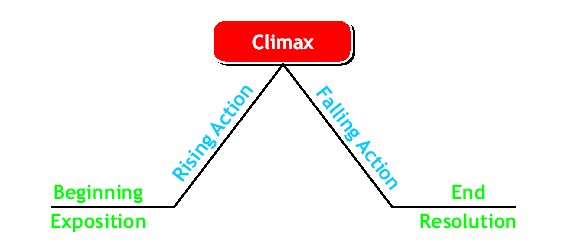
Exposition: The start of the story, the situation before the action begins.
Rising Action: The series of conflicts and crisis in the story that leads to the climax.
Climax: The turning point, the most intense moment in action.
Falling Action: Action which comes after the climax and moves towards the resolution.
Resolution: The conclusion and tying together of all threads.
Complete the following stories in about 150-200 words. Give a suitable title.
- “Dolly woke up in the middle of the night hearing some noise in her room …..”
- “It was late night when Tarun heard a loud thumping sound on the roof. It woke him up and his parents as well. He decided to …”
HINTS: Search – a bag with black powder – fallen with a parachute – informed police – explosive – important information – police caught terrorists – rewarded.
- Aryan was awfully quite today. He never sits quiet in the class. Mrs. Arora, Maths teacher always calls him a ‘Talking Machine’. He has been a busy bee in vacant periods. No one liked his calmness today. She soberly asked: “ Are you alright Aryan?” He didn’t respond. He sat there with tears rolling down his eyes …….
- Arjun pestered his mother to give him permission to go to the village fair ……
- A farmer was going to the market with his son to sell his donkey. He was very anxious to keep the creature in good condition. ……
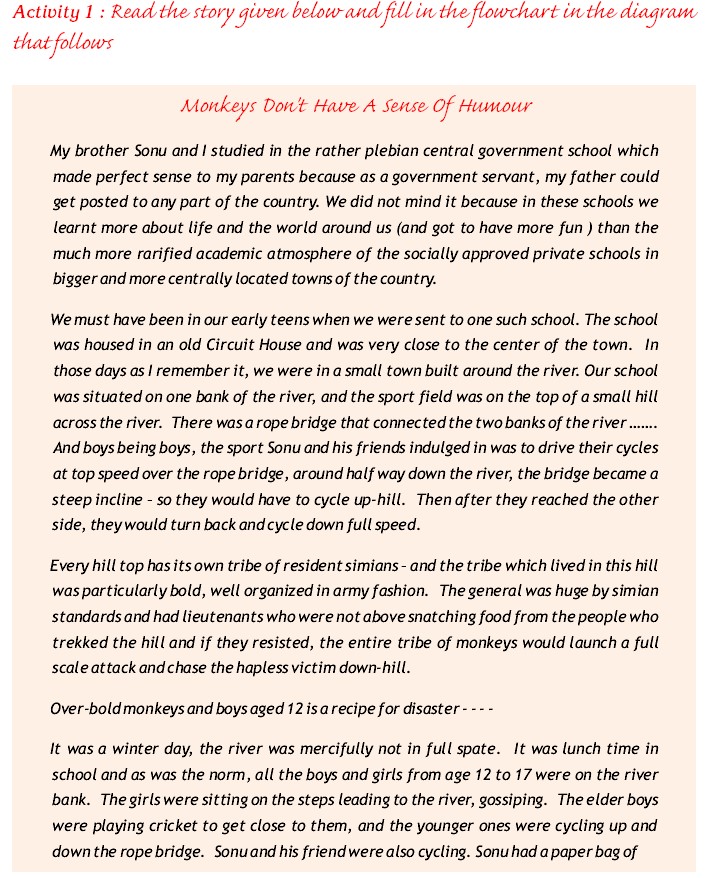

NOW IDENTIFY THE DETAILS REGARDING
(a) Setting: _________________________________________________________________
(b) Main Characters: ________________________________________________________
(c) Supporting Characters: ___________________________________________________
(d)Antagonist: _____________________________________________________________
(e) Climax: _________________________________________________________________
(f) Resolution: ______________________________________________________________
Free study material for English
CBSE Class 8 English Study Material: Writing Skills Short Story Writing
Comprehensive Study Resources for Writing Skills Short Story Writing
Explore essential learning tools for Class 8 English Writing Skills Short Story Writing. This curated collection features in-depth notes and targeted practice questions built around the active 2026 curriculum to streamline your daily revision.
Understanding Marking Schemes
Built using official NCERT guidelines for Class 8 English, these materials provide reliable academic support. Integrating past examination questions and step-by-step solutions helps students understand official CBSE grading criteria.
Complete Revision for English
Maximize your grade potential by utilizing Class 8 English practice papers in tandem with these structured notes. All printable assignments and interactive mock tests on our platform are updated for the 2026 session and available free of charge.
FAQs
Our advanced study package for Writing Skills Short Story Writing includes detailed concepts, diagrams, Mind Maps, and explanation of complex topics to ensure Class 8 students learn as per syllabus for 2026 exams.
The Mind Maps provided for Writing Skills Short Story Writing act as visual anchors which will help faster recall during high-pressure exams.
Yes, teachers use our Class 8 English resources for lesson planning as they are in simple language and have lot of solved examples.
Yes, You can download the complete, mobile-friendly PDF of the English Writing Skills Short Story Writing advanced resources for free.
Yes, our subject matter experts have updated the Writing Skills Short Story Writing material to align with the rationalized NCERT textbooks and have removed deleted topics and added new competency-based questions.