

Chapter-wise Worksheets for Class 6 Science: Chapter 02 Components of Food
Access comprehensive chapter-wise worksheets for Chapter 02 Components of Food using the CBSE Class 6 Science Components Of Food Worksheet Set 04. Designed to align with the 2026-27 academic syllabus for Class 6 Science, these printable practice sets help students reinforce key concepts and improve their overall exam readiness.
Practice Class 6 Science Worksheets: Chapter 02 Components of Food
Navigate directly to the solved Science worksheets using the digital viewer below. Each practice set includes detailed step-by-step solutions, allowing students to instantly cross-check their work and identify areas requiring further revision.
Match the Column
DIRECTIONS : Match Column-I with Column-II and select the correct answer using the codes given below the columns.
Question. Column-I (Disease) Column-II (Deficient substance)
(A) Scurvy (p) Iodine
(B) Rickets (q) Vitamin D
(C) Goitre (r) Vitamin A
(D) Night blindness (s) Vitamin C
(a) A → (s); B → (q) ; C → (p) ; D → (r)
(b) A → (s); B → (q) ; C → (r ; D → (p)
(c) A → (q); B → (p) ; C → (r) ; D → (s)
(d) A → (p); B → (r) ; C → (q) ; D → (s)
Answer : A
Question. Column-I (Components of diet) Column-II (Functions)
(A) Fats (p) Keeps our skin and eyes healthy
(B) Vitamin A (q) Helps our body to use calcium for bones and steeth
(C) Vitamin D (r) Sources of energy and essential fatty acids in diet.
(D) Water (s) Act as a lubricant
(a) A → (p); B → (q); C → (r); D → (s)
(b) A → (q); B → (r); C → (s); D → (p)
(c) A → (r); B → (p); C → (s); D → (q)
(d) A → (r); B → (p); C → (q); D → (s)
Answer : D
Question. Column-I (Mineral) Column-II (Source)
(A) Iron (p) Milk and milk products
(B) Calcium (q) Leafy green vegetables
(C) Iodine (r) Protein rich foods like meat, fish
(D) Phosphorus (s) Sea weeds
(a) A → (q); B → (p); C → (s); D → (r)
(b) A → (p); B → (q); C → (r); D → (s)
(c) A → (r); B → (s); C → (p); D → (q)
(d) A → (s); B → (r); C → (q); D → (p)
Answer : A
Question. Column-I (Nutrients) Column-II (Function)
(A) Fats & carbohydrate (p) Growth & repair
(B) Proteins (q) Protect our body against diseases
(C) Vitamins (r) Help to get rid of undigested food
(D) Roughage (s) Provide energy
(a) A → (s); B → (p); C → (q); D → (r)
(b) A → (p); B → (q); C → (r); D → (s)
(c) A → (r); B → (s); C → (p); D → (q)
(d) A → (s); B → (r); C → (q); D → (p)
Answer : A
Passage Based Questions
DIRECTIONS : Read the passage(s) given below and answer the questions that follow.
Passage-1
Carbohydrates mainly provide energy to our body.
Fats also give us energy. In fact, fats give much more energy as compared to the same amount of carbohydrates.
Foods containing fats and carbohydrates are called energy giving foods.
Question. Which of the following is not a plant source of fats?
(a) Ground nuts
(b) Milk
(c) Coconut oil
(d) Til
Answer : B
Question. Which one will give more energy for the same quantity?
(a) Mango
(b) Melon
(c) Maize
(d) Milk
Answer : D
Question. Which cereal is called the “carbohydrate rich” source of food?
(a) Wheat
(b) Rice
(c) Maize
(d) Barley
Answer : B
Passage-2
For growth and maintainance of good health, our diet should have all the nutrients that our body needs, in right quantities.
The diet should also contain good amount of roughage and water. Such a diet is called balanced diet.
Question. India is a developing country and a large number of its population is not getting a balanced diet because
(a) balanced diet is quite expensive.
(b) balanced diet need not contain roughage and water.
(c) roughages do not provide any nutrient to our body.
(d) All of the above
Answer : A
Question. Some nutrients get lost in the process of cooking and preparations. Which of the following nutrients is generally lost if vegetables and fruits are washed after cutting or peeling them?
(a) Carbohydrates
(b) Proteins
(c) Vitamins
(d) All of these
Answer : C
Question. Which of the following gets easily destroyed by heat during cooking?
(a) Vitamin A
(b) Vitamin B
(c) Vitamin C
(d) Vitamin D
Answer : C
Passage-3
Deficiency of one or more nutrients can cause diseases or disorders in our body, Diseases that occur due to lack of nutrients over a long period are called deficiency diseases.
Question. The deficiency of iron in our diet results into a diseases called
(a) rickets
(b) goitre
(c) scurvy
(d) anaemia
Answer : D
Question. If a person does not get enough proteins in food for a long time. He is likely to have
(a) stunted growth
(b) swelling of face
(c) discolouration of hair
(d) All of the above
Answer : D
Question. Which of the following is a symptoms of deficiency of vitamin D?
(a) Bones became soft and bent
(b) Weak bones and tooth decay
(c) Bleeding gums, wounds take longer time to heal
(d) Poor vision
Answer : A
Assertion/ Reason Based Questions
DIRECTIONS : The questions in this segment consists of two statements, one labelled as “assertion A” and the other labelled as “reason R”. You are to
examine these two statements carefully and decide if the assertion A and reason R are individually true and if so, whether the reason is a correct explanation of the assertion. Select your answers to these items using codes given below.
(a) Both A and R are true and R is the correct explanation of A.
(b) Both A and R are true but R is not the correct explanation of A.
(c) A is true but R is false.
(d) A is false but R is true.
Question. Assertion (A) : Deficiency of calcium causes rickets.
Reason (R) : In our diet milk and milk products are the major source of calcium.
Answer : B
Question. Assertion (A) : Foods containing proteins are called body building foods.
Reason (R) : Paneer is a plant source of protein
Answer : C
Question. Assertion (A) : Dried beans and eggs contain appreciable amounts of phosphorus.
Reason (R) : Milk and dairy products are excellent sources of phosphorus.
Answer : B
Question. Assertion (A) : Obesity occurs when one takes more food than requirement.
Reason (R) : The extra food gets stored as fat and the person becomes too fat.
Answer : A
Figure Based Questions
Question. The food items shown in the figure are sources of mainly of
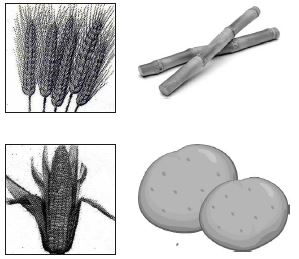
(a) fats
(b) carbohydrates
(c) proteins
(d) vitamins.
Answer : B
Question. You read a healthy diet that also contain fibre rich food in it. Can you identify the fibre rich food among the following
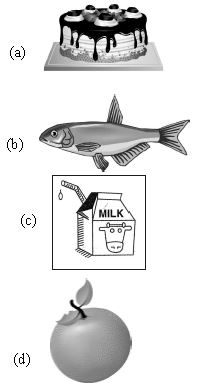
Answer : D
Question. Select the one which is not a part of salad?
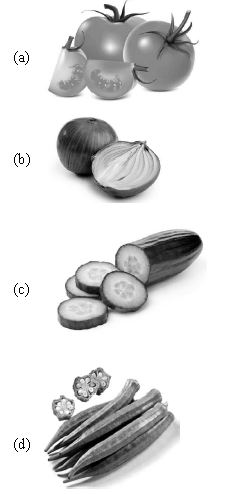
Answer : D
Question. Observe the given experimental figures carefully. What does this experiment prove?
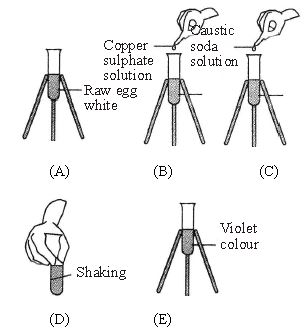
(a) Raw egg white contains proteins
(b) Raw egg white contains carbo-hydrates
(c) Raw egg white contains fats
(d) Raw egg white contains iodine
Answer : B
Question. The child in the given figure is suffering from a deficiency disease. This disease is caused due to deficiency of
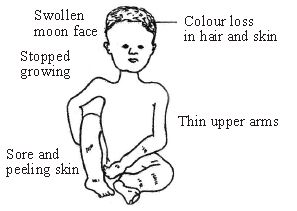
(a) carbohydrates
(b) proteins
(c) fats
(d) vitamins
Answer : B
Components Of Food
FILL IN THE BLANKS
1. The main carbohydrates found in our food are in te form of __________ and ______________.
2. Carbohydrates and fats provide ______________ to our body .
3. Foods containing carbohydrates and fats are also called ______________ giving foods.
4. Foods containing proteins are often called _________________________ foods.
5. Vitamin ________ gets easily destroyed by heat during cooking.
6. Over eating fat rich food leads to ________________
7. Deficiency diseases can be prevented by taking a _______________ diet.
8. _____________ help in protecting our body against diseases.
NAME THE FOLLOWING
1. Two sources of carbohydrates . __________________ _____________
2. Two sources of fats __________________ _____________
3. Two sources of protein __________________ ____________
4. Two sources of vitamin C __________________ ____________
5. Disease caused due to deficiency of iron ______________
6. Disease caused due to deficiency of vitamin A _____________
7. Disease caused due to deficiency of iodine_____________
TRUE OR FALSE
1. Dietary fibres are also known as roughage. _________
2. Minerals are needed by our body in large quantity. ___________
3. Our body prepares vitamin D in presence of sunlight. __________
DEFINE THE FOLLOWING
1Nutrients 2 Balanced diet 3 Deficiency diseases
DISTINGUISH BETWEEN
Proteins and Fats
EXTRA QUESTIONS
1Write the three groups of food and give examples
2 Write the test to show the presence of protein in any food item
3 Write the test to show the presence of starch in any food item
Components Of Food
1. The pigment which gives red colour to blood is _____________
2. The _____________ is also called school lunch or school meal programme
3. The diseases which occur due to imbalances in diet are called _______________diseases.
4. There are ______________essential nutrients in our food.
5. _________________is a term used to describe diets which lack proteins and carbohydrates.
6. The vitamin that gets easily destroyed by heat during cooking is ________________
7. About 70% of our body weight is that of __________________
II) Name the following :
1. Disease caused by deficiency of iron _________________
2. Disease caused by deficiency of iodine ______________
3. Disease caused by deficiency of vitamin D ________________
4. Disease caused by deficiency of vitamin C ________________
5. Disease caused by deficiency of vitamin B1 _______________
6. Disease caused by deficiency of vitamin A_______________
7. Diseases caused by deficiency of protein _______________ and _______________
8. Disease caused by deficiency of Fluorine ___________
9. Two sources of roughage __________ __________
III) True or False :
1. Fats provide more than double the energy provided by carbohydrates. __________
2. Calcium and phosphorous are required for making bones and teeth hard._____________
3. Vitamins and minerals are needed in large quantities.____________________
4. The condition arising out of inadequate or unbalanced food is called malnutrition , _____________________
5. Procesing of rice, wheat etc removes many of vitamin B1._________________
IV) Distinguish between
1. Carbohydrates and proteins
2. Body building foods and protective foods.
1. The chemical substances in food that our body needs are called
a) Nutrients
b) proteins
c) fats
d) carbohydrates
2. Some animals usually eat the dead bodies of other animals are called
a) producers
b) parasites
c) scavengers
d) herbivores
3. Herbivores are animals that eat only
a) Plants
b) flesh of other animals
c) both plants and animals
4. Carnivores are animals that eat only
(a) Plants
b) flesh of other animals
c) both plants and animals
5. Omnivores are animals that eat only
(b) Plants
b) flesh of other animals
c) both plants and animals
6. Animals that help to keep the surroundings clean are
(a) producers
b) parasites
c) scavengers
d) herbivores
7. The ingredients used to make food are mainly obtained from
(a) plants
b) animals
c) plants and animals
8. All food chains begin with
(a) plants
b) animals
c) plants and animals
9. Small animals that depend on other living animals for their food.
(a) ) producers
b) parasites
c) scavengers
d) herbivores
10. Which of these animals has a long, sharp pipe instead of teeth?
a) Mosquitoes
b) beers
c) frog
d) crow
11. Write two examples of following:-
(a) Herbivores
(b) Carnivores
(c) Omnivores
(d) Parasites
(e) Scavengers
Free study material for Science
Free CBSE Practice Worksheets: Class 6 Science Chapter 02 Components of Food
Daily Practice Questions for Class 6 Science
Review targeted practice exercises for Class 6 Science Chapter 02 Components of Food. Curated to match official CBSE guidelines, these printable problem sets support daily revision and improve overall test readiness.
Detailed Answers for Class 6 Science Chapter 02 Components of Food
Each worksheet draws directly from authorized standard textbooks to maintain academic accuracy. Evaluating your finished exercises against expert-verified solutions helps master the formal presentation standards expected in school evaluations.
Complete Your Chapter Revision
Wrap up your chapter revision by testing your knowledge against standard objective question formats. Explore our full library of free, up-to-date printable assignments to maximize your academic results in upcoming CBSE evaluations.
FAQs
You can download the latest chapter-wise printable worksheets for Class 6 Science Chapter 02 Components of Food for free from StudiesToday.com. These have been made as per the latest CBSE curriculum for this academic year.
Yes, Class 6 Science worksheets for Chapter 02 Components of Food focus on activity-based learning and also competency-style questions. This helps students to apply theoretical knowledge to practical scenarios.
Yes, we have provided solved worksheets for Class 6 Science Chapter 02 Components of Food to help students verify their answers instantly.
Yes, our Class 6 Science test sheets are mobile-friendly PDFs and can be printed by teachers for classroom.
For Chapter 02 Components of Food, regular practice with our worksheets will improve question-handling speed and help students understand all technical terms and diagrams.