CBSE Class 6 Science Motion And Measurement Of Distances Worksheet Set A

Read and download the CBSE Class 6 Science Motion And Measurement Of Distances Worksheet Set A in PDF format. We have provided exhaustive and printable Class 6 Science worksheets for Chapter 10 Motion and Measurement of Distances, designed by expert teachers. These resources align with the 2025-26 syllabus and examination patterns issued by NCERT, CBSE, and KVS, helping students master all important chapter topics.

Chapter-wise Worksheet for Class 6 Science Chapter 10 Motion and Measurement of Distances

Students of Class 6 should use this Science practice paper to check their understanding of Chapter 10 Motion and Measurement of Distances as it includes essential problems and detailed solutions. Regular self-testing with these will help you achieve higher marks in your school tests and final examinations.

Class 6 Science Chapter 10 Motion and Measurement of Distances Worksheet with Answers

MOTION AND MEASUREMENT OF DISTANCES

ACTIVITY- 13 .1: Measuring the time period of a simple pendulum. 
 
Question 1- What is simple pendulum? 
Answer : Heavy mass suspended by a thread from a rigid support is called simple pendulum. 
 
Question 2- What is the to and from motion of a simple pendulum called? 
Answer : Oscillation. 
 
Question 3- The taken for one oscillation of the pendulum is called its _________. 
Answer : Time period. 
 
Question 4- ________ is the number of oscillations per unit time. 
Answer : Frequency. 
 
ACTIVITY- 13 .2: Measuring the speed of a ball 
 
Question 1- What do you measure by using a stop clock? 
Answer : Time 
 
Question 2- What is the unit of measuring distance? OR Name the S.I. unit of distance. 
Answer : metre (m). 
EXERCISE 
Question 1- Fill In The Blanks
 
(i). The motion of an object in a straight line is called linear motion
(ii). A clock is used to measure time. 
(iii).The Distance-Time graph for uniform speed is a straight line
(iv).The motion of a simple pendulum is called oscillatory motion
 
Question 2- Write True Or False
 
(i). Speed is the distance travelled by an object per unit time. (False) 
(ii). The S.I. unit of speed is km/s. (True) 
(iii).The time taken to complete one oscillation of a pendulum is its time period. (True) 
(iv). The instrument used to measure the speed of a vehicle is odometer. (False) 
 
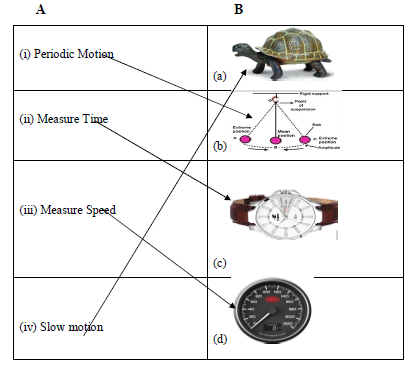
Question 3- Match The Column ‘A’ With Column ‘B’.

7th.sci.eng.july.aug.new 3 

Question 4. Multiple Choice Questions :
 
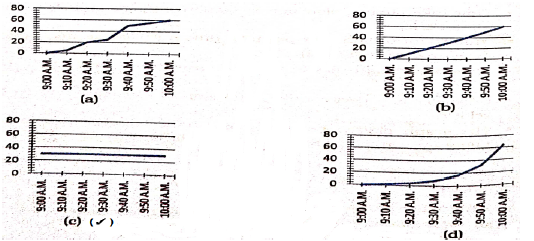
(i). Which of the following is a Distance-Time graph for an object at rest?

7th.sci.eng.july.aug.new 4 

(ii). Which of the following relation is correct for finding speed of an object? 

a) Speed = Distance x Time

b) Speed = Distance / Time (✓)

c) Speed = Time / Distance   
d) Speed = 1 / Distance x Time
 
(iii). Simple pendulum is an example of ……………. Motion.
a) Rectilinear motion
b) Oscillatory motion (✓)
c) Periodic motion
d) Rotational motion.
 
(iv). A car moves with a speed of 40 km/h for 15 minutes and then with speed of 60 km/h for the next 15 minutes. The total distance covered by the car is :
a) 100 km
b) 25 km(✓)
c) 15 km
d) 10 km
 
Question 5- Very Short Answer Type Questions.
 
(i) Define speed. Give its S.I. unit?
Answer : Speed is the distance covered by an object in unit time. S.I. unit of speed is metre (m).
 
(ii) Which instruments were used for measuring time by the ancient people?
Answer : Sundial, sand watch and water watch etc.
 
(iii) Name the instruments used for measuring (a) the speed of a moving vehicle, (b) the distance moved by a vehicle.
Answer : (a) The speed of a moving vehicle- Speedometer.
(b) The distance moved by a vehicle- odometer.
 
(iv) What is Graph? Give its types.
Answer : Graph- A Graph is a pictorial representation of variation of one quantity with respect to the other quantity.
Types- Line Graph, Bar Graph and Pie chart etc.
 
Question 6- Short Answer Type Questions.
 
(i) Differentiate between slow and fast motion. Give examples
Answer : Slow motion- An object is said to be in slow motion, if it takes more time to cover a certain distance.
Examples- Motion of a snail and tortoise.
Fast motion- An object is said to be in fast motion, if it takes shorter time to cover a certain distance.
Examples- Motion of a racing car and tiger.
 
(ii) Differentiate between uniform and non-uniform motion. Give examples.
Answer : Uniform motion- Object moving in a straight line at a constant speed are said to be in uniform motion. For example a train moving with constant speed on a straight track.
Non-uniform motion- Object moving in a straight line with a varying speed are said to be in nonuniform motion. For example motion of our bicycle while coming from home to school.
 
(iii) Ajay goes to his school 600 meters away from his house. Find the speed in ms-1 , with which he must walk to reach his school in 5 minutes.
Answer : Distance = 600 m
Time = 5 minutes = 5 X 60 seconds = 300 seconds
Speed = Distance / time =600/300
                                    = 2 ms-1.
 
(iv) The distance between two stations is 216 km. In how many hours will a train reach the destination which is moving at a speed of 20 m/s.
Answer : Distance = 216 km = 216 X 1000 m = 216000 m
Speed = 20 m/s
Time = ?
We know that, Speed = Distance / Time
So, Time = Distance / Speed
Time = 216000/20  = 10800 sec = 10800/3600  hours = 3 hours.
 
(v) Find the time period of a simple pendulum, which takes 20 s to complete 50 oscillations.
Answer : Time taken to complete 50 oscillations = 20 sec
Time taken to complete 1 oscillation = 20/50 = 0.4 sec.
 
Question 7- Long Answer Type Questions.
 
(i) Describe the method to find the time period of a simple pendulum.
Answer : Suspend the bob of simple pendulum with 1 metre long thread from a rigid support. Mark the mean position of pendulum on the floor with chalk. Take the bob to one side while keeping the thread stretched and start stop watch. Measure the time taken by pendulum to complete 20 oscillations. Divide this time with 20,you will get time period for 1 oscillation i.e. time period.
 
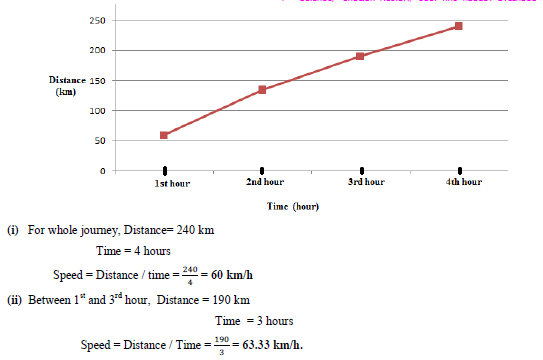
(ii) A car moves a distance of 60 km in 1st hour, 75 km in 2nd hour, 55 km in 3rd hour and 50 km in 4th hour. Plot a distance-time graph for the motion of the car.
(i) Find the speed of the car for the whole journey,
(ii) Find the speed of the car between 1st and 3rd hour.
Answer :

7th.sci.eng.july.aug.new 5

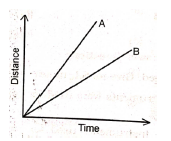
(iii) Figure shown below represents the distance-time graph for the motion of two vehicles A and B. Which one of them is moving faster?
7th.sci.eng.july.aug.new 6
Answer : Vehicle A is moving faster, because in graph A has more slope than vehicle B. In distance-time graph slope gives the speed.
 

ASSIGNMENT No.9

Q1. What is a unit? Why do we need standard units?

Q2. What is the standard unit of length?

Q3. Name the various units of measurement used in ancient times.

Q4. Why are hand span and cubit not used as standard units?

Q5. Convert:

1. 142cm = _____________ mm.

2. 5.4 km = _____________ m.

3. 7.5 m = _____________ cm.

Q6. Name the suitable measuring device you would choose to measure :

1. the size of your chest.

2. the length of a piece of cloth.

3. the length of a line segment.

4. the girth of a tree.

Q7.Mention the various precautions that you must keep in mind while taking measurements of the length of a object.

Q8. While measuring the length of a match box, the reading at one end is 1.0cm and at the other end is 4.3cm. What is the actual length of the match box?

Q9. Describe how you would measure the length of a curved line using a thread.

Q10. Define with examples:
a) Motion
b) Rectilinear motion
c) Circular motion
d) Periodic motion
e) Rolling motion.

Q11. Identify the types of motion in the following examples:
1. Heartbeat
2.Motion of a drawer of a table
3. Potter’s wheel
4. Motion of a drill machine
5. Wheels of a moving car
6. A boy sliding down a slope
7. An apple falling from a tree
8. Needle of a sewing machine

~ Class 6 Science (Old Chapters)
CBSE Class 6 Science Air Around Us Worksheet
CBSE Class 6 Science Body Movements Worksheet Set A
CBSE Class 6 Science Body Movements Worksheet Set D
CBSE Class 6 Science Changes Around Us Worksheet Set A
CBSE Class 6 Science Changes Around Us Worksheet Set D
CBSE Class 6 Science Components Of Food Worksheet Set A
CBSE Class 6 Science Components Of Food Worksheet Set B
CBSE Class 6 Science Components Of Food Worksheet Set C
CBSE Class 6 Science Components Of Food Worksheet Set D
CBSE Class 6 Science Components Of Food Worksheet Set G
CBSE Class 6 Science Electricity And Circuits Worksheet
CBSE Class 6 Science Fibre To Fabric Worksheet Set B
CBSE Class 6 Science Fibre To Fabric Worksheet Set C
CBSE Class 6 Science Fibre To Fabric Worksheet Set E
CBSE Class 6 Science Food Where Does It Come From Worksheet Set A
CBSE Class 6 Science Food Where Does It Come From Worksheet Set B
CBSE Class 6 Science Food Where Does It Come From Worksheet Set I
CBSE Class 6 Science Fun With Magnets Worksheet
CBSE Class 6 Science Garbage In Garbage Out Worksheet
CBSE Class 6 Science Getting To Know Plants Worksheet Set C
CBSE Class 6 Science Getting To Know Plants Worksheet Set E
CBSE Class 6 Science Getting To Know Plants Worksheet Set F
CBSE Class 6 Science Light Shadows And Reflections Worksheet Set A
CBSE Class 6 Science Light Shadows And Reflections Worksheet Set B
CBSE Class 6 Science Light Shadows And Reflections Worksheet Set E
CBSE Class 6 Science Living Beings And Their Surroundings Worksheet
CBSE Class 6 Science Living Organisms And Their Surroundings Worksheet Set A
CBSE Class 6 Science Living Organisms And Their Surroundings Worksheet Set C
CBSE Class 6 Science Motion And Measurement Of Distances Worksheet Set A
CBSE Class 6 Science Motion And Measurement Of Distances Worksheet Set B
CBSE Class 6 Science Motion And Measurement Of Distances Worksheet Set C
CBSE Class 6 Science Motion And Measurement Of Distances Worksheet Set D
CBSE Class 6 Science Motion And Measurement Of Distances Worksheet Set E
CBSE Class 6 Science Movements Of The Body And Air Worksheet
CBSE Class 6 Science Separation Of Substances Worksheet Set A
CBSE Class 6 Science Separation Of Substances Worksheet Set B
CBSE Class 6 Science Separation Of Substances Worksheet Set C
CBSE Class 6 Science Separation Of Substances Worksheet Set D
CBSE Class 6 Science Separation Of Substances Worksheet Set E
CBSE Class 6 Science Separation Of Substances Worksheet Set G
CBSE Class 6 Science Sorting Materials Into Groups Worksheet Set A
CBSE Class 6 Science Sorting Materials Into Groups Worksheet Set E
CBSE Class 6 Science The Living Organisms Worksheet
CBSE Class 6 Science Water Worksheet Set A
CBSE Class 6 Science Water Worksheet Set C
CBSE Class 6 Science Water Worksheet Set F
CBSE Class 6 Science Water Worksheet Set I

CBSE Science Class 6 Chapter 10 Motion and Measurement of Distances Worksheet

Students can use the practice questions and answers provided above for Chapter 10 Motion and Measurement of Distances to prepare for their upcoming school tests. This resource is designed by expert teachers as per the latest 2026 syllabus released by CBSE for Class 6. We suggest that Class 6 students solve these questions daily for a strong foundation in Science.

Chapter 10 Motion and Measurement of Distances Solutions & NCERT Alignment

Our expert teachers have referred to the latest NCERT book for Class 6 Science to create these exercises. After solving the questions you should compare your answers with our detailed solutions as they have been designed by expert teachers. You will understand the correct way to write answers for the CBSE exams. You can also see above MCQ questions for Science to cover every important topic in the chapter.

Class 6 Exam Preparation Strategy

Regular practice of this Class 6 Science study material helps you to be familiar with the most regularly asked exam topics. If you find any topic in Chapter 10 Motion and Measurement of Distances difficult then you can refer to our NCERT solutions for Class 6 Science. All revision sheets and printable assignments on studiestoday.com are free and updated to help students get better scores in their school examinations.

Where can I download the 2025-26 CBSE printable worksheets for Class 6 Science Chapter Chapter 10 Motion and Measurement of Distances?

You can download the latest chapter-wise printable worksheets for Class 6 Science Chapter Chapter 10 Motion and Measurement of Distances for free from StudiesToday.com. These have been made as per the latest CBSE curriculum for this academic year.

Are these Chapter Chapter 10 Motion and Measurement of Distances Science worksheets based on the new competency-based education (CBE) model?

Yes, Class 6 Science worksheets for Chapter Chapter 10 Motion and Measurement of Distances focus on activity-based learning and also competency-style questions. This helps students to apply theoretical knowledge to practical scenarios.

Do the Class 6 Science Chapter Chapter 10 Motion and Measurement of Distances worksheets have answers?

Yes, we have provided solved worksheets for Class 6 Science Chapter Chapter 10 Motion and Measurement of Distances to help students verify their answers instantly.

Can I print these Chapter Chapter 10 Motion and Measurement of Distances Science test sheets?

Yes, our Class 6 Science test sheets are mobile-friendly PDFs and can be printed by teachers for classroom.

What is the benefit of solving chapter-wise worksheets for Science Class 6 Chapter Chapter 10 Motion and Measurement of Distances?

For Chapter Chapter 10 Motion and Measurement of Distances, regular practice with our worksheets will improve question-handling speed and help students understand all technical terms and diagrams.