

Download Class 6 Science Practice Worksheets
Explore structured practice materials through the CBSE Class 6 Science Getting To Know Plants Worksheet Set 03. Tailored for Class 6 learners, utilizing these Science worksheets ensures thorough preparation and strengthens problem-solving accuracy before final school evaluations.
Access Chapter 07 Getting to Know Plants Practice Papers and Solutions
Navigate directly to the solved Science worksheets using the digital viewer below. Each practice set includes detailed step-by-step solutions, allowing students to instantly cross-check their work and identify areas requiring further revision.
Learning Objectives
1. Plants can be classified into herbs, shrubs and trees.
2. A flowering plant has 2 septum -shoot and root septum.
3. Roots are of two types-top and fibrous.
4. Stem conducts water and minerals. Some stems store food and water.
5. Leaf prepares food for the plant by photosynthesis.
6. Flower is the reproductive part of the plant.
7. Pollination and fertilization result in the formation of fruit.
Plants grow all around us. They grow on land as well as in water. There are about 2,50,000 types of plants.Carolus inneaus put forward a method of naming living things and classifying them into groups.
Classification of Plants:
I. Plants were divided into two broad groups – flowering plants and non-flowering plants. Flowering plants are rose, mango, sunflower and jasmine, etc. Ferns & mosses are non-flowering plants.
II. Based on their life span : Depending on the duration of their life cycle, there are three types of plants:
(i) Annuals : The life cycle of these plants is completed in one year. They grow, produce flowers and seeds during this period and then die. E.g. wheat, pulses, gram.
(ii) Biennials : These plants complete their life cycle in two years. These plants are usually herbs.
(iii) Perennials : These remain alive for many years. These are mostly shrubs and trees. They keep producing flowers, fruits and seeds year after year. E.g. neem, mango, Hibiscus, etc
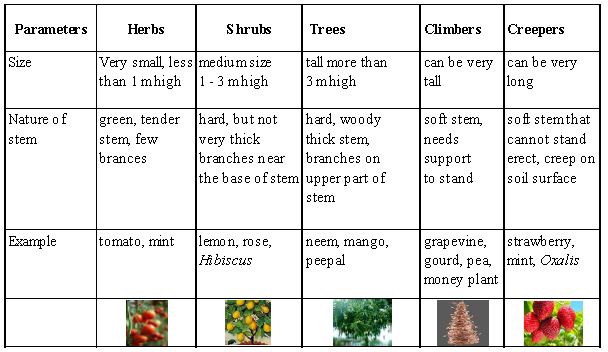
III. Classification based on the size and nature of stem.
Based on nature of stem plants can be grouped into
(a) Herbs
(b) Shrubs
(c) Trees
(d) Climbers
(e) Creepers
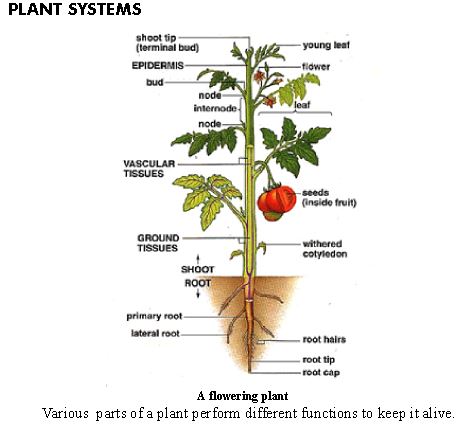
1. Root system : The part of the plant that grows below the surface of the soil is called the root. The root is a very important part of a plant. It has three main functions:
(i) It helps in holding the plant firmly in the soil.
(ii) They absorb water and dissolved minerals from the soil.
(iii) Some roots, like carrot and radish, store food for the plant.
Plants need water and minerals to stay alive-suck these from the soil and send them up to the rest of the plant. Roots generally grow in the direction where they find the correct amount of air, water and minerals needed for the plant.
Root Systems
Tap roots
A typical root consists of the following parts:-
(a) Primary root
(b) Secondary root
(c) Root cap and root hair (temporary)
Tap roots are true roots. They generally grow vertically downwards and give off lateral branches from main root. They develop from radicle of embryo (germinating seed).
Secondary root : These are lateral branches of the primary root which hold on to the soil and give mechanical support to the plant.
Root cap : It covers the tip of the main root. It protects the growing root tip.
Plants with tap roots bear leaves that are generally broad and have a criss cross network
Fibrous root:
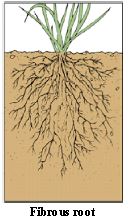
Fibrous root of grass : The fibrous roots generally grow in clusters of slender roots from the base of stem. These do not develop from radicle of embryo. They develop from any other part of plant. They do not have any secondary or primary root system. These do not have root caps. Plant with fibrous root bear leaves which are long and tapering and have parallel venation.
E.g. – wheat, rice, corn, grass and barley etc.
Modifications of Roots:
1. Storage : Roots of carrot, radish, sweet potato and beet root store food prepared by plant. Let eat these roots. Plants use this food when conditions are unfavorable.
Do You Know : The high energy roots of baobab tree are much sought after when nothing else grows during famine. In Rajasthan roots of khejri trees are eaten when crops fail.
2. Aerial roots : The banyan tree has roots that grow down from its branches.
They, provide support to the spreading branches of the huge tree. Such roots are called prop roots.
Do You Know : The big banyan tree in the Indian Botanical Garden near Kolkatta have more than 900 prop roots.
3. The roots in sugar cane and maize provide extra support to the thin stem. These are called stilt roots.
Do You Know : Pneumatophores are breathing roots seen in mangroves and other plants growing in swampy environment. They grow vertically upward, against gravity and help the plant get oxygen.
The Shoot System
The aerial part of the plant is called the shoot system. It consists of two regions.
1. The vegetative organs comprising the stem and leaf.
2. The reproductive organs, namely the flower.
The stem : It forms the main axis on which leaves, buds, flowers, branches and fruits arise.
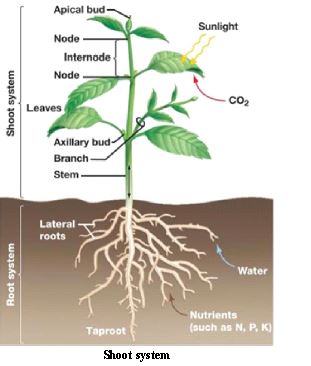
Stem develops from plumule of the embryo of the seed. Unlike roots, the stem has distinct regions called nodes from which the leaf arises. Region between two successive nodes is called internode. Angle between the stem and leaf is known as axil. Axil has a bud called axillary bud. Bud grow into a branch or a flower. At the tip of the stem is the terminal bud which is responsible for elongation of the plant.
| S.NO | Root | Stem |
| 1 | It is descending non green part of the plant grows towards the soil and water and away from sunlight. | It is ascending portion of axis of plant. It growsaway from soil and water but towards sunlight |
| 2 | It is not differentiated into nodes and internodes. | It is differentiated into nodes and internodes. |
| 3 | Root has rootlets and root hair and does not bear leaves, buds and flowers | Stem bears leaves, buds and flowers |
Functions of stems
1. It holds leaves in position and keep the plant upright.
2. It bears flowers, fruits, buds, leaves, etc., leaves are arranged in such a way that they are exposed to sunlight.
3. Green stem has chlorophyll and can carry out food manufacturing by photosynthesis.
4. It conducts water and minerals from roots to leaves. It also carries food made by leaves to other parts of the plant. Xylem tissue carries water and minerals and phloem tissue carries prepared food.
Stem Modifications
1. Storage of water : Stems of plants like cactus swell up to store water in them. They also have a waxy layer for protection from the sun.
2. To manufacture food : Stems of cactus become leaf like and flattened to perform photosynthesis.
3. For protection : Stems may be modified as thorns (as in Bougainvillea), prickles (as in rose), to protect the plant from being eaten by animals.
4. For support : Stems of some climbers like grapes are modified to form special structures called tendrils. These help the climber plant to coil round the support.
Do You Know : Cacti can gather and hold a lot of water in their stems. The water is not pure and clear but is thick viscous liquid. It is drinkable and has been known to save many lives in the desert.
5. For storage of food : Potato, onion and ginger are modified stems that store food. There are three kinds of underground stems:- Bulbs of onions & garlic, tuber of potato and rhizome of ginger.
6. For multiplication of the plant : Rhizomes, bulbs and tubers also help in multiplication of plant. Some plants like rose multiply by stem cutting.
The leaf is a flat, green lateral outgrowth of the stem, arising from the node. The flat portion of the leaf is called leaf blade or lamina. The lamina is attached to the stem by a stalk called petiole. Such leaves are called petiolate leaves and if the petiole is not distinct, the leaf is called sessile. At the tip of the leaf, lateral outgrowths called stipules are present. Petiole continues into parts of a leaf the leaf as midrib. Midrib branches out into venation of veins which may be criss cross in reticulate venation and parallel to each other in parallel venation. Midrib supports the leaf and the veins distribute water and nutrients throughout the leaf. Reticulate venation is seen in plants with tap roots and parallel venation is seen in plants with fibrous roots.
The green colour of the leaves is due to presence of a pigment called chlorophyll. They may sometimes have yellow, red or violet spots besides green colour. Such leaves are called variegated leaves.
Leaf surface also has small pores or openings called stomata which allow exchange of gases for photosynthesis, transpiration and respiration.
Functions of the Leaf
1. Photosynthesis : Leaves make food in the presence of sunlight with the help of water from soil and carbon dioxide from air. Chlorophyll traps sunlight and provides energy to the plant for making food by the leaves is called photosynthesis. The sugar that is prepared by leaves in glucose. This changes to starch and is stored in plant fruits, roots and stems.
Test for starch : When iodine solution is added to a leaf which has been boiled in water and spirit, shows blue-black colouration. This confirms presence of starch.
Experiments :
1. If a leafy branch is enclosed in a polythene bag and its mouth tied, and kept in the sun, droplets of water are seen in the bag. This water comes from the leaves due to a process called transpiration.
2. Put a leaf in a test tube and cover it with spirit. Keep the test tube in a beaker half filled with water and then heat the beaker till all the green colour from leaf disappears. Now remove the leaf and test the leaf for starch by putting some iodine solution on the leaf. Blue black colouration confirms presence of starch.
2. Transpiration : The pores present on the leaf surface allow excess of water from the plant to escape in the form of water vapour. This is called transpiration .It helps in cooling down the plant. Transpiration also exerts a pull on the roots which absorbs more nutrients from the soil. It also plays an important role in water cycle.
3. Protection : In cactus plants the leaves are modified into spines. They protect the plant from being eaten by grazing animals.
4. Respiration : There are many small pores called stomata on the leaves.
Through these holes, oxygen enters the leaves and carbon dioxide is released.
Modifications of leaf
1. Leaf tendril : Some of the upper portion of leaves are modified into tendrils. These tendrils coil around support.
2. Spines : In cactus, leaves are modified to form spines. This reduces loss of water from the leaves. Spines also protect the plant.
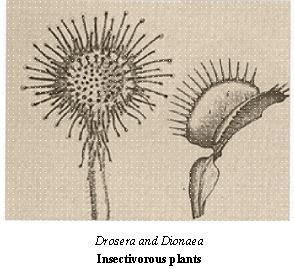
3. Insectivorous plant : Some plants cannot get enough nitrogen from the soil. So they become carnivorous.
They trap the insects and digest them to derive proteins.
E.g. Nepenthes and Venus fly trap.
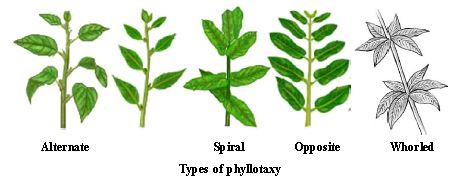
Arrangement of leaves on the stem is called phyllotaxy. There are three types of phyllotaxy such as, alternate, opposite and whorled.
Flower
The most attractive part of a plant is its flower. Many flowers have sweet smell and some have emplacement smell. Flower is the main reproductive organ of flowering plant
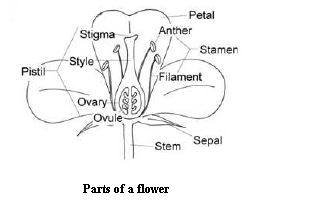
Pedicel : It is the axis in bearing the flower and joins it to the stem.
Thalamus : The upper part of pedicel is wide and slightly swollen. It is called receptacle or thalamus.
In an angiosperm flower, four whorls of leaf like structures arise from the thalamus. These are called floral leaves.
1. Calyx : The outermost whorl of green, leaf like structures is called calyx.
A single unit is called sepal. These protect the flower in the bud stage.
2. Corolla : Next to calyx in the whorl of brightly coloured leaf like structures. A single unit is called petal. Calyx and corolla together protect the inner whorls in the bud stage but later the petals secure to attract the insects for pollination.
3. Androecium : This is the third whorl from outside. The single units are called stamens. Stamens form the male reproductive part of the flower.
• Each stamen consist of a stalk called filament and at the tip of the filament is a sac like structure called anther. The anthers produce pollen grains which consist of male gametes.
• Gynoecium : This is the innermost whorl of the flower. It forms the female part of the flower. A single unit is called carpel.
• Each carpel consists of a swollen base called ovary, a short tube like part called style and a discoid tip called stigma.
• Stigma is usually sticky and forms the landing place for pollen grains.
Ovary contains small swells which contains the female gametes. Parts of gynoecium Parts of androecium
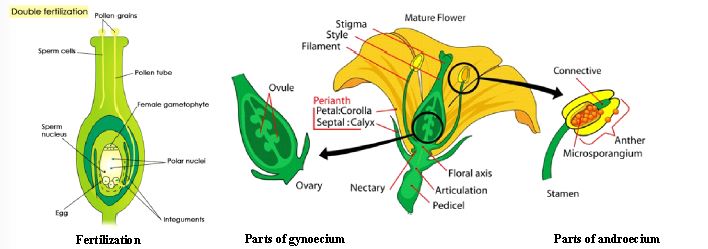
• Pollination : The transfer of pollen grains from the anther of a flower to the stigma of a flower is called pollination. It can occur by wind, water or insects.
Fertilization
• From the stigma, the male gametes travel downward through the style into the ovary and fuse with the female gamete. This results in formation of zygote. The process of fusion of male and female gametes is called fertilization.
• After fertilization, the sepals and petals wither and fall off. The ovary develops into a fruit and the ovules form seeds. The seeds contain the embryonic plant which under suitable conditions germinate into a new plant.
Key words
• Venation : arrangement of views on a leaf
• Lamina : the flat green portion of leaf
• Taproot : root which develops from radicle
• Flower : reproductive part of a plant
• Photosynthesis : process by which green plants manufacture food
Class-VI
L-7
Getting to know Plants
Part I - Assignment - I
1. Enlist the function of roots?
.............................................................................................................................
.............................................................................................................................
2. Enlist the function of stem?
.............................................................................................................................
.............................................................................................................................
3. Enlist the function of Leaf?
.............................................................................................................................
.............................................................................................................................
4. Give 2 examples of each __
a. Harbs .................... , ......................
b. Shrubs .................... , ......................
c. Trees .................... , ......................
5. What are the main difference between a taproot and fibrous root?
Taproot Fibrous root.
.......................................... ..........................................
.......................................... ..........................................
.......................................... ..........................................
.......................................... ..........................................
.......................................... ..........................................
.......................................... ..........................................
6. Fillup the following by using kewords given ____
Pistil, stem, root, anther, petal, filament.
i) The underground part of the plant is called _______________.
ii) The female reproductive part of the plant is _______________.
iii) The part of plant that conduct water and mineral is called __________.
iv) _________ and ___________ are parts of stamen.
v) ________ is the most attractive part of the flower
Students should free download the worksheets as per CBSE and CCE patters and get better marks in exams. Studiestoday.com panel of teachers recommend students to practice questions in the worksheets.
Free study material for Science
Download Class 6 Science Chapter 07 Getting to Know Plants Practice Worksheets
Download Chapter Worksheets: Class 6 Science
Access structured practice worksheets for Chapter 07 Getting to Know Plants aligned with the 2026 CBSE curriculum. These downloadable exercises for Class 6 Science help students build accuracy and reinforce core concepts for upcoming school tests.
Concept Clarification for Chapter 07 Getting to Know Plants
Each worksheet draws directly from authorized standard textbooks to maintain academic accuracy. Evaluating your finished exercises against expert-verified solutions helps master the formal presentation standards expected in school evaluations.
Effective Revision Strategies for School Exams
Consistent engagement with these exercises builds familiarity with recurring exam themes. If specific areas within Chapter 07 Getting to Know Plants cause trouble, utilize our dedicated NCERT solutions for Class 6 Science to clear up doubts immediately.
FAQs
You can download the latest chapter-wise printable worksheets for Class 6 Science Chapter 07 Getting to Know Plants for free from StudiesToday.com. These have been made as per the latest CBSE curriculum for this academic year.
Yes, Class 6 Science worksheets for Chapter 07 Getting to Know Plants focus on activity-based learning and also competency-style questions. This helps students to apply theoretical knowledge to practical scenarios.
Yes, we have provided solved worksheets for Class 6 Science Chapter 07 Getting to Know Plants to help students verify their answers instantly.
Yes, our Class 6 Science test sheets are mobile-friendly PDFs and can be printed by teachers for classroom.
For Chapter 07 Getting to Know Plants, regular practice with our worksheets will improve question-handling speed and help students understand all technical terms and diagrams.