

Chapter-wise Worksheets for Class 6 Science: Magnetism
Access comprehensive chapter-wise worksheets for Magnetism using the CBSE Class 6 Science Magnetism Worksheet Set 02. Designed to align with the 2026-27 academic syllabus for Class 6 Science, these printable practice sets help students reinforce key concepts and improve their overall exam readiness.
Practice Class 6 Science Worksheets: Magnetism
Navigate directly to the solved Science worksheets using the digital viewer below. Each practice set includes detailed step-by-step solutions, allowing students to instantly cross-check their work and identify areas requiring further revision.
Question. Some objects were classified into two groups as under.
Group 1 : Iron, graphite, silver
Group 2 : Rubber, plastics, wood
The classification of objects has been done using which one of the following categories?
(a) Magnetic substances and non-magnetic substances
(b) Metals and non-metals
(c) Conductors and insulators
(d) All the above
Answer : C
Question. A magnet is also called lodestone because
(a) it can lift load
(b) it is like a stone
(c) it helps us to locate directions
(d) All the above are correct
Answer : C
Question. The making of magnet of an iron needle with the help of a magnet is called
(a) magnetisation
(b) demagnetisation
(c) method of demagnetisation of an iron needle
(d) None of the above is correct
Answer : A
Question. North pole of a magnet is
(a) that pole of the magnet which points in north direction when the magnet is freely suspended
(b) that pole of the magnet which is known as north seeking end when magnet is freely suspended
(c) that pole of the magnet which is attracted towards the south pole of earth’s magnet
(d) All the above are correct
Answer : D
Question. The loss of magnetic properties by a magnet is called
(a) demagnetisation
(b) magnetisation
(c) dropping of magnet
(d) None of these
Answer : A
Question. Which of the following statement(s) is/are correct?
(a) A magnetic substance when brought near the north pole of a bar magnet gets attracted towards it
(b) A magnetic substance when brought near the south pole of a bar magnet gets attracted towards it
(c) A magnetic substance when brought near the middle of a bar magnet gets attracted towards it
(d) All the above are correct
Answer : D
Question. Which of the following can be used to find if the given iron piece is a magnet?
(a) By trying to attract another magnet
(b) By trying to repel another magnet
(c) By bringing another piece of iron near to it
(d) By trying to attract small pieces of paper.
Answer : B
Question. A compass
(a) is a device used by navigators to find the directions at a place
(b) is a device that makes use of a magnetic needle to locate the directions at a place
(c) Both the above are correct
(d) None of these are correct
Answer : C
Question. Which of the following statement(s) is/are correct?
(a) A bar magnet loses its magnetic properties to a large extent if it is dropped from some height
(b) A bar magnet that has been demagnetized can be again converted into a magnet
(c) Both the above are correct
(d) None of these are correct
Answer : C
Question. Select the proper method for storage of bar magnets
(a) bar magnets should be kept in pairs
(b) bar magnets should be kept in pairs with their unlike poles on the same side
(c) bar magnets should be kept in pairs with their unlike poles on the opposite sides
(d) All the above are correct
Answer : B
Question. Magnetite is
(a) a naturally occurring mineral
(b) an artificial magnet
(c) Both the above
(d) None of these
Answer : A
Question. Identify the function of magnetic belt from the following.
(a) To mix iron objects to trash
(b) To melt iron objects from trash
(c) To separate iron objects from trash
(d) To repel magnetic substances
Answer : C
Question. How many ends of a magnetic needle are painted red?
(a) 1
(b) 2
(c) 3
(d) 4
Answer : A
Question. The North end of the freely suspended magnet points towards .............?
(a) geographical East
(b) geographical North
(c) geographical West
(d) geographical South
Answer : D
Question. Which of the following features will you observe in the needle of compass?
(i) it will attract metals
(ii) it will show a deflection if a magnet is brought near it
(iii) it will always come to rest in east-west direction
(iv) it will always come to rest in north-south direction
(a) (i) and (ii)
(b) (i), (ii) and (iii)
(c) (ii) and (iv)
(d) (ii) only
Answer : C
Question. What characteristics do magnetic substances have?
(a) They can give a “shock” when you touch them.
(b) They can push or pull objects they are not touching.
(c) They are always black and cold to touch.
(d) They fall faster than other objects when you drop them.
Answer : B
Question. Which of the following cannot be used to make a magnet?
(a) Cobalt
(b) Iron
(c) Ebonite
(d) Steel
Answer : C
Question. The number of magnetic poles in a horse shoe magnet is/are
(a) 1
(b) 2
(c) 3
(d) 4
Answer : B
Question. Which of the following is not a non-magnetic substance?
(a) Glass
(b) Wood
(c) China ware
(d) Nickel
Answer : D
Question. For an electromagnet to have a magnetic field
(a) It must be heated
(b) It has to be touching another magnet
(c) It must be lined up with Earth’s magnetic field
(d) It must be connected to an electrical source
Answer : D
Question. What is our best evidence that Earth has a magnetic field?
(a) All things fall towards Earth’s centre.
(b) All compass needle lines up with it.
(c) Winds blows from east to west.
(d) Earth’s oceans have current.
Answer : B
Question. Magnet which is used in cranes to lift heavy containers from ships is a/an
(a) bar magnet
(b) cylindrical magnet
(c) electromagnet
(d) horseshoe magnet
Answer : C
Question. When a magnet is placed on a plastic plate with common pins spread on it, then maximum number of pins stick
(a) at the middle of the magnet
(b) at the ends of the magnet
(c) all around the magnet
(d) None of these
Answer : B
Question. Ancient people discovered magnetic rocks called lodestone. They use them
(a) to start fires
(b) for compasses
(c) for sculptures
(d) for telephone receivers
Answer : B
Question. How is earth similar to that of a magnet?
(a) It has North and South poles
(b) It is hundreds of miles long.
(c) It is made in Earth’s core.
(d) It is shaped like a horseshoe.
Answer : A
Question. .................. is the natural magnet.
(a) Magnetite
(b) Ebonite
(c) Cobalt
(d) Nickel
Answer : A
Question. Which of the following device using electromagnet?
(a) Electric bell
(b) Ceiling fan
(c) Electric motor
(d) All of the above
Answer : D
Fill in the blanks:
1)Two magnets when arranged as shown above, will _____ each other.
2)A _____ pole of a magnet will be attracted to the South pole of another magnet.
3)When two magnets are brought closer to each other, there might be attraction or repulsion. For each combination of poles below, fill whether there will be attraction or repulsion.
North-North
__________
North-South
__________
South-North
__________
South-South
__________
4)Two magnets, close to each other, with their south poles facing each other will _____ each other.
5)Materials which get attracted towards magnet are known as _________ materials.
6)Maximum iron fillings get stuck to the _____ of the bar magnet. (centre/poles) Answer in one word:
1)How many poles does a bar magnet have?
2)Name a non-magnetic metal.
3)Direction in which a suspended bar magnet points when at rest.
Match the Column
DIRECTIONS : Match Column-I with Column-II and select the correct answer using the codes given below the columns.
Question. Column - I Column - II
A. North-seeking pole (p) Pole of a freely suspended magnet which points to south.
B. South-seeking pole (q) cannot exists independently.
C. Electromagnet (r) Pole of a freely suspended magnet which points to north.
D. Magnetic poles (s) are used to lift heavy weights.
(a) A → (p); B → (q); C → (r); D → (s)
(b) A → (p); B → (r); C → (q); D → (s)
(c) A → (s) ; B → (p); C → (r); D → (q)
(d) A → (r) ; B → (p); C → (s); D → (q)
Answer : D
Passage Based Questions
DIRECTIONS : Read the passage (s) given below and answer the questions that follow.
Passage-1
A shepherd named magnes lived in Greece used to take his herd of sheeps and goats on a mountain for grazing.
He always carried a stick to control his herd.
The stick had a small piece of iron attached to one end.
One day he had to pull hard to free his stick from a rock on the mountain side.
Question. Why magnes has to pull hard to free his stick from a rock on the mountain side on that particular day?
(a) His stick was stuck in the bushes on the mountain.
(b) He was holding his stick in such a way that the portion of stick having small piece of iron attached was held by him in his hand.
(c) The portion of stick having iron piece attached to it was pointing towards rock and get attracted strongly by the rock
(d) None of these
Answer : C
Question. The credit for the discovery of natural magnet goes to
(a) Mendes
(b) Mendel
(c) Magnes
(d) None of these
Answer : C
Question. Magnes lived in
(a) Ancient India
(b) Ancient China
(c) Egypt
(d) Ancient Greece
Answer : D
Passage-2
One of the important property of magnet is that a freely
suspended magnet always rests in the same direction (North-South).
Question. The freely suspended magnet always rests in
(a) east-west direction
(b) north-south direction
(c) west-north direction
(d) None of these
Answer : B
Question. We want to find the exact direction at a place, to find this
(a) we can look at the rising sun at that place and then our face is in east direction, on our left will be north.
(b) we can use a magnetic compass and find the direction by looking at its dial.
(c) both the above methods give us an exact knowledge of the directions.
(d) None of the above is correct
Answer : B
Question. One end of magnetic needle in the magnetic compass is coloured red. This end of the needle does not always point towards
(a) south
(b) west
(c) east (d) both
(b) and (c)
Answer : D
Assertion/ Reason Based Questions
DIRECTIONS : The questions in this segment consists of two statements, one labelled as “Assertion A” and the other labelled as “Reason R”. You are to examine these two statements carefully and decide if the Assertion A and Reason R are individually true and if so, whether the reason is a correct explanation of the assertion. Select your answers to these items using codes given below.
(a) Both A and R are true and R is the correct explanation of A.
(b) Both A and R are true but R is not the correct explanation of A.
(c) A is true but R is false.
(d) A is false but R is true.
Question. Assertion (A) : It is easier to bring North pole of a magnet to South pole of other magnet.
Reason (R) : There is a force of attraction between unlike poles of magnet.
Answer : A
Question. Assertion (A) : Tennis ball attracts towards a magnet
Reason (R) : Tennis balls is a non-magnetic object.
Answer : D
Question. Assertion (A) : Iron is a non-magnetic substance.
Reason (R) : Iron is attracted towards a magnet.
Answer : D
Question. Assertion (A) : A magnet attracts cobalt.
Reason (R) : A horse shoe magnet is rectangular in shape.
Answer : C
Statement Based Questions
DIRECTIONS : Read the following two statementscare fully and choose the correct options.
(a) Statement (1) is correct while statement (2) is incorrect.
(b) Statement (2) is correct while statement (1) is incorrect.
(c) Both statements are correct
(d) Both statements are incorrect.
Question. Statement-1 : A compass is a device used to find directions.
Statement-2 : Electromagnet is used to make a magnetic compass.
Answer : A
Question. Statement-1 : Magnetite is a naturally occurring mineral.
Statement-2 : Magnetite attracts magnetic material but the force of attraction is weak.
Answer : C
Figure Based Questions
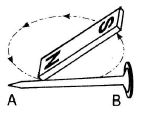
Question. A nail is magnetized as shown in the figure.
Which polarity will develop at A and B?
(a) A – North, B – North
(b) A – North, B – South
(c) A – South, B – South
(d) A – South, B – North
Answer : B
1. Explain the Induction method.
2. Explain the Double touch method.
3. Why is Magnetic force at the poles maximum.
4. What is the Directive property of a magnet?
5. Magnetic poles always occur in pairs.
6. State the uses of magnets.
Match the Column
DIRECTION : Match Column-I with Column-II and select the correct answer using the code given below the columns.
Question.
Column-I Column-II
A. Iron (p) Can be magnetised easily
B. Magnetite (q) A magnetic material
C. Aluminium (r) A light metal that is not a magnetic material
D. Nickel (s) A natural magnet
(a) A®(p); B®(q); C®(r); D®(s)
(b) A®(s); B®(r); C®(q); D®(p)
(c) A®(p); B®(s); C®(r); D®(q)
(d) A®(r); B®(q); C®(p); D®(s)
Answer : C
Question.
Column-I Column-II
A. Magnets (p) Occurs when a magnet is heated
B. Horse shoe magnet (q) Should be kept in pairs with their opposite poles on the same side.
C. Bar magnet (r) It is U-shaped
D. Demagnetisation (s) Must always be kept away from mobiles, T.V., Music system, computers, etc.
(a) A®(p); B®(r); C®(q); D®(s)
(b) A®(s); B®(q); C®(r); D®(p)
(c) A®(r); B®(p); C®(s); D®(q)
(d) A®(s); B®(r); C®(q); D®(p)
Answer : D
Passage Based Questions
DIRECTIONS (Qs.30-35 ) : Read the passage (s) given below and answer the questions that follow.
Passage-1
The trains that use magnets to float above a track is called Maglev (Magnetic Levitation) trains.
This trains work on the principle that like poles repel and unlike poles attract each other.
Due to magnetic force of attraction and repulsion this vehicle moves in forward direction.
This train does not require wheels.
Question. Maglev train
(1) floats above the guideway
(2) experiences very less friction
(3) does not require wheels
(a) (1) only (b) (1) and (3)
(c) (3) only (d) (1), (2) and (3)
Answer : D
Question. Maglev trains work on the principle that
(a) like poles repel each other
(b) unlike poles attract each other
(c) both (a) and (b)
(d) None of these
Answer : C
Question. What is used in Maglev trains instead of wheels?
(a) Bar magnets
(b) Horse shoe magnets
(c) Natural magnets
(d) Electromagnets
Answer : D
Passage-2
You are provided with a soil and asked to find out if the given soil contains some magnetic substance or not?
You rubbed a magnet in the soil and then pulled out the magnet.
Your magnet appeared as shown below:
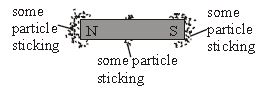
Question. The soil provided to you
(a) contains magnetic substance
(b) does not contain any magnetic substance
(c) Both the above are correct
(d) None of the above is correct
Answer : A
Question. The substance sticking to the magnet is
(a) iron
(b) cobalt
(c) nickel
(d) any magnetic substance
Answer : D
Question. When a magnet is brought near a heap of magnetic substance, the particles of magnetic substance will be attracted.
(a) attracted through out the length of bar magnet with the some force
(b) attracted more near north pole and less near south pole
(c) attracted more near south pole and less near north pole
(d) attracted more near the poles and less near the middle portion
Answer : D
Assertion/ Reason Based Questions
DIRECTIONS : The questions in this segment consists of two statements, one labelled as “Assertion A” and the other labelled as “Reason R”. You are to examine these two statements carefully and decide if the Assertion A and Reason R are individually true and if so, whether the reason is a correct explanation of the assertion. Select your answers to these items using codes given below.
(a) Both A and R are true and R is the correct explanation of A.
(b) Both A and R are true but R is not the correct explanation of A.
(c) A is true but R is false.
(d) A is false but R is true.
Question. Assertion (A) : Maglev is the train which does not require wheels.
Reason (R) : Maglev train experiences very less friction.
Answer : B
Question. Assertion (A) : Strength of electromagnet depends on the magnitude of current flowing through them.
Reason (R) : Electromagnets are used to lift heavy weights.
Answer : A
Question. Assertion (A) : The north pole of a freely suspended magnet points towards geographic north.
Reason (R) : Using pieces of iron we can make artificial magnets.
Answer : B
Question. Assertion (A) : A compass is a magnetic device that is used by sailors to find directions.
Reason (R) : The sailor can find directions by use of dial of magnetic compass even if there is no magnetic needle fixed in the compass.
Answer : C
Question. Assertion (A) : A simple magnetic compass can be prepared by inserting a magnetised iron needle in a piece of cork and allow the cork to float in water kept in a bowl.
Reason (R) : In the above arrangement the needle must touch water while floating.
Answer : C
Statement Based Questions
DIRECTIONS : Read the following three statements carefully and choose the correct option.
(a) Statement (1) and (3) are incorrect while statement (2) is correct.
(b) Statement (1) and (2) are incorrect while (3) is correct.
(c) All the statements are correct.
(d) All the statements are incorrect.
Question. Statement-1 : Permanent magnet can never lose its magnetic property.
Statement-2 : Two magnets should never stored with like poles alongside for a long time.
Statement-3 : On heating magnetic property of a magnet increases.
Answer : A
Figure Based Questions
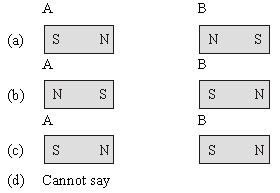
Question. Magnets A and B are of equal magnetic strength.
In which position will magnets A and B have the greatest attractive force towards each other?
Answer : C
Question. Letters A, B, C, and D represent locations on a bar magnet.
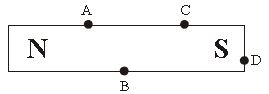
Which location has the greatest magnetic force?
(a) A
(b) B
(c) C
(d) D
Answer : D
Question. The diagram below shows a bar magnet resting on top of a piece of white paper. The north and south poles of the magnet are labeled N and S. Points A, B, C, and D represent four locations around the magnet.
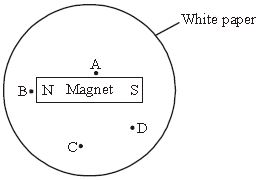
If iron filings were sprinkled evenly across the entire paper circle, at which location would the greatest concentration of iron filings be found after 30 seconds?
(a) A
(b) B
(c) C
(d) D
Answer : B
Question. A student put five ring magnets on a pencil. The magnets are labeled 1, 2, 3, 4, and 5.
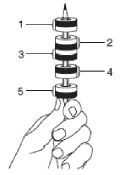
Which two magnets are attracting each other?
(a) 1 and 2
(b) 2 and 3
(c) 3 and 4
(d) 4 and 5
Answer : B
Question. A magnet is freely suspended in air as shown in diagram and another magnet is brought near it as shown in the diagram. What will be observed
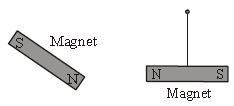
(a) It will show repulsion
(b) It will show attraction
(c) Nothing will happen
(d) Can’t predict
Answer : A
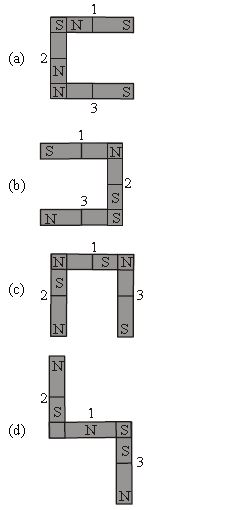
Question. Choose the correct method for arranging three bar magnets.
Answer : C
Question. Look at the figure showing iron pins being attracted towards nail in (ii) and tell which of the following is demonstrated by it?
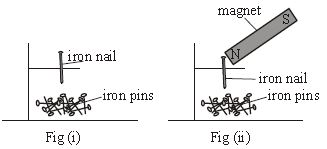
(a) Pins get converted into artificial magnet in fig. (ii)
(b) Pins gets demagnetised in fig. (i)
(c) The iron nail becomes an artificial magnet in fig. (ii)
(d) None of the above occurs
Answer : C
Question. The results of some observations about the number of iron pins attracted by a bar magnet are shown below. In your opinion which of the given reading are correct?
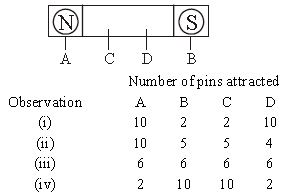
Answer : A
Question. The correct method of making an artificial magnet is
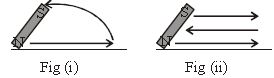
(a) as shown in fig. (i)
(b) as shown in fig. (ii)
(c) Both are correct
(d) None of these is correct
Answer : A
Question. Why is the ring magnet P floating on ring magnet Q in the given figure?
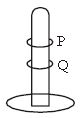
(a) Magnet P is lighter as compared to magnet Q.
(b) Magnet Q is more powerful as compared to magnet P.
(c) Like poles of magnets P and Q are facing each other.
(d) Unlike poles of magnets P and Q are facing each other
Answer : C
1. Define magnetic and non- magnetic substances with examples.
2. Enumerate and draw the types of magnets.
3. State the properties of magnets.
4. State the different methods of making a magnet.
Free study material for Science
Magnetism Printable Worksheets and Exercises for Class 6 Science
Mastering Magnetism with Printable Worksheets
Explore reliable practice questions for Magnetism tailored for Class 6 Science learners. Use these structured worksheets to evaluate exam preparedness and strengthen problem-solving skills throughout the 2026 academic session.
Verified Solutions and NCERT Alignment
Designed around the official curriculum for Class 6 Science, these practice sheets guarantee standard compliance. Reviewing step-by-step solutions after completion sharpens your accuracy and clarifies complex sub-topics within Magnetism.
Additional Study Resources for Class 6 Science
Wrap up your chapter revision by testing your knowledge against standard objective question formats. Explore our full library of free, up-to-date printable assignments to maximize your academic results in upcoming CBSE evaluations.
FAQs
You can download the latest chapter-wise printable worksheets for Class 6 Science Magnetism for free from StudiesToday.com. These have been made as per the latest CBSE curriculum for this academic year.
Yes, Class 6 Science worksheets for Magnetism focus on activity-based learning and also competency-style questions. This helps students to apply theoretical knowledge to practical scenarios.
Yes, we have provided solved worksheets for Class 6 Science Magnetism to help students verify their answers instantly.
Yes, our Class 6 Science test sheets are mobile-friendly PDFs and can be printed by teachers for classroom.
For Magnetism, regular practice with our worksheets will improve question-handling speed and help students understand all technical terms and diagrams.