

Chapter-wise Worksheets for Class 6 Science: Chapter 05 Separation of Substances
Access comprehensive chapter-wise worksheets for Chapter 05 Separation of Substances using the CBSE Class 6 Science Separation Of Substances Worksheet Set 03. Designed to align with the 2026-27 academic syllabus for Class 6 Science, these printable practice sets help students reinforce key concepts and improve their overall exam readiness.
Practice Class 6 Science Worksheets: Chapter 05 Separation of Substances
Access the complete worksheet PDF for Class 6 Science below. Regular practice with these targeted academic tasks builds familiarity with standard question patterns and helps secure higher marks in final school examinations.
Match the Column
DIRECTIONS : Match Column-I with Column-II and select the correct answer using the codes given below the columns.
Question.
| Column-I | Column-II |
| A. The process of removal of larger particles from | (p) Decantation smaller ones. |
| B. The process of separation of butter from milk. | (q) Filtration |
| C. The process of separation of components of a | (r) Churning muddy water. |
| D. The process of separation of components of | (s) Sieving a mixture of oil and water. |
(a) A → (p), B →(q), C→ (r), D → (s)
(b) A → (s), B →(r), C→ (q), D → (p)
(c) A → (r), B →(s), C→ (p), D → (s)
(d) A → (q), B →(s), C→ (p), D → (r)
Answer : B
Question.
| Column-I | Column-II |
| A. The process involved when a heavier component | (p) Condensation in a mixture settles after water is added to it. |
| B. The process where by the liquid layer above | (q) Evaporation the settled heavier component is removed. |
| C. The process in which the liquids get | (r) Sedimentation converted to gases (vapours) on heating. |
| D. The process in which gases (vapours) get | (s) Decantation converted to liquids on cooling. |
(a) A → (r), B →(s), C→ (q), D → (p)
(b) A → (q), B →(r), C→ (p), D → (q)
(c) A → (p), B →(q), C→ (r), D → (s)
(d) A → (s), B →(r), C→ (q), D → (p)
Answer : A
Passage Based Questions
DIRECTIONS : Read the passage(s) given below and answer the questions that follow.
Passage-1
You are provided with a thoroughly grinded mixture consisting of dry sand and powdered dry leaves.
You are asked to separate the components of this mixture either by using the process of winnowing or by any other process.
Question. Which other process would you use to separate the components of this mixture?
(a) Threshing
(b) Hand picking
(c) Filtration
(d) None of these
Answer : D
Question. Winnowing is based on which property of component of a mixture?
(a) Difference in size
(b) Difference in weight
(c) Difference in shape
(d) Difference in colour
Answer : B
Question. Which component of the mixture will fall near the platform used for winnowing?
(a) Sand
(b) Dried leaves
(c) Both of these
(d) None of these
Answer : A
Passage-2
You are asked to add two spoons of solid salt to some liquid water taken in a beaker.
On stirring it you find that whole of the salt has disappeared and only liquid can be seen in beaker.
Question. After stirring the salt completely disappears and you can see only liquid in the beaker. The liquid in beaker is
(a) water
(b) solution
(c) solute
(d) solvent
Answer : B
Question. Which of the following processes will be useful to get salt from this solution?
(a) Condensation
(b) Evaporation
(c) Filtration
(d) Sedimentation
Answer : B
Question. Which process can you use to get liquid water from the water vapours if you collect them in another container?
(a) Sedimentation
(b) Condensation
(c) Evaporation
(d) Filtration
Answer : B
Assertion/ Reason Based Questions
DIRECTIONS : The questions in this segment consists of two statements, one labelled as “Assertion A” and the other labelled as “Reason R”. You are to examine these two statements carefully and decide if the Assertion A and Reason R are individually true and if so, whether the reason is a correct explanation of the assertion. Select one of the current options (a), (b), (c) and (d) given below in each questions.
(a) Both A and R are true and R is the correct explanation of A.
(b) Both A and R are true but R is not the correct explanation of A.
(c) A is true but R is false.
(d) A is false but R is true.
Question. Assertion (A) : The process of settling of heavier insoluble particles from a suspension of a substance in water known as decantation.
Reason (R) : This process along with sedimentation is used to get clear water from muddy water.
Answer : C
Question. Assertion (A) : The process of conversion of liquid water to its vapours by heating the liquid is called evaporation.
Reason (R) : The process of conversion of water vapours to liquid by cooling the vapours is called condensation.
Answer : B
Statement Based Questions
Directions : Read the following two statements carefully and choose the correct option.
(a) Statement (i) is correct while statement (ii) is incorrect.
(b) Statement (ii) is correct while statement (i) is incorrect.
(c) Both statements are correct.
(d) Both statements are incorrect.
Question. (i) A mixture of sand and salt is partly soluble in water.
(ii) The process of threshing is used to separate grains from stalks.
Answer : C
Question. (i) If the solid dissolve in liquid, then decantation process can be used to separate them.
(ii) Oil and water solution can be separated by decantation.
Answer : B
Question. (i) A solution that is capable of dissolving more of solute at the given temperature is known as saturated solution.
(ii) A saturated solution on heating becomes unsaturated solution.
Answer : B
Figure Based Questions
Question. The apparatus shown in picture below is used in the process of filteration. Name of this apparatus is
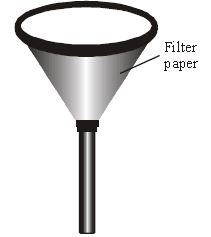
(a) separating funnel
(b) connical flask
(c) filter funnel
(d) stirrer
Answer : C
Question. The diagram shows which process of separation?
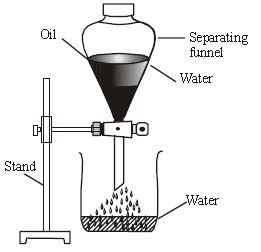
(a) Sedimentation
(b) Decantation
(c) Filtration
(d) Distillation
Answer : B
Question. A solution is given which is prepared by adding sugar crystals to water. The solution as shown in diagram is
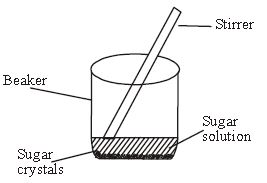
(a) a saturated solution
(b) an unsaturated solution
(c) a clear solution
(d) a suspension
Answer : A
Question. Which two methods of separation are shown in Fig. I and Fig. II?
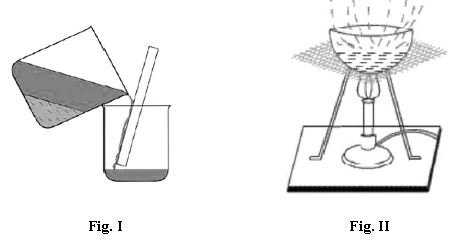
(a) Fig. I → Evaporation, Fig II → Decantation
(b) Fig. I → Sedimentation, Fig II → Decantation
(c) Fig. I → Decantation, Fig II → Filtration
(d) Fig. I → Decantation, Fig II → Evaporation
Answer : D
Free study material for Science
Download Class 6 Science Chapter 05 Separation of Substances Practice Worksheets
Daily Practice Questions for Class 6 Science
Explore reliable practice questions for Chapter 05 Separation of Substances tailored for Class 6 Science learners. Use these structured worksheets to evaluate exam preparedness and strengthen problem-solving skills throughout the 2026 academic session.
Detailed Answers for Class 6 Science Chapter 05 Separation of Substances
Each worksheet draws directly from authorized standard textbooks to maintain academic accuracy. Evaluating your finished exercises against expert-verified solutions helps master the formal presentation standards expected in school evaluations.
Complete Your Chapter Revision
Follow up your worksheet practice by attempting the interactive online MCQ tests for Chapter 05 Separation of Substances to evaluate your execution speed. All printable assignments and revision sheets on our platform are updated for the 2026 session and available free of charge.
FAQs
You can download the latest chapter-wise printable worksheets for Class 6 Science Chapter 05 Separation of Substances for free from StudiesToday.com. These have been made as per the latest CBSE curriculum for this academic year.
Yes, Class 6 Science worksheets for Chapter 05 Separation of Substances focus on activity-based learning and also competency-style questions. This helps students to apply theoretical knowledge to practical scenarios.
Yes, we have provided solved worksheets for Class 6 Science Chapter 05 Separation of Substances to help students verify their answers instantly.
Yes, our Class 6 Science test sheets are mobile-friendly PDFs and can be printed by teachers for classroom.
For Chapter 05 Separation of Substances, regular practice with our worksheets will improve question-handling speed and help students understand all technical terms and diagrams.