

Class 6 Science Practice Sheet: CBSE Class 6 Science Sorting Materials Into Groups Worksheet Set 05
Access comprehensive chapter-wise worksheets for Chapter 04 Sorting Materials Into Groups using the CBSE Class 6 Science Sorting Materials Into Groups Worksheet Set 05. Designed to align with the 2026-27 academic syllabus for Class 6 Science, these printable practice sets help students reinforce key concepts and improve their overall exam readiness.
Download Chapter 04 Sorting Materials Into Groups Worksheet PDF with Answers
Navigate directly to the solved Science worksheets using the digital viewer below. Each practice set includes detailed step-by-step solutions, allowing students to instantly cross-check their work and identify areas requiring further revision.
DIRECTION : Match Column-I with Column-II and select the correct answer using the code given below the columns.
Question.
Column I Column II
A. Aluminum (p) Transparent
B. Sand (q) Translucent
C. Glass (r) Dull appearance
D. Oiled paper (s) Shiny appearance
(a) A → (p); B → (q); C → (r); D → (s)
(b) A → (q); B → (r); C → (s); D → (p)
(c) A → (r); B → (q); C → (s); D → (p)
(d) A → (s); B → (r); C → (p); D → (q)
Answer : D
Question.
Column I Column II
A. Transparent (p) Butter paper
B. Opaque (q) Window glass
C. Translucent (r) Copper
D. Lustre (s) Wood
(a) A → (s), B → (p), C → (r), D → (q)
(b) A → (r), B → (s), C → (q), D → (p)
(c) A → (q), B → (p), C → (s), D → (r)
(d) A → (q), B → (s), C → (p), D → (r)
Answer : D
Question.
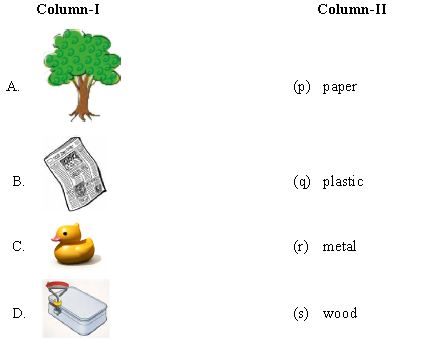
(a) A → (q); B → (p); C → (r); D → (s);
(b) A → (p); B → (s); C → (r); D → (q);
(c) A → (s); B → (p); C → (q); D → (r);
(d) A → (s); B → (q); C → (p); D → (r);
Answer : C
Passage Based Questions
DIRECTIONS : Read the passage(s) given below and answer the questions that follow.
Passage -1
Materials usually look different from each other. Wood looks very different from iron. Iron appears different from copper or aluminium. At the same time there may be some similarities between iron, copper and aluminium that are not their in wood
Question. In which property do iron, copper and aluminium differ from wood?
(a) appearance
(b) solubility in water
(c) hardness
(d) None of these
Answer : A
Question. Which one of the following will float over surface of water?
(a) Copper wire
(b) Sawdust
(c) Chalk piece
(d) None of these
Answer : B
Question. An iron smith, look out for freshly cut surfaces of metal rods to see if they have lustre. What other process can be used to see if a material has lustre or not?
(a) Heat the material
(b) Wash the material with water
(c) Rub the surface of material with sand paper
(d) Allow the material to remain exposed to air for some time.
Answer : C
Passage -2
We have two beakers A and B. Beaker A contains some sugar dissolved in water whereas beaker B contains some salt dissolved in water.
Question. What is the total number of components present in the two beakers?
(a) 1
(b) 2
(c) 3
(d) 4
Answer : C
Question. What is the total number of components that is common to the contents of both the beakers?
(a) 1
(b) 2
(c) 3
(d) 4
Answer : A
Question. What is the total number of components in each beaker?
(a) 1
(b) 2
(c) 3
(d) 4
Answer : B
Passage -3
Study the Venn diagram given below that represents the characteristics that materials may have.
On the basis of the diagram answer the following questions.
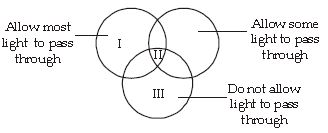
Question. Which of the following substance represent (I)?
(a) Wood
(b) Mirror
(c) Window glass
(d) Plastic
Answer : C
Question. Which of the following substance represents (II) ?
(a) A butter paper
(b) A plastic bag
(c) A paper bag
(d) A flower vase
Answer : D
Question. Which of the following substance represents (III)?
(a) Windscreen of a car
(b) Cellophane paper
(c) Wooden door
(d) Salt solution
Answer : C
Passage -4
On the basis of given information answer the questions given below:
Notebook, glass, pencil, cement, gravel, wooden bowl, brick, ink, silver breclet, gold coin.
Question. Number of things made up of paper are ______.
(a) 1
(b) 4
(c) 3
(d) 2
Answer : A
Question. Number of things that are lustrous ___________
(a) 3
(b) 2
(c) 1
(d) None of these
Answer : B
Question. Number of things that are used in construction __________.
(a) 4
(b) 2
(c) 3
(d) 1
Answer : C
Passage -5
Look at the following venn diagram and answer the questions.
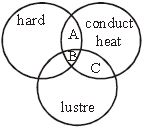
Question. Which of the following represent ‘A’?
(a) Plastic handle of a fry pan
(b) Wooden spoon
(c) Steel spoon
(d) Glass
Answer : C
Question. Which of the following represent ‘C’?
(a) Rusted iron nail
(b) Plastic flower vase
(c) Bark of tree
(d) Steel fry pan
Answer : D
Question. Which of the following represent ‘B’?
(a) Wooden bowl
(b) Gold jewellery
(b) Silver anklet
(d) Both (b) and (c)
Answer : D
Assertion/ Reason Based Questions
DIRECTIONS : The questions in this segment consists of two statements, one labelled as “Assertion A” and the other labelled as “Reason R”. You have to examine these two statements carefully and decide if the Assertion A and Reason R are individually true and if so, whether the reason is a correct explanation of the assertion. Select your answers to these items using codes given below.
(a) Both A and R are true and R is the correct explanation of A.
(b) Both A and R are true but R is not the correct explanation of A.
(c) A is true but R is false.
(d) A is false but R is true.
Question. Assertion (A) : Some plastics are transparent in nature
Reason (R) : We can see clearly through some plastic containers.
Answer : A
Question. Assertion (A) : It would not be wise to use plastic materials for cooking vessels.
Reason (R) : We choose materials to make an object depending on its properties, and the purpose for which object is to be used.
Answer : B
Question. Assertion (A) : Shopkeepers usually keep biscuits, sweets etc in transparent containers of glass or plastic.
Reason (R) : Buyers could see through the transparent materials.
Answer : A
Question. Assertion (A) : Wood, plastic and paper are poor conductor of heat.
Reason (R) : Poor conductors are also called insulators.
Answer : B
Question. Assertion (A): Rain coats are made up of plastic like material.
Reason (R) : Plastic is waterproof
Answer : A
Question. Assertion(A) : Cotton is used in stuffing of soft toys
Reason (R) : Cotton floats in water
Answer : B
Statement Based Questions
DIRECTIONS : Read the following three statementsca refully and choose the correct option.
(a) Statement (i) and (iii) are incorrect while statement (ii) is correct.
(b) Statement (i) and (ii) are incorrect while (iii) is correct.
(c) All the statements are correct.
(d) All the statements are incorrect.
Question. (i) When we see through oiled paper we can see clearly everything on the other side of paper.
(ii) A note book has lustre.
(iii) A piece of wood floats on water.
Answer : B
Question. (i) Iron is a non-magnetic material.
(ii) Petrol, and coconut oil are water soluble materials.
(iii) A dry leaf floats on water.
Answer : B
Question. (i) Sugar does not dissolve in water.
(ii) Oil and saw dust sinks in water.
(iii) Oil and wax are miscible with water.
Answer : D
Question. (i) Sand and sugar floats on water.
(ii) Properties of plastics are different from metals.
(iii) Metals are non-lustrous materials.
Answer : A
Question. (i) Sponge is compressible substance.
(ii) Vinegar and alcohol dissolves in water.
(iii) Wood and coal are hard materials.
Answer : C
Question. (i) Wood and plastic are heat conductors.
(ii) Air is transparent.
(iii) Sulphur and graphite does not dissolve in water.
Answer : A
Question. (i) A notebook has lustre while eraser does not.
(ii) Chalk dissolves in water.
(iii) Vinegar do not dissolves in water.
Answer : D
Figure Based Questions
DIRECTIONS (Qs. a to c) : On the basis of following diagram/picture answer the questions given below :
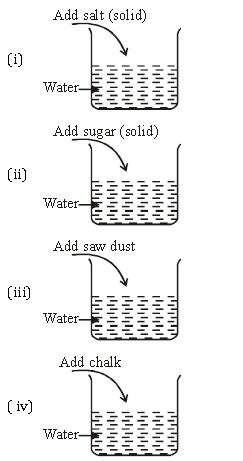
Question a. In which container would you find some solid at the bottom of container even after stirring the mixture?
(a) (i)
(b) (ii)
(c) (iii)
(d) (iv)
Answer : D
Question b. In which container you would find something floating on the surface of water?
(a) (i)
(b) (ii)
(c) (iii)
(d) (iv)
Answer : C
Question c. The soluble substance is present in container(s)
(a) (i) only
(b) (ii) only
(c) (i) and (ii)
(d) (i),(ii) and (iii)
Answer : C
DIRECTIONS (a to b) : Look at the following picture of a playground and answer the following questions.
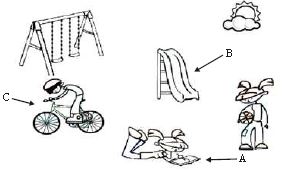
Question a. Object ‘A’ is made up of which of the following materials?
(a) Wood
(b) Rubber
(c) Metal
(d) Paper
Answer : D
Question b. Object ‘B’ is made up of which of the following material?
(a) Plastic
(b) Rubber
(c) Metal
(d) both (a) and (c)
Answer : D
Question c. Object ‘C’ is made up of which of the following material?
(a) Paper
(b) Wood
(c) Metal
(d) Rubber
Answer : C
Sorting Materials into Groups
1) Fillup the following ________
1. Material which can be compressed or scratched easily are called ___________
2. Material which are difficult to compress are called _______________.
3. Iron and copper have ______________ on their surface after rubbing with sand paper.
4. ___________ is man made transparent substance / object.
5. ___________ does not mix in water.
6. ___________ and ___________ are opaque.
Fill in the blanks
1. Objects are made up of large variety of ________________.
2. Tumblers are made with materials that can hold ___________________.
3. Materials that have lustre are usually called as ____________________.
4. Three examples of metals are ____________,_____________& ________________.
5. The gas which can dissolve in water is _________________.
6. Materials are grouped together on the basis of _____ and _________ in their properties.
7. Some metals lose their shine and often look dull because of the action of ______ and ________________ on them.
8. Based upon transparency, materials can be grouped as ______, _____ and ____________.
Name the following:
1. Two liquids soluble in water
2. Two liquids insoluble in water
3. Two transparent objects
4. Two translucent objects
5. Two opaque objects
6. Two solids soluble in water
Write true or false :
1. Stones and nails float on water.
2. Cotton is soft while iron is hard.
3. We choose a material to make an object depending on its properties and the purpose for usage.
Define the following:
1. Transparent materials 2. Translucent materials 3. Opaque materials
Distinguish between soluble and insoluble substances.
Answer the following questions:
1. Why do we need to group materials?
2. Name any four properties that can be used for sorting materials.
Sorting Materials Into Groups
I) Fill in the blanks :
1. A substance which is used in making different objects is called _________________
2. The materials which occur in nature are called _______________ materials.
3. The materials made by man are called ______________materials.
4. The materials which have natural shine on their surface are called ____________
5. The substances which dissolves in water are called _____________substances and which do not dissolve in water are called __________substances.
6. _____________is called the universal solvent.
7. The liquids which dissolve in water are called ____________liquids and which do not dissolve in water are called ____________liquids.
II) Name the following :
1. A liquid metal ____________
2. Two miscible liquids____________ ____________
3. Two immiscible liquids ___________ ___________
4. Two soluble substances in water____________ ____________
5. Two insoluble substances in water ____________________ ___________
6. Two substances that float on the surface of water _______________
7. Two substances that sink in water ____________ ___________
III) True or False :
1. All gases are non lustrous.___________
2. Iodine crystals have luster.____________
3. All gases are opaque materials._________
4. Butter paper, oiled paper etc are transparent materials.____________
IV) Distinguish between :
1. Soluble / insoluble
2. Hard / soft
V) Define :
1. Transparent
2. Opaque
3. Translucent
Free study material for Science
CBSE Class 6 Science Worksheets for Chapter 04 Sorting Materials Into Groups
Practice Exercises for Class 6 Science Chapter 04 Sorting Materials Into Groups
Review targeted practice exercises for Class 6 Science Chapter 04 Sorting Materials Into Groups. Curated to match official CBSE guidelines, these printable problem sets support daily revision and improve overall test readiness.
Step-by-Step Solutions and Practice Guidelines
Each worksheet draws directly from authorized standard textbooks to maintain academic accuracy. Evaluating your finished exercises against expert-verified solutions helps master the formal presentation standards expected in school evaluations.
Enhance Speed with Online Practice
Wrap up your chapter revision by testing your knowledge against standard objective question formats. Explore our full library of free, up-to-date printable assignments to maximize your academic results in upcoming CBSE evaluations.
FAQs
You can download the latest chapter-wise printable worksheets for Class 6 Science Chapter 04 Sorting Materials Into Groups for free from StudiesToday.com. These have been made as per the latest CBSE curriculum for this academic year.
Yes, Class 6 Science worksheets for Chapter 04 Sorting Materials Into Groups focus on activity-based learning and also competency-style questions. This helps students to apply theoretical knowledge to practical scenarios.
Yes, we have provided solved worksheets for Class 6 Science Chapter 04 Sorting Materials Into Groups to help students verify their answers instantly.
Yes, our Class 6 Science test sheets are mobile-friendly PDFs and can be printed by teachers for classroom.
For Chapter 04 Sorting Materials Into Groups, regular practice with our worksheets will improve question-handling speed and help students understand all technical terms and diagrams.