

Download Class 6 Science Practice Worksheets
Review targeted academic worksheets with the CBSE Class 6 Science Magnetism Worksheet Set 01. Built according to official educational standards for the 2026-27 term, these downloadable Class 6 Science resources support effective daily practice and detailed self-evaluation for Magnetism.
Access Magnetism Practice Papers and Solutions
View or download the dedicated CBSE Class 6 Science Magnetism Worksheet Set 01 resource below. Engaging with these practice papers under focused study conditions ensures continuous academic progress and mastery of the 2026-27 curriculum for Magnetism.
Learning Objectives
1. Introduction
2. Magnetic and Non-magnetic materials
3. Poles of a magnet
4. Directive properties of magnets
5. Types of magnets - Permanent, Temporary magnets - Electromagnets
6. Maglev
7. Loss of Magnetism
INTRODUCTION
Magnet was discovered about 4000 years ago. We observe that filings of some materials like iron, nickel, cobalt etc., cling to magnets, however other things
around us like wood, plastic etc. are not affected by the presence of magnet near them. The name magnetite has been derived from magnesia and magnets are named after magnetite.
You must have often observed that when a refrigerator door is opened a little and left, it shuts by itself. Also many cupboard doors also click shut the same way. It happens because they have magnets inside. Thus we can define magnets as the materials which attract certain substances (magnetic) like iron, cobalt, nickel etc.
The ancient greeks observed electric and magnetic phenomena as early as 700 B.C. They found that a piece of amber when rubbed attracts pieces of straw or feathers
MAGNETIC AND NON-MAGNETIC MATERIALS
All objects are not attracted to magnets. When we bring a magnet near various objects, some are attracted to the magnet and some are not.
The materials which get attracted to the magnets are called magnetic materials. Iron, Cobalt and Nickel are some examples of magnetic materials. On the other hand, the materials which are unaffected by magnets are called non-magnetic materials. Wood, plastic, gold, silver, cotton etc., are some examples of non-magnetic materials.
POLES OF A MAGNET
The magnetic forces are strongest at the two ends of a bar magnet. These ends are called the poles of a magnet. There are two poles of every magnet and they are termed as North Pole and South Pole
It is important to note that the two poles cannot exist independently. Poles always exist in pairs. So if a magnet is cut into pieces, then even the smallest piece of a magnet will have both the poles.
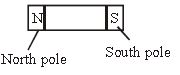
Magnets help in case of mental unrest by applying the south pole of a weak magnet to the forehead for about 10 minutes daily.
Attraction and Repulsion
It is observed that when the ends of two magnets are brought near each other, they either pull towards or push away from each other. The pulling of magnets towards each other is termed as attraction and pushing away from each other is called repulsion.
When North pole of a magnet is brought near the North pole of another magnet or South pole of a magnet is brought near the South pole of another magnet, they repel each other i.e., like poles repel each other.
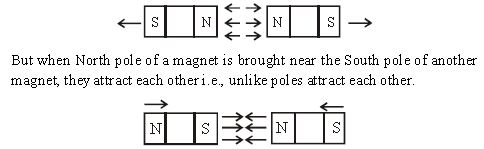
Remember : It is repulsion and not attraction is the sure tests for polarity of a magnet.
DIRECTIVE PROPERTIES OF MAGNETS
When a magnet is allowed to move freely, it comes to rest in such a way that its North-South lies very close to the earth’s South-North direction. This directive property of a magnet can be used to find directions on the surface of earth. Magnetic compass is the instrument used to find directions.
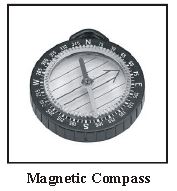
A magnetic compass has a magnetic needle at its centre that rotates freely. The magnetic needle always points in the North-South direction.
A freely suspended magnet always comes to rest in the north-south direction.
The earth’s magnetism exists due to its molten iron core.
In the 13th century, sailors using lodestone as a compass to help them find their way across the seas.
TYPES OF MAGNETS
There are two types of magnets
1. Temporary magnets
2. Permanent magnets
1. Temporary magnets : Temporary magnets are those which retain their magnetic properties only over a short interval of time. Temporary magnets are usually made of iron, cobalt or nickel. They behave as magnets under the influence of a strong magnet and lose their magnetism as soon as the strong magnet is removed. Electromagnets are temporary magnets.
Superconductors are the strongest magnets that are made from coils of wire.
Electromagnets : The magnets in which the magnetism has been produced by passing electric current through them are called electromagnets.
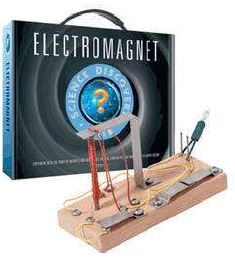
Eletromagnets behave as magnets so long as the current is flowing through them and the magnetism disappears as soon as the flow of current stops.
The strength of electromagnets depends on the magnitude of current flowing through them.
Earths magnetic field helps migration of birds from one place to another.
Uses of electromagnets
· Electromagnets are used to lift tons of scrap metal because the strength of electromagnets can be increased as per the requirement.
· Electromagnets are used in the door bell, electric fan, etc.
2. Permanent magnets : The magnet whose magnetism lasts for a long time or does not lose its magnetism is called permanent magnet.
MAGLEV TRAIN
The word Maglev stands for magnetic levitation. Maglev train is a train that uses magnets to float above a track. The principle of a maglev train is that like poles repel and unlike poles attract each other.
The magnets are arranged in a specific manner that moves the train along the guideway. Maglev train floats above the track, so it experiences very less friction. Thus, speed of a maglev train is very high exceeding 500 km/h.
LOSS OF MAGNETISM
A permanent magnet can lose its magnetic properties i.e., demagnetised under following conditions:
• Mishandling or rough handling.
• Two magnets if stored with North pole alongside the North pole of the other magnet for a long time.
• Hammering or heating.
• Dropping a magnet from a height.
In order to prevent magnet from getting demagnetised, a piece of iron called keeper is placed across the poles of the magnet.
Multiple Choice Questions
Question. The lodestone is a
(a) temporary magnet
(b) artificial magnet
(c) natural magnet
(d) None of these
Answer : C
Question. A piece of iron should place across the poles of horse shoe magnet
(a) to conserve its magnetic property
(b) to increase its magnetic property
(c) to make it demagnetise
(d) to decrease its magnetic property
Answer : A
Question. The attractive property of magnet was discovered by
(a) Indians
(b) Chinese
(c) Greeks
(d) Japanese
Answer : C
Question. The magnets which retain their magnetic properties only over a short interval of time are called
(a) natural magnet
(b) artificial magnet
(c) permanent magnet
(d) temporary magnet
Answer : D
Question. Magnetic compass
(a) always points in N-S direction
(b) used to find directions
(c) is a magnet
(d) all of these
Answer : D
Question. Which of the following does not get demagnetised when a powerful magnet is kept near it?
(a) compact disc
(b) iron container
(c) cell phone
(d) comb
Answer : D
Question. You are advised not to store your floppy disk near a magnet because
(a) it may cause your magnet to rust
(b) it may make you magnet weaker
(c) it may erase the information stored in your disk
(d) it may break your disk
Answer : C
Question. When two magnets are stored with North pole alongside the North of the other magnet for a long time.
(a) its magnetic property increases
(b) its magnetic property decreases
(c) its magnetic property remains same
(d) none of these
Answer : B
Question. The two poles of any magnet are
(a) east pole and west pole
(b) north pole and south pole
(c) north pole and west pole
(d) south pole and east pole
Answer : B
Question. Shapes of natural magnets are.......
(a) horse-shoe
(b) irregular
(c) cylindrical
(d) regular
Answer : B
Question. A freely suspended magnet always rests in
(a) north-south direction
(b) south-north direction
(c) east-west direction
(d) Both (a) and (b) are correct
Answer : D
Question. A magnet is likely to loose its magnetic properties when
(a) it is wrapped in cotton wool
(b) it is struck with a hammer
(c) it is kept in a cool room
(d) None of the above is correct
Answer : B
Question. Following are some of the operations performed on magnet. Which of these can demagnetise the given magnet?
(1) Heating
(2) Hammering
(3) Keep it in close contact with another magnet is such away, that like poles are together
(4) Keeping it in water
(a) (1), (2) and (4)
(b) (1), (3) and (4)
(c) (1), (2) and (3)
(d) (2), (3) and (4)
Answer : C
Question. The pole of a freely suspended magnet that points towards north direction is called
(a) north seeking end
(b) south seeking end
(c) east seeking end
(d) west seeking end
Answer : A
Question. A magnet attracts which of the following metals?
(a) Iron
(b) Cobalt
(c) Nickel
(d) All of these
Answer : D
Question. Which of the following gets demagnetised when a powerful magnet is kept near it?
(a) Plastic ruler
(b) Compact disc
(c) Glass tumbler
(d) Wood
Answer : B
Question. Which part of a bar magnet will attract the maximum number of iron nails when it is brought near a heap of iron nails?
(a) North pole
(b) South pole
(c) Middle portion
(d) Near both poles
Answer : D
Question. A device used by pilots and navigators to find the direction is
(a) barometer
(b) thermometer
(c) magnetic compass
(d) none of these
Answer : A
Question. Which of the following are a group of nonmagnetic material?
(a) Plastic and wood
(b) Wood and iron
(c) Iron and cobalt
(d) Plastic and nickel
Answer : A
Question. A natural magnet has
(a) only one pole
(b) two poles
(c) can’t say
(d) unlimited number of poles
Answer : B
Question. When we break a magnet into pieces, each piece having
(a) North Pole only
(b) South Pole only
(c) both North and South Poles
(d) None of these
Answer : C
Question. A magnetic compass is a device that is used to show
(a) time
(b) mass
(c) temperature
(d) direction
Answer : D
Question. ................. is the surest test of magnetism.
(a) Attraction
(b) Rotation
(c) Repulsion
(d) None of these
Answer : C
Question. Two like poles of magnets always
(a) repel each other
(b) attract each other
(c) sometimes repel sometimes attract each other
(d) cann’t say
Answer : A
Question. The part of magnetic needle of magnetic compass that points towards north is generally coated with
(a) white colour
(b) blue colour
(c) red colour
(d) None of these
Answer : C
Question. Many household appliances contain magnet in them. Which of the following does not contain a magnet in it?
(a) Radio
(b) Fan
(c) Refrigerator
(d) Torch
Answer : D
Question. Magnetism of a magnet is lost by
(a) keeping in a box
(b) heating
(c) hammering
(d) both (b) and (c)
Answer : D
Question. Which of the following is a non-magnetic material?
(a) Iron
(b) Cobalt
(c) Nickel
(d) None of these
Answer : D
Question. Which part of a magnetic compass can rotate freely?
(a) The metal box
(b) The glass cover on metal box
(c) The magnetic needle
(d) The dial
Answer : C
Question. Why are cobalt, nickel and iron called magnetic substances?
(a) They can be converted into any shape by heating.
(b) They get attracted by a magnet.
(c) They get repelled by a magnet.
(d) None of the above is correct.
Answer : B
Question. Which of the following statement(s) is/are correct?
(a) A magnetic needle used in compass is not a magnet
(b) The dial of a compass can rotate freely
(c) One end of the magnetic needle of a compass is generally painted with red colour
(d) All the above are correct
Answer : C
Question. Which of the following is a magnetic element?
(a) Copper
(b) Aluminium
(c) Cobalt
(d) Zinc
Answer : C
Question. From a heap of sand and small iron pieces which method would you use to separate iron pieces from the heap?
(a) Hand picking
(b) By using a magnet
(c) Either of the two
(d) None of these two
Answer : B
Question. Which of the following statement(s) is/are correct?
(a) A freely suspended bar magnet always points in East-North direction.
(b) Glass is not a magnetic substance
(c) Plastic is a magnetic substance
(d) All the above are correct
Answer : B
Question. A rock is known as a natural magnet. The rock contains iron. The rock is called
(a) Magnes
(b) Magnesia
(c) Magnetite
(d) None of these
Answer : C
Question. Magnetic pole
(a) a point in a bar magnet where magnetic forces are strongest
(b) the central point of a bar magnet where the magnetic forces are least
(c) Both the above are correct
(d) None of the above is correct
Answer : A
Question. One end of magnetic needle in the magnetic compass is coloured red. This end of the needle always points
(a) towards south
(b) towards north
(c) towards east
(d) towards west
Answer : B
1) Classify the following materials as magnetic and non-magnetic:
plastic bottle, paper cup, glass rod, steel spoon, woolen sweater, iron lock, chalk stick, gold bangle, Key , Wood , Glass , Chalk , Pencil , Nail , Cup of tea , Book , Geometry box , Rubber , Needle , Fork
MAGNETIC NON-MAGNETIC
2)Vibha spread some iron fillings and put a magnet on top of them. The iron fillings got stuck to the magnet and looked as shown below.
Why did the iron fillings get attracted to the magnet and make this pattern? Why did they not stick all over the magnet? 3)
List 3 things by doing which, magnets may lose their property.
Magnetism
• Magnetite is a rock that has the property to attract objects made of iron.
• The substance that can attract iron, cobalt, or nickel is known as a magnet.
• Magnet was discovered by a shepherd named Magnes around 2000 B.C. who lived in Magnesia, Greece.
• With the passage of time, people learned to make magnets from iron pieces. These magnets are known as artificial magnets.
• Materials that get attracted towards the magnets are the magnetic materials.
• Materials that do not get attracted towards the magnets are the non-magnetic materials.
• Pin-holders, screwdrivers, refrigerator stickers, junkyard cranes, etc. consist of magnets.
• There are two poles of a magnet – North Pole (N) and South Pole (S).
• A large number of iron filings stick at the two poles of a magnet in comparison to the rest of the magnet body.
• Materials that get attracted towards the magnets are the magnetic materials.
• Materials that do not get attracted towards the magnets are the non-magnetic materials.
• Pin-holders, screwdrivers, refrigerator stickers, junkyard cranes, etc. consist of magnets.
• The magnet attached at the end of the mechanical arm of a crane is used to separate magnetic materials, i.e., those made up of iron, from the rest of the junk.
• There are two poles of a magnet – North Pole (N) and South Pole (S).
• A large number of iron filings stick at the two poles of a magnet in comparison to the rest of the magnet body.
• Afreely suspended bar magnet always aligns along North-South direction.
• The direction at a place can be identified with the help of a bar magnet or a magnetic compass.
• A magnetic compass consists of a magnetic needle that always comes to rest in the North-South direction.
• In older days, sailors found direction by suspending bar magnets.
• There are two poles of a magnet – North Pole (N) and South Pole (S).
• Like poles of two magnets always repel each other.
• Unlike poles of two magnets always attract each other.
• A magnetic compass works on this principle because the earth is considered as a huge bar magnet with its North and South poles aligned along the geographical South and North Poles respectively.
• Repulsion is considered the sure way for testing magnets.
There are several methods of making magnets, the simplest one is touch-stroke method.
• An iron bar becomes a bar magnet when one of the poles of a bar magnet is rubbed on it several times. This is known as touch-stroke method.
• Remember that the pole of the magnet and the direction of its movement should not change.
• You can convert iron nail, a needle or a blade into magnet by this method.
• A freely suspended bar magnet always aligns along North-South direction.
• Induced Magnetism: The temporarily acquired magnetism by a magnetic material such as soft iron or steel when placed near or in contact with a permanent magnet is known as induced magnetism.
• The direction at a place can be identified with the help of a bar magnet or a magnetic compass.
• A magnetic compass consists of a magnetic needle that always comes to rest in the North-South direction.
• In older days, sailors found direction by suspending bar magnets.
• Properties of Magnetic field lines
• Originate from the North pole and end at the South pole [outside the magnet]
• They are closed continuous lines
• Density of the lines increases near the poles and decreases away from the poles
• Lines never cross each other
• Like poles repel and unlike poles attract each other
• The region where magnetic field lines are crowded has relatively greater strength
• The magnetic poles of the Earth continuously change their position with time i.e., the magnetic North Pole becomes the magnetic South Pole and vice-versa. This phenomenon of flipping of poles is known as magnetic reversal.
• The angle of the horizontal plane between the geographic North (true North) and the magnetic North is known as magnetic declination.
• Magnetic field of the Earth: Earth behaves as a large magnet. The North Pole of the Earth acts like the south pole of a bar magnet and the South Pole of the Earth behaves like the north pole of the magnet.
• Neutral points: These are the points situated symmetrically on either side of a magnet where the magnetic field of the magnet and the horizontal component of the Earth magnetic field are equal in magnitude and opposite in direction. Hence, these two magnetic fields neutralise each other at these points.
1. When an electric current flows through a wire, it behaves as a magnet. This is called the magnetic effect of electric current.
2. Electric bell works on the principle of magnetic effect of electric current.
3. A compass needle shows deflection when brought near a current carrying wire.
4. An iron nail behaves as a electromagnet when a current is allowed to flow through a wire, which is wrapped around the nail.
5. Magnet is used to separate iron objects from a heap of garbage.
6. Types of electromagnet : Bar-shaped or I-shaped electromagnet and Horseshoe or U-shaped electromagnet
7. An electric bell works on the principle of electromagnetism.
Free study material for Science
Download Class 6 Science Magnetism Practice Worksheets
Mastering Magnetism with Printable Worksheets
Access structured practice worksheets for Magnetism aligned with the 2026 CBSE curriculum. These downloadable exercises for Class 6 Science help students build accuracy and reinforce core concepts for upcoming school tests.
Verified Solutions and NCERT Alignment
Built using official NCERT guidelines for Class 6 Science, these practice sheets provide reliable academic support. Cross-reference your completed work with our detailed solutions to learn standard answer-writing formats for CBSE exams.
Additional Study Resources for Class 6 Science
Wrap up your chapter revision by testing your knowledge against standard objective question formats. Explore our full library of free, up-to-date printable assignments to maximize your academic results in upcoming CBSE evaluations.
FAQs
You can download the latest chapter-wise printable worksheets for Class 6 Science Magnetism for free from StudiesToday.com. These have been made as per the latest CBSE curriculum for this academic year.
Yes, Class 6 Science worksheets for Magnetism focus on activity-based learning and also competency-style questions. This helps students to apply theoretical knowledge to practical scenarios.
Yes, we have provided solved worksheets for Class 6 Science Magnetism to help students verify their answers instantly.
Yes, our Class 6 Science test sheets are mobile-friendly PDFs and can be printed by teachers for classroom.
For Magnetism, regular practice with our worksheets will improve question-handling speed and help students understand all technical terms and diagrams.