

Official Class 6 Science Worksheets: Chapter 01 Food Where Does It Come From
Review targeted academic worksheets with the CBSE Class 6 Science Food Where Does It Come From Worksheet Set 09. Built according to official educational standards for the 2026-27 term, these downloadable Class 6 Science resources support effective daily practice and detailed self-evaluation for Chapter 01 Food Where Does It Come From.
Solved Practice Worksheets for Science
Access the complete worksheet PDF for Class 6 Science below. Regular practice with these targeted academic tasks builds familiarity with standard question patterns and helps secure higher marks in final school examinations.
Multiple Choice Questions
Question. The first link in all food chains is:–
(a) herbivore
(b) Carnivore
(c) Plants
(d) Omnivores
Answer : C
Question. Which of these ingredients is not obtained from plants or animals?
(a) Salt
(b) honey
(c) wheat
(d) milk
Answer : A
Question. Which of the following animals does not have teeth?
(a) snake
(b) lion
(c) mosquito
(d) elephant
Answer : C
Question. Which of the following animals is a parasite?
(a) tapeworm
(b) snake
(c) eagle
(d) crow
Answer : A
Question. Identify the spice
(a) Nutmeg
(b) Wheat
(c) Banana
(d) Salt
Answer : A
Question. Sugar is obtained from
(a) sugarcane
(b) beetroot
(c) Both (a) and (b)
(d) none
Answer : C
Question. Fruits provide
(a) vitamins
(b) Minerals
(c) water
(d) All the three
Answer : D
Question. Which of the following flowers in edible?
(a) Drumstick
(b) Banana
(c) Pumpkin
(d) All the above
Answer : D
Question. Which of the following stems are edible?
(a) Ginger, onion, potato
(b) Carrot, radish, pumpkin
(c) Carrot, ginger, onion
(d) Onion, potato, garlic
Answer : A
Question. Mushrooms are rich sources of :
(a) Roughage
(b) Proteins
(c) Roots
(d) Carbohydrates
Answer : B
Question. People of Rajasthan eat roots of khijri trees during
(a) festivals
(b) drought
(c) flood
(d) None of these
Answer : B
Question. Milk giving animals are called:-
(a) Dairy animals
(b) Milch animals
(c) Milk animals
(d) None of these
Answer : B
Question. What is added to milk to set curd?
(a) Bacteria
(b) Virus
(c) Fungi
(d) Lemon
Answer : A
Question. When lemon/vinegar is added to warm milk, it is called:-
(a) setting of milk
(b) curdling of milk
(c) pasteurization
(d) creaming
Answer : B
Question. Hens reared for eggs are called
(a) Broilers
(b) Layers
(c) Both (a) and (b)
(d) None of these
Answer : B
Question. Look at the following food chain
Grass → Zebra → Lion
Here grass is a __________
(a) herbivore
(b) omnivore
(c) producer
(d) None of these
Answer : C
Question. Study the following food chain. What is wrongly depicted in this food chain?

(a) grasshopper eating frog
(b) frog eating grasshopper
(c) snake eating eagle
(d) eagle eating snake
Answer : C
Question. Which of the following is an insectivorous plant?

(a) only II
(b) only I
(c) II and III
(d) III and IV
Answer : C
Question. Which of the following is a function food?
(a) Food keeps us healthy and fit
(b) Food keeps us free from diseases
(c) Food given us energy to do work
(d) All of the above
Answer : D
Question. Germination of seeds is known as
(a) sapling
(b) sprouts
(c) vegetation
(d) None of these
Answer : B
Question. Identify a carnivore from the following
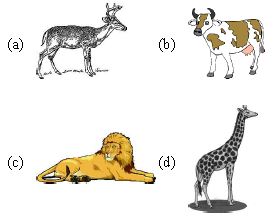
Answer : C
Question. The following parts of banana plant are used as food
(a) roots, fruits
(b) stem, leaves, fruits
(c) stem, fruits , flower
(d) flower, fruits
Answer : C
Question. Anita’s mother soaked some gram seeds in mater and left them overnight. Next day, she remoued the water and tied the seeds in a wet cloth. Next day Anita saw some white structures will develop into
(a) root
(c) flowers
(b) leaues
(d) stems
Answer : D
Question. Which of the following food is obtained from the roots of the plant?
(a) Radish, carrot, turnip
(b) Potato, ginger, onion
(c) Spinach, lettuce, mint
(d) Sugarcane, onion, ginger
Answer : A
Question. Food is stored in different parts of a plant.
Choose the parts of the plant from which the following food items (P,Q,R & S) are obtained and select the correct option
P Q R S
(a) Root stem leaf flower
(b) Stem leaf flower seed
(c) Fruit leaf flower seed
(d) Flower stem leaf fruit
Answer : B
Question. How do decomposers obtain their food ?
(a) Hunting and killing prey for food
(b) Changing carbon dioxide and water into food.
(c) Absorbing food from dead organisms
(d) Producing food from oxygen and sunlight
Answer : C
Question. Living things are classified as producers or consumers according to
(a) their speed of movement
(b) the size of their communities
(c) how they obtain food
(d) how they reproduce
Answer : C
Question. Grasses, shrubs, trees are called producers because they make
(a) water
(b) minerals
(c) food
(d) carbon dioxide
Answer : C
Question. Which of the following is a seed containing stored food ?
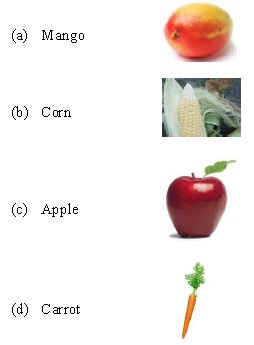
Answer : B
Question. When you are eating sugarcane, you are actually eating
(a) fruit of sugarcane
(b) root of sugarcane
(c) stem of sugarcane
(d) grains of sugarcane
Answer : C
Question. Whch one of the following does not belong to the group formed by the others ?
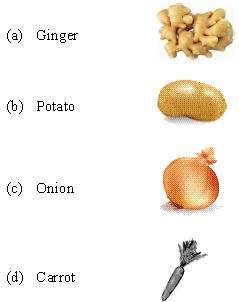
Answer : D
Question. Which of the following is not an ingredient for preparing dal?
(a) Pulses
(b) Kerosene
(c) Oil/ghee
(d) Salt
Answer : B
Question. The ingredients of kheer cooked at house are obtained from
(a) plants
(b) animals
(c) both plants and animals
(d) None of these
Answer : C
Question. The process of taking in food and utilizing it for the growth and development is known as
(a) nutrient
(b) nutrition
(c) ingredient
(d) None of these
Answer : B
Question. Brinjal is an important ingredient for preparation of brinjal curry. The part of brinjal plant that is source of this ingredient is
(a) root
(b) stem
(c) flower
(d) fruit
Answer : D
Question. Which plant part is the source of chilli used as spices?
(a) Stem
(b) Root
(c) Seed
(d) Fruit
Answer : D
Question. The soyabean oil is obtained from which part of the plant?
(a) Root
(b) Seed
(c) Fruit
(d) Stem
Answer : B
Question. Which of the following is not of animal source?
(a) Prawns
(b) Pork
(c) Beef
(d) None of these
Answer : D
Question. Which of the following is not a milk product?
(a) Butter
(b) Cheese
(c) Curd
(d) None of these
Answer : D
Question. The source of honey (a food article) is
(a) plant
(b) animal
(c) human beings
(d) Both (a) and (b)
Answer : B
Question. Clove and saffron are obtained from which plant part?
(a) Roots
(b) Stems
(c) Flower
(d) Fruits
Answer : C
Question. Sugar is extracted from
(a) fruits
(b) stems
(c) roots
(d) All of these
Answer : B
Question. The two underground stems used as food are
(a) radish and potato
(b) onion and arvi
(c) carrot and onion
(d) arvi and asparagus
Answer : B
Question. Which of the following leaves are used as spices?
(a) Coriander
(b) Peppermint
(c) Turmeric
(d) Red chillies
Answer : B
Question. Which of the following is added to food to make it tasty and to add flavour?
(a) Oil
(b) Tea
(c) Coffee
(d) Spices
Answer : D
Question. Herbivores do not eat meat but they can eat
(a) steak
(b) fish
(c) beef
(d) fruits
Answer : D
Question. Which part of the plant is cabbage?
(a) Root
(b) Stem
(c) Leaves
(d) Fruit
Answer : C
Question. Cereals are
(a) seeds mostly obtained from grasses
(b) fruits mostly obtained from grasses
(c) vegetables
(d) animal products
Answer : A
Question. Cocoa tree is the source of natural chocolate flavour, which part of the tree is the source?
(a) Roots
(b) Stem
(c) Seeds
(d) Leaves
Answer : C
Question. Nectar is
(a) a place where bees live
(b) honey
(c) sweet juice of flowers.
(d) name of queen bee.
Answer : C
Question. Milk, curd, paneer and ghee
(a) are all animal products
(b) are vegetables
(c) are plant products
(d) None of the above
Answer : A
Question. Read the following two statements carefully and choose the correct options.
I. Carrot and radish are underground roots.
II. Potato and ginger are underground roots.
(a) Statement I is correct while statements II is incorrect
(b) Statement I is incorrect while statement II
(c) Both statements are correct.
(d) Both statements are incorrect.
Answer : C
Question. Read the following statements and identify the true statement
A – Frog in an herbivorous animal as it eats only plants.
B – Man in a herbivore
C – Animals like tiger, snake are carnivores
D – Cow is a herbivore
(a) Both B and D are correct
(b) Only D is correct
(c) C and D are correct
(d) None of these
Answer : C
Question. Cooking of food
I. makes food edible
II. make food soft and dilatable
III. make food tasty
IV. adds germs to food
(a) Both I and II are correct
(b) I, II and III are correct
(c) All are correct
(d) Only I is correct
Answer : B
Question. A balanced diet should have
I. only proteins
II. only vitamins and minerals
III. only carbohydrates and fats
IV. only roughage
(a) Both I and II are correct
(b) All are correct
(c) I, II and III are correct
(d) None of these
Answer : C
Question 1. Why does our body need food?
Answer: Our body needs food for several vital functions: it provides energy to perform various daily activities, supplies materials for the growth and repair of body tissues, and protects the body from various diseases by boosting immunity.
In simple words: Food acts as fuel for our body to grow, work, and stay healthy.
Exam Tip: Mention the three main functions of food: energy, growth/repair, and protection from disease to secure full marks.
Question 2. Why are animals and plants important for us?
Answer: Plants and animals are important because they are the primary sources of our food. Plants provide us with grains, pulses, fruits, and vegetables, while animals provide us with milk, eggs, meat, honey, and other products.
In simple words: They give us all the food we eat every day.
Exam Tip: Categorize plant products (fruits, vegetables) and animal products (milk, meat) clearly.
Question 3. What are the main sources of food?
Answer: The two main sources of food are plants and animals.
In simple words: All our food comes either from plants or from animals.
Exam Tip: Keep the answer direct and precise: plants and animals.
Question 4. What are called edible parts of the plants?
Answer: The parts of plants that are safe and fit for human consumption are called edible parts. Examples include roots, stems, leaves, flowers, fruits, and seeds of various plants.
In simple words: The parts of a plant that we can eat are called edible parts.
Exam Tip: Give at least two examples of edible plant parts (e.g., roots like carrot, seeds like wheat) for completeness.
Question 5. Give any one use of honey?
Answer: Honey is commonly used as a natural sweetener in food and beverages, and it is also used in traditional medicines due to its antiseptic and healing properties.
In simple words: Honey is used as a sweet food and in medicines.
Question 6. Flesh eating animals are called _____________.
Answer: Flesh eating animals are called carnivores.
In simple words: Animals that eat only meat are carnivores.
Exam Tip: Spell scientific terms like carnivores correctly.
Question 7. Plant eating animals are called _____________.
Answer: Plant eating animals are called herbivores.
In simple words: Animals that eat only plants are herbivores.
Exam Tip: Remember that herbivores depend directly on producers (plants).
Question 8. _____________ and _____________ are the two plants with more than one edible part.
Answer: Mustard and lotus are the two plants with more than one edible part. (Note: Other correct answers like banana or pumpkin are also acceptable).
In simple words: Mustard gives us edible seeds (mustard oil) and edible leaves (sarson ka saag).
Exam Tip: Mention mustard (seeds and leaves) as it is the standard textbook example.
CHAPTER : 2 COMPONENTS OF FOOD
Question 1. Food contains _____________ and _____________ are called energy giving foods.
Answer: Food contains carbohydrates and fats are called energy giving foods.
In simple words: Carbohydrates and fats give us energy to work and play.
Exam Tip: Always pair carbohydrates and fats together when asked for energy-giving components.
Question 2. _____________ and _____________ are the two forms of carbohydrate in food.
Answer: Starch and sugar are the two main forms of carbohydrates in food.
In simple words: Carbohydrates in our food are mainly present as starch and sugar.
Exam Tip: Recall the iodine test which specifically detects starch.
Question 3. Dietary fibres are otherwise called as _____________
Answer: Dietary fibres are otherwise called roughage.
In simple words: Roughage is another name for dietary fibre.
Exam Tip: Note that dietary fibre does not provide nutrients but helps in bowel movement.
Question 4. Scurvy is caused due to the deficiency of _____________ in our diet.
Answer: Scurvy is caused due to the deficiency of Vitamin C in our diet.
In simple words: Lack of Vitamin C causes bleeding gums, known as scurvy.
Exam Tip: Memorize vitamin deficiency diseases clearly (e.g., Vitamin C - Scurvy).
Question 5. _____________ is caused due to the deficiency of iodine.
Answer: Goitre is caused due to the deficiency of iodine.
In simple words: Iodine deficiency leads to the swelling of the neck gland, called goitre.
Exam Tip: Associate iodine strictly with goitre and iron with anaemia.
Question 6. _____________ and _____________ are the chemicals used to test proteins.
Answer: Copper sulphate and caustic soda are the chemicals used to test proteins.
In simple words: These two chemical solutions help find out if protein is present in food.
Question 7. The vitamin prepared by our body in the presence of sunlight is _____________
Answer: The vitamin prepared by our body in the presence of sunlight is Vitamin D.
In simple words: Sunlight helps our skin make Vitamin D.
Exam Tip: Vitamin D is often called the sunshine vitamin.
Question 8. Write the role of roughage in our body?
Answer: Roughage helps our body get rid of undigested food. It adds bulk to the food, prevents constipation, and ensures smooth movement of the digestive tract.
In simple words: Roughage helps clear waste from our body easily.
Exam Tip: Emphasize that roughage provides no nutritional value but is essential for digestion.
Question 9. How can we prevent the deficiency diseases?
Answer: Deficiency diseases can be prevented by eating a balanced diet that contains all the essential nutrients (carbohydrates, fats, proteins, vitamins, and minerals) in the right amounts, along with adequate water and roughage.
In simple words: By eating a healthy and balanced diet every day.
Question 10. Repeated washing of pulses and cereals should be avoided .Give reason?
Answer: Repeated washing of pulses and cereals should be avoided because it washes away important water-soluble vitamins and minerals present on their outer layer, reducing their nutritional value.
In simple words: Washing too much removes essential vitamins and minerals.
Exam Tip: Mention the loss of vitamins and minerals due to repeated washing.
Question 11. Give the name of five nutrients present in milk?
Answer: The five main nutrients present in milk are proteins, fats, carbohydrates (lactose), calcium (mineral), and Vitamin A.
In simple words: Milk is considered a complete food containing proteins, fats, carbohydrates, vitamins, and minerals.
Question 12. What are the functions of water in our body?
Answer: Water helps our body absorb nutrients from food, transports substances within the body, regulates body temperature through sweating, and helps in removing waste products from the body as urine and sweat.
In simple words: Water helps absorb food, maintain body temperature, and flush out waste.
Question 13. What is the harmful effect of using excess fatty foods?
Answer: Eating too much fatty food leads to a condition called obesity, where excess fat gets deposited in the body, which can further cause serious health issues like heart diseases.
In simple words: Eating too much fat makes us obese and unhealthy.
Question 14. What are the symptoms developed due to beriberi and rickets?
Answer: Beriberi (caused by Vitamin B1 deficiency) symptoms include weak muscles and very little energy to work. Rickets (caused by Vitamin D deficiency) symptoms include bones becoming soft and bent.
In simple words: Beriberi causes weak muscles, and rickets causes weak, bent bones.
Question 15. What are the symptoms developed due to the deficiency of proteins?
Answer: Symptoms of protein deficiency include stunted growth, swelling of the face, discolouration of hair, skin diseases, and diarrhoea.
In simple words: Lack of proteins stops proper growth and causes swelling and hair problems.
Question 16. Define nutrients .What are the various nutrients present in food?
Answer: Nutrients are components of food that our body needs in adequate amounts for proper growth, energy, maintenance, and good health. The major nutrients present in food are carbohydrates, fats, proteins, vitamins, and minerals.
In simple words: Nutrients are essential food components that keep us healthy and energetic.
Free study material for Science
Download Class 6 Science Chapter 01 Food Where Does It Come From Practice Worksheets
Daily Practice Questions for Class 6 Science
Access structured practice worksheets for Chapter 01 Food Where Does It Come From aligned with the 2026 CBSE curriculum. These downloadable exercises for Class 6 Science help students build accuracy and reinforce core concepts for upcoming school tests.
Detailed Answers for Class 6 Science Chapter 01 Food Where Does It Come From
Designed around the official curriculum for Class 6 Science, these practice sheets guarantee standard compliance. Reviewing step-by-step solutions after completion sharpens your accuracy and clarifies complex sub-topics within Chapter 01 Food Where Does It Come From.
Complete Your Chapter Revision
Wrap up your chapter revision by testing your knowledge against standard objective question formats. Explore our full library of free, up-to-date printable assignments to maximize your academic results in upcoming CBSE evaluations.
FAQs
You can download the latest chapter-wise printable worksheets for Class 6 Science Chapter 01 Food Where Does It Come From for free from StudiesToday.com. These have been made as per the latest CBSE curriculum for this academic year.
Yes, Class 6 Science worksheets for Chapter 01 Food Where Does It Come From focus on activity-based learning and also competency-style questions. This helps students to apply theoretical knowledge to practical scenarios.
Yes, we have provided solved worksheets for Class 6 Science Chapter 01 Food Where Does It Come From to help students verify their answers instantly.
Yes, our Class 6 Science test sheets are mobile-friendly PDFs and can be printed by teachers for classroom.
For Chapter 01 Food Where Does It Come From, regular practice with our worksheets will improve question-handling speed and help students understand all technical terms and diagrams.