

Class 6 Science Practice Sheet: CBSE Class 6 Science Nutrition In Plants Worksheet
Access comprehensive chapter-wise worksheets for Nutrition In Plants using the CBSE Class 6 Science Nutrition In Plants Worksheet. Designed to align with the 2026-27 academic syllabus for Class 6 Science, these printable practice sets help students reinforce key concepts and improve their overall exam readiness.
Download Nutrition In Plants Worksheet PDF with Answers
Access the complete worksheet PDF for Class 6 Science below. Regular practice with these targeted academic tasks builds familiarity with standard question patterns and helps secure higher marks in final school examinations.
Question. CHLOROPHYLL in the leaf of the plant is responsible for utilization of sunlight in the process of photosynthesis. The part of the spectrum required for photosynthesis is ABSORBED by chlorophyll. Which colour(s) of the spectrum does chlorophyll use during photosynthesis?
(a) All the colours
(b) Only the green colour
(c) Mainly the non-green colours
(d) Only the infra-red part
Answer : A
Question. Wrap a coin with a thread and hang it in a lighted candle as shown in the figure for a few minutes. What will happen?
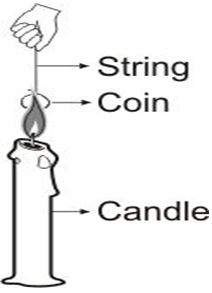
(a) The thread will burn, but the coin will not become hot.
(b) The thread will burn and the coin will become hot
(c) The thread will not burn but the coin will become hot.
(d) The thread will not burn and the coin will not become hot.
Answer : C
Question. Some hydrochloric acid has accidentally spilled on the laboratory counter. Which of the following chemicals should the lab in-charge immediately use to minimise the damage?
(a) Acetic acid
(b) Copper sulphate
(c) Sodium bicarbonate
(d) Manganese dioxide
Answer : C
Question. People who suffer from acidity are prescribed 'antacids' that often bring them relief. Which of these could be the pH value of an antacid?
(a) 1
(b) 4
(c) 7
(d) 10
Answer : D
Question. Study the table given below - it shows the pH value of many common liquids. The pH value represents the acidity of a given liquid. Pure water is said to be neutral, that is, neither acidic nor basic
Which of these is a valid conclusion that can be drawn from the table?
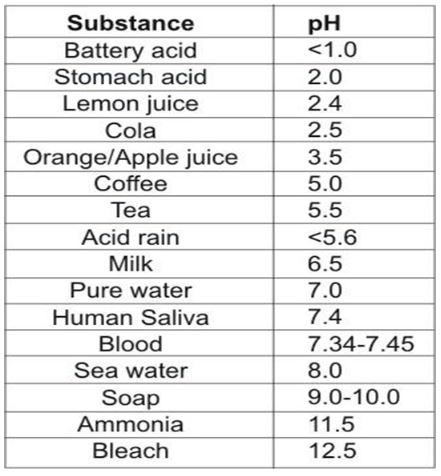
(a) Many common food items are quite acidic in nature.
(b) Our stomach contains a liquid which is a weak acid.
(c) Sea water is neither acidic nor basic - it is neutral.
(d) Acid rain, in spite of its name, is basic in nature.
Answer : A
Question. Which of these is a reason why a bird 'sings'?
(a) To mark out its territory to others of its own species
(b) To frighten other birds that may attack / eat it
(c) To attract its food like worms and insects
(d) To wake up other birds and animals
Answer : A
Question. Study this food chain.
What is likely to be an immediate effect if the cat population INCREASES a lot?

(a) The food chain will not be affected.
(b) The bird population will decrease.
(c) The snake population will decrease.
(d) The caterpillar population will decrease.
Answer : B
Question. Here is a food web IMAGE.
Which of these correctly describes what the arrow stands for?
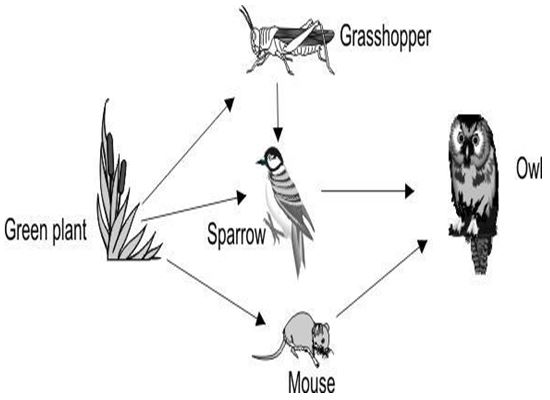
(a) Eats
(b) Gets energy from
(c) Provides energy to
(d) Depends on
Answer : C
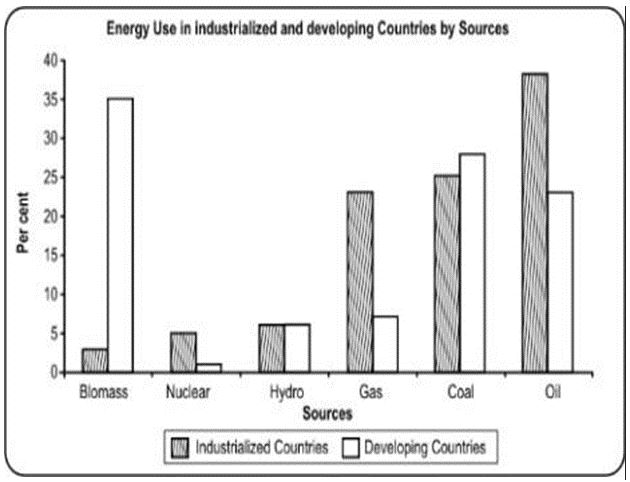
Question. Energy sources are sometimes classified as renewable and non-renewable. Considering nuclear energy, gas, coal and petroleum as non-renewable sources of energy, what percentage of energy in the INDUSTRIALIZED countries comes from renewable resources?
Study the graph given below and answer the question.
(a) < 10%
(b) 10 -20 %
(c) 20-25 %
(d) > 85%
Answer : A
Question. From the graph shown, what can we conclude about how the energy usage of a country may change as it moves from a developing to industrialized nation?
Study the graph given below and answer the question.
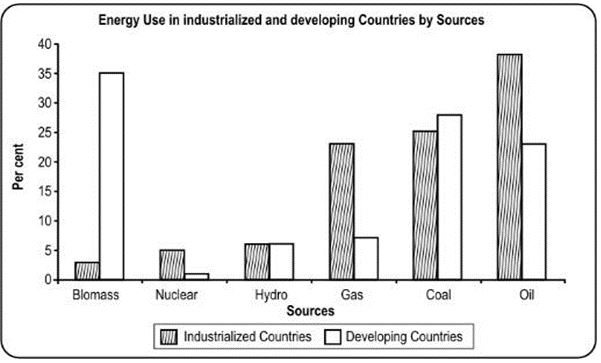
(a) Its dependence on fossil fuels will reduce and biomass energy will increase
(b) Usage of hydro energy as well as coal is likely to increase.
(c) Usage of biomass energy is likely to reduce in favour of fossil fuels.
(d) Usage of nuclear energy as a percentage of the total is likely to reduce.
Answer : C
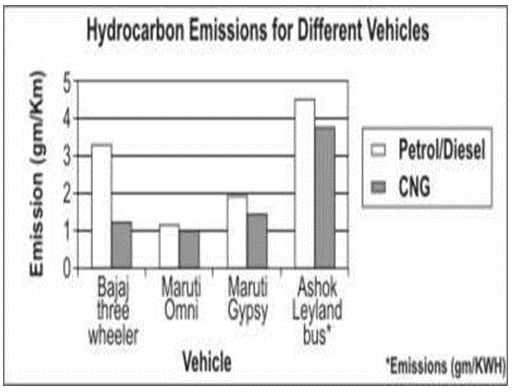
Question. Hydrocarbon emissions from vehicles are due to partial burning of fuel and contribute to the air pollution. To reduce the amount of hydrocarbon emissions (and other pollutants), the use of CNG (Compressed Natural Gas) as an alternative to petrol and diesel is being tried in some Indian cities. The hydrocarbon emissions for different vehicles using petrol/diesel and CNG as fuel are shown in the graph below.For which of these vehicles is the percentage reduction in the amount of hydrocarbon emission the most?
(a) Bajaj three wheeler
(b) Maruti Omni
(c) Maruti Gypsy
(d) Ashok Leyland bus
Answer : A
Question. Neeta, Usha and Ganesh make lists as follows:
Neeta lists insects that have 4 stages in their life cycle.
Usha lists insects that spread diseases.
Ganesh lists animals that spread diseases through contaminated food and water.
Which of the following animals would be in all their lists?
(a) rats
(b) mosquito
(c) housefly
(d) no animal can be in all the lists
Answer : C
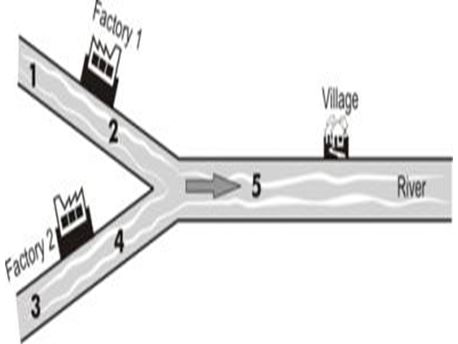
Question. See the map below showing the position of two factories and a village. People in the village suspect that one or both of the factories are polluting the river from which they use the water for their daily needs. However the factories claim that the river is polluted upstream and they are not responsible for the pollution. (Note the direction of the rivers flow). Which is the minimum number of points at which samples of water should be taken to identify whether and which factory is polluting?
(a) All five points 1, 2, 3, 4 and 5
(b) Four points 1, 2, 3 and 4
(c) Four points 1, 2, 4 and 5
(d) Three points 2, 4 and 5
Answer : B
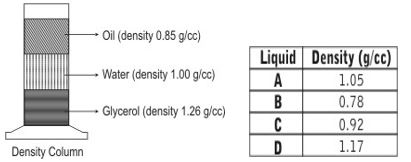
Question. Using the density column and the data table, predict which of these will FLOAT on oil? _
(a) Sample A
(b) Sample B
(c) Sample C
(d) Sample D
Answer : B
I. Filll in the blanks.
1. Green plants are called .................. since they synthesise their own food.
2. The food synthesised by the plants is stored as ..................
3. All organisms take ..................and utilise it to get energy for the growth and the maintenance of their bodies.
4. .................. energy is stored by the leaves with the help of chlorophyll.
5. .................. derive nutrition from dead, decaying matter.
6. All animals are categorised as ..................
7. .................. is produced and .................. is utilised during photosynthesis.
8. .................. is the site of reception of light energy in leaves.
9. Plants like cuscuta take food from plant.
10. Green plants synthesise their food themselves by the process of .................. they are called
True or false
1. Leaves are the food factories of plant
2. Water comes out into leaves through stomata in the form of vapours.
3. carbon dioxide is released during photosynthesis.
4. plants which synthesise their food themselves are called saprotrophs.
5. The product of photosynthesis is not a protien.
Answer the folllowing
1. What are nutrients ? Name them.
2. Define nutrition.
3. What are autotrophs and heterotrophs ? Give examples.
4. Define cell.
5. What are stomata ? Mention their functions.
6. Name the raw materials needed for photosynthesis
7. What is the mode of nutitrion in fungi?
8. In the absence of photosynthesis, life is impossible on earth. Explain.
9. What are lichens.
10. What do you mean by symbiotic relationship?
11. Name a plant that has both autotrophic and heterotrophic mode of nutrition.
Free study material for Science
CBSE Class 6 Science Worksheets for Nutrition In Plants
Practice Exercises for Class 6 Science Nutrition In Plants
Explore reliable practice questions for Nutrition In Plants tailored for Class 6 Science learners. Use these structured worksheets to evaluate exam preparedness and strengthen problem-solving skills throughout the 2026 academic session.
Step-by-Step Solutions and Practice Guidelines
Each worksheet draws directly from authorized standard textbooks to maintain academic accuracy. Evaluating your finished exercises against expert-verified solutions helps master the formal presentation standards expected in school evaluations.
Enhance Speed with Online Practice
Wrap up your chapter revision by testing your knowledge against standard objective question formats. Explore our full library of free, up-to-date printable assignments to maximize your academic results in upcoming CBSE evaluations.
FAQs
You can download the latest chapter-wise printable worksheets for Class 6 Science Nutrition In Plants for free from StudiesToday.com. These have been made as per the latest CBSE curriculum for this academic year.
Yes, Class 6 Science worksheets for Nutrition In Plants focus on activity-based learning and also competency-style questions. This helps students to apply theoretical knowledge to practical scenarios.
Yes, we have provided solved worksheets for Class 6 Science Nutrition In Plants to help students verify their answers instantly.
Yes, our Class 6 Science test sheets are mobile-friendly PDFs and can be printed by teachers for classroom.
For Nutrition In Plants, regular practice with our worksheets will improve question-handling speed and help students understand all technical terms and diagrams.