

Download Class 6 Science Practice Worksheets
Access comprehensive chapter-wise worksheets for Chapter 05 Separation of Substances using the CBSE Class 6 Science Separation Of Substances Worksheet Set 01. Designed to align with the 2026-27 academic syllabus for Class 6 Science, these printable practice sets help students reinforce key concepts and improve their overall exam readiness.
Access Chapter 05 Separation of Substances Practice Papers and Solutions
Access the complete worksheet PDF for Class 6 Science below. Regular practice with these targeted academic tasks builds familiarity with standard question patterns and helps secure higher marks in final school examinations.
Match the Column
DIRECTIONS : Match column I with column II and select the correct answer using the code given below the columns.
Question.
| Column - I | Column - II |
| A. The process by which coffee machines | (p) Threshing separate ground coffee from the coffee solution |
| B. The process in which stalks are beaten for | (q) Condensation separating grain seeds |
| C. The process due to which clothes | (r) Filtration are dried in cloth dryer |
| D. The process due to which cloud | (s) Evaporation formation takes place |
(a) A → (q), B → (s), C → (p), D → (r)
(b) A → (r), B → (p), C → (s), D → (q)
(c) A → (s), B → (p), C → (q), D → (r)
(d) A → (r), B → (s), C → (q), D → (p)
Answer : B
Question. Meena is preparing a saturated solution of sugar in water by dissolving 50 g sugar in water. On the basis of given information, find out the correct answer as per the given directions.
| Column I | Column II |
| A. She added more of the sugar in | (p) Sugar crystals are formed and settle solution at the same temperature. down. |
| B. She added more of the sugar in | (q) Solution become unsaturated due to solution at high temperature. dilution |
| C. She allowed the solution to cool | (r) Sugar does not dissolve any more |
| D. She added more of the water at | (s) Sugar get dissolve in water. the same temperature |
(a) A → (r), B → (s), C → (p), D → (q)
(b) A → (r), B → (p), C → (q), D → (s)
(c) A → (s), B → (q), C → (r), D → (p)
(d) A → (q), B → (s), C → (p), D → (r)
Answer : A
Passage Based Questions
DIRECTIONS : Read the passage (s) given below and answer the questions that follow.
Passage-1
Lemonade is prepared by mixing lemon juice and sugar in water. You extracted lemon juice from lemon and used some method to remove solid particles of pulp from it before mixing it with water. Now you add sugar and ice to the above solution before serving it.
Question. Which process have you used to remove pulp from lemon juice?
(a) decantation
(b) sedimentation
(c) filtration
(d) All of these
Answer : C
Question. In which case would the lesser amount of sugar be dissolved in it?
(a) If we first add ice.
(b) If we first add sugar.
(c) If we use a stirrer.
(d) Can't predict.
Answer : A
Question. Suppose you allow the lemonade to be left undisturbed and allow it to attain room temperature. Now if you add a little more of sugar to it, then
(a) it will be dissolved.
(b) it will remain undissolved.
(c) the lemonade will not be fit to drink.
(d) the lemonade will be less sweet than it was previously.
Answer : A
Passage-2
See the following chart carefully then answer the questions that follows :
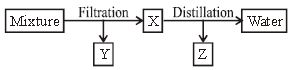
Question. What could have been the mixture?
(a) Water + Sand + Glass
(b) Oxygen + Hydrogen + Salt
(c) Stones + Rice + Water
(d) Sand + Sugar + Water
Answer : D
Question. In the above question what could have been the substance Z?
(a) Sugar
(b) Sand
(c) Glass
(d) Oil
Answer : A
Question. What is Y in the given flow chart?
(a) Sugar
(b) Sand
(c) Glass
(d) Oil
Answer : B
Passage-3
Mohan’s mother bought rice from market.
Before cooking rice Mohan and his mother observed that rice contains impurities such as pebbles, husk and chaff in it.
Mohan said that he will not eat these rice as it contain various impurities.
But his mother told him that before cooking these impurities are removed by different methods.
Question. Which method would you suggest to Mohan’s mother to remove pebbles from rice?
(a) Filtration
(b) Handpicking
(c) Sedimentation
(d) None of these
Answer : B
Question. Which process is used for separation of husk and chaff from rice?
(a) Winnowing
(b) Sedimentation
(c) Sieving
(d) Both (a) and (b)
Answer : D
Question. Winnowing method is based on the difference in ________ of the component of the mixture:
(a) colour
(b) shape
(c) weight
(d) size
Answer : C
Passage-4
Ram’s mother wanted to prepare cottage cheese (paneer) at home.
For this, she added some drops of lemon to warm milk, which results in the formation of solid paneer from milk.
His mother separated out this solid paneer from liquid portion by using a muslin cloth and kept it for drying.
Question. Which of the following process is involved in separation of solid paneer from liquid portion?
(a) Filtration
(b) Winnowing
(c) Evaporation
(d) Handpicking
Answer : A
Question. What is residue and filtrate in case of separation of Paneer?
(a) Residue : Paneer, Filtrate-liquid portion
(b) Residue : liquid portion, Filtrate - Paneer
(c) Residue : Milk, Filtrate - Paneer
(d) Residue : liquid portion, Filtrate - Milk
Answer : A
Question. Filtration method is used to separate the component of a mixture on the basis of difference in their ________.
(a) density
(b) shape
(c) size
(d) colour
Answer : C
DIRECTIONS : The questions in this segment consists of two statements, one labelled as “Assertion A” and the other labelled as “Reason R”. You are to examine these two statements carefully and decide if the Assertion A and Reason R are individually true and if so, whether the reason is a correct explanation of the assertion. Select your answers to these items using codes given below.
(a) Both A and R are true and R is the correct explanation of A.
(b) Both A and R are true but R is not the correct explanation of A.
(c) A is true but R is false.
(d) A is false but R is true.
Question. Assertion (A) : At construction sites the pebbles and such other impurities are removed from sand by the process of sieving.
Reason (R) : In the process of sieving we make use of the difference in size of particles to separate them.
Answer : A
Question. Assertion (A) : A saturated solution is that solution which can dissolve any more of solute only on heating.
Reason (R) : If a saturated solution is cooled some of the solute can be seen at the bottom of the container.
Answer : B
Statement Based Questions
DIRECTIONS : Read the following three statements carefully and choose the correct option.
(a) Statements (i) and (iii) are incorrect but (ii) is correct.
(b) Statements (i) and (ii) are incorrect but (iii) is correct.
(c) All statements are correct.
(d) All statements are incorrect.
Question. (i) The process of evaporation is used to separate tea leaves from prepared tea.
(ii) To separate the components of a mixture of salt and sand we use the process of distillation.
(iii) The process of winnowing is used to separate wheat grains from husk.
Answer : B
Question. (i) Cream is separated from milk by sedimentation.
(ii) A mixture of milk and water can be separated by filtration.
(iii) Separation of sugar from sugar solution can be done by filtration.
Answer : D
Question. (i) When heavier components in a mixture settles to the bottom after water is added to it, the process is called sedimentation.
(ii) The process of mechanically transferring clear liquid without disturbing the settled solid is called decantation.
(iii) Sedimentation and decantation is used for separating two immiscible liquids.
Answer : C
Figure Based Questions
Question. In which of the following cases drying of handkerchief will be at faster rate?
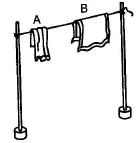
(a) Only A
(b) Only B
(c) A and B both
(d) Can’t predicted
Answer : B
Question. The figure shows the process of filtration. In it X and Y are respectively
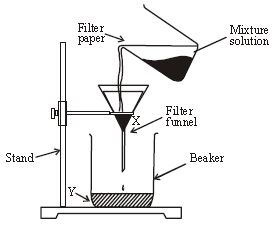
(a) Residue and filtrate
(b) Mixture and filtrate
(c) Residue and solution
(d) None of these
Answer : A
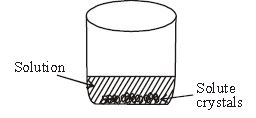
Question. The figure below shows a container containing a saturated solution. If to this beaker we add some more of solvent the solute crystals present at the bottom get dissolved.
This is because of
(a) increase in solubility of the solute
(b) decrease in solubility of the solute
(c) increase in volume of solvent
(d) None of the above
Answer : C
Question. Kapil observed water droplets on the outside of a glass of cold water. The water droplets come from
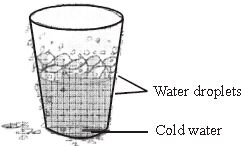
(a) the water vapour in the air
(b) the cold glass surface
(c) the ice cubes
(d) None of these
Answer : A
Question. Suresh wants to separate mixture of sand and water for which he used following set up
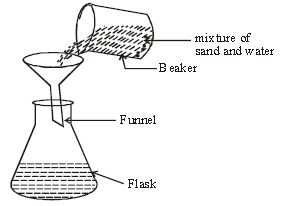
But still he was not able to separate sand and water. Look at the picture given above and find out which important material is missing due to which separation is not occurring?
(a) Stirrer
(b) Alum
(c) Filter paper
(d) Nothing is missing
Answer : C
SEPARATION OF SUBSTANCES
b) Threshing
More Question-
Q.1 Multiple choice questions (Choose the correct option)
(A) Most of the substances we see around us are
(a) Pure Elements
(b) Pure Compounds
(c) Mixtures
(B) A solution of salt in water is a?
(a) Compound
(b) Homogeneous Mixture
(c) Heterogeneous Mixture
(d) Element
(C) The property used in separating a mixture of two solids by winnowing is
(a) difference in color
(b) difference in size
(c) difference in weight
(d) Attraction by magnet
(D) Which method is used to obtain pure liquid from a solution?
(a) Distillation
(b) Condensation
(c) Filtration
(d) Loading
(E) Which of the following can dissolve in water?
(a) Only Solids
(b) Only solids and liquids
(c) Solids, liquids & gases
(d) only liquids
Q.2 What is separation?
Q.3 Why the separation of substances is necessary?
Q.4 What is the basis of separation of components of mixture?
Q.5 When do we use hand picking as the method of separation?
Q.6 What is threshing? How is it done?
Q.7 Define winnowing? What is the principle of using winnowing as method of separation?
Q.8 Where do we find sieving as the method of separation?
Q.9 You are given a mixture of sand, salt and iron filling. Suggest some methods for separating all the components of this mixture?
Q.10 Define filtration? Give 3 examples where filtration method is used.
Q.11 What is evaporation? Where do we use this method at home?
Q.12 What method is used to separate salt from sea water and how?
Q.13 In which cases handpicking is enough as a method of separation?
Q.14 One method of separation is not enough. Comment.
Q.15 Differentiate between a pure substance and a mixture.
Q.16 Is the separation of two immiscible liquids using separating funnel same as decantation?
Q.17 What do you use to remove discarded tea leaves from tea?
Q.18 What impurities are present when you buy wheat, rice or pulses from the market?
Q.19 What is the process called when stem of plants (stalks) are beaten to separate grains?
Q.20 What process is used to separate light solid particles from heavier solid particles?
Q.21 What will settle down when mud and rice are added to water?
Q.22 What is the process called when strainer or filter funnel is used?
Q.23 What is a solution called which contains the maximum amount of dissolved solute?
Q.24 How do you separate a light liquid from a heavier liquid?
HOTS QUESTIONS
Q.1 You are given a sample of water. How will you find out whether it is pure or not?
Q.2 A bottle contains either salt or chalk. How will you find out what it has, without tasting it.
Q.3 Sea water has salt dissolved in it. You know that pure water can be obtained from sea water by distillation. However, this method is not used to get drinking water from sea water. What do you think is the reason?
Free study material for Science
Chapter 05 Separation of Substances Printable Worksheets and Exercises for Class 6 Science
Daily Practice Questions for Class 6 Science
Access structured practice worksheets for Chapter 05 Separation of Substances aligned with the 2026 CBSE curriculum. These downloadable exercises for Class 6 Science help students build accuracy and reinforce core concepts for upcoming school tests.
Detailed Answers for Class 6 Science Chapter 05 Separation of Substances
Built using official NCERT guidelines for Class 6 Science, these practice sheets provide reliable academic support. Cross-reference your completed work with our detailed solutions to learn standard answer-writing formats for CBSE exams.
Complete Your Chapter Revision
Wrap up your chapter revision by testing your knowledge against standard objective question formats. Explore our full library of free, up-to-date printable assignments to maximize your academic results in upcoming CBSE evaluations.
FAQs
You can download the latest chapter-wise printable worksheets for Class 6 Science Chapter 05 Separation of Substances for free from StudiesToday.com. These have been made as per the latest CBSE curriculum for this academic year.
Yes, Class 6 Science worksheets for Chapter 05 Separation of Substances focus on activity-based learning and also competency-style questions. This helps students to apply theoretical knowledge to practical scenarios.
Yes, we have provided solved worksheets for Class 6 Science Chapter 05 Separation of Substances to help students verify their answers instantly.
Yes, our Class 6 Science test sheets are mobile-friendly PDFs and can be printed by teachers for classroom.
For Chapter 05 Separation of Substances, regular practice with our worksheets will improve question-handling speed and help students understand all technical terms and diagrams.