

Chapter-wise Worksheets for Class 12 Political Science: Contemporary World Politics Chapter 03 Contemporary South Asia
Explore structured practice materials through the CBSE Class 12 Political Science Contemporary South Asia Worksheet. Tailored for Class 12 learners, utilizing these Political Science worksheets ensures thorough preparation and strengthens problem-solving accuracy before final school evaluations.
Practice Class 12 Political Science Worksheets: Contemporary World Politics Chapter 03 Contemporary South Asia
Navigate directly to the solved Political Science worksheets using the digital viewer below. Each practice set includes detailed step-by-step solutions, allowing students to instantly cross-check their work and identify areas requiring further revision.
ASSERTION AND REASON BASED MCQs
Directions: In the following questions, a statement of Assertion (A) is followed by a statement of Reason (R). Mark the correct choice as:
(A) Both (A) and (R) are true, but (R) is the correct explanation of (A).
(B) Both (A) and (R) are true, but (R) is not the correct explanation of (A).
(C) (A) is true, but (R) is false.
(D) (A) is false, but (R) is true.
Question. Assertion: Pakistan gave an independent status to Bangladesh without any conflict.
Reason: Bangladesh was a part of Pakistan from 1947 to 1971.
Answer : D
Question. Assertion: Various countries in South Asia do not have the same kind of political systems.
Reason: Despite many problems and limitations, Sri Lanka and India have successfully operated a democratic system since their independence from the British.
Answer : B
Question. Assertion: Bangladesh drafted its constitution declaring faith in secularism, democracy and socialism.
Reason: However, in 1975 Sheikh Mujib got the constitution amended to shift from the parliamentary to presidential form of government.
Answer : B
Question. Assertion: Bhutan never became a constitutional monarchy.
Reason: Under the leadership of the king, Bhutan emerged as a multi-party democracy.
Answer : D
Question. Assertion: General Pervez Musharraf removed Prime Minister Nawaz Sharif in 2001.
Reason: Pakistan continued to enjoy the status of being a democratic nation.
Answer : C
Question. Assertion: In April 2006, there were massive, country wide, pro-democracy protests.
Reason: The largely non-violent movement was led by the Seven Party Alliance (SPA), the Maoists and social activists.
Answer : B
Question. Assertion: Political parties and the common people of Nepal have wanted a more open and responsive system of government.
Reason: The king accepted the demand for a new democratic constitution in 1990, in the wake of a strong pro-democracy movement.
Answer : A
Question. Assertion: The Sri Lankan problem involves people of Indian origin, and there is considerable pressure from the Tamil people in India to the effect that the Indian government should protect the interests of the Tamils in Sri Lanka.
Reason: The government of India has from time to time tried to negotiate with the Sri Lankan government on the Tamil question.
Answer : A
Question. Assertion: Democratic governments had a short and troubled career. K
Reason: India continued to enjoy democratic status since its inception. It is considered to be among the best democracies of the world.
Answer : D
Question. Assertion: India’s conflict with Pakistan is also over strategic issues like the control of the Siachen glacier and over acquisition of arms.
Reason: India and Pakistan never come face to face on the war field over these issues.
Answer : C
Question. Assertion: Despite the mixed record of the democratic experience, the people in all these countries share the aspiration for democracy.
Reason: A recent survey of the attitudes of the people in the five big countries of the region showed that there is widespread support for democracy in all these countries.
Answer : A
Question. Assertion: The Maoist groups agreed to suspend armed struggle.
Reason: In 2008, Nepal became a democratic republic after abolishing the monarchy
Answer : B
Question. Assertion: General Ayub Khan had to give up office when there was popular dissatisfaction against his rule.
Reason: This gave way to a military takeover once again under General Yahya Khan.
Answer : A
Question. Assertion: Sinhala were hostile to a large number of Tamils who had migrated from India to Sri Lanka and settled there. This migration continued even after independence.
Reason: The Sinhala nationalists thought that Sri Lanka should not give ‘concessions’ to the Tamils because Sri Lanka belongs to the Sinhala people only.
Answer : A
Question. Assertion: The Sri Lankan crisis continued to be violent.
Reason: However, international actors, particularly the Scandinavian countries such as Norway and Iceland tried to bring the warring groups back to negotiations.
Answer : B
Question. Assertion: Pakistan and Bangladesh have experienced both civilian and military rulers.
Reason: Bangladesh remained a democracy in the post-Cold War period. Pakistan began the post-Cold War period with successive democratic governments under Benazir Bhutto and Nawaz Sharif respectively. But it suffered a military coup in 1999.
Answer : A
CASE-BASED MCQs
I. Read the following paragraph and answer the questions that follow:
The Sri Lankan problem involves people of Indian origin, and there is considerable pressure from the Tamil people in India to the effect that the Indian government should protect the interests of the Tamils in Sri Lanka. The government of India has from time to time tried to negotiate with the Sri Lankan government on the Tamil question. But in 1987, the government of India for the first time got directly involved in the Sri Lankan Tamil question. India signed an accord with Sri Lanka and sent troops to stabilise relations between the Sri Lankan government and the Tamils. Eventually, the Indian Army got into a fight with the LTTE. The presence of Indian troops was also not liked much by the Sri Lankans. They saw this as an attempt by India to interfere in the internal affairs of Sri Lanka. In 1989, the Indian Peace Keeping Force (IPKF) pulled out of Sri Lanka without attaining its objective. The Sri Lankan crisis continued to be violent. However, international actors, particularly the Scandinavian countries such as Norway and Iceland tried to bring the warring groups back to negotiations. Finally, the armed conflict came to an end, as the LTTE was vanquished in 2009.
Question. Why was there a pressure of Indian Tamils to protect and safeguard the interests of Tamil living in Sri Lanka?
(A) Because Tamils living in Sri Lanka share the same ethnicity with Indian Tamils.
(B) Because the conflict in Sri Lanka involves people of Indian origin.
(C) Because Tamils from Sri Lanka are the ancestors of Indian Tamils.
(D) All of the above
Answer : B
Question. When did government of India directly got involve in the conflict of Sri Lanka?
(A) in 1987
(B) in 1988
(C) in 1990
(D) in 1989
Answer : A
Question. Who posed challenge to Indian Army in Sri Lanka?
(A) Local Tamils
(B) Indian Tamils
(C) LTTE
(D) Sri Lankan government
Answer : C
Question. When did IPKF have to abort the objective in Sri Lanka?
(A) 1989
(B) 1990
(C) 1999
(D) 2009
Answer : A
II. Study the cartoon given below carefully and answer the following questions:
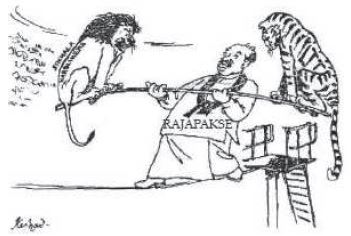
Question. What does lion in the cartoon represent?
(A) Sinhala community
(B) LTTE
(C) Indian Tamils
(D) Opposition party in Sri Lankan government
Answer : A
Question. What does tiger in the cartoon represent?
(A) Sinhala community
(B) Sri Lankan rebels
(C) LTTE
(D) None of the above
Answer : C
Q. 3. Which country’s problem is depicted here?
(A) Tamil Nadu in India
(B) South India
(C) Sri Lanka
(D) Indian Tamils
Answer : C
Question. Which external powers that helped to resolve issues?
(A) France and Canada
(B) USA and Russia
(C) Pakistan
(D) Norway and Iceland
Answer : D
III. Read the following paragraph and answer the questions that follow:
Territorial disputes over the Kashmir region sparked two of the three major Indo- Pakistani wars in 1947 and 1965, and a limited war in 1999. Although both countries have maintained a fragile cease-fire since 2003, they regularly exchange fire across the contested border, known as the Line of Control. Both sides accuse the other of violating the cease-fire and claim to be shooting in response to attacks. An up-tick in border skirmishes that began in late 2016 and continued into 2018 killed dozens and displaced thousands of civilians on both sides of the Line of Control.
In 2014, after India’s then newly elected Prime Minister Modi invited then Pakistani Prime Minister Nawaz Sharif to attend his inauguration, there were hopes that Modi’s government would pursue meaningful peace negotiations with Pakistan. However, after a brief period of optimism, relations turned sour once more when India cancelled talks with Pakistan’s foreign minister in August 2014 after the Pakistani high commissioner in India met with Kashmiri separatist leaders. A series of openings continued throughout 2015, including an unscheduled December meeting on the side-lines of the UN Climate Change Conference in Paris. This led to a meeting between national security advisors in Bangkok a few days later, where the Kashmir dispute was discussed. Later in December, Prime Minister Modi made a surprise visit to Lahore to meet with Prime Minister Sharif, the first visit of an Indian leader to Pakistan in more than a decade.
Question. In which years, according to this paragraph, India and Pakistan were involved in face to face conflicts?
(A) 1947, 1965, 1999
(B) 1971, 1961, 1999
(C) 1991, 1999, 2003
(D) None of the above
Answer : A
Question. Till which year both the countries have maintained “fragile cease fire”?
(A) 2005
(B) 2003
(C) 1999
(D) 2016
Answer : B
Question. Under whose leadership in India, there was a hope of peace on LOC?
(A) Dr. Manmohan Singh
(B) Indira Gandhi
(C) Narendra Modi
(D) Rajiv Gandhi
Answer : C
Question. When did PM Narendra Modi make a surprise visit to Pakistan?
(A) November 2015
(B) December 2015
(C) March 2015
(D) January 2015
Answer : B
IV. Read the following paragraph and answer the questions that follow:
After Pakistan framed its first constitution, General Ayub Khan took over the administration of the country and soon got himself elected. He had to give up office when there was popular dissatisfaction against his rule. This gave way to a military takeover once again under General Yahya Khan. During Yahya’s military rule, Pakistan faced the Bangladesh crisis, and after a war with India in 1971, East Pakistan broke away to emerge as an independent country called Bangladesh. After this, an elected government under the leadership of Zulfikar Ali Bhutto came to power in Pakistan from 1971 to 1977. The Bhutto government was removed by General Zia-ul-Haq in 1977. General Zia faced a pro-democracy movement from 1982 onwards and an elected democratic government was established once again in 1988 under the leadership of Benazir Bhutto. In the period that followed, Pakistani politics centred around the competition between her party, the Pakistan People’s Party, and the Muslim League. This phase of elective democracy lasted till 1999 when the army stepped in again and General Pervez Musharraf removed Prime Minister Nawaz Sharif. In 2001, General Musharraf got himself elected as the President. Pakistan continued to be ruled by the army, though the army rulers have held some elections to give their rule a democratic image. Since 2008, democratically elected leaders have been ruling Pakistan.
Question. Pakistan’s first constitution was enacted by the Constituent Assembly in
(A) 1956
(B) 1947
(C) 1962
(D) 1952
Answer : A
Question. How long did Zulfikar Ali Bhutto’s Government lasted?
(A) 1971 to 1988
(B) 1971 to 1976
(C) 1971 to 1977
(D) 1971 to 1973
Answer : C
Question. Who removed Bhutto’s govt.? When?
(A) General Zia-ul-Haq, 1977
(B) General Yahya Khan, 1990
(C) Benazir Bhutto, 1976
(D) Asif Ali zardari, 2000
Answer : A
Question. Why democracy isn’t stable in Pakistan?
(A) It is a communist state.
(B) Military has all the power.
(C) People are anti-democracy.
(D) None of the above.
Answer : B
Free CBSE Practice Worksheets: Class 12 Political Science Contemporary World Politics Chapter 03 Contemporary South Asia
Download Chapter Worksheets: Class 12 Political Science
Explore reliable practice questions for Contemporary World Politics Chapter 03 Contemporary South Asia tailored for Class 12 Political Science learners. Use these structured worksheets to evaluate exam preparedness and strengthen problem-solving skills throughout the 2026 academic session.
Concept Clarification for Contemporary World Politics Chapter 03 Contemporary South Asia
Each worksheet draws directly from authorized standard textbooks to maintain academic accuracy. Evaluating your finished exercises against expert-verified solutions helps master the formal presentation standards expected in school evaluations.
Effective Revision Strategies for School Exams
Follow up your worksheet practice by attempting the interactive online MCQ tests for Contemporary World Politics Chapter 03 Contemporary South Asia to evaluate your execution speed. All printable assignments and revision sheets on our platform are updated for the 2026 session and available free of charge.
FAQs
You can download the latest chapter-wise printable worksheets for Class 12 Political Science Contemporary World Politics Chapter 03 Contemporary South Asia for free from StudiesToday.com. These have been made as per the latest CBSE curriculum for this academic year.
Yes, Class 12 Political Science worksheets for Contemporary World Politics Chapter 03 Contemporary South Asia focus on activity-based learning and also competency-style questions. This helps students to apply theoretical knowledge to practical scenarios.
Yes, we have provided solved worksheets for Class 12 Political Science Contemporary World Politics Chapter 03 Contemporary South Asia to help students verify their answers instantly.
Yes, our Class 12 Political Science test sheets are mobile-friendly PDFs and can be printed by teachers for classroom.
For Contemporary World Politics Chapter 03 Contemporary South Asia, regular practice with our worksheets will improve question-handling speed and help students understand all technical terms and diagrams.