

Official Class 12 Political Science Worksheets: Politics in India since Independence Chapter 03 Politics of Planned Development
Explore structured practice materials through the CBSE Class 12 Political Science Politics Of Planned Development Worksheet. Tailored for Class 12 learners, utilizing these Political Science worksheets ensures thorough preparation and strengthens problem-solving accuracy before final school evaluations.
Solved Practice Worksheets for Political Science
View or download the dedicated CBSE Class 12 Political Science Politics Of Planned Development Worksheet resource below. Engaging with these practice papers under focused study conditions ensures continuous academic progress and mastery of the 2026-27 curriculum for Politics in India since Independence Chapter 03 Politics of Planned Development.
Question. Consider the following statement and select the incorrect statement(s).
(i) Planned development means to develop a design or plan for development.
(ii) Verghese Kurien was popularly known as the ‘Iron Man of India’
(iii) The ‘Bombay Plan’was a joint proposal of big industrialists.
(iv) PC Mahalanobis was the founder of Indian Statistical Institute.
Codes
(a) Both (i) and (iv)
(b) Only (iii)
(c) Only (ii)
(d) None of these
Answer : C
Question. The …………… is the name given to the path of planning and development charted by the State of ……………… .
(a) Kerala model, Kerala
(b) Uttar Pradesh model, Uttar Pradesh
(c) Bihar model, Bihar
(d) Rajasthan model, Rajasthan
Answer : A
Question. How many Five Year Plans have been completed so far in India?
(a) Twelve
(b) Six
(c) Eight
(d) Four
Answer : A
Question. Consider the following statements and select the correct statement(s).
(i) The New Agricultural strategy was adopted in India during the Third Five Year Plan i.e. during 1960.
(ii) The government introduced a pilot project known as Intensive Area Development Programme (IADP) in selected areas.
(iii) In Kharif season, in 1966, India adopted High Yielding Varieties Programme (HYVP) for the first time.
Codes
(a) Both (i) and (ii)
(b) Both (ii) and (iii)
(c) All of these
(d) None of these
Answer : C
Question. In India, planning was conceived as the main instrument of which of the following?
(a) Political development
(b) Cultural development
(c) Social development
(d) Socio-economic development
Answer : D
Question. Which of the following ideas did not form part of the early phase of India’s development policy?
(a) Planning
(b) Liberalisation
(c) Co-operative Farming
(d) Self-sufficiency
Answer : B
Question. Which of the following is not a contributory factor for development?
(a) Abundance of national resources
(b) Character of people
(c) Frequent and free elections
(d) Level of technology
Answer : B
Question. Consider the following statements regarding NITI Aayog and select the correct statement(s).
(i) On 1st January, 2015, NITI Aayog was constituted in place of Planning Commission.
(ii) Prime Minister is the ex-officio Chairman of NITI Aayog.
(iii) The first vice chairperson of NITI Aayog was Arvind Panagariya.
(iv) Dr. Rajiv Kumar is the current vice chairperson of NITI Aayog.
Codes
(a) Both (i) and (iv)
(b) Both (ii) and (iii)
(c) Only (i)
(d) All of these
Answer : D
Question. Arrange the following events in sequence.
(i) Bombay Plan
(ii) Planning Commission
(iii) NITI Aayog
(iv) Third Five Year Plan
Codes
(a) (i), (ii), (iii) and (iv)
(b) (i), (ii), (iv) and (iii)
(c) (ii), (i), (iv) and (iii)
(d) (iv), (i), (ii) and (iii)
Answer : B
Question. The First Five Year Plan was commenced in ………… and drafted by Young Economist …………… with the emphasis on poverty alleviation.
(a) 1950, Jawaharlal Nehru
(b) 1951, KN Roy
(c) 1952, PC Mahalanobis
(d) 1953, Charan Singh
Answer : B
Question. Consider the following statements and select the incorrect statement(s).
(i) After launching Green Revolution, India achieved self-sufficiency in food production.
(ii) Poor farmers also benefit from this revolution.
(iii) The states of Kerala, Andhra Pradesh and Tamil Nadu flourished more and here the living standards also improved.
(iv) The political strength of the middleman increased.
Codes
(a) Both (i) and (iv)
(b) Only (iii)
(c) Only (iv)
(d) None of these
Answer : B
Assertion/Reason :
Answer the following questions based on Assertion and Reason and select the correct codes of each question from the options mentioned below.
Codes
(a) Both (A) and (R) are true and (R) is the correct explanation of (A).
(b) Both (A) and (R) are true, but (R) is not the correct explanation of (A).
(c) (A) is true, but (R) is false.
(d) (A) is false, but (R) is true.
Question. Assertion (A) Instead of the earlier policy of giving more support to the areas and farmers that were lagging behind, now it was decided to put more resources into those areas which already had irrigation and those farmers who were already well-off.
Reason (R) The argument was that those who already had the capacity could help increase production rapidly in the short run.
Answer : A
Question. Assertion (A) For some, industrialisation seemed to be the preferred path. For others, the development of agriculture and in particular alleviation of rural poverty was the priority.
Reason (R) Despite the various differences, there was a consensus on one point: that development could not be left to private actors, that there was the need for the government to develop a design or plan for development.
Answer : A
Question. Assertion (A) India did not follow any of the two known paths to development – neither capitalist mode nor socialist mode of development.
Reason (R) Elements from both these models were taken and mixed together in India. That is why it was described as ‘mixed economy’.
Answer : A
Question. Study the following picture and answer the following question.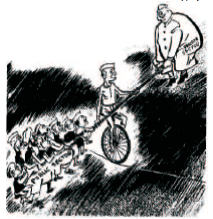
Name the person who is making efforts to balance both the sectors.
(a) Sardar Vallabhbhai Patel
(b) Jawaharlal Nehru
(c) JC Kumarappa
(d) Chaudhary Charan Singh
Answer : B
Very Short Answer Type Questions :
Politics in India since Independence Chapter 03 Politics of Planned Development Printable Worksheets and Exercises for Class 12 Political Science
Practice Exercises for Class 12 Political Science Politics in India since Independence Chapter 03 Politics of Planned Development
Explore reliable practice questions for Politics in India since Independence Chapter 03 Politics of Planned Development tailored for Class 12 Political Science learners. Use these structured worksheets to evaluate exam preparedness and strengthen problem-solving skills throughout the 2026 academic session.
Step-by-Step Solutions and Practice Guidelines
Each worksheet draws directly from authorized standard textbooks to maintain academic accuracy. Evaluating your finished exercises against expert-verified solutions helps master the formal presentation standards expected in school evaluations.
Enhance Speed with Online Practice
Follow up your worksheet practice by attempting the interactive online MCQ tests for Politics in India since Independence Chapter 03 Politics of Planned Development to evaluate your execution speed. All printable assignments and revision sheets on our platform are updated for the 2026 session and available free of charge.
FAQs
You can download the latest chapter-wise printable worksheets for Class 12 Political Science Politics in India since Independence Chapter 03 Politics of Planned Development for free from StudiesToday.com. These have been made as per the latest CBSE curriculum for this academic year.
Yes, Class 12 Political Science worksheets for Politics in India since Independence Chapter 03 Politics of Planned Development focus on activity-based learning and also competency-style questions. This helps students to apply theoretical knowledge to practical scenarios.
Yes, we have provided solved worksheets for Class 12 Political Science Politics in India since Independence Chapter 03 Politics of Planned Development to help students verify their answers instantly.
Yes, our Class 12 Political Science test sheets are mobile-friendly PDFs and can be printed by teachers for classroom.
For Politics in India since Independence Chapter 03 Politics of Planned Development, regular practice with our worksheets will improve question-handling speed and help students understand all technical terms and diagrams.