Question. State whether the following statements regarding the Emergency are correct or incorrect.
(a) It was declared in 1975 by Indira Gandhi.
(b) It led to the suspension of all fundamental rights.
(c) It was proclaimed due to the deteriorating economic conditions.
(d) Many Opposition leaders were arrested during the emergency.
(e) CPI supported the proclamation of the Emergency.
Answer:
(a) Correct,
(b) Correct,
(c) Wrong,
(d) Correct,
(e) Correct.
Question. Find the odd one out in the context of proclamation of Emergency.
(a) The call for ‘Total Revolution’.
(b) The Railway Strike of 1974
(c) The Naxalite Movement
(d) The Allahabad High Court verdict
(e) The findings of the Shah Commission Report
Answer: (c) The Naxalite Movement
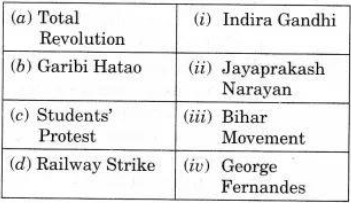
Question. Match the following:
Answer: (a)-(iii), (b)-(i), (c)-(ii), (d)-(iv).
Question. What were the reasons which led to the mid-term elections in 1980?
Answer: 1. Janata party lacked direction, leadership and a common programme.
2. Janata party government could not bring a fundamental change in policies pursued by Congress.
3. There was a split in Janata Party and the government led by Morarji Desai which lost its majority in less than 18 months.
4. Charan Singh government was formed due to support of Congress party which later decided to withdraw its support resulting resignation of Charan Singh government within four months.
5. All the above mentioned reasons led midterm elections of 1980, which defeated Janata Party and again Congress led by Indira Gandhi came back to power by winning 353 seats.
Question. The Shah Commission was appointed in 1977 by the Janata Party Government. Why was it appointed and what were its findings?
Answer:
The Shah commission was appointed in May 1977 by Janata Party government which was headed by J.C. Shah, retired chief justice of Supreme Court of India to look into the matters of:
1. Allegations of abuse of authority, excesses and malpractices as well as actions taken in the name of emergency proclaimed on 25 June 1975.
2. The Commission performed to examine various evidences to give testimonies even includingIndira Gandhi to appear before Commission, but she refused to answer any questions.
Findings of Shah Commission:
(a) It found many ‘excesses’ committed during Emergency.
(b) Under preventive detention laws nearly one lakh eleven thousand people were arrested.
(c) Press censorship took place without any proper legal sanctions.
(d) Even general manager of Delhi Power Supply Corporation received verbal orders from the officers of the Lt. Governor of Delhi to cut electricity to all newspapers press at 2 a.m. on 26 June 1975.
Q.6. What reasons did the Government give for declaring a National Emergency in 1975?
Answer: Emergency was proclaimed in response to petition filed by Raj Narain to declare Indira Gandhi’s election invalid.
(i) On June 25, 1975, the government declared the threat of internal disturbances to invoke Article 352 of constitution.
(ii) Article 352 can declare emergency on ground of either internal or external disturbances.
(iii) The government decided a grave crisis to be arisen to proclaim emergency to bring law and order, restore efficiency and implement pro-poor welfare programmes.
(iv) The President Fakhruddin Adi Ahmad proclaimed emergency which became the most controversial episode in Indian Politics.
Question. The 1977 elections for the first time saw the Opposition coming into power at the Centre. What would you consider as the reasons for this development?
Answer: The 1977 elections were evolved as a shock to everyone as Congress party was defeated for the very first time and opposition party came into power:
1. The opposition adopted the slogan ‘Save democracy’ against imposition of emergency earlier.
2. The opposition campaigned non- democratic character of rule which provided various excesses.
3. The opposition party highlighted the preventive detention and press censorship to favour public opinion.
4. Janata Party also ensured not to divide non-Congress votes.
5. Middle section of north India was moving away from Congress for whom Janata Party became a platform.
6. Hence, elections of 1977 emerged many other factors instead about emergency only.
Question. Discuss the effects of Emergency on the following aspects of our polity.
(a) Effects on civil liberties for citizens.
(b) Impact on relationship between the Executive and Judiciary.
(c) Functioning of Mass Media.
(d) Working of Police and Bureaucracy.
Answer: (a) Effects on Civil Liberties for Citizens:
1. The government made large scale arrests under preventive detention.
2. Arrested political persons could not challenge arrest even under Habeas Corpus petition.
3. Despite of filing many petitions government claimed it not to be necessary to be informed on grounds to arrested persons.
4. In April 1976, finally it was proved that the government could take away citizen’s right to life and liberty by overruling of high courts under supreme court and accept government’s plea.
(b) Impact on Relationship between the Executive and Judiciary:
1. The Parliament brought in many new changes in Constitution which made an amendment declaring that elections of Prime Minister, President and Vice¬President could not be challenged in the court.
2. The forty-second amendment (42nd) was also passed to bring a series of changes in constitutionlike duration of legislatures, elections can be postponed by one year during an emergency.
(c) Functioning of Mass Media :
1. Press censorship took place which banned freedom of press and newspapers w7ere supposed to prior approval before they publish any material i.e. RSS and Janata Island were banned. 2. Protests, strikes and public agitations were also banned.
3. Various fundamental rights were also suspended including even Right to move to court for restoration of Fundamental Rights.
4. Kannada writer Shivarama Karanth awarded with Padma Bhushan and Hindi writer
Fanishwarnath Tlenu with Padmashri returned their awards in protest against suspension of democracy.
5. Newspapers mainly Indian Express, and the statesman protested against censorship by leaving blank spaces where news items were censored.
(d) Working of Police and Bureaucracy:
Refer Part (a) + (b) of the same question.
Question. In what way did the imposition of Emergency affect the party system in India? Elaborate your answer with examples.
Answer: 1. Due to absolute majority to party in power, leadership even dared to suspend democratic process.
2. The constitution makers presumed to be abide by laws and democratic orders, hence, wide and open ended powers were given to the government during emergency.
3. A tension and differences arose between institution based democracy and democracy based on spontaneous popular participation.
4. It was attributed to incapability of party system to incorporate aspirations of the people.
5. For the first time, opposition parties came together to form a new party ‘Janata Party’ not to divide the non-Congress votes.
6. 1977 elections brought an end to one party dominance and created coalition government.
Question. Read the passage and answer the questions below:
“Indian democracy was never so close to a two-party system as it was during the 1977 elections. However, the next few years saw a complete change. Soon after its defeat, the Indian National Congress split into two groups The Janata Party also went through major convulsions David Butler, Ashok Lahiri and Prannoy Roy.
—Partha Chatterjee
(a) What made the party system in India look like a two-party system in 1977?
(b) Many more than two parties existed in 1977. Why then are the authors describing this period as close to a two-party system?
(c) What caused splits in Congress and the Janata Party?
Answer: (a) The imposition of emergency in 1977 and political crisis made the party system in India look like a two-party system.
(b) Two parties existed in 1977 were Congress and non-Congress parties to be described as close to two party system because it ended the one party dominance and emerged Janata Party, umbrella of non¬Congress parties.
(c) Split in Congress: Congress splitted on the issues of presidential elections in 1969. Split in Janata Party: On tensions among three leaders Morarji Desai, Charan Singh and Jagjivan Ram for leadership in 1979.