

Class 11 Physics Practice Set: Chapter 05 Work Energy and Power
Access printable practice worksheets for Chapter 05 Work Energy and Power designed to align with the 2026-27 academic syllabus for Class 11 Physics. These structured exercises help students evaluate their conceptual understanding and improve exam readiness.
Download Chapter 05 Work Energy and Power Worksheet PDF
View or download the dedicated Chapter 05 Work Energy and Power practice resource below. Engaging with these objective and subjective questions daily ensures continuous academic progress and mastery of the 2026-27 curriculum.
Assertion and Reason
Note: Read the Assertion (A) and Reason (R) carefully to mark the correct option out of the options given below:
a. If both assertion and reason are true and the reason is the correct explanation of the assertion.
b. If both assertion and reason are true but reason is not the correct explanation of the assertion.
c. If assertion is true but reason is false.
d. If the assertion and reason both are false.
e. If assertion is false but reason is true.
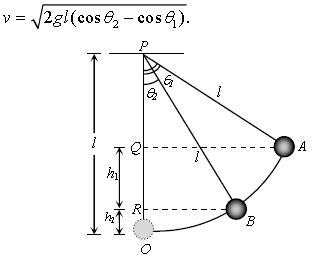
Question. Assertion: A simple pendulum of length l is displaced from its mean position O to position A so that the string makes an angle θ1 with the vertical and then released. If air resistances is neglected, the speed of the bob when the string makes an angle θ2 with the vertical is
Reason: The total momentum of a system is conserved if no external force acts on it.
Answer : B
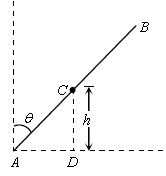
Question. Assertion: A uniform rod of mass m and length l is held at an angle θ with the vertical. The potential energy of the rod in this position is 1/2 mgl cosθ .
Reason: The entire mass of the rod can be assumed to be concentrated at its centre of mass.
Answer : A
Question. Assertion: A crane P lifts a car up to a certain height in 1 min. Another crane Q lifts the same car up to the same height in 2 min. Then crane P consumes two times more fuel than crane Q.
Reason: Crane P supplies two times more power than crane Q.
Answer : D
Question. Assertion: In above question, block P will take a longer time to reach the bottom than block Q.
Reason: Block Q has a greater acceleration down the track than block P.
Answer : A
Question. Assertion: Comets move around the sun in highly elliptical orbits. The work done by the gravitational force of the sun on a comet over a complete orbit is zero.
Reason: The gravitational force is conservative.
Answer : A
Question. Assertion: A block of mass m starts moving on a rough horizontal surface with a velocity v. It stops due to friction between the block and the surface after moving through a certain distance. The surface is now tilted to an angle of 30º with the horizontal and the same block is made to go up on the surface with the same initial velocity v. The decrease in the mechanical energy in the second situation is smaller than in the first situation.
Reason: The coefficient of friction between the block and the surface decreases with the increase in the angle of inclination.
Answer : C
Question. Assertion: A man carrying a bucket of water and walking on a rough level road with a uniform velocity does no work while carrying the bucket.
Reason: The work done on a body by a force F in giving it a displacement S is defined as W = F ⋅ S = FS cosθ. Whereθ is the angle between vectors F and S.
Answer : A
Question. Assertion: Two inclined frictionless tracks of different inclinations θ1 and θ2 meet at A from where two blocks P and Q of different masses m1 and m2 are allowed to slide down from rest, one on each track as shown in Fig.
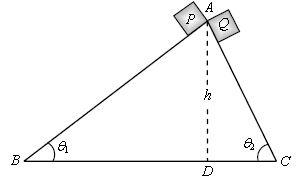
Then blocks P and Q will reach the bottom with the same speed.
Reason: Blocks P and Q have equal accelerations down their respective tracks.
Answer : C
Question. Assertion: In a collision between two bodies, each body exerts and equal and opposite force on the other at each instant of time during the collision.
Reason: The total energy of the system is conserved.
Answer : B
Question. Assertion: Two identical balls B and C lie on a horizontal smooth straight groove so that they are touching. A third identical ball A moves at a speed υ along the groove and collides with B (see Fig).

If the collisions are perfectly elastic, then after the collision, balls A and B will come to rest and ball C moves with velocity υ to the right.
Reason: In an elastic collision, linear momentum and kinetic energy are both conserved.
Answer : A
Question. Assertion: In an inelastic collision between two bodies, the total energy does not change after the collision but the kinetic energy of the system decreases.
Reason: The loss of kinetic energy appears as heat in the system.
Answer : A
Question. Assertion: The total energy of a system is always conserved irrespective of whether external forces act on the system.
Reason: If external forces act on a system, the total momentum and energy will increase.
Answer : D
Question. Assertion: The rate of change of the total linear momentum of a system consisting of many particles is proportional to the vector sum of all the internal forces due to inter-particle interactions.
Reason: The internal forces can change the kinetic energy of the system of particles but not the linear momentum of the system.
Answer : D
Question. Assertion: An elastic spring of force constant k is stretched by a small length x. The work done in extending the spring by a further length x is 2 kx2 .
Reason: The work done in extending an elastic spring by a length x is proportional to x2
.Answer : A
Question. Assertion: Two bodies A and B of masses m and 2 m respectively are placed on a smooth floor. They are connected by a spring. A third body C of mass m moves with a velocity u and collides elastically with A as shown in Fig.
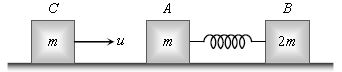
At a certain instant 0 t after the collision, it is found that the velocities of A and B are the same = 3/u
Reason: In an elastic collision, the kinetic energy of the system is conserved.
Answer : B
Question. Assertion: The term ‘collision’ between two bodies does not necessarily mean that the two bodies actually strike against each other.
Reason: In physics, a collision is said to take place if the one body influences the motion of the other
Answer : A
Comprehension Based
Paragraph –I
The work done is defined as W = ∫ Fdx. It can be measured as area between force displacement graph
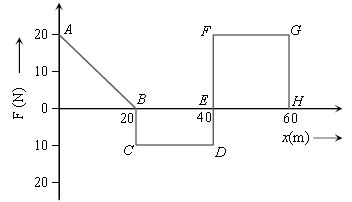
It is a scalar quantity. The graph below shows the variation of force and displacement. The word done in different regions is:
Question. Total work done is:
a. 800 J
b. 200 J
c. 600 J
d. 400 J
Answer : D
Question. Work done is zero upto displacement:
a. 20 m
b. 40 m
c. 60 m
d. cannot be known
Answer : B
Question. Positive work done is during displacement:
a. 0 to 80 m
b. 0 to 80 m and 40 to 60 m
c. 0 to 40 m
d. 20 to 40 m
Answer : B
Paragraph –II
Bodies are falling under gravity along different paths. The paths may be smooth or rough. Bodies cover different distances.
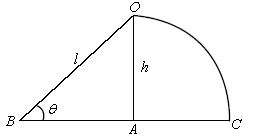
Question. The work done by force of gravity along the paths OA, OB, OC if smooth, are in the order:
a. WOA < WOC < WOOB
b. WOA < WOB < WOOC
c. WOB < WOC < WOOA
d. WOA = WOB = WOOC
Answer : D
Question. If surface is smooth the work done under gravity in moving a body along the path OCAO is W1 and along the path OA, BO is W2 , then:
a. W1 = W2
b. W1 > W2
c. W1 < W2
d. zero in both cases
Answer : D
Question. If surface OB is rough and μ is coefficient of friction θ is angle of repose, the work done in taking a body form OB and back BO is:
a. zero
b. 2mgh
c. 2mgl
d. 2μmgh
Answer : B
Paragraph –III
The potential energy of a particle varies with displacement x as shown in figure when the particle is acted upon by a conservative force.
Question. The force acting on particle is maximum in magnitude at:
a. B, C
b. A, G
c. B, F
d. D
Answer : A
Question. Particle is in equilibrium at points:
a. A, D, G
b. C, E
c. B, F
d. A, G
Answer : A
Question. Body is in stable equilibrium at:
a. A and G
b. D
c. A, D, G
d. C and E
Answer : B
SECTION – A CONCEPTUAL AND APPLICATION TYPE QUESTIONS
1. A body is moving at constant speed over a frictionless horizontal surface. What is the work done by gravitational force?
2. Does the work done in raising a suitcase on to a platform depend upon how fast it is raised up?
3. Is it possible that a body be in accelerated motion under a force acting on the body, yet no work is being done by the force ? Explain with an example.
4. A light body and a heavy body have same kinetic energy.Which one has greater linear momentum?
5. How does KE of a body change if its momentum is doubled?
6. Can a body have momentum without energy?
7. Name the process in which
(i)Momentum is conserved but KE is not conserved?
(ii)Momentum changes but KE does not change?
8. Difference between conservative and non – conservative forces.
9. Show that power is equal to dot product of force and velocity.
10. Why does a pilot looping a vertical loop not fall down even at the highest point?
SECTION – B NUMERICAL PROBLEMS
1. In a ballistics demonstration a police officer fires a bullet of mass 50 g with speed 200 m/s on a soft plywood of thickness 2 cm . The bullet emerges with only 10 % of its KE. What is the emergent speed of the bullet ?
2. A bullet of mass 50 g moving with velocity of 400 m/s strikes a wall and goes out from the other side with a velocity of 100 m/s . Calculate the work done in passing through the wall?
3. The momentum of a body is increased by 100 % .What is the percentage increase in its KE?
4. A ball is dropped from rest at a height of 12 m. If it loses 25 % of KE on striking the ground ,what is the height to which it bounces ?
5. A mass of 2 kg attached to a spring is vibrated horizontally by displacing the mass 40 cm from its equilibrium position and releasing it . Find the maximum velocity of the mass .Spring constant is 24.5 N/m
6. 10. A pump on the ground floor of a building can pump up water to fill a tank of volume 30m3 in 11. 15 min . If the tank is 40 m above the ground , the efficiency of the pump is 30 % ,how much electric power is consumed by the pump ?
7. 12. A bullet of mass 0.012 kg and horizontal speed 70 m/s strikes a block of wood of mass 0.41 kg and instantly comes to rest with respect to the block. The block is
suspended from the ceiling by means of thin wires. Calculate the height to which the block rises.
8. A metal ball of mass 2 kg moving with speed of 36 km/h has a head on collision with a stationary ball of mass 3 kg . If after collision both the balls move as a single mass , what will be the loss in kinetic energy due to collision ?
9. A mass of 4 kg moving with 10 m/s comes to rest , after covering 2m on a horizontal surface . Calculate
(i)coefficient of kinetic friction between surfaces
(ii) workdone by frictional force
(iii)workdone by gravitational force.
10. A body of mass 2 kg is resting on a rough horizontal surface . A force of 20 N is now applied to itfor 10 seconds , parallel to the surface . If the coefficient of kinetic friction between the surfaces in contact is 0.2 s , calculate
(i)workdone by the applied force in 10s
ii)change in kinetic energy of the object in 10 s
11. A girl of mass 50 kg sits in a swing formed by a rope of 8m length. A person pulls the swing to aside so that the rope makes an angle of 60 0 with the vertical . What is the gain in potential energy of the girl?
12. A car of mass 1000 kg accelerates uniformly from rest to a velocity of 54 km/hr in 5 seconds. Calculate
(i)its acceleration
(ii)its gain in KE
(iii)average power of the engine during this period , neglect friction.
13.
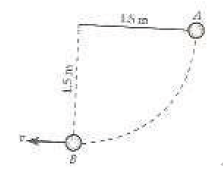
The bob of a pendulum is released from a horizontal position A as shown . If the length of the pendulum is 1.5 m , what is the speed with which the bob arrives at the lowermost point B , given that it dissipates 5 % of its initial energy against air resistance ?
14. A 1 kg block situated on a rough incline is connected to a spring of spring constant 100 N m–1as shown in figure. The block is released from rest with the spring in the unstretched position. The block moves 10 cm down the incline before coming to rest. Find the coefficient of friction between the block and the incline. Assume that the spring has a negligible mass and the pulley is frictionless.
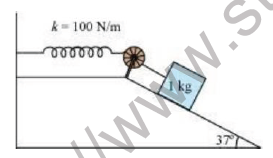
Please click on below link to download CBSE Class 11 Physics Work Energy And Power Worksheet Set E
Free study material for Physics
Practice Worksheet and Study Resources for Class 11 Physics Chapter 05 Work Energy and Power
Chapter Practice Questions for Class 11 Physics
Access structured practice worksheets for Chapter 05 Work Energy and Power designed in alignment with the latest CBSE curriculum for Class 11 Physics. These printable problem sets help students build accuracy and prepare effectively for school tests.
Expert Practice Material for Class 11 Physics
Built using the official NCERT book for Class 11 Physics, these practice materials provide reliable academic guidance. Pair your practice with our recommended NCERT solutions to master optimal problem-solving approaches.
Complete Your Chapter Revision
Follow up your worksheet practice by attempting the interactive online Physics MCQ test for this chapter to evaluate your execution speed. All platform resources are free to access.
FAQs
You can download the teacher-verified PDF for CBSE Class 11 Physics Work Energy And Power Worksheet Set 05 from StudiesToday.com. These practice sheets for Class 11 Physics are designed as per the latest CBSE academic session.
Yes, our CBSE Class 11 Physics Work Energy And Power Worksheet Set 05 includes a variety of questions like Case-based studies, Assertion-Reasoning, and MCQs as per the 50% competency-based weightage in the latest curriculum for Class 11.
Yes, we have provided detailed solutions for CBSE Class 11 Physics Work Energy And Power Worksheet Set 05 to help Class 11 and follow the official CBSE marking scheme.
Daily practice with these Physics worksheets helps in identifying understanding gaps. It also improves question solving speed and ensures that Class 11 students get more marks in CBSE exams.
All our Class 11 Physics practice test papers and worksheets are available for free download in mobile-friendly PDF format. You can access CBSE Class 11 Physics Work Energy And Power Worksheet Set 05 without any registration.