

Download Class 11 Physics Worksheets for Chapter 14 Waves
Explore reliable practice materials for Chapter 14 Waves tailored for Class 11 learners. Utilizing these Physics worksheets ensures thorough preparation and strengthens problem-solving speed for upcoming school assessments.
Access Chapter 14 Waves Questions and Exercises
Access the complete worksheet PDF for Chapter 14 Waves below. Regular practice with these targeted questions builds familiarity with standard exam patterns and helps secure higher marks in final Physics evaluations.
Question. A source X of unknown frequency produces 8 beats per second with a source of 250 Hz and 12 beats per second with a source of 270 Hz. The frequency of the source X is
(a) 242 Hz
(b) 258 Hz
(c) 282 Hz
(d) 262 Hz
Answer: B
Question. When a sound wave of frequency 300 Hz passes through a medium, the maximum displacement of a particle of the medium is 0.1 cm. The maximum velocity of the particle is equal to
(a) 60p cms–1
(b) 30p cms–1
(c) 30 cms–1 30 cms-1
(d) 60 cms–1
Answer: A
Question. A thick uniform rope of length L is hanging from a rigid support. A transverse wave of wavelength λ0 is set up at the middle of rope as shown in figure. The wavelength of the wave as it reaches to the topmost point is
(a) 2λ0
(b) √2λ0
(c) λ0/√2
(d) λ0
Answer: B
Question. The phase difference between two waves, represented by
y1 = 10–6 sin{100 t + (x/50) + 0.5} m
y2 = 10–6 cos{100 t + (x/50)} m
where x is expressed in metres and t is expressed in seconds, is approximately
(a) 1.5 radians
(b) 1.07 radians
(c) 2.07 radians
(d) 0.5 radians
Answer: B
Question. Two vibrating tuning forks produce progressive waves given by Y1 = 4 sin 500 πt and Y2 = 2 sin 506 πt. Number of beats produced per minute is
(a) 360
(b) 180
(c) 60
(d) 3
Answer: B
Question. A whistle S of frequency f revolves in a circle of radius R at a constant speed v. What is the ratio of largest and smallest frequency detected by a detector D at rest at a distance 2R from the centre of circle as shown in figure ? (take c as speed of sound)
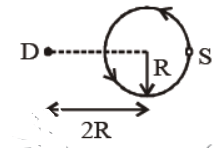
(a) (c+v/c-v)
(b) √2(c+v/c-v)
(c) √2
(d) (c+v)/c√2
Answer: A
Question. Where should the two bridges be set in a 110cm long wire so that it is divided into three parts and the ratio of the frequencies are 3 : 2 : 1 ?
(a) 20cm from one end and 60cm from other end
(b) 30cm from one end and 70cm from other end
(c) 10cm from one end and 50cm from other end
(d) 50cm from one end and 40cm from other end
Answer: A
Question. An organ pipe P1 closed at one end vibrating in its first overtone and another pipe P2 open at both ends vibrating in third overtone are in resonance with a given tuning fork. The ratio of the length of P1 to that of P2 is
(a) 8/3
(b) 3/8
(c) 1/2
(d) 1/3
Answer: B
Question. A transverse wave is represented by y = A sin ( ω t – kx). For what value of the wavelength is the wave velocity equal to the maximum particle velocity?
(a) πA/2
(b) π A
(c) 2πA
(d) A
Answer: C
Question. A tuning fork of freqqency 512 Hz makes 4 beats per second with the vibrating string of a piano. The beat frequency decreases to 2 beats per sec when the tension in the piano string is slightly increased. The frequency of the piano string before increasing the tension was
(a) 510 Hz
(b) 514 Hz
(c) 516 Hz
(d) 508 Hz
Answer: D
Question. Velocity of sound waves in air is 330 m/s. For a particular sound wave in air, a path difference of 40 cm is equivalent to phase difference of 1.6p. The frequency of this wave is
(a) 165 Hz
(b) 150 Hz
(c) 660 Hz
(d) 330 Hz
Answer: C
Question. An isotropic point source S of sound emits constant power. Two points A and B separated by a distance r are situated near the source as shown in figure. The difference of the intensity level of sound at the points A and B is about
(a) 3 dB
(b) 2 dB
(c) 6 dB
(d) 12 dB
Answer: C
Question. A whistle of frequency 1000 Hz is sounded on a car travelling towards a cliff with velocity of 18 m s–1 normal to the cliff. If c = 330 m s–1, then the apparent frequency of the echo as heard by the car driver is nearly
(a) 1115 Hz
(b) 115 Hz
(c) 67 Hz
(d) 47.2 Hz
Answer: A
Question. Two waves are represented by the equations y1 = a sin (ωt + kx + 0.57) m and y2 = a cos (ωt + kx) m, where x is in meter and t in sec. The phase difference between them is
(a) 1.0 radian
(b) 1.25 radian
(c) 1.57 radian
(d) 0.57 radian
Answer: A
Question. Sound waves travel at 350 m/s through a warm air and at 3500 m/s through brass. The wavelength of a 700 Hz acoustic wave as it enters brass from warm air
(a) decreases by a factor 10
(b) increases by a factor 20
(c) increases by a factor 10
(d) decreases by a factor 20
Answer: C
Question. Two sources of sound placed close to each other are emitting progressive waves given by y1 = 4 sin 600 pt and y2 = 5 sin 608 pt. An observer located near these two sources of sound will hear
(a) 4 beats per second with intensity ratio 25 : 16 between waxing and waning.
(b) 8 beats per second with intensity ratio 25 : 16 between waxing and waning
(c) 8 beats per second with intensity ratio 81 : 1 between waxing and waning
(d) 4 beats per second with intensity ratio 81 : 1 between waxing and waning
Answer: D
Directions for : Each question contains STATEMENT-1 and STATEMENT-2. Choose the correct answer (ONLY ONE option is correct ) from the following-
(a) Statement -1 is false, Statement-2 is true
(b) Statement -1 is true, Statement-2 is true; Statement -2 is a correct explanation for Statement-1
(c) Statement -1 is true, Statement-2 is true; Statement -2 is not a correct explanation for Statement-1
(d) Statement -1 is true, Statement-2 is false
Question. Statement 1 : Two waves moving in a uniform string having uniform tension cannot have different velocities.
Statement 2 : Elastic and inertial properties of string are same for all waves in same string. Moreover speed of wave in a string depends on its elastic and inertial properties only.
Answer: D
Question. Statement 1 : Doppler formula for sound wave is symmetric with respect to the speed of source and speed of observer.
Statement 2 : Motion of source with respect to stationary observer is not equivalent to the motion of an observer with respect to stationary source.
Answer: D
Question. Statement 1 : All points on a wavefront vibrate in same phase with same frequency.
Statement 2 : Two sources are said to be coherent if they produce waves of same frequency with a constant phase difference.
Answer: C
Question. Statement 1 : A transverse waves are produced in a very long string fixed at one end. Only progressive wave is observed near the free end.
Statement 2 : Energy of reflected wave does not reach the free end.
Answer: B
Download free printable worksheets for your students. All worksheets are in pdf format with the answers on the next page. Please give the questions to the child and then compare answers with the suggested answers provided by us. Free worksheets with questions and answers are available for all subjects. Use the worksheets to get better marks in tests and exams.
1. If the displacement of two waves at a point is given by:-
Y1 = a sin wt
Y2 = aSin(wt+π/2)
Calculate the resultant amplitude?
2. Why do the stages of large auditoriums gave curved backs?
3. Show that Doppler effect in sound is asymmetric?
4. An organ pipe P1 closed at one end vibrating in its first overtone and another pipe P2 open at both the ends vibrating in its third overtone are in resonance with a given tuning fork. Find the ratio of length of P1 and P2?
5. A simple Romanic wave has the equation Y = 0.30 Sin (314 t – 1.57x) t = sec, x = meters, y = cm. Find the frequency and wavelength of this wave.
Another wave has the equation-
Y1 = 0.1 Sin (314 t – 1.57x + 1.57)
Deduce the phase difference and ratio of intensities of the above two waves?
6. Two parts of a Sonometer wire divided by a movable knife differ by 2 mm and produce one beat per record when sounded together. Find their frequencies if the whole length of the wire is 1 meter?
7. The component waves producing a stationary wave have amplitude, Frequency and velocity of 8 cm, 30HZ and 180 cm/s respected. Write the equation of the stationary wave?
8. A wine of density a g/cm3 is stretched between two clamps 1 m apart while subjected to an extension of 0.05 cm. What is the lowest frequency of transverse vibration in the wire? Let young’s Modulus = y = 9x10¹⁰ N/m2 ?
9. Differentiate between the types of vibration in closed and open organ pipes?
Click on link below to download CBSE Class 11 Waves Worksheet C.
Free study material for Physics
Practice Worksheet and Study Resources for Class 11 Physics Chapter 14 Waves
Chapter 14 Waves Printable Worksheet for Class 11 Physics
Review targeted practice exercises for Class 11 Physics Chapter 14 Waves. Curated to match official CBSE guidelines, these downloadable PDF sheets support daily revision and core concept reinforcement.
How to Use These Practice Sheets
Cross-reference your completed exercises with comprehensive NCERT solutions for Class 11 Physics to ensure absolute clarity across all sub-topics in this chapter.
Enhance Speed with Online Practice
Follow up your worksheet practice by attempting the interactive online Physics MCQ test for this chapter to evaluate your execution speed. All platform resources are free to access.
FAQs
You can download the teacher-verified PDF for CBSE Class 11 Waves Worksheet Set 03 from StudiesToday.com. These practice sheets for Class 11 Physics are designed as per the latest CBSE academic session.
Yes, our CBSE Class 11 Waves Worksheet Set 03 includes a variety of questions like Case-based studies, Assertion-Reasoning, and MCQs as per the 50% competency-based weightage in the latest curriculum for Class 11.
Yes, we have provided detailed solutions for CBSE Class 11 Waves Worksheet Set 03 to help Class 11 and follow the official CBSE marking scheme.
Daily practice with these Physics worksheets helps in identifying understanding gaps. It also improves question solving speed and ensures that Class 11 students get more marks in CBSE exams.
All our Class 11 Physics practice test papers and worksheets are available for free download in mobile-friendly PDF format. You can access CBSE Class 11 Waves Worksheet Set 03 without any registration.