

Download Class 11 Physics Worksheets for Chapter 12 Kinetic Theory
Access printable practice worksheets for Chapter 12 Kinetic Theory designed to align with the 2026-27 academic syllabus for Class 11 Physics. These structured exercises help students evaluate their conceptual understanding and improve exam readiness.
Access Chapter 12 Kinetic Theory Questions and Exercises
Navigate directly to the printable exercises for Chapter 12 Kinetic Theory using the digital viewer below. Each practice set allows students to isolate specific topics for thorough review and uninterrupted practice alongside standard textbooks.
Question. Boyle's law is applicable for an
(a) adiabatic process
(b) isothermal process
(c) isobaric process
(d) isochoric process
Answer: B
Question. A cylinder containing an ideal gas is in vertical position and has a piston of mass M that is able to move up or down without friction (figure). If the temperature is increased
(a) both p and V of the gas will change
(b) only p will increase according to Charles' law
(c) V will change but not p
(d) p will change but not V
Answer: C
Question. Volume versus temperature graphs for a given mass of an ideal gas are shown in figure. At two different values of constant pressure. What can be inferred about relation between p1 and p2?
(a) p1 > p2
(b) p1 = p2
(c) p1 < p2
(d) Data is insufficient
Answer: A
Question. A vessel has 6g of hydrogen at pressure P and temperature 500K. A small hole is made in it so that hydrogen leaks out. How much hydrogen leaks out if the final pressure is P/2 and temperature falls to 300 K ?
(a) 2g
(b) 3g
(c) 4g
(d) 1g
Answer: D
Question. The molecules of a given mass of a gas have r.m.s. velocity of 200 ms–1 at 27°C and 1.0 × 10⁵ Nm–2 pressure. When the temperature and pressure of the gas are respectively, 127°C and 0.05 × 10⁵ Nm–2, the r.m.s. velocity of its molecules in ms–1 is :
(a) 100√2
(b) 400/√3
(c) 100 √2/3
(d) 100/3
Answer: B
Question. At identical temperatures, the rms speed of hydrogen molecules is 4 times that for oxygen molecules. In a mixture of these in mass ratio H2 : O2 = 1:8, the rms speed of all molecules is n times the rms speed for O2 molecules, where n is
(a) 3
(b) 4/3
(c) (8/3)1/2
(d) (11)1/2
Answer: D
Question. Two monatomic ideal gases 1 and 2 of molecular masses m1 and m2 respectively are enclosed in separate containers kept at the same temperature. The ratio of the speed of sound in gas 1 to that in gas 2 is given by
(a) √m1/m2
(b) √m2/m1
(c) m1/m2
(d) m2/m1
Answer: A
Question. A vessel of volume V contains a mixture of 1 mole of hydrogen and 1 mole oxygen (both considered as ideal).
Let f1(v)dv, denote the fraction of molecules with speed between v and (v + dv ) with f2(v)dv, similarly for oxygen. Then,
(a) f1(v) + f2 (v) = f (v) obeys the Maxwell's distribution law
(b) f1(v), f2(v) will obey the Maxwell's distribution law separately
(c) neither f1(v), nor f2(v) will obey the Maxwell's distribution law
(d) f2(v) and f1(v) will be the same
Answer: B
Question. The amount of heat energy required to raise the temperature of 1g of Helium at NTP, from T1K to T2K is
(a) 3/2 NakB(T2 – T1)
(b) 3/4 NakB(T2 – T1)
(c) 3/4 NakB T2/T1
(d) 3/8 NakB(T2 – T1)
Answer: D
Question. In a vessel, the gas is at a pressure P. If the mass of all the molecules is halved and their speed is doubled, then the resultant pressure will be
(a) 4P
(b) 2P
(c) P
(d) P/2
Answer: B
Question. The mean free path of molecules of a gas, (radius ‘r’) is inversely proportional to :
(a) r3
(b) r2
(c) r
(d) √r
Answer: B
Question. If pressure of a gas contained in a closed vessel is increased by 0.4% when heated by 1ºC, the initial temperature must be
(a) 250 K
(b) 250ºC
(c) 2500 K
(d) 25ºC
Answer: A
Question. In Vander Waal’s equation the critical pressure Pc is given by
(a) 3 b
(b) a/27 b2
(c) 27a/b2
(d) b2/a
Answer: B
Question. The ratio of the specific heats Cp/Cv = γ in terms of degrees of freedom (n) is given by
(a) (1+n/3)
(b) (1+2/n)
(c) (1+n/2)
(d) (1+1/n)
Answer: B
Question. One mole of an ideal diatomic gas undergoes a transition from A to B along a path AB as shown in the figure.
The change in internal energy of the gas during the transition is:
(a) – 20 kJ
(b) 20 J
(c) –12 kJ
(d) 20 kJ
Answer: A
Question. Which one the following graphs represents the behaviour of an ideal gas ?
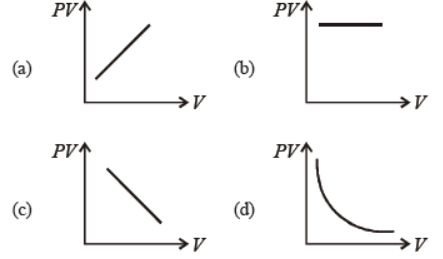
Answer: B
Question. 1 mole of H2 gas is contained in a box of volume V = 1.00 m3 at T =300 K. The gas is heated to a temperature of T = 3000 K and the gas gets converted to a gas of hydrogen atoms. The final pressure would be (considering all gases to be ideal)
(a) same as the pressure initially
(b) 2 times the pressure initially
(c) 10 times the pressure initially
(d) 20 times the pressure initially
Answer: D
DIRECTIONS for Each of these question contains two statements: STATEMENT-1 (Assertion) and STATEMENT-2 (Reason). Answer these questions from the following four options.
(a) Statement-1 is True, Statement-2 is True; Statement-2 is a correct explanation for Statement -1
(b) Statement-1 is True, Statement -2 is True; Statement-2 is NOT a correct explanation for Statement - 1
(c) Statement-1 is True, Statement- 2 is False
(d) Statement-1 is False, Statement -2 is True
Question. Statement 1 : The total translational kinetic energy of all the molecules of a given mass of an ideal gas is 1.5 times the product of its pressure and its volume.
Statement 2 : The molecules of a gas collide with each other and the velocities of the molecules change due to the collision.
Answer: B
Question. Statement 1 : Mean free path of a gas molecules varies inversely as density of the gas.
Statement 2 : Mean free path varies inversely as pressure of the gas.
Answer: A
Question. Statement 1 : The ratio Cv/Cp for a monatomic gas is less than for a diatomic gas.
Statement 2 : The molecules of a monatomic gas have more degrees of freedom than those of a diatomic gas.
Answer: C
Question. Statement 1 : Air pressure in a car tyre increases during driving.
Statement 2 : Absolute zero temperature is not zero energy temperature.
Answer: B
Free study material for Physics
Chapter 12 Kinetic Theory Practice Sheet and Solutions for Class 11 Physics
Chapter Practice Questions for Class 11 Physics
Explore reliable practice questions for Chapter 12 Kinetic Theory tailored for Class 11 Physics learners. Use these structured worksheets to evaluate preparedness and strengthen problem-solving skills.
Expert Practice Material for Class 11 Physics
Each worksheet is structured around standard CBSE textbooks, allowing students to check their working steps and correct mistakes early in their revision.
Complete Your Chapter Revision
Follow up your worksheet practice by attempting the interactive online Physics MCQ test for this chapter to evaluate your execution speed. All platform resources are free to access.
FAQs
You can download the teacher-verified PDF for CBSE Class 11 Physics Kinetic Energy Worksheet Set 01 from StudiesToday.com. These practice sheets for Class 11 Physics are designed as per the latest CBSE academic session.
Yes, our CBSE Class 11 Physics Kinetic Energy Worksheet Set 01 includes a variety of questions like Case-based studies, Assertion-Reasoning, and MCQs as per the 50% competency-based weightage in the latest curriculum for Class 11.
Yes, we have provided detailed solutions for CBSE Class 11 Physics Kinetic Energy Worksheet Set 01 to help Class 11 and follow the official CBSE marking scheme.
Daily practice with these Physics worksheets helps in identifying understanding gaps. It also improves question solving speed and ensures that Class 11 students get more marks in CBSE exams.
All our Class 11 Physics practice test papers and worksheets are available for free download in mobile-friendly PDF format. You can access CBSE Class 11 Physics Kinetic Energy Worksheet Set 01 without any registration.