

Practice Worksheets for Class 11 Physics: Chapter 12 Kinetic Theory
Review targeted practice sets for Class 11 Physics Chapter 12 Kinetic Theory. Built according to official educational guidelines for the 2026-27 academic year, these downloadable worksheets support daily revision and core concept reinforcement.
Practice Chapter 12 Kinetic Theory Worksheets for Class 11 Physics
Access the complete worksheet PDF for Chapter 12 Kinetic Theory below. Regular practice with these targeted questions builds familiarity with standard exam patterns and helps secure higher marks in final Physics evaluations.
Download free printable worksheets for your students. All worksheets are in pdf format with the answers on the next page. Please give the questions to the child and then compare answers with the suggested answers provided by us. Free worksheets with questions and answers are available for all subjects. Use the worksheets to get better marks in tests and exams.
Question. The temperature of the mixture of one mole of helium and one mole of hydrogen is increased from 0°C to 100°C at constant pressure. The amount of heat delivered will be
(a) 600 cal
(b) 1200 cal
(c) 1800 cal
(d) 3600 cal
Answer: B
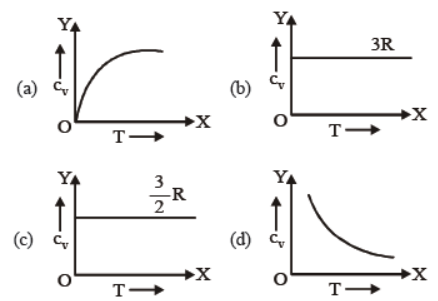
Question. Graph of specific heat at constant volume for a monatomic gas is
Answer: C
Question. The total degree of freedom of a CO2 gas molecule is
(a) 3
(b) 6
(c) 5
(d) 4
Answer: C
Question. One litre of oxygen at a pressure of 1 atm, and 2 litres of nitrogen at a pressure of 0.5 atm. are introduced in the vessel of 1 litre capacity, without any change in temperature. The total pressure would be
(a) 1.5 atm.
(b) 0.5 atm.
(c) 2.0 atm.
(d) 1.0 atm.
Answer: C
Question. Two vessels separately contain two ideal gases A and B at the same temperature. The pressure of A being twice that of B. Under such conditions, the density of A is found to be 1.5 times the density of B. The ratio of molecular weight of A and B is :
(a) 3/4
(b) 2
(c) 1/2
(d) 2/3
Answer: A
Question. N molecules, each of mass m, of gas A and 2 N molecules, each of mass 2 m, of gas B are contained in the same vessel which is maintained at a temperature T. The mean square velocity of molecules of B type is denoted by V2 and the mean square velocity of A type is denoted by V1, then V1/V2 is
(a) 2
(b) 1
(c) 1/3
(d) 2/3
Answer: B
Question. An ideal gas is found to obey an additional law VP2 = constant. The gas is initially at temperature T and volume V. When it expands to a volume 2 V, the temperature becomes
(a) T / √2
(b) 2 T
(c) 2T √2
(d) 4 T
Answer: A
Question. Air is pumped into an automobile tube upto a pressure of 200 kPa in the morning when the air temperature is 22°C. During the day, temperature rises to 42°C and the tube expands by 2%. The pressure of the air in the tube at this temperature, will be approximately
(a) 212 kPa
(b) 209 kPa
(c) 206 kPa
(d) 200 kPa
Answer: B
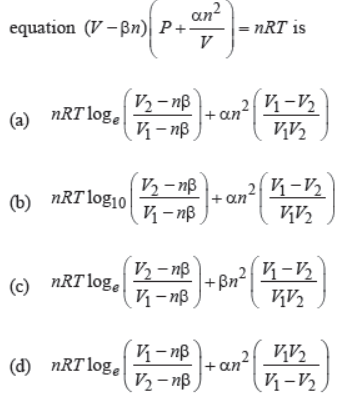
Question. Work done by a system under isothermal change from a volume V1 to V2 for a gas which obeys Vander Waal's
Answer: A
Question. A gas mixture consists of 2 moles of oxygen and 4 moles of Argon at temperature T. Neglecting all vibrational moles, the total internal energy of the system is
(a) 4 RT
(b) 15 RT
(c) 9 RT
(d) 11RT
Answer: D
Question. An inflated rubber balloon contains one mole of an ideal gas, has a pressure p, volume V and temperature T. If the temperature rises to 1.1 T, and the volume is increased to 1.05 V, the final pressure will be
(a) 1.1 p
(b) p
(c) less than p
(d) between p and 1.1
Answer: D
Question. A graph is plotted with PV/T on y-axis and mass of the gas along x-axis for different gases. The graph is
(a) a straight line parallel to x-axis for all the gases
(b) a straight line passing through origin with a slope having a constant value for all the gases
(c) a straight line passing through origin with a slope having different values for different gases
(d) a straight line parallel to y-axis for all the gases
Answer: C
Question. Four mole of hydrogen, two mole of helium and one mole of water vapour form an ideal gas mixture. What is the molar specific heat at constant pressure of mixture?
(a) 16/7 R
(b) 7/16 R
(c) R
(d) 23/7 R
Answer: D
Question. An ideal gas is taken through a process in which the pressure and the volume are changed according to the equation P = kV. Molar heat capacity of the gas for the process is
(a) C = Cv + R
(b) C = Cv + R/2
(c) C = Cv –R/2
(d) C = Cv + 2R
Answer: B
Question. If one mole of a monatomic gas (γ = 5/3) is mixed with one mole of a diatomic gas (γ = 7/3), the value of g for the mixture is
(a) 1.40
(b) 1.50
(c) 1.53
(d) 3.07
Answer: C
Question. To what temperature should be the hydrogen at 327°C be cooked at constant pressure so that the root mean square velocity of its molecules becomes half of its previous value
(a) –123°C
(b) 120°C
(c) –100°C
(d) 0°C
Answer: A
Question. 1 mole of a gas with γ = 7/5 is mixed with 1 mole of a gas with γ = 5/3, then the value of g for the resulting mixture is
(a) 7/5
(b) 2/5
(c) 24/16
(d) 12/7
Answer: C
Question. The molar specific heat at constant pressure of an ideal gas is (7/2)R. The ratio of specific heat at constant pressure to that at constant volume is
(a) 5/7
(b) 9/7
(c) 7/5
(d) 8/7
Answer: C
Question. A cubic vessel (with face horizontal + vertical) contains an ideal gas at NTP. The vessel is being carried by a rocket which is moving at a speed of 500 m s–1 in vertical direction.
The pressure of the gas inside the vessel as observed by us on the ground
(a) remains the same because 500 ms–1 is very much smaller than vrms of the gas
(b) remains the same because motion of the vessel as a whole does not affect the relative motion of the gas molecules and the walls
(c) will increase by a factor equal to (v2rms + (500)2) / v2rms where vrms was the original mean square velocity of the gas
(d) will be different on the top wall and bottom wall of the vessel
Answer: B
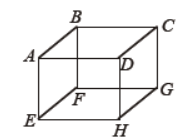
Question. 1 mole of an ideal gas is contained in a cubical volume V, ABCDEFGH at 300K (figure). One face of the cube (EFGH) is made up of a material which totally absorbs any gas
(a) the pressure on EFGH would be zero
(b) the pressure on all the faces will the equal
(c) the pressure of EFGH would be double the pressure on ABCD
(d) the pressure on EFGH would be half that on ABCD
Answer: D
Question. The order of magnitude of the number of nitrogen molecules in an air bubble of diameter 2 mm under ordinary conditions is
(a) 105
(b) 109
(c) 1013
(d) 1017
Answer: D
Question. If the potential energy of a gas molecule is U = M/r6 – N/r12, M and N being positive constants, then the potential energy at equilibrium must be
(a) zero
(b) M2/4N
(c) N2/4M
(d) MN2/4
Answer: B
1. Given Samples of 1 cm3 of Hydrogen and 1 cm3 of oxygen, both at N. T. P. which sample has a larger number of molecules?
2. Find out the ratio between most probable velocity, average velocity and root Mean square Velocity of gas molecules?
3. What is Mean free path?
4. What happens when an electric fan is switched on in a closed room?
5. If a certain mass of gas is heated first in a small vessel of volume V1 and then in a large vessel of volume V2. Draw the P – T graph for two cases?
6. Derive the Boyle’s law using kinetic theory of gases?
7. At what temperature is the root mean square speed of an atom in an argon gas
cylinder equal to the r.m.s speed of a helium gas atom at- 20°C? Given Atomic Mass of Ar = 39.9 and of He = 4.0?
8. Show that constant – temperature bulk modulus K of an ideal gas is the pressure P of the gas?
9. If Nine particles have speeds of 5, 8, 12, 12, 12, 14, 14, 17 and 20 m/s. find :→
1) the average speed
2) the Most Probable speed
3) the r.m.s. Speed of the particles?
10. The earth with out its atmosphere would be inhospitably cold. Explain Why?
Click on link below to download CBSE Class 11 Kinetic Theory of Gases Worksheet C.
Free study material for Physics
Practice Worksheet and Study Resources for Class 11 Physics Chapter 12 Kinetic Theory
CBSE Practice Material: Class 11 Physics Chapter 12 Kinetic Theory
Explore reliable practice questions for Chapter 12 Kinetic Theory tailored for Class 11 Physics learners. Use these structured worksheets to evaluate preparedness and strengthen problem-solving skills.
NCERT-Aligned Questions and Solutions
Cross-reference your completed exercises with comprehensive NCERT solutions for Class 11 Physics to ensure absolute clarity across all sub-topics in this chapter.
Next Steps in Your Exam Preparation
Follow up your worksheet practice by attempting the interactive online Physics MCQ test for this chapter to evaluate your execution speed. All platform resources are free to access.
FAQs
You can download the teacher-verified PDF for CBSE Class 11 Kinetic Theory of Gases Worksheet Set 03 from StudiesToday.com. These practice sheets for Class 11 Physics are designed as per the latest CBSE academic session.
Yes, our CBSE Class 11 Kinetic Theory of Gases Worksheet Set 03 includes a variety of questions like Case-based studies, Assertion-Reasoning, and MCQs as per the 50% competency-based weightage in the latest curriculum for Class 11.
Yes, we have provided detailed solutions for CBSE Class 11 Kinetic Theory of Gases Worksheet Set 03 to help Class 11 and follow the official CBSE marking scheme.
Daily practice with these Physics worksheets helps in identifying understanding gaps. It also improves question solving speed and ensures that Class 11 students get more marks in CBSE exams.
All our Class 11 Physics practice test papers and worksheets are available for free download in mobile-friendly PDF format. You can access CBSE Class 11 Kinetic Theory of Gases Worksheet Set 03 without any registration.