

Download Class 11 Physics Worksheets for Chapter 12 Kinetic Theory
Review targeted practice sets for Class 11 Physics Chapter 12 Kinetic Theory. Built according to official educational guidelines for the 2026-27 academic year, these downloadable worksheets support daily revision and core concept reinforcement.
Access Chapter 12 Kinetic Theory Questions and Exercises
Access the complete worksheet PDF for Chapter 12 Kinetic Theory below. Regular practice with these targeted questions builds familiarity with standard exam patterns and helps secure higher marks in final Physics evaluations.
Download free printable worksheets for your students. All worksheets are in pdf format with the answers on the next page. Please give the questions to the child and then compare answers with the suggested answers provided by us. Free worksheets with questions and answers are available for all subjects. Use the worksheets to get better marks in tests and exams.
Question. The internal energy of an ideal gas is
(a) the sum of total kinetic and potential energies.
(b) the total translational kinetic energy.
(c) the total kinetic energy of randomly moving molecules.
(d) the total kinetic energy of gas molecules.
Answer: D
Question. A vessel contains air at a temperature of 15ºC and 60% R.H. What will be the R.H. if it is heated to 20ºC? (S.V.P. at 15ºC is 12.67 & at 20ºC is 17.36mm of Hg respectively)
(a) 262%
(b) 26.2%
(c) 44.5%
(d) 46.2%
Answer: C
Question. The root mean square speed of the molecules of a diatomic gas is v. When the temperature is doubled, the molecules dissociate into two atoms. The new root mean square speed of the atom is
(a) √2v
(b) v
(c) 2v
(d) 4v
Answer: C
Question. The kinetic theory of gases
(a) explains the behaviour of an ideal gas.
(b) describes the motion of a single atom or molecule.
(c) relates the temperature of the gas with K.E. of atoms of the gas
(d) All of the above
Answer: D
Question. A gas mixture consists of molecules of type 1, 2 and 3, with molar masses m1 > m2 > m3. vrms and K are the r.m.s. speed and average kinetic energy of the gases. Which of the following is true?
(a) (vrms)1 < (vrms)2 < (vrms)3 and (K̅)1 = (K̅)2 = (K̅)3
(b) (vrms)1 = (vrms)2 = (vrms)3 and (K̅)1 = (K̅)2 > (K̅)3
(c) (vrms)1 > (vrms)2 > (vrms)3 and (K̅)1 < (K̅)2 > (K̅)3
(d) (vrms)1 > (vrms)2 > (vrms)3 and (K̅)1 < (K̅)2 < (K̅)3
Answer: A
Question. In kinetic theory of gases, it is assumed that molecules
(a) have same mass but can have different volume
(b) have same volume but mass can be different
(c) have different mass as well as volume
(d) have same mass but negligible volume.
Answer: D
Question. The adjoining figure shows graph of pressure and volume of a gas at two tempertures T1 and T2. Which of the following inferences is correct?
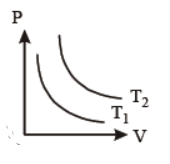
(a) T1 > T2
(b) T1 = T2
(c) T1 < T2
(d) None of these
Answer: C
Question. The air in a room has 15 gm of water vapours per cubic metre of its volume. However for saturation one cubic metre of volume requires 20 gm of water vapour then relative humidity is
(a) 50%
(b) 75%
(c) 20%
(d) 25%
Answer: B
Question. The ratio of principal molar heat capacities of a gas is maximum for
(a) a diatomic gas
(b) a monatomic gas
(c) a polyatomic gas having linear molecules.
(d) a polyatomic gas having non-linear molecules.
Answer: B
Question. The correct statement of the law of equipartition of energy is
(a) the total energy of a gas is equally divided among all the molecules.
(b) The gas possess equal energies in all the three directions x,y and z-axis.
(c) the total energy of a gas is equally divided between kinetic and potential energies.
(d) the total kinetic energy of a gas molecules is equally divided among translational and rotational kinetic energies.
Answer: B
Question. The value of critical temperature in terms of van der Waal’s constant a and b is given by

Answer: A
Question. At room temperature, the rms speed of the molecules of a certain diatomic gas is found to be 1930 m/s. The gas is
(a) H2
(b) F2
(c) O2
(d) Cl2
Answer: A
Question. Two gases A and B having the same temperature T, same pressure P and same volume V are mixed. If the mixture is at the same temperature T and occupies a volume V, the pressure of the mixture is
(a) 2 P
(b) P
(c) P/2
(d) 4 P
Answer: A
Question. The velocity of the molecules of a gas at temperature 120 K is v. At what temperature will the velocity be 2 v?
(a) 120 K
(b) 240 K
(c) 480 K
(d) 1120 K
Answer: C
Question. The perfect gas equation for 4 gram of hydrogen gas is
(a) PV = RT
(b) PV = 2RT
(c) PV= 1/2 RT
(d) PV = 4RT
Answer: B
Question. Let v denote the rms speed of the molecules in an ideal diatomic gas at absolute temperature T. The mass of a molecule is ‘m’ Neglecting vibrational energy terms, the false statement is
(a) a molecule can have a speed greater than √2v
(b) v is proportional to √T
(c) the average rotational K.E. of a molecule is 1/4 mv2
(d) the average K.E. of a molecule is 5/6 mv2
Answer: C
Question. Maxwell's laws of distribution of velocities shows that
(a) the number of molecules with most probable velocity is very large
(b) the number of molecules with most probable velocity is very small
(c) the number of molecules with most probable velocityis zero
(d) the number of molecules with most probable velocity is exactly equal to 1
Answer: A
Question. According to kinetic theory of gases, which one of the following statement(s) is/are correct?
(a) Real gas behave as ideal gas at high temperature and low pressure.
(b) Liquid state of ideal gas is impossible
(c) At any temerature and pressure, ideal gas obeys Boyle's law and charles' law
(d) The molecules of real gas do not exert any force on one another.
Answer: A,B,C
Question. For hydrogen gas Cp – Cv = a and for oxygen gas Cp – Cv = b. So, the relation between a and b is given by
(a) a = 16 b
(b) 16 a = b
(c) a = 4 b
(d) a = b
Answer: D
Question. Which of the following formula is wrong?
(a) CV = R/γ-1
(b) CP = γ R/γ-1
(c) Cp / CV = γ
(d) Cp – CV = 2R
Answer: D
Question. The relation between the gas pressure P and average kinetic energy per unit volume E is
(a) P = 1/2 E
(b) P = E
(c) P = 3/2 E
(d) P = 2/3 E
Answer: D
Question. If the critical temperature of a gas is 100ºC, its Boyle temperature will be approximately
(a) 337.5ºC
(b) 500ºC
(c) 33.3ºC
(d) 1000ºC
Answer: A
Question. A fixed mass of gas at constant pressure occupies a volume V. The gas undergoes a rise in temperature so that the root mean square velocity of its molecules is doubled. The new volume will be
(a) V/2
(b) V /√2
(c) 2 V
(d) 4 V
Answer: D
Question. The molecules of a given mass of gas have a root mean square velocity of 200m s–1 at 27°C and 1.0 × 10⁵ N m–2 pressure. When the temperature is 127°C and the pressure 0.5 × 10⁵ Nm–2, the root mean square velocity in ms–1, is
(a) 400/√3
(b) 100 √2
(c) 100 √2/3
(d) 100/3
Answer: A
Question. For a gas if ratio of specific heats at constant pressure and volume is γ then value of degrees of freedom is
(a) 3γ-1/2γ-1
(b) 2/γ-1
(c) 9/2(γ-1)
(d) 25/2(γ-1)
Answer: B
1. State the law of equi-partition of energy?
2. On what factors, does the average kinetic energy of gas molecules depend?
3. Why the temperature less than absolute zero is not possible?
4. If a vessel contains 1 mole of O2 gas (molar mass 32) at temperature T. The pressure of the gas is P. What is the pressure if an identical vessel contains 1 mole of He at a temperature 2 T?
5. At very low pressure and high temperature, the real gas behaves like ideal gas. Why?
6. Two perfect gases at absolute temperature T1 and T2 are mixed. There is no loss of energy. Find the temperature of the mixture if the masses of molecules are m1 and m2 and number of molecules is n1 and n2?
7. Calculate the degree of freedom for monatomic, diatomic and triatomic gas?
8. Determine the volume of 1 mole of any gas at s. T. P., assuming it behaves like an ideal gas?
9. A tank of volume 0.3m3 contains 2 moles of Helium gas at 20°C. Assuming the helium behave as an ideal gas;
1) Find the total internal energy of the system.
2) Determine the r. m. s. Speed of the atoms.
10. State Graham’s law of diffusion and derive it?
11. What is the relation between pressure and kinetic energy of gas?
Click on link below to download CBSE Class 11 Kinetic Theory of Gases Worksheet B.
Free study material for Physics
Practice Worksheet and Study Resources for Class 11 Physics Chapter 12 Kinetic Theory
Chapter Practice Questions for Class 11 Physics
Explore reliable practice questions for Chapter 12 Kinetic Theory tailored for Class 11 Physics learners. Use these structured worksheets to evaluate preparedness and strengthen problem-solving skills.
Expert Practice Material for Class 11 Physics
Each worksheet is structured around standard CBSE textbooks, allowing students to check their working steps and correct mistakes early in their revision.
Complete Your Chapter Revision
Explore our broader library of printable assignments, chapter notes, and mock tests designed to support continuous revision and secure higher marks in CBSE assessments.
FAQs
You can download the teacher-verified PDF for CBSE Class 11 Kinetic Theory of Gases Worksheet Set 02 from StudiesToday.com. These practice sheets for Class 11 Physics are designed as per the latest CBSE academic session.
Yes, our CBSE Class 11 Kinetic Theory of Gases Worksheet Set 02 includes a variety of questions like Case-based studies, Assertion-Reasoning, and MCQs as per the 50% competency-based weightage in the latest curriculum for Class 11.
Yes, we have provided detailed solutions for CBSE Class 11 Kinetic Theory of Gases Worksheet Set 02 to help Class 11 and follow the official CBSE marking scheme.
Daily practice with these Physics worksheets helps in identifying understanding gaps. It also improves question solving speed and ensures that Class 11 students get more marks in CBSE exams.
All our Class 11 Physics practice test papers and worksheets are available for free download in mobile-friendly PDF format. You can access CBSE Class 11 Kinetic Theory of Gases Worksheet Set 02 without any registration.