

Class 11 Physics Practice Set: Chapter 14 Waves
Access printable practice worksheets for Chapter 14 Waves designed to align with the 2026-27 academic syllabus for Class 11 Physics. These structured exercises help students evaluate their conceptual understanding and improve exam readiness.
Download Chapter 14 Waves Worksheet PDF
View or download the dedicated Chapter 14 Waves practice resource below. Engaging with these objective and subjective questions daily ensures continuous academic progress and mastery of the 2026-27 curriculum.
Question. Doppler’s effect is not applicable for
(a) audio waves
(b) electromagnetic waves
(c) shock waves
(d) None of these
Answer: C
Question. Two sinusoidal plane waves of same frequency having intensities I0 and 4 I0 are travelling in the same direction. The resultant intensity at a point at which waves meet with a phase difference of zero radian is
(a) I0
(b) 5 I0
(c) 9 I0
(d) 3 I0
Answer: C
Question. If the intensities of two interfering waves be I1 and I2, the contrast between maximum and minimum intensity is maximum, when
(a) I1 > > I2
(b) I1 << I2
(c) I1 = I2
(d) either I1 or I2 is zero
Answer: C
Question. Sound waves of length λ travelling with velocity v in a medium enter into another medium in which their velocity is 4 v. The wavelength in 2nd medium is
(a) 4λ
(b) λ
(c) λ/4
(d) 16λ
Answer: A
Question. Two periodic waves of intensities I1 and I2 pass through a region at the same time in the same direction. The sum of the maximum and minimum intensities is
(a) 2 (I1 + I2)
(b) I1 + I2
(c) (√I1 +√I2)2
(d) (√I1 - √I2)2
Answer: A
Question. Two tones of frequencies n1 and n2 are sounded together. The beats can be heard distinctly when
(a) 10 < (n1 – n2) < 20
(b) 5 < (n1 – n2) > 20
(c) 5 < (n1 – n2) < 20
(d) 0 < (n1 – n2) < 10
Answer: D
Question. The equation of a spherical progressive wave is
(a) y = a sin ωt
(b) y = a sin (ωt - kr)
(c) y = a/√2 sin(ωt kr)
(d) y = a/r sin(ωt kr)
Answer: D
Question. In the sonometer experiment, a tuning fork of frequency 256 Hz is in resonance with 0.4 m length of the wire when the iron load attached to free end of wire is 2 kg. If the load is immersed in water, the length of the wire in resonance would be (specific gravity of iron = 8)
(a) 0.37 m
(b) 0.43 m
(c) 0.31 m
(d) 0.2 m
Answer: A
Question. The velocity of sound in air is 330 m/s. The r.m.s. velocity of air molecules (g = 1.4) is approximately equal to
(a) 400 m/s
(b) 471.4 m/s
(c) 231 m/s
(d) 462 m/s
Answer: B
Question. The velocity of sound in hydrogen is 1224 m/s. Its velocity in a mixture of hydrogen and oxygen containing 4 parts by volume of hydrogen and 1 part oxygen is
(a) 1224 m/s
(b) 612 m/s
(c) 2448 m/s
(d) 306 m/s
Answer: B
Question. An open and closed organ pipe have the same length. The ratio of pth mode of frequency of vibration of two pipes is
(a) 1
(b) p
(c) p (2p + 1)
(d) 2 p/((2p -1)
Answer: D
Question. Sound waves are not transmitted to long distances because,
(a) they are absorbed by the atmosphere
(b) they have constant frequency
(c) the height of antenna required, should be very high
(d) velocity of sound waves is very less
Answer: A
Question. What is the effect of increase in temperature on the frequency of sound produced by an organ pipe?
(a) increases
(b) decreases
(c) no effect
(d) erratic change
Answer: A
Question. Shock waves are produced by objects
(a) carrying electric charge and vibrating
(b) vibrating with frequency greater than 20000 Hz
(c) vibrating with very large amplitude
(d) moving with a speed greater than that of sound in the medium
Answer: D
Question. The speed of sound in a medium depends on
(a) the elastic property but not on the inertia property
(b) the inertia property but not on the elastic property
(c) the elastic property as well as the inertia property
(d) neither the elastic property nor the inertia property
Answer: C
Question. Consider the three waves z1, z2 and z3 as
z1 = A sin (kx – ωt)
z2 = A sin (kx + ωt)
z3 = A sin (ky – ωt)
Which of the following represents a standing wave?
(a) z1 + z2
(b) z2 + z3
(c) z3 + z1
(d) z1 + z2 + z3
Answer: A
Question. Two sound waves of equal intensity I produce beats. The maximum intensity of sound produced in beats will be
(a) I
(b) 2I
(c) 3I
(d) 4I
Answer: D
Question. The speed of sound in oxygen (O2) at a certain temperature is 460 ms–1. The speed of sound in helium (He) at the same temperature will be (assume both gases to be ideal)
(a) 460 ms–1
(b) 500 ms–1
(c) 650 ms–1
(d) 330 ms–1
Answer: B
Question. Frequencies of sound produced from an organ pipe open at both ends are
(a) only fundamental note
(b) only even harmonics
(c) only odd harmonics
(d) even and odd harmonics
Answer: D
Question. Each of the properties of sound listed in column A primarily depends on one of the quantitites in column B. Choose the matching pairs from two columns
Column A Column B
Pitch Waveform
Quality Frequency
Loudness Intensity
(a) Pitch-wave form; Quality-frequency; Loudnessintensity
(b) Pitch-frequency; Quality-wave form; Loudnessintensity
(c) Pitch-intensity; Quality-wave form; Loudnessfrequency
(d) Pitch-wave form; Quality-intensity; Loudnessfrequency
Answer: B
Question. When a tuning fork vibrates with 1.0 m or 1.05 m long wire of a sonometer, 5 beats per second are produced in each case. What will be the frequency of the tuning fork?
(a) 195
(b) 200
(c) 205
(d) 210
Answer: C
Question. The fundamental frequency of an organ pipe is 512 Hz. If its length is increased, then frequency will
(a) decrease
(b) increase
(c) remains same
(d) cannot be predicted
Answer: A
Question. The property of a medium necessary for wave propagation is
(a) inertia
(b) elasticity
(c) low resistance
(d) All of the above
Answer: D
Question. Sound waves are travelling in a medium whose adiabatic elasticity is E and isothermal elasticity E'. The velocity of sound waves is proportional to
(a) E'
(b) E
(c) √E'
(d) E/E'
Answer: B
Question. An organ pipe, open from both end produces 5 beats per second when vibrated with a source of frequency 200 Hz. The second harmonic of the same pipes produces 10 beats per second with a source of frequency 420 Hz. The fundamental frequency of organ pipe is
(a) 195 Hz
(b) 205 Hz
(c) 190 Hz
(d) 210 Hz
Answer: B
Question. The equation of a cylindrical progressive wave is
(a) y = a sin ωt
(b) y = a sin (ωt - kr)
(c) y = a/√r sin (ωt - kr)
(d) y = a/r sin (ωt - kr)
Answer: C
Question. A wave y = a sin (wt – kx) on a string meets with another wave producing a node at x = 0. Then the equation of the unknown wave is
(a) y = a sin (ωt + kx)
(b) y = –a sin (ωt + kx)
(c) y = a sin (ωt – kx)
(d) y = –a sin (ωt – kx)
Answer: B
Question. When a string is divided into three segments of length l1, l2, and l3 the fundamental frequencies of these three segments are v1, v2 and v3 respectively. The original fundamental frequency (v) of the string is
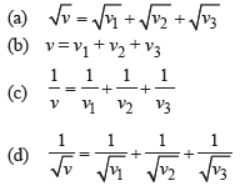
Answer: C
Question. The equation of a plane progressive wave is y = 0.9 sin 4π[t - x/2] . When it is reflected at a rigid support, its amplitude becomes 2/3 of its previous value. The equation of the reflected wave is
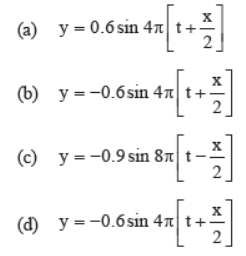
Answer: B
Question. If two waves of same frequency and same amplitude, on superposition, produce a resultant disturbance of the same amplitude, the wave differ in phase by
(a) π
(b) 2 π/3
(c) Zero
(d) π/3
Answer: B
Please click on below link to download pdf file for CBSE Class 11 Physics Waves Worksheet Set A
Free study material for Physics
Practice Worksheet and Study Resources for Class 11 Physics Chapter 14 Waves
Chapter Practice Questions for Class 11 Physics
Access structured practice worksheets for Chapter 14 Waves designed in alignment with the latest CBSE curriculum for Class 11 Physics. These printable problem sets help students build accuracy and prepare effectively for school tests.
Expert Practice Material for Class 11 Physics
Cross-reference your completed exercises with comprehensive NCERT solutions for Class 11 Physics to ensure absolute clarity across all sub-topics in this chapter.
Complete Your Chapter Revision
Follow up your worksheet practice by attempting the interactive online Physics MCQ test for this chapter to evaluate your execution speed. All platform resources are free to access.
FAQs
You can download the teacher-verified PDF for CBSE Class 11 Physics Waves Worksheet Set 01 from StudiesToday.com. These practice sheets for Class 11 Physics are designed as per the latest CBSE academic session.
Yes, our CBSE Class 11 Physics Waves Worksheet Set 01 includes a variety of questions like Case-based studies, Assertion-Reasoning, and MCQs as per the 50% competency-based weightage in the latest curriculum for Class 11.
Yes, we have provided detailed solutions for CBSE Class 11 Physics Waves Worksheet Set 01 to help Class 11 and follow the official CBSE marking scheme.
Daily practice with these Physics worksheets helps in identifying understanding gaps. It also improves question solving speed and ensures that Class 11 students get more marks in CBSE exams.
All our Class 11 Physics practice test papers and worksheets are available for free download in mobile-friendly PDF format. You can access CBSE Class 11 Physics Waves Worksheet Set 01 without any registration.