

Official Class 11 Physics Worksheets: Chapter 04 Laws of Motion
Explore reliable practice materials for Chapter 04 Laws of Motion tailored for Class 11 learners. Utilizing these Physics worksheets ensures thorough preparation and strengthens problem-solving speed for upcoming school assessments.
Chapter-wise Practice Material: Chapter 04 Laws of Motion
View or download the dedicated Chapter 04 Laws of Motion practice resource below. Engaging with these objective and subjective questions daily ensures continuous academic progress and mastery of the 2026-27 curriculum.
Law of Motion MCQ Questions with Answers Class 11 Physics Chapter 5
Assertion and Reason
Note: Read the Assertion (A) and Reason (R) carefully to mark the correct option out of the options given below:
a. If both assertion and reason are true and the reason is the correct explanation of the assertion.
b. If both assertion and reason are true but reason is not the correct explanation of the assertion.
c. If assertion is true but reason is false.
d. If the assertion and reason both are false.
e. If assertion is false but reason is true.
Question. Assertion: A truck moving on a horizontal surface with a uniform speed u is carrying sand. If a mass Δm of the sand ‘leaks’ from the truck in time Δt , the force needed to keep the truck moving at its uniform speed is u Δm/ Δt .
Reason: Force = rate of change of momentum.
Answer : D
Question. Assertion: A cloth covers a table. Some dishes are kept on it. The cloth can be pulled out without dislodging the dishes from the table.
Reason: For every action there is an equal and opposite reaction.
Answer : B
Question. Assertion: Linear momentum of a body changes even when it is moving uniformly in a circle.
Reason: Force required to move a body uniformly along a straight line is zero.
Answer : B
Question. Assertion: The maximum value of force F such that the block shown in fig. 5 does not move is m mg / cosθ , where μ is the coefficient of friction between the block and the horizontal surface.

Reason: Frictional force = coefficient of friction X normal reaction.
Answer : C
Question. Assertion: A rocket works on the principle of conservation of linear momentum.
Reason: Whenever there is a change in momentum of one body, the same change occurs in the momentum of second body of the same system but in opposite direction.
Answer : A
Question. Assertion: When a ball dropped from a certain height hits the floor, it exerts a force equal to the rate of change of momentum.
Reason: The floor does not move because the action and reaction forces, being equal and opposite, cancel each other.
Answer : D
Question. Assertion: No force is required by the body to remain in any value.
Reason: In uniform linear motion, acceleration has a finite value.
Answer : C
Question. Assertion: The work done in bringing a body down from the top to the base along a frictionless incline plane is the same as the work done in bringing it down the vertical side.
Reason: The gravitational force on the body along the inclined plane is the same as that along the vertical side.
Answer : C
Question. Assertion: Two blocks of masses m and M are placed on horizontal surface as shown in Fig.

The coefficient of friction between the two blocks is μ1 and that between the block M and the horizontal surface is μ2 . The maximum force that can be applied to block M so that the two blocks move without slipping is F = (μ1 + μ2) (M + m) g.
Reason: Maximum force = total mass X maximum acceleration.
Answer : C
Question. Assertion: A shell of mass m is at rest initally. It explodes into three fragments having masses in the ratio 2:2:1, The fragments having equal masses fly off along mutually perpendicular directions with speed v. The speed of the third (lighter) fragment will be 2√2v
Reason: The momentum of system of particles is conserved if no-external force acts on it.
Answer : C
Question. Assertion: Newton’s third law of motion is applicable only when bodies are in motion.
Reason: Newton’s third law applies to all types of forces, e.g., gravitational electric or magnetic forces, etc.
Answer : C
Question. Assertion: The acceleration produced by a force in the motion of a body depends only upon its mass.
Reason: Larger is the mass of the body, lesser will be the acceleration produced.
Answer : B
Question. Assertion: A body subjected to three concurrent forces cannot be in equilibrium.
Reason: If large number of concurrent forces are acting on the same point, then the point will be in equilibrium, if sum of all the forces is equal to zero.
Answer : E
Comprehension Based
Paragraph –I
A man of mass m climbs up the rope attached with a mass M as shown in figure passing over a pulley
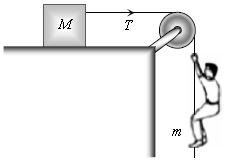
Question. The acceleration of M when man is at rest on the rope is:
a. Mg/M + m
b. mg/M + m
c. (M - m)g/M + m
d. Zero
Answer : C
Question. If man climbs up the rope by acceleration a, then the tension in the rope is:
a. M mg/M + m
b. 2M mg/M + m
c. Mm(g + a)/M + m
d. Mm(g + a)/M + m
Answer : D
Question. If man climbs down the acceleration of system will be:
a. g − a
b. M(g - a)/M + m
c. m(g - a)/M + m
d. m(g + a)/M + m
Answer : A
Paragraph –II
A spring is attached between two masses 1 m and 2 m as shown in figure. Both masses are pulled by forces f1 and f2 where f2 > f1 .
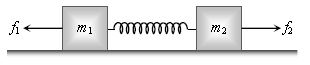
Question. The system will move with acceleration a given by:
a. f2 - f1/m1 + m2
b. f1 + f2/m1 + m2
c. f1 - f2/m1 + m2
d. f1 + f2/m1 - m2
Answer : A
Question. The tension in the spring will be T equal to:
a. f1 + f2
b. f1 - f2
c. m1f2 + m2f1/m1 + m2
d. m1f2 - m2f1/m1 - m2
Answer : C
Question. If two masses are equal but pulling forces are different then tension in spring is:
a. independent of masses attached to spring
b. more is sum of masses of system more is tension
c. more is sum of masses of system less is tension
d. tension depends on nature of spring selected
Answer : A
Integer
Question. A Ship of mass 3×10⁷ kg initially at rest is pulled by a force of 5×10⁶ N through a distance of 3 m. If resistance due to water is negligible, the speed of the ship would be:
Answer : 1
Question. An open knife edge of mass 200 g is dropped from a height of 10 m on a cardboard. If the knife edge penetrates a distance of 4 m into the cardboard, average resistance offered by the cardboard to the knife edge is: (neglect air resistance and take g = 10 m/s2).
Answer : 5
Question. A block is released from top of a smooth inclined plane. It reaches the bottom of the plane in √2s ⋅ The time taken by the body to cover 1st half of inclined plane is:
Answer : 1
Question. Two bodies of masses 3 kg and 2 kg are connected by a spring balance; fig. two forces of 10N and 5N are applied on the blocks as shown. The reading of the spring balance would be:

Answer : 7
Question. Three identical blocks each of mass 2 kg are drawn by a force of 10.2 N with an acceleration of 0.6 m/s² on a frictionless surface, fig. What is the tension in the string between blocks A and B?

Answer : 9
1. What is the unit of coefficient of friction?
2. Name the factor on which coefficient of friction depends?
3. What provides the centripetal force to a car taking a turn on a level road?
4. Give the magnitude and direction of the net force acting on
(a) A drop of rain falling down with constant speed.
(b) A kite skillfully held stationary in the sky.
5. Two blocks of masses m1, m2 are connected by light spring on a smooth horizontal surface. The two masses are pulled apart and then released. Prove that the ratio of their acceleration is inversely proportional to their masses.
6. A shell of mass 0.020kg is fired by a gun of mass 100kg. If the muzzle speed of the shell is 80m/s, what is the recoil speed of the gun?
7. A train runs along an unbanked circular bend of radius 30m at a speed of 54km/hr. The mass of the train is 106kg. What provides the necessary centripetal force required for this purpose? The engine or the rails? What is the angle of banking required to prevent wearing out of the rail?
8. Three identical blocks each having a mass m, are pushed by a force F on a frictionless table as shown in figure

What is the acceleration of the blocks? What is the net force on the block P? What force does P apply on Q. What force does Q apply on R?
9. (a) Define impulse. State its S.I. unit?
(b) State and prove impulse momentum theorem?
Click on link below to download CBSE Class 11 Laws of Motion Worksheet D.
Free study material for Physics
Exam Preparation Worksheet for Class 11 Physics Chapter 04 Laws of Motion
CBSE Practice Material: Class 11 Physics Chapter 04 Laws of Motion
Review targeted practice exercises for Class 11 Physics Chapter 04 Laws of Motion. Curated to match official CBSE guidelines, these downloadable PDF sheets support daily revision and core concept reinforcement.
NCERT-Aligned Questions and Solutions
Built using the official NCERT book for Class 11 Physics, these practice materials provide reliable academic guidance. Pair your practice with our recommended NCERT solutions to master optimal problem-solving approaches.
Next Steps in Your Exam Preparation
Follow up your worksheet practice by attempting the interactive online Physics MCQ test for this chapter to evaluate your execution speed. All platform resources are free to access.
FAQs
You can download the teacher-verified PDF for CBSE Class 11 Laws of Motion Worksheet Set 04 from StudiesToday.com. These practice sheets for Class 11 Physics are designed as per the latest CBSE academic session.
Yes, our CBSE Class 11 Laws of Motion Worksheet Set 04 includes a variety of questions like Case-based studies, Assertion-Reasoning, and MCQs as per the 50% competency-based weightage in the latest curriculum for Class 11.
Yes, we have provided detailed solutions for CBSE Class 11 Laws of Motion Worksheet Set 04 to help Class 11 and follow the official CBSE marking scheme.
Daily practice with these Physics worksheets helps in identifying understanding gaps. It also improves question solving speed and ensures that Class 11 students get more marks in CBSE exams.
All our Class 11 Physics practice test papers and worksheets are available for free download in mobile-friendly PDF format. You can access CBSE Class 11 Laws of Motion Worksheet Set 04 without any registration.