

Class 11 Physics Practice Set: Chapter 04 Laws of Motion
Explore reliable practice materials for Chapter 04 Laws of Motion tailored for Class 11 learners. Utilizing these Physics worksheets ensures thorough preparation and strengthens problem-solving speed for upcoming school assessments.
Download Chapter 04 Laws of Motion Worksheet PDF
Access the complete worksheet PDF for Chapter 04 Laws of Motion below. Regular practice with these targeted questions builds familiarity with standard exam patterns and helps secure higher marks in final Physics evaluations.
Law of Motion MCQ Questions with Answers Class 11 Physics Chapter 5
Question. A simple pendulum of length L and mass (bob) M is oscillating in a plane about a vertical line between angular limits − φ and + φ. For an angular displacement θ (|θ |<φ ), the tension in the string and the velocity of the bob are T and v respectively. The following relations hold good under the above conditions
a. T cosθ = Mg
b. T −Mg cosθ = Mv2 / L
c. The magnitude of the tangential acceleration of the bob ╿aT╿ = g sin θ
d. T = Mg cosθ
Answer : B, C
Question. A reference frame attached to the earth:
a. is an inertial frame by definition
b. cannot be an inertial frame because the earth is revolving round the sun
c. is an inertial frame because Newton’s laws are applicable in this frame
d. cannot be an inertial frame because the earth is rotating about its own axis
Answer : B, D
Question. A point mass of 1 kg collides elastically with a stationary point mass of 5 kg. After their collision, the 1 kg mass reverses its direction and moves with a speed of 2 ms–1. Which of the following statement(s) is/are correct for the system of these two masses?
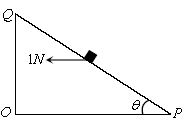
a. Total momentum of the system is 3 kg-ms–1
b. Momentum of 5 kg mass after collision is 4 kg-ms–1
c. Kinetic energy of the centre of mass is 0.75 J
d. Total kinetic energy of the system is 4 J
Answer : A, C
Question. Which of the following are correct?
a. The mechanical advantage for system of pulley is 4. The force needed to lift a mass of 100 kg will be 25 kg-wt
b. A wide hose pipe is held horizontally by a fireman. It deliver water through a nozzle at one litre per second. On increasing the pressure, this increase to tow litre per second. The fireman has now to push forward four times as hard
c. A jet of water with a cross-sectional area A is striking against a wall at an angle θ to the horizontal and rebounds elastically. If the velocity of water jet is υ and the density
ρ, then the normal force acting on the wall is 2Aυ2ρ cos θ:
d. All of these
Answer : ALL
Question. Refer to the figure, the pulleys and the string are light. T is the tension in the string. Takes g = 10 ms–2. Which of the following are correct?
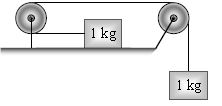
a. The acceleration of the system is 5 ms–2
b. The acceleration of the system is 10 ms–2
c. T = 0 N
d. T = 5 N
Answer : A, D
Question. If a particle under the action of force F has potential energy U, then in equilibrium:
a. F = 0 but U = 0
b. F ≠ 0 but U = 0
c. F = 0 but U ≠ 0
d. F ≠ 0 but U ≠ 0
Answer : A, C
Question. A body will not be in equilibrium if:
a. Σ F = 0 and Στ = 0
b. Σ F ≠ 0 but Στ = 0
c. Σ F = 0 but Στ ≠ 0
d. Σ F ≠ 0 but Στ ≠ 0
Answer : B, C, D
Question. The equilibrium of a negative point charge between two collinear positive charges:
a. can be stable
b. can be unstable
c. I neutral
d. is not possible
Answer : A, B
Question. If a dipole I situated in a non-uniform field:
a. Σ F = 0 and Στ = 0
b. Σ F ≠ 0 and Στ = 0
c. Σ F = 0 but Στ ≠ 0
d. Σ F ≠ 0 but Στ ≠ 0
Answer : B, D
Question. A metal sphere is hung by a string fixed on a wall. The forces acting on the sphere are shown in the figure. Which of the following statement is correct?
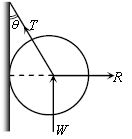
a. R + T + W = 0
b. T2 + R2 + W2
c. T = R + W
d. R = W tan θ
Answer : A, B, D
Question. A rocket in a gravity free space burns fuel at a constant rate until time 't0' when all the fuel is burnt out. Initially, the fuel form a substantial portion of the mass of the rocket and the velocity of the rocket is zero. Which of the following graph represents the velocity υ and acceleration a against time ‘t’ for the rocket?
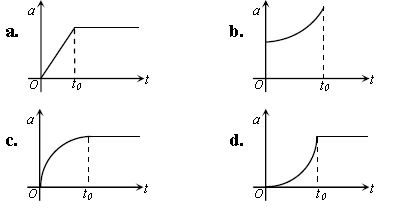
Answer : B, D
Question. A block is resting over a smooth horizontal plane. A constant horizontal force starts acting on it at t = 0. Which of the following graphs are correct?

Answer : B, D
Question. A long block A is at rest on a smooth horizontal surface. A small block B, whose mass if half of A is placed on A at one end and projected along A with some velocity v. The coefficient of friction between the blocks is .μ Then:
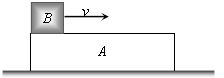
a. the blocks will reach a final common velocity v / 3
b. the work done against friction is two-thirds of the initial kinetic energy of B
c. before the blocks reach a common velocity, the acceleration of A relative to B is (2/3)μ g
d. before the blocks reach a common velocity, the acceleration of A relative to B is (3/2)μg
Answer : A, B, C
Question. Two blocks having masses m1 and m2 are connected by a thread and are placed on an inclined plane with thread loose as showing in figure.
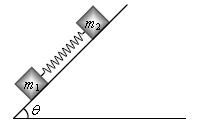
When the blocks are released:
a. thread will remain loose if m1 < m2
b. thread will remain loose if plane is smooth
c. thread will remain loose if m1 is smooth and m2 is rough
d. thread will remain loose if m1
is rough and m2 is smooth
Answer : B, D
Question. Two men of unequal masses hold on to the two sections of a light rope passing over a smooth light pulley
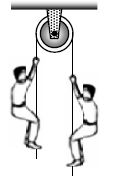
Which of the following are possible?
a. The lighter man is stationary while the heavier man slides with some acceleration
b. The heavier man is stationary while the lighter man slides with some acceleration
c. The two men slide with the same acceleration in the same direction
d. The two mean slide with the acceleration of the same magnitude in opposite directions
Answer : A, B, D
Question. Figure shows the displacement x of a particle going along the x-axis as a function of time. The force acting on the particle is zero in the regions:
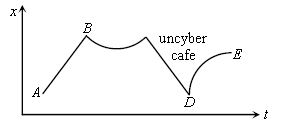
a. AB
b. BC
c. CD
d. DE
Answer : A, C
Match the Column
Question. Match the type of forces in Column I with the statement is Column II.
Column I Column II
(A) Weight of body 1. Force opposite to the force applied to press a body on due to gravity
(B) Thrust 2. Force due to gravity
(C) Reaction 3. Force acting opposite to weight of body
(D) Friction 4. Force along the surface in contact
a. A → 2, B → 3, C → 1, D → 4
b. A → 1, B → 2, C → 3, D → 4
c. A → 4, B → 3, C → 2, D → 1
d. A → 3, B → 2, C → 1, D → 4
Answer : A
Question. A body of mass m is placed on a rough inclined surface of inclination equal to angle of repose. The match the statements in Column I with those in Column II.
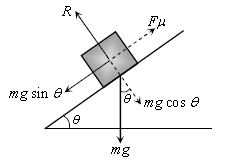
| Column I | Column II |
| (A) Force of limiting friction is |
1. zero |
| (B) Force required to accelerate the body moving down is |
2. mg sinθ |
| (C) Force required to move the body up |
3. 2mg sinθ |
| (D) Force required to stop the body moving up |
4. greater than zero |
A → 2 B → 4, C → 3, D → 1
b. A → 2, B → 2, C → 3, D → 4
c. A → 4, B → 3, C → 2, D → 1
d. A → 4, B → 1, C → 3, D → 2
Answer : A
Question. Bodies are in equilibrium even when a number of forces are acting on the body. Column I gives some condition in which body is in some different type of equilibrium mentioned in Column II. Match them and give suitable answer:
| Column I | Column II |
| (A) For body to be in equilibrium | 1. Potential energy is either maximum or minimum or zero |
| (B) Body can be in steady or dynamic equilibrium if |
2. Body is either at rest or moving with constant velocity |
| (C) The potential energy of body during equilibrium can be | 3. Vector sum of all the forces acting at a point is zero |
a. A→3, B→2, C→1
b. A→1, B→3, C→2
c. A→2, B→1, C→3
d. A→1, B→2, C→3
Answer : A
More question-
1. Why is it desired to hold a gun tight to one’s shoulder when it is being fired?
2. Why does a swimmer push the water backwards?
3. Friction is a self adjusting force. Justify.
4. A force is being applied on a body but it causes no acceleration. What possibilities may be considered to explain the observation?
5. Force of 16N and 12N are acting on a mass of 200kg in mutually perpendicular directions. Find the magnitude of the acceleration produced?
6. An elevator weighs 3000kg. What is its acceleration when the in the tension supporting cable is 33000N. Given that g = 9.8m/s2.
7. Write two consequences of Newton’s second law of motion?
8. How is centripetal force provided in case of the following?
(i) Motion of planet around the sun,
(ii) Motion of moon around the earth.
(iii) Motion of an electron around the nucleus in an atom.
9. State Newton’s second, law of motion. Express it mathematically and hence obtain a relation between force and acceleration.
10. A railway car of mass 20 tonnes moves with an initial speed of 54km/hr. On applying brakes, a constant negative acceleration of 0.3m/s2 is produced.
(i) What is the breaking force acting on the car?
(ii) In what time it will stop?
(iii) What distance will be covered by the car before if finally stops?
Click on link below to download CBSE Class 11 Laws of Motion Worksheet C.
Free study material for Physics
Practice Worksheet and Study Resources for Class 11 Physics Chapter 04 Laws of Motion
CBSE Practice Material: Class 11 Physics Chapter 04 Laws of Motion
Access structured practice worksheets for Chapter 04 Laws of Motion designed in alignment with the latest CBSE curriculum for Class 11 Physics. These printable problem sets help students build accuracy and prepare effectively for school tests.
NCERT-Aligned Questions and Solutions
Each worksheet is structured around standard CBSE textbooks, allowing students to check their working steps and correct mistakes early in their revision.
Next Steps in Your Exam Preparation
Explore our broader library of printable assignments, chapter notes, and mock tests designed to support continuous revision and secure higher marks in CBSE assessments.
FAQs
You can download the teacher-verified PDF for CBSE Class 11 Laws of Motion Worksheet Set 03 from StudiesToday.com. These practice sheets for Class 11 Physics are designed as per the latest CBSE academic session.
Yes, our CBSE Class 11 Laws of Motion Worksheet Set 03 includes a variety of questions like Case-based studies, Assertion-Reasoning, and MCQs as per the 50% competency-based weightage in the latest curriculum for Class 11.
Yes, we have provided detailed solutions for CBSE Class 11 Laws of Motion Worksheet Set 03 to help Class 11 and follow the official CBSE marking scheme.
Daily practice with these Physics worksheets helps in identifying understanding gaps. It also improves question solving speed and ensures that Class 11 students get more marks in CBSE exams.
All our Class 11 Physics practice test papers and worksheets are available for free download in mobile-friendly PDF format. You can access CBSE Class 11 Laws of Motion Worksheet Set 03 without any registration.