

Official Class 11 Physics Worksheets: Chapter 08 Mechanical Properties Of Solids
Explore reliable practice materials for Chapter 08 Mechanical Properties Of Solids tailored for Class 11 learners. Utilizing these Physics worksheets ensures thorough preparation and strengthens problem-solving speed for upcoming school assessments.
Chapter-wise Practice Material: Chapter 08 Mechanical Properties Of Solids
View or download the dedicated Chapter 08 Mechanical Properties Of Solids practice resource below. Engaging with these objective and subjective questions daily ensures continuous academic progress and mastery of the 2026-27 curriculum.
Question. The value of tan (90 – θ) in the graph gives
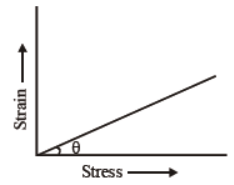
(a) Young's modulus of elasticity
(b) compressibility
(c) shear strain
(d) tensile strength
Answer: A
Question. A beam of metal supported at the two edges is loaded at the centre. The depression at the centre is proportional to
(a) Y2
(b) Y
(c) 1/Y
(d) 1/Y2
Answer: C
Question. What per cent of length of wire increases by applying a stress of 1 kg weight/mm2 on it?
(Y = 1 × 10¹¹ N/m2 and 1 kg weight = 9.8 newton)
(a) 0.0067%
(b) 0.0098%
(c) 0.0088%
(d) 0.0078%
Answer: B
Question. A circular tube of mean radius 8 cm and thickness 0.04 cm is melted up and recast into a solid rod of the same length. The ratio of the torsional rigidities of the circular tube and the solid rod is
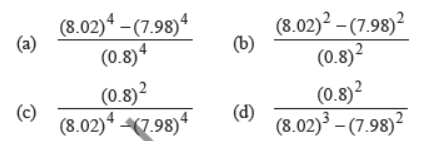
Answer: A
Question. A steel rod of radius R = 10 mm and length L= 100 cm is stretched along its length by a force F = 6.28 × 10⁴ N. If the Young’s modulus of steel is Y = 2 ×10¹¹ N/m2, the percentage elongation in the length of the rod is :
(a) 0.100
(b) 0.314
(c) 2.015
(d) 1.549
Answer: A
Question. An iron rod of length 2m and cross-sectional area of 50 mm2 stretched by 0.5 mm, when a mass of 250 kg is hung from its lower end. Young’s modulus of iron rod is
(a) 19.6´1020 N/m2
(b) 19.6´1018 N/m2
(c) 19.6´1010 N/m2
(d) 19.6´1015 N/m2
Answer: C
Question. A wire suspended vertically from one of its ends is stretched by attaching a weight of 200N to the lower end. The weight stretches the wire by 1 mm. Then the elastic energy stored in the wire is
(a) 0.2 J
(b) 10 J
(c) 20 J
(d) 0.1 J
Answer: D
Question. If the ratio of diameters, lengths and Young’s modulus of steel and copper wires shown in the figure are p, q and s respectively, then the corresponding ratio of increase in their lengths would be
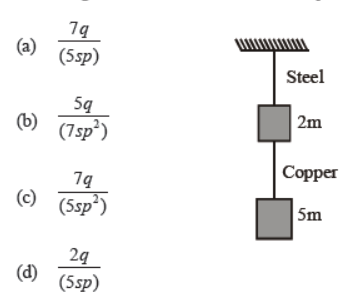
Answer: C
Question. A wire fixed at the upper end stretches by length l by applying a force F. The work done in stretching is
(a) 2Fl
(b) Fl
(c) F/2l
(d) Fl/2
Answer: D
Question. Which of the following relation is true ?
(a) 3Y = K(1- σ)
(b) K = 9ηY/Y+η
(c) σ = (6K + η)Y
(d) σ = 05.Y - η/η
Answer: D
Question. For a given material, the Young's modulus is 2. 4 times that of rigidity modulus. Its Poisson's ratio is
(a) 2.4
(b) 1.2
(c) 0.4
(d) 0.2
Answer: D
Question. On stretching a wire, the elastic energy stored per unit volume is
(a) Fl/2AL
(b) FA/2L
(c) FL/2A
(d) FL/2
Answer: A
Question. When a pressure of 100 atmosphere is applied on a spherical ball, then its volume reduces to 0.01%. The bulk modulus of the material of the rubber in dyne/cm2 is
(a) 10 × 1012
(b) 100 × 1012
(c) 1 × 10¹²
(d) 10 × 1012
Answer: C
Question. The diagram below shows the change in the length X of a thin uniform wire caused by the application of stress F at two different temperatures T1 and T2. The variation shown suggests that
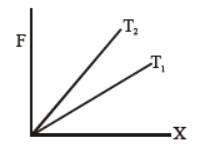
(a) T1 > T2
(b) T1 < T2
(c) T2 > T1
(d) T1 ≥ T2
Answer: A
Question. Young’s modulus of brass and steel are respectively 1010 N/m2. and 2 × 10¹⁰ N/m2. A brass wire and a steel wire of the same length are extended by 1 mm under the same force, the radii of brass and steel wires are RB and RS respectively. Then
(a) RS = √2 RB
(b) RS = RB /√2
(c) RS = 4RB
(d) RS = RB / 4
Answer: B
Question. Two wires A and B are of the same material. Their lengths are in the ratio of 1 : 2 and the diameter are in the ratio 2 : 1. If they are pulled by the same force, then increase in length will be in the ratio of
(a) 2 : 1
(b) 1 : 4
(c) 1 : 8
(d) 8 : 1
Answer: C
Question. The Young’s modulus of a perfectly rigid body is
(a) unity
(b) zero
(c) infinity
(d) some finite non-zero constant
Answer: C
Question. Minimum and maximum values of Possion’s ratio for a metal lies between
(a) – ∞ to + ∞
(b) 0 to 1
(c) – ∞ to 1
(d) 0 to 0.5
Answer: D
Question. A rubber cord catapult has cross-sectional area 25 mm2 and initial length of rubber cord is 10 cm. It is stretched to 5 cm and then released to project a missile of mass 5 gm.
Taking Yrubber = 5 × 10⁸ N/m2. Velocity of projected missile is
(a) 20 ms–1
(b) 100 ms–1
(c) 250 ms–1
(d) 200 ms–1
Answer: C
Question. K is the force constant of a spring. The work done in increasing its extension from l1 to l2 will be
(a) K(l2 – l1)
(b) K/2(l2 + l1)
(c) K(l22 - l12)
(d) K/2(l22 - l12)
Answer: D
Question. Modulus of rigidity of ideal liquids is
(a) infinity
(b) zero
(c) unity
(d) some finite small non-zero constant value
Answer: B
Question. The maximum load a wire can withstand without breaking, when its length is reduced to half of its original length, will
(a) be double
(b) be half
(c) be four times
(d) remain same
Answer: D
Question. The Young's modulus of steel is twice that of brass. Two wires of same length and of same area of cross section, one of steel and another of brass are suspended from the same roof. If we want the lower ends of the wires to be at the same level, then the weights added to the steel and brass wires must be in the ratio of :
(a) 2 : 1
(b) 4 : 1
(c) 1 : 1
(d) 1 : 2
Answer: A
Question. The diagram shows a force - extension graph for a rubber band. Consider the following statements :
I. It will be easier to compress this rubber than expand it
II. Rubber does not return to its original length after it is stretched
III. The rubber band will get heated if it is stretched and released
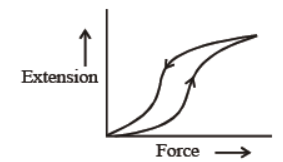
Which of these can be deduced from the graph?
(a) III only
(b) II and III
(c) I and III
(d) I only
Answer: C
Question. A rod of length l and radius r is joined to a rod of length l/2 and radius r/2 of same material. The free end of small rod is fixed to a rigid base and the free end of larger rod is given a twist of q°, the twist angle at the joint will be
(a) q/4
(b) q/2
(c) 5q/6
(d) 8q/48
Answer: D
Question. A steel wire of uniform cross-section of 1mm2 is heated upto 50°C and clamped rigidly at its ends. If temperature of wire falls to 40°C, change in tension in the wire is (coefficient of linear expansion of steel is 1.1 × 10⁻⁵/°C and Young's modulus of elasticity of steel is 2 × 10¹¹ N/m2 )
(a) 22 N
(b) 44 N
(c) 88 N
(d) 88 × 106 N
Answer: A
Question. A steel wire of length 20 cm and uniform cross-section 1 mm2 is tied rigidly at both the ends. The temperature of the wire is altered from 40ºC to 20ºC. Coefficient of linear expansion for steel a = 1.1 × 10⁻⁵/ºC and Y for steel is 2.0 × 10¹¹ N/m2. The change in tension of the wire is
(a) 2.2 × 10⁶ newton
(b) 16 newton
(c) 8 newton
(d) 44 newton
Answer: D
Question. A material has poisson’s ratio 0.50. If a uniform rod of it suffers a longitudinal strain of 2 × 10⁻³, then the percentage change in volume is
(a) 0.6
(b) 0.4
(c) 0.2
(d) Zero
Answer: D
Question. In solids interatomic forces are
(a) totally repulsive
(b) totally attractive
(c) both (a) and (b)
(d) None of these
Answer: C
Question. If a rubber ball is taken at the depth of 200 m in a pool, its volume decreases by 0.1%. If the density of the water is 1 × 10³ kg/m3 and g = 10m/s2, then the volume elasticity in N/m2 will be
(a) 108
(b) 2 × 10⁸
(c) 109
(d) 2 × 10⁹
Answer: D
Free study material for Physics
Chapter 08 Mechanical Properties Of Solids Practice Sheet and Solutions for Class 11 Physics
CBSE Practice Material: Class 11 Physics Chapter 08 Mechanical Properties Of Solids
Review targeted practice exercises for Class 11 Physics Chapter 08 Mechanical Properties Of Solids. Curated to match official CBSE guidelines, these downloadable PDF sheets support daily revision and core concept reinforcement.
NCERT-Aligned Questions and Solutions
Cross-reference your completed exercises with comprehensive NCERT solutions for Class 11 Physics to ensure absolute clarity across all sub-topics in this chapter.
Next Steps in Your Exam Preparation
Follow up your worksheet practice by attempting the interactive online Physics MCQ test for this chapter to evaluate your execution speed. All platform resources are free to access.
FAQs
You can download the teacher-verified PDF for CBSE Class 11 Physics Mechanical Properties of Solids Worksheet Set 01 from StudiesToday.com. These practice sheets for Class 11 Physics are designed as per the latest CBSE academic session.
Yes, our CBSE Class 11 Physics Mechanical Properties of Solids Worksheet Set 01 includes a variety of questions like Case-based studies, Assertion-Reasoning, and MCQs as per the 50% competency-based weightage in the latest curriculum for Class 11.
Yes, we have provided detailed solutions for CBSE Class 11 Physics Mechanical Properties of Solids Worksheet Set 01 to help Class 11 and follow the official CBSE marking scheme.
Daily practice with these Physics worksheets helps in identifying understanding gaps. It also improves question solving speed and ensures that Class 11 students get more marks in CBSE exams.
All our Class 11 Physics practice test papers and worksheets are available for free download in mobile-friendly PDF format. You can access CBSE Class 11 Physics Mechanical Properties of Solids Worksheet Set 01 without any registration.