

Class 11 Physics Practice Set: Chapter 11 Thermodynamics
Explore reliable practice materials for Chapter 11 Thermodynamics tailored for Class 11 learners. Utilizing these Physics worksheets ensures thorough preparation and strengthens problem-solving speed for upcoming school assessments.
Download Chapter 11 Thermodynamics Worksheet PDF
View or download the dedicated Chapter 11 Thermodynamics practice resource below. Engaging with these objective and subjective questions daily ensures continuous academic progress and mastery of the 2026-27 curriculum.
Download free printable worksheets for your students. All worksheets are in pdf format with the answers on the next page. Please give the questions to the child and then compare answers with the suggested answers provided by us. Free worksheets with questions and answers are available for all subjects. Use the worksheets to get better marks in tests and exams.
Question. During an isothermal expansion, a confined ideal gas does –150 J of work against its surroundings. This implies that
(a) 150 J heat has been removed from the gas
(b) 300 J of heat has been added to the gas
(c) no heat is transferred because the process is isothermal
(d) 150 J of heat has been added to the gas
Answer: A,D
Question. When 1 kg of ice at 0°C melts to water at 0°C, the resulting change in its entropy, taking latent heat of ice to be 80 cal/°C, is
(a) 273 cal/K
(b) 8 × 10⁴ cal/K
(c) 80 cal/K
(d) 293 cal/K
Answer: D
Question. During an adiabatic process, the pressure of a gas is found to be proportional to the cube of its temperature. The ratio of Cp/Cv for the gas is
(a) 2
(b) 5/3
(c) 3/2
(d) 4/3
Answer: C
Question. A system is taken from state a to state c by two paths adc and abc as shown in the figure. The internal energy at a is Ua = 10 J. Along the path adc the amount of heat absorbed δQ1 = 50 J and the work done δW1 = 20 J whereas along the path abc the heat absorbed δQ2 = 36 J. The amount of work done along the path abc is
(a) 6 J
(b) 10 J
(c) 12 J
(d) 36 J
Answer: A
Question. 1 gm of water at a pressure of 1.01 × 10⁵ Pa is converted into steam without any change of temperature. The volume of 1 g of steam is 1671 cc and the latent heat of evaporation is 540 cal. The change in internal energy due to evaporation of 1 gm of water is
(a) ≈ 167 cal
(b) ≈ 500 cal
(c) 540 cal
(d) 581 cal
Answer: B
Question. The internal energy change in a system that has absorbed 2 kcals of heat and done 500 J of work is
(a) 6400 J
(b) 5400 J
(c) 7900 J
(d) 8900 J
Answer: C
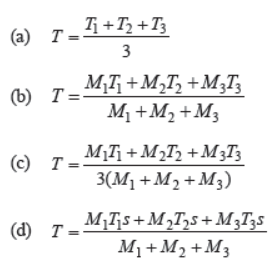
Question. Three copper blocks of masses M1, M2 and M3 kg respectively are brought into thermal contact till they reach equilibrium. Before contact, they were at T1, T2, T3 (T1 > T2 > T3). Assuming there is no heat loss to the surroundings, the equilibrium temperature T is (s is specific heat of copper)
Answer: B
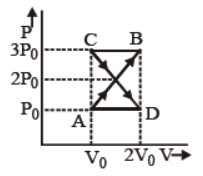
Question. A thermodynamic system undergoes cyclic process ABCDA as shown in fig. The work done by the system in the cycle is :
(a) P0V0
(b) 2P0V0
(c) P0V0/2
(d) Zero
Answer: D
Question. A monoatomic gas at a pressure P, having a volume V expands isothermally to a volume 2V and then adiabatically to a volume 16V. The final pressure of the gas is :(take γ =5/3)
(a) 64P
(b) 32P
(c) P/64
(d) 16P
Answer: C
Question. Figure below shows two paths that may be taken by a gas to go from a state A to a state C. (14 EX 3)
In process AB, 400 J of heat is added to the system and in process BC, 100 J of heat is added to the system. The heat absorbed by the system in the process AC will be
(a) 500 J
(b) 460 J
(c) 300 J
(d) 380 J
Answer: B
Question. A carnot engine having an efficiency of 1/10 as heat engine, is used as a refrigerator. If the work done on the system is 10 J, the amount of energy absorbed from the reservoir at lower temperature is :-
(a) 90 J
(b) 99 J
(c) 100 J
(d) 1 J
Answer: A
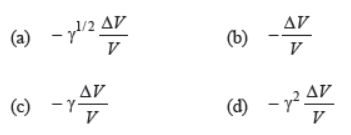
Question. For an isothermal expansion of a perfect gas, the value of ΔP/P is equal to
Answer: B
Question. If an average person jogs, he produces 14.5 × 10³ cal/min. This is removed by the evaporation of sweat. The amount of sweat evaporated per minute (assuming 1 kg requires 580 × 103 cal for evaporation) is
(a) 0.025 kg
(b) 2.25 kg
(c) 0.05 kg
(d) 0.20 kg
Answer: A
Question. Consider p-V diagram for an ideal gas shown in figure.
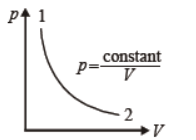
Out of the following diagrams, which figure represents the T-p diagram?
(a) (iv)
(b) (ii)
(c) (iii)
(d) (i)
Answer: C
Question. A gas is taken through the cycle A→ B→ C→ A, as shown in figure. What is the net work done by the gas ?
(a) 1000 J
(b) zero
(c) – 2000 J
(d) 2000 J
Answer: A
Question. An ideal gas goes from state A to state B via three different processes as indicated in the P-V diagram : (43)
If Q1, Q2, Q3 indicate the heat a absorbed by the gas along the three processes and ΔU1, ΔU2, ΔU3 indicate the change in internal energy along the three processes respectively, then
(a) Q1 > Q2 > Q3 and ΔU1 = ΔU2 = ΔU3
(b) Q3 > Q2 > Q1 and ΔU1= ΔU2 = ΔU3
(c) Q1 = Q2 = Q3 and ΔU1 > ΔU2 > ΔU3
(d) Q3 > Q2 > Q1 and ΔU1> ΔU2 > ΔU3
Answer: A
Question. Thermodynamic processes are indicated in the following diagram :
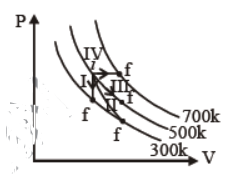
Match the following
Column-1 Column-2
P. Process I A. Adiabatic
Q. Process II B. Isobaric
R. Process III C. Isochoric
S. Process IV D. Isothermal
(a) P → C, Q → A, R → D, S → B
(b) P → C, Q → D, R → B, S → A
(c) P → D, Q → B, R → A, S → C
(d) P → A, Q → C, R → D, S → B
Answer: A
Question. A diatomic gas initally at 18ºC is compressed adiabatically to one eighth of its original volume. The temperature after compression will be
(a) 18ºC
(b) 887ºC
(c) 327ºC
(d) None of these
Answer: D
Question. The figure shows the P-V plot of an ideal gas taken through a cycle ABCDA. The part ABC is a semi-circle and CDA is half of an ellipse. Then,
(a) the process during the path A → B is isothermal
(b) heat flows out of the gas during the path B → C → D
(c) work done during the path A → B → C is zero
(d) positive work is done by the gas in the cycle ABCDA
Answer: D
1. If a air is a cylinder is suddenly compressed by a piston. What happens to the pressure of air?
2. What is the ratio of find volume to initial volume if the gas is compressed adiabatically till its temperature is doubled?
3. What is the ratio of slopes of P-V graphs of adiabatic and isothermal process?
4. A motor car tyre has a Pressure of four atmosphere at a room temperature of 27°C. If the tyre suddenly bursts, calculate the temperature of escaping gas?
5. How does Carnot cycle operates?
6. Calculate the work done by the gas in going from the P-V graph of the thermodynamic behavior of a gas from point A to point B to point C?
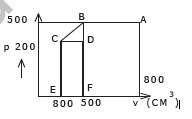
7. Why does absolute zero not correspond to zero energy?
8. State the Second law of thermodynamics and write 2 applications of it?
9. At 0°C and normal atmospheric pressure, the volume of 1g of water increases from 1cm3 to 1.091 cm3 on free zing. What will be the change in its internal energy? Normal atmospheric pressure is 1.013x10⁵ N|m2 and the latent heat of melting of ice is 80 cal/g?
Click on link below to download CBSE Class 11 Thermodynamics Worksheet D.
Free study material for Physics
Chapter 11 Thermodynamics Practice Sheet and Solutions for Class 11 Physics
Download Practice Sheet: Chapter 11 Thermodynamics (Class 11 Physics)
Access structured practice worksheets for Chapter 11 Thermodynamics designed in alignment with the latest CBSE curriculum for Class 11 Physics. These printable problem sets help students build accuracy and prepare effectively for school tests.
Concept Clarification for Chapter 11 Thermodynamics
Each worksheet is structured around standard CBSE textbooks, allowing students to check their working steps and correct mistakes early in their revision.
Additional Study Resources for Class 11 Physics
Explore our broader library of printable assignments, chapter notes, and mock tests designed to support continuous revision and secure higher marks in CBSE assessments.
FAQs
You can download the teacher-verified PDF for CBSE Class 11 Thermodynamics Worksheet Set 04 from StudiesToday.com. These practice sheets for Class 11 Physics are designed as per the latest CBSE academic session.
Yes, our CBSE Class 11 Thermodynamics Worksheet Set 04 includes a variety of questions like Case-based studies, Assertion-Reasoning, and MCQs as per the 50% competency-based weightage in the latest curriculum for Class 11.
Yes, we have provided detailed solutions for CBSE Class 11 Thermodynamics Worksheet Set 04 to help Class 11 and follow the official CBSE marking scheme.
Daily practice with these Physics worksheets helps in identifying understanding gaps. It also improves question solving speed and ensures that Class 11 students get more marks in CBSE exams.
All our Class 11 Physics practice test papers and worksheets are available for free download in mobile-friendly PDF format. You can access CBSE Class 11 Thermodynamics Worksheet Set 04 without any registration.