

Download Class 11 Physics Worksheets for Chapter 10 Thermal Properties Of Matter
Review targeted practice sets for Class 11 Physics Chapter 10 Thermal Properties Of Matter. Built according to official educational guidelines for the 2026-27 academic year, these downloadable worksheets support daily revision and core concept reinforcement.
Access Chapter 10 Thermal Properties Of Matter Questions and Exercises
Navigate directly to the printable exercises for Chapter 10 Thermal Properties Of Matter using the digital viewer below. Each practice set allows students to isolate specific topics for thorough review and uninterrupted practice alongside standard textbooks.
Question. Solar radiation emitted by sun resembles that emitted by a black body at a temperature of 6000 K. Maximum intensity is emitted at wavelength of about 4800 Å. If the sun were to cool down from 6000 K to 3000 K, then the peak intensity would occur at a wavelength
(a) 4800 Å
(b) 9600 Å
(c) 2400 Å
(d) 19200 Å
Answer: B
Question. For the construction of a thermometer, one of the essential requirements is a thermometric substance which
(a) remains liquid over the entire range of temperatures to be meaured .
(b) has property that varies linearly with temperature
(c) has a property that varies with temperature
(d) obey Boyle's law
Answer: C
Question. The coefficient of thermal conductivity depends upon
(a) temperature difference between the two surfaces.
(b) area of the plate
(c) material of the plate
(d) All of these
Answer: C
Question. The sprinkling of water slightly reduces the temperature of a closed room because
(a) temperature of water is less than that of the room
(b) specific heat of water is high
(c) water has large latent heat of vaporisation
(d) water is a bad conductor of heat
Answer: C
Question. If a bar is made of copper whose coefficient of linear expansion is one and a half times that of iron, the ratio of force developed in the copper bar to the iron bar of identical lengths and cross-sections, when heated through the same temperature range (Young’s modulus of copper may be taken to be equal to that of iron) is
(a) 3/2
(b) 2/3
(c) 9/4
(d) 4/9
Answer: A
Question. The wavelength of radiation emitted by a body depends upon
(a) the nature of its surface
(b) the area of its surface
(c) the temperature of its surface
(d) All of the above
Answer: D
Question. A vessel completely filled with a liquid is heated. If α and γ represent coefficient of linear expansion of material of vessel and coefficient of cubical expansion of liquid respectively, then the liquid will not overflow if
(a) γ = 3 α
(b) γ > 3 α
(c) γ < 3 α
(d) γ ≤ 3 α
Answer: D
Question. A mountain climber finds that water boils at 80ºC. The temperature of this boiling water is...... Fahrenheit
(a) 50º
(b) 150º
(c) 176º
(d) 200º
Answer: C
Question. A spherical black body with a radius of 12 cm radiates 450 watt power at 500 K. If the radius were halved and the temperature doubled, the power radiated in watt would be :
(a) 450
(b) 1000
(c) 1800
(d) 225
Answer: C
Question. Two straight metallic strips each of thickness t and length l are rivetted together. Their coefficients of linear expansions are α1 and α2 . If they are heated through temperature DT, the bimetallic strip will bend to form an arc of radius
(a) t /{α1 + α2)ΔT}
(b) t /{(α2 - α1)ΔT}
(c) t (α1 - α2)ΔT
(d) t (α2 - α1)ΔT
Answer: B
Question. Two solid spheres, of radii R1 and R2 are made of the same material and have similar surfaces. The spheres are raised to the same temperature and then allowed to cool under identical conditions. Assuming spheres to be perfect conductors of heat, their initial rates of loss of heat are
(a) R12/R22
(b) R1 / R2
(c) R2 / R1
(d) R22/R12
Answer: A
Question. A radiation of energy E falls normally on a perfectly reflecting surface. The momentum transferred to the surface is
(a) Ec
(b) 2E/c
(c) E/c
(d) E/c2
Answer: B
Question. Which of the following graph correctly represents the relation between ln E and lnT where E is the amount of radiation emitted per unit time from unit area of body and T is the absolute temperature
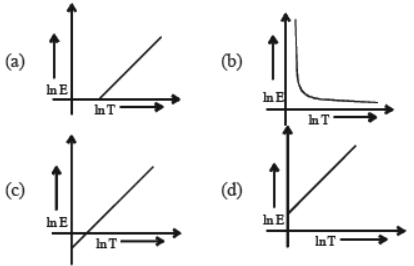
Answer: C
Question. The temperature of the Sun is measured with
(a) platinum thermometer
(b) gas thermometer
(c) pyrometer
(d) vapour pressure thermometer.
Answer: C
Question. Which of the following circular rods, (given radius r and length l) each made of the same material and whose ends are maintained at the same temperature will conduct most heat?
(a) r = 2r0; l = 2l0
(b) r = 2r0; l = l0
(c) r = r0; l = 2l0
(d) r = r0; l = l0
Answer: B
Question. At a certain temperature for given wave length , the ratio of emissive power of a body to emissive power of black body in same circumstances is known as
(a) relative emissivity
(b) emissivity
(c) absorption coefficient
(d) coefficient of reflection
Answer: C
Question. If a liquid is heated in weightlessness, the heat is transmitted through
(a) conduction
(b) convection
(c) radiation
(d) None of these, because the liquid cannot be heated in weightlessness.
Answer: A
Question. 540 g of ice at 0°C is mixed with 540 g of water at 80°C. The final temperature of mixture is
(a) 0°C
(b) 40°C
(c) 80°C
(d) less than 0°C
Answer: A
Question. Which of the following is not close to a black body?
(a) Black board paint
(b) Green leaves
(c) Black holes
(d) Red roses
Answer: A
Question. Two rods of the same length and areas of cross-section A1 and A2 have their ends at the same temperature. K1 and K2 are the thremal conductivities of the two rods. The rate of flow of heat is same in both rods if
(a) A1/A2 = K1/K2
(b) A1/A2 = K2/K1
(c) A1A2 = K1K2
(d) A1 K12 = A2K22
Answer: B
Question. The resistance of a resistance thermometer has values 2.71 and 3.70 ohms at 10ºC and 100ºC respectively. The temperature at which the resistance is 3.26 ohm is
(a) 40ºC
(b) 50ºC
(c) 60ºC
(d) 70ºC
Answer: C
Question. The temperature of stars is determined by
(a) Stefan’s law
(b) Wien’s displacement law
(c) Kirchhoff’s law
(d) Ohm’s law
Answer: B
Question. A metal ball of surface area 200 square cm, temperature 527ºC is surrounded by a vessel at 27ºC. If the emissivity of the metal is 0.4, then the rate of loss of heat from the ball is approximately σ = 5.67 x 10⁻⁸ joule/m2 x sec x K2
(a) 108 joule
(b) 168 joule
(c) 182 joule
(d) 192 joule
Answer: C
Question. A metallic rod l cm long, A square cm in cross-section is heated through tºC. If Young’s modulus of elasticity of the metal is E and the mean coefficient of linear expansion is a per degree celsius, then the compressional force required to prevent the rod from expanding along its length is
(a) E A α t
(b) E A α t/(1 + αt)
(c) E A α t/(1 – α t)
(d) E l α t
Answer: A
Question. A black body rediates energy at the rate of E watt per metre2 at a high temperature T K. when the temperature is reduced to (T/2) K, the radiant energy will be
(a) E/16
(b) E/4
(c) E/2
(d) 2E
Answer: A
Please click on below link to download pdf file for CBSE Class 11 Physics Thermal Properties of Matter Worksheet Set A
Free study material for Physics
Exam Preparation Worksheet for Class 11 Physics Chapter 10 Thermal Properties Of Matter
Chapter Practice Questions for Class 11 Physics
Access structured practice worksheets for Chapter 10 Thermal Properties Of Matter designed in alignment with the latest CBSE curriculum for Class 11 Physics. These printable problem sets help students build accuracy and prepare effectively for school tests.
Expert Practice Material for Class 11 Physics
Each worksheet is structured around standard CBSE textbooks, allowing students to check their working steps and correct mistakes early in their revision.
Complete Your Chapter Revision
Wrap up your chapter revision by testing your knowledge against standard question formats. Everything on our platform is provided free of charge.
FAQs
You can download the teacher-verified PDF for CBSE Class 11 Physics Thermal Properties of Matter Worksheet Set 01 from StudiesToday.com. These practice sheets for Class 11 Physics are designed as per the latest CBSE academic session.
Yes, our CBSE Class 11 Physics Thermal Properties of Matter Worksheet Set 01 includes a variety of questions like Case-based studies, Assertion-Reasoning, and MCQs as per the 50% competency-based weightage in the latest curriculum for Class 11.
Yes, we have provided detailed solutions for CBSE Class 11 Physics Thermal Properties of Matter Worksheet Set 01 to help Class 11 and follow the official CBSE marking scheme.
Daily practice with these Physics worksheets helps in identifying understanding gaps. It also improves question solving speed and ensures that Class 11 students get more marks in CBSE exams.
All our Class 11 Physics practice test papers and worksheets are available for free download in mobile-friendly PDF format. You can access CBSE Class 11 Physics Thermal Properties of Matter Worksheet Set 01 without any registration.