

Official Class 11 Physics Worksheets: Chapter 02 Motion in a Straight Line
Access printable practice worksheets for Chapter 02 Motion in a Straight Line designed to align with the 2026-27 academic syllabus for Class 11 Physics. These structured exercises help students evaluate their conceptual understanding and improve exam readiness.
Chapter-wise Practice Material: Chapter 02 Motion in a Straight Line
Navigate directly to the printable exercises for Chapter 02 Motion in a Straight Line using the digital viewer below. Each practice set allows students to isolate specific topics for thorough review and uninterrupted practice alongside standard textbooks.
Question. In the displacement d versus time t graph given below, the value of average velocity in the time interval 0 to 20 s is (in m/s)
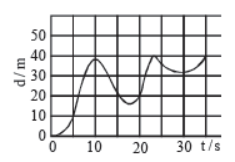
(a) 1.5
(b) 4
(c) 1
(d) 2
Answer: C
Question. A body starts from rest and travels a distance x with uniform acceleration, then it travels a distance 2x with uniform speed, finally it travels a distance 3x with uniform retardation and comes to rest. If the complete motion of the particle is along a straight line, then the ratio of its average velocity to maximum velocity is
(a) 2/5
(b) 3/5
(c) 4/5
(d) 6/7
Answer: B
Question. A particle accelerates from rest at a constant rate for some time and attains a velocity of 8 m/sec. Afterwards it decelerates with the constant rate and comes to rest. If the total time taken is 4 sec, the distance travelled is
(a) 32 m
(b) 16 m
(c) 4 m
(d) None of the above
Answer: B
Question. The displacement x of a particle at the instant when its velocity is v is given by v = √3x +16 . Its acceleration and initial velocity are
(a) 1.5 units, 4 units
(b) 3 units, 4 units
(b) 16 units, 1.6 units
(d) 16 units, 3 units
Answer: A
Question. A ball is thrown vertically upward with a velocity ‘u’ from the balloon descending with velocity v. The ball will pass by the balloon after time
(a) u-v/2g
(b) u+v/2g
(c) 2(u-v)/g
(d) 2(u+v)/g
Answer: D
Question. Two bodies begin a free fall from the same height at a time interval of N s. If vertical separation between the two bodies is 1 after n second from the start of the first body, then n is equal to
(a) √nN
(b) 1/gN
(c) 1/gN + N/2
(d) 1/gN - N/4
Answer: C
Question. Which one of the following equations represents the motion of a body with finite constant acceleration ? In these equations, y denotes the displacement of the body at time t and a, b and c are constants of motion.
(a) y = at
(b) y = at + bt2
(c) y = at + bt2 + ct3
(d) y = a/t + bt
Answer: B
Question. For the velocity time graph shown in the figure below the distance covered by the body in the last two seconds of its motion is what fraction of the total distance travelled by it in all the seven seconds?
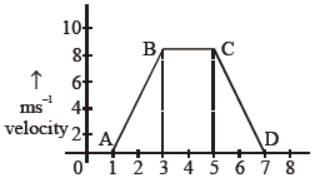
(a) 1/2
(b) 1/4
(c) 2/3
(d) 1/3
Answer: B
Question. A rocket is fired upward from the earth’s surface such that it creates an acceleration of 19.6 ms-2 . If after 5 s, its engine is switched off, the maximum height of the rocket from earth’s surface would be
(a) 980 m
(b) 735 m
(c) 490 m
(d) 245 m
Answer: B
Question. The dependence of velocity of a body with time is given by the equation v = 20 + 0.1t2. The body is in
(a) uniform retardation
(b) uniform acceleration
(c) non-uniform acceleration
(d) zero acceleration.
Answer: C
Question. A man leaves his house for a cycle ride. He comes back to his house after half-an-hour after covering a distance of one km. What is his average velocity for the ride ?
(a) zero
(b) 2 km h–1
(c) 10 km s–1
(d) 1/2 km s-1
Answer: A
Question. The distance time graph of a particle at time t makes angles 45° with the time axis. After one second, it makes angle 60° with the time axis. What is the acceleration of the particle?
(a) √3 -1
(b) √3 +1
(c) √3
(d) 1
Answer: A
Question. Two particles A and B are connected by a rigid rod AB. The rod slides along perpendicular rails as shown here. The velocity of A to the left is 10 m/s. What is the velocity of B when angle α = 60°?
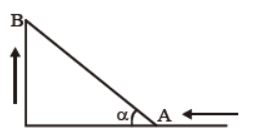
(a) 9.8 m/s
(b) 10 m/s
(c) 5.8 m/s
(d) 17.3 m/s
Answer: C
Question. The relation between time t and distance x is t = αx2 +βx where a and b are constants. The retardation is
(a) 2Vv3
(b) 2βv3
(c) 2αβv3
(d) 2β2v3
Answer: A
Question. A ball released from a height falls 5 m in one second. In 4 seconds it falls through
(a) 20 m
(b) 1.25 m
(c) 40 m
(d) 80 m
Answer: D
Question. A car travels from A to B at a speed of 20 km h–1 and returns at a speed of 30 km h–1. The average speed of the car for the whole journey is
(a) 5 km h–1
(b) 24 km h–1
(c) 25 km h–1
(d) 50 km h–1
Answer: B
Question. Two stones are thrown from the top of a tower, one straight down with an initial speed u and the second straight up with the same speed u. When the two stones hit the ground, they will have speeds in the ratio
(a) 2 : 3
(b) 2 : 1
(c) 1 : 2
(d) 1 : 1
Answer: D
Question. A parachutist after bailing out falls 50 m without friction. When parachute opens, it decelerates at 2 m/s2 . He reaches the ground with a speed of 3 m/s. At what height, did he bail out ?
(a) 182 m
(b) 91 m
(c) 111 m
(d) 293 m
Answer: D
Question. A man throws balls with same speed vertically upwards one after the other at an interval of 2 sec. What should be the speed of throw so that more than two balls are in air at any time
(a) only with speed 19.6 m/s
(b) more than 19.6 m/s
(c) at least 9.8 m/s
(d) any speed less then 19.6 m/s.
Answer: B
Question. Let A, B, C, D be points on a vertical line such that AB = BC = CD. If a body is released from position A, the times of descent through AB, BC and CD are in the ratio.
(a) 1: √3 - √2 : √3 + √2
(b) 1: √2 -1: √3 - √2
(c) 1: √2 -1: √3
(d) 1: √2 : √3 -1
Answer: B
Question. When two bodies move uniformly towards each other, the distance decreases by 6 ms–1. If both bodies move in the same directions with the same speeds (as above), the distance between them increases by 4 ms–1. Then the speeds of the two bodies are
(a) 3 ms–1 and 3 ms–1
(b) 4 ms–1 and 2 ms–1
(c) 5 ms–1 and 1 ms–1
(d) 7 ms–1 and 3 ms–1
Answer: C
Question. A ball is dropped from a high rise platform at t = 0 starting from rest. After 6 seconds another ball is thrown downwards from the same platform with a speed v. The two balls meet at t = 18s. What is the value of v?
(take g = 10 m/s2)
(a) 75 m/s
(b) 55 m/s
(c) 40 m/s
(d) 60 m/s
Answer: A
Question. A particle moves a distance x in time t according to equation x = (t + 5)–1. The acceleration of particle is proportional to
(a) (velocity)3/2
(b) (distance)2
(c) (distance)–2
(d) (velocity)2
Answer: A
Question. A particle has initial velocity (2i̅ + 3j̅) and acceleration (0.3i̅ + 0.2j̅). The magnitude of velocity after 10 seconds will be
(a) 9 √2 units
(b) 5 √2 units
(c) 5 units
(d) 9 units
Answer: B
Question. A car accelerates from rest at a constant rate a for some time after which it decelerates at a constant rate β to come to rest. If the total time elapsed is t, the maximum velocity acquired by the car is given by
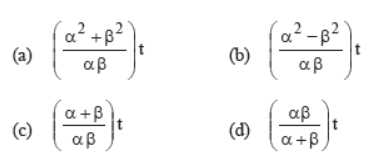
Answer: D
Free study material for Physics
Exam Preparation Worksheet for Class 11 Physics Chapter 02 Motion in a Straight Line
CBSE Practice Material: Class 11 Physics Chapter 02 Motion in a Straight Line
Explore reliable practice questions for Chapter 02 Motion in a Straight Line tailored for Class 11 Physics learners. Use these structured worksheets to evaluate preparedness and strengthen problem-solving skills.
NCERT-Aligned Questions and Solutions
Cross-reference your completed exercises with comprehensive NCERT solutions for Class 11 Physics to ensure absolute clarity across all sub-topics in this chapter.
Next Steps in Your Exam Preparation
Explore our broader library of printable assignments, chapter notes, and mock tests designed to support continuous revision and secure higher marks in CBSE assessments.
FAQs
You can download the teacher-verified PDF for CBSE Class 11 Physics Motion in a Straight Line Worksheet Set 01 from StudiesToday.com. These practice sheets for Class 11 Physics are designed as per the latest CBSE academic session.
Yes, our CBSE Class 11 Physics Motion in a Straight Line Worksheet Set 01 includes a variety of questions like Case-based studies, Assertion-Reasoning, and MCQs as per the 50% competency-based weightage in the latest curriculum for Class 11.
Yes, we have provided detailed solutions for CBSE Class 11 Physics Motion in a Straight Line Worksheet Set 01 to help Class 11 and follow the official CBSE marking scheme.
Daily practice with these Physics worksheets helps in identifying understanding gaps. It also improves question solving speed and ensures that Class 11 students get more marks in CBSE exams.
All our Class 11 Physics practice test papers and worksheets are available for free download in mobile-friendly PDF format. You can access CBSE Class 11 Physics Motion in a Straight Line Worksheet Set 01 without any registration.