

Class 11 Physics Practice Set: Chapter 03 Motion in a Plane
Explore reliable practice materials for Chapter 03 Motion in a Plane tailored for Class 11 learners. Utilizing these Physics worksheets ensures thorough preparation and strengthens problem-solving speed for upcoming school assessments.
Download Chapter 03 Motion in a Plane Worksheet PDF
View or download the dedicated Chapter 03 Motion in a Plane practice resource below. Engaging with these objective and subjective questions daily ensures continuous academic progress and mastery of the 2026-27 curriculum.
Download free printable worksheets for your students. All worksheets are in pdf format with the answers on the next page. Please give the questions to the child and then compare answers with the suggested answers provided by us. Free worksheets with questions and answers are available for all subjects. Use the worksheets to get better marks in tests and exams.
Question. The component of vector a̅ = 2î + 3ĵ along the vector î + ĵ is
(a) 5/√2
(b) 10 √2
(c) 5 √2
(d) 5
Answer: A
Question. A particle moves so that its position vector is given by r̅ = cosωtx̅ + sinωty̅. Where ω is a constant. Which of the following is true ?
(a) Velocity and acceleration both are perpendicular to r̅
(b) Velocity and acceleration both are parallel to r̅
(c) Velocity is perpendicular to r̅ and acceleration is directed towards the origin
(d) Velocity is perpendicular to r̅ and acceleration is directed away from the origin
Answer: C
Question. A body is projected at an angle of 30º to the horizontal with speed 30 m/s. What is the angle with the horizontal after 1.5 seconds? Take g = 10 m/s2.
(a) 0º
(b) 30º
(c) 60º
(d) 90º
Answer: A
Question. A projectile is moving at 60 m/s at its highest point, where it breaks into two equal parts due to an internal explosion.
One part moves vertically up at 50 m/s with respect to the ground. The other part will move at a speed of
(a) 110 m/s
(b) 120 m/s
(c) 130 m/s
(d) 10 √61 m/ s
Answer: C
Question. A particle having a mass 0.5 kg is projected under gravity with a speed of 98 m/sec at an angle of 60º. The magnitude of the change in momentum (in N-sec) of the particle after 10 seconds is
(a) 0.5
(b) 49
(c) 98
(d) 490
Answer: B
Question. A large number of bullets are fired in all directions with the same speed v. What is the maximum area on the ground on which these bullets will spread?
(a) πV2/g
(b) πV4/g2
(c) π2 v2/g2
(d) π2V4/g2
Answer: B
Question. If |a̅ + b̅| = a̅ - b̅| then angle between a̅ & b̅ is
(a) 45º
(b) 30º
(c) 90º
(d) 180º
Answer: C
Question. Two bullets are fired horizontally, simultaneously and with different velocities from the same place. Which bullet will hit the ground earlier ?
(a) It would depend upon the weights of the bullets.
(b) The slower one.
(c) The faster one.
(d) Both will reach simultaneously.
Answer: D
Question. A cricket ball is hit with a velocity 25 ms-1 , 60° above the horizontal. How far above the ground, ball passes over a fielder 50 m from the bat (consider the ball is struck very close to the ground)?
Take √3 =1.7 and g = 10 ms–2
(a) 6.8 m
(b) 7 m
(c) 5 m
(d) 10 m
Answer: C
Question. The angles which the vector A̅ = 3î + 6ĵ + 2k̂ makes with the co-ordinate axes are :
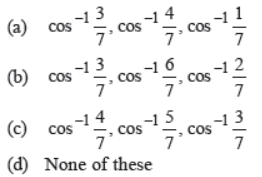
Answer: B
Question. The resultant of two forces 3P and 2P is R. If the first force is doubled then the resultant is also doubled. The angle between the two forces is
(a) 60º
(b) 120º
(c) 70º
(d) 180º
Answer: B
Question. The equation of a projectile is y = √3x - gx2/2 The angle of projection is given by
(a) tanθ = 1/√3
(b) tanθ = √3
(c) π/2
(d) zero.
Answer: B
Question. A body is thrown horizontally with a velocity √2gh from the top of a tower of height h. It strikes the level ground through the foot of the tower at a distance x from the tower.
The value of x is
(a) gh
(b) gh/2
(c) 2h
(d) 2gh/3
Answer: C
Question. A plane flying horizontally at a height of 1500 m with a velocity of 200 ms–1 passes directly overhead on antiaircraft gun. Then the angle with the horizontal at which the gun should be fired from the shell with a muzzle velocity of 400 ms–1 to hit the plane, is
(a) 90°
(b) 60°
(c) 30°
(d) 45°
Answer: B
Question. A projectile A is thrown at an angle of 30° to the horizontal from point P. At the same time, another projectile B is thrown with velocity v2 upwards from the point Q vertically below the highest point. For B to collide with A,v1/v2 should be (51)
(a) 1
(b) 2
(c) 1/2
(d) 4
Answer: C
Question. If the sum of two unit vectors is a unit vector, then the magnitude of their difference is
(a) √3
(b) √2
(c) √5
(d) 1/√2
Answer: A
Question. In a two dimensional motion, instantaneous speed v0 is a positive constant. Then, which of the following are necessarily true?
(a) The acceleration of the particle is zero
(b) The acceleration of the particle is bounded
(c) The acceleration of the particle is necessarily in the plane of motion
(d) The particle must be undergoing a uniform circular motion
Answer: C
Question. A body of 3kg. moves in X-Y plane under the action of force given by 6tî + 4tĵ . Assuming that the body is at rest at time t = 0, the velocity of body at t = 3 sec is
(a) 9î + 6ĵ
(b) 18î + 6ĵ
(c) 18î + 12ĵ
(d) 12î + 68ĵ
Answer: A
Question. A bullet is fired with a speed of 1500 m/s in order to hit a target 100 m away. If g = 10 m/s2. The gun should be aimed
(a) 15 cm above the target
(b) 10 cm above the target
(c) 2.2 cm above the target
(d) directly towards the target
Answer: C
Question. A projectile of mass m is thrown with a velocity v making an angle 60° with the horizontal. Neglecting air resistance, the change in momentum from the departure A to its arrival at B, along the vertical direction is
(a) 2 mv
(b) √3mv
(c) mv
(d) mv/√3
Answer: B
Question. A person sitting in the rear end of the compartment throws a ball towards the front end. The ball follows a parabolic path. The train is moving with velocity of 20 m/s. A person standing outside on the ground also observes the ball. How will the maximum heights (ym) attained and the ranges (R) seen by the thrower and the outside observer compare with each other?
(a) Same ym different R
(b) Same ym and R
(c) Different ym same R
(d) Different ym and R
Answer: A
Question. A force of (3î + 4ĵ) N acts on a body and displaces it by (3î + 4ĵ) m. The work done by the force is
(a) 5 J
(b) 30 J
(c) 25 J
(d) 10 J
Answer: C
Question. The position vector of a particle R̅ as a function of time is given by:
R̅ = 4sin(2πt) î+4cos(2πt)ĵ
Where R is in meter, t in seconds and î and ĵ denote unit vectors along x-and y-directions, respectively.
Which one of the following statements is wrong for the motion of particle?
(a) Magnitude of acceleration vector is v2/R, where v is the velocity of particle
(b) Magnitude of the velocity of particle is 8 meter/second
(c) path of the particle is a circle of radius 4 meter.
(d) Acceleration vector is along -R̅
Answer: B
Question. A cyclist moving at a speed of 20 m/s takes a turn, if he doubles his speed then chance of overturn
(a) is doubled
(b) is halved
(c) becomes four times
(d) becomes 1/4 times
Answer: D
Question. A person swims in a river aiming to reach exactly on the opposite point on the bank of a river. His speed of swimming is 0.5 m/s at an angle of 120º with the direction of flow of water. The speed of water is
(a) 1.0 m/s
(b) 0.5 m/s
(c) 0.25 m/s
(d) 0.43 m/s
Answer: C
Question. A gun is aimed at a horizontal target. It takes 1/2 s for the bullet to reach the target. The bullet hits the target x metre below the aim. Then, x is equal to
(a) 9.8/4 m
(b) 9.8/8 m
(c) 9.8 m
(d) 19.6 m.
Answer: B
Question. If a̅ = î - ĵ + k̂and b̅ 2î + ĵ + 3k̂, then the unit vector along a̅ + b̅ is
(a) 3i + 4k/5
(b) -3i + 4k/5
(c) -3i - 4k/5
(d) None of these
Answer: A
Question. The position vector of a particle is r̅ = (a cos ωt) î + (a sin ωt)ĵ . The velocity of the particle is
(a) directed towards the origin
(b) directed away from the origin
(c) parallel to the position vector
(d) perpendicular to the position vector
Answer: D
1. What is “Trajectory of a projectile?
2. A projectile is fired at an angle of 30° with the horizontal with velocity 10m/s. At what angle with the vertical should it be fired to get maximum range?
3. What is the value of angular speed for 1 revolution?
4. What is the angle between two forces of 2N and 3N having resultant as 4N?
5. What is the angle of projection at which horizontal range and maximum height are equal?
6. Prove that for elevations which exceed or fall short of 45° by equal amounts the ranges are equal?
7. At what range will a radar set show a fighter plane flying at 3 km above its centre and at distance of 4 km from it?
8. Derive expressions for velocity and acceleration for uniform circular motion.
OR
Derive expression for linear acceleration in uniform circular motion.
9. Derive an equation for the path of a projectile fired parallel to horizontal.
10. (a) Define time of flight and horizontal range?
(b) From a certain height above the ground a stone A is dropped gently.
Simultaneously another stone B is fired horizontally. Which of the two stones will arrive on the ground earlier?
Click on link below to download CBSE Class 11 Motion in Plane Worksheet A.
Free study material for Physics
Practice Worksheet and Study Resources for Class 11 Physics Chapter 03 Motion in a Plane
CBSE Practice Material: Class 11 Physics Chapter 03 Motion in a Plane
Explore reliable practice questions for Chapter 03 Motion in a Plane tailored for Class 11 Physics learners. Use these structured worksheets to evaluate preparedness and strengthen problem-solving skills.
NCERT-Aligned Questions and Solutions
Cross-reference your completed exercises with comprehensive NCERT solutions for Class 11 Physics to ensure absolute clarity across all sub-topics in this chapter.
Next Steps in Your Exam Preparation
Follow up your worksheet practice by attempting the interactive online Physics MCQ test for this chapter to evaluate your execution speed. All platform resources are free to access.
FAQs
You can download the teacher-verified PDF for CBSE Class 11 Motion in Plane Worksheet Set 01 from StudiesToday.com. These practice sheets for Class 11 Physics are designed as per the latest CBSE academic session.
Yes, our CBSE Class 11 Motion in Plane Worksheet Set 01 includes a variety of questions like Case-based studies, Assertion-Reasoning, and MCQs as per the 50% competency-based weightage in the latest curriculum for Class 11.
Yes, we have provided detailed solutions for CBSE Class 11 Motion in Plane Worksheet Set 01 to help Class 11 and follow the official CBSE marking scheme.
Daily practice with these Physics worksheets helps in identifying understanding gaps. It also improves question solving speed and ensures that Class 11 students get more marks in CBSE exams.
All our Class 11 Physics practice test papers and worksheets are available for free download in mobile-friendly PDF format. You can access CBSE Class 11 Motion in Plane Worksheet Set 01 without any registration.