

Download Class 11 Physics Worksheets for Chapter 07 Gravitation
Explore reliable practice materials for Chapter 07 Gravitation tailored for Class 11 learners. Utilizing these Physics worksheets ensures thorough preparation and strengthens problem-solving speed for upcoming school assessments.
Access Chapter 07 Gravitation Questions and Exercises
Access the complete worksheet PDF for Chapter 07 Gravitation below. Regular practice with these targeted questions builds familiarity with standard exam patterns and helps secure higher marks in final Physics evaluations.
Question. A satellite is revolving round the earth in an orbit of radius r with time period T. If the satellite is revolving round the earth in an orbit of radius r + Δ r (Δr << r) with time period T + Δ T then,
(a) ΔT/T = 3/2 Δr/r
(b) ΔT/T = 2/3 Δr/r
(c) ΔT/T = Δr/r
(d) ΔT/T =- Δr/r
Answer: A
Question. If gE and gM are the accelerations due to gravity on the surfaces of the earth and the moon respectively and if Millikan’s oil drop experiment could be performed on the two surfaces, one will find the ratio electronic charge on the moon/electronic charge on the earth. to be
(a) gM / gE
(b) 1
(c) 0
(d) gE / gM
Answer: B
Question. If ve and v0 represent the escape velocity and orbital velocity of a satellite corresponding to a circular orbit of radius R, then
(a) ve = vo
(b) ve = √2 vo
(c) ve = (1/√2) vo
(d) ve and vo are not related
Answer: B
Question. The amount of work done in lifting a mass ‘m’ from the surface of the earth to a height 2R is
(a) 2mgR
(b) 3mgR
(c) 3/2mgR
(d) 2/3 mgR
Answer: D
Question. Which of the following graphs represents the motion of a planet moving about the sun ?
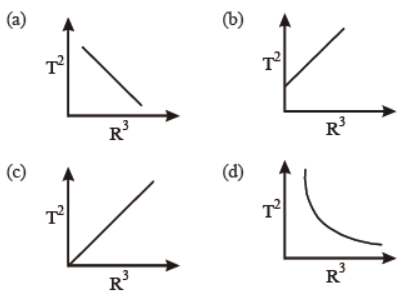
Answer: C
Question. There are _______ gravitational lines of force inside a spherically symmetric shell.
(a) infinitely many
(b) zero
(c) varying number depending upon surface area
(d) varying number depending upon volume
Answer: B
Question. An earth satellite of mass m revolves in a circular orbit at a height h from the surface of the earth. R is the radius of the earth and g is acceleration due to gravity at the surface of the earth. The velocity of the satellite in the orbit is given by
(a) g R2/(R + h)
(b) g R
(c) g R/(R – h)
(d) √[gR2/(R + h)]
Answer: D
Question. Mass of the Earth has been determined through
(a) use of Kepler's T2/R3 constancy law and Moon's period
(b) sampling the density of Earth's crust and using Earth's radius
(c) Cavendish's determination of G and using Earth radius and g at its surface
(d) use of periods of satellites at different heights above Earth's surface and known radius of Earth
Answer: C
Question. A body starts from rest from a point distance R0 from the centre of the earth. The velocity acquired by the body when it reaches the surface of the earth will be (R represents radius of the earth).
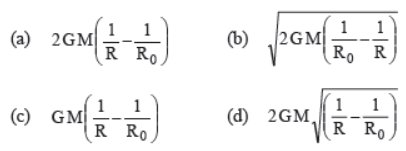
Answer: B
Question. There are two bodies of masses 103 kg and 105 kg separated by a distance of 1 km. At what distance from the smaller body, the intensity of gravitational field will be zero
(a) 1/9 km
(b) 1/10 km
(c) 1/11 km
(d) 10/11 km
Answer: C
Question. A planet is revolving around the sun in an elliptical orbit. Its closests distance from the sun is rmin. The farthest distance from the sun is rmax. If the orbital angular velocity of the planet when it is nearest to the sun is w, then the orbital angular velocity at the point when it is at the farthest distance from the sun is
(a) √(rmin / rmax) ω
(b) √(rmax / rmin) ω
(c) (rmax2/rmin2) ω
(d) (rmin2/rmax2) ω
Answer: D
Question. Two spherical bodies of mass M and 5M and radii R and 2R respectively are released in free space with initial separation between their centres equal to 12 R. If they attract each other due to gravitational force only, then the distance covered by the smaller body just before collision is
(a) 2.5 R
(b) 4.5 R
(c) 7.5 R
(d) 1.5 R
Answer: C
Question. If the radius of the earth were to shrink by one per cent, its mass remaining the same, the acceleration due to gravity on the earth’s surface would
(a) decrease
(b) remain unchanged
(c) increase
(d) None of these
Answer: C
Question. If earth is supposed to be a sphere of radius R, if g30 is value of acceleration due to gravity at lattitude of 30° and g at the equator, the value of g – g30 is
(a) 1/4 ω2R
(b) 3/4 ω2R
(c) ω2R
(d) 1/2 ω2R
Answer: C
Question. A missile is launched with a velocity less than escape velocity. The sum of its kinetic and potential energies is
(a) zero
(b) negative
(c) positive
(d) may be positive, negative or zero.
Answer: B
Question. The gravitational potential difference between the surface of a planet and a point 20 m above the surface is 2 joule/kg.
If the gravitational field is uniform, then the work done in carrying a 5 kg body to a height of 4 m above the surface is
(a) 2 J
(b) 20 J
(c) 40 J
(d) 10 J
Answer: A
Question. A uniform ring of mass m and radius r is placed directly above a uniform sphere of mass M and of equal radius. The centre of the ring is directly above the centre of the sphere at a distance r√3 as shown in the figure.
The gravitational force exerted by the sphere on the ring will be

Answer: C
Question. Two bodies of masses 10 kg and 100 kg are separated by a distance of 2m ( G = 6.67 × 10⁻¹¹ Nm2 kg–2). The gravitational potential at the mid point on the line joining the two is
(a) 7.3 × 10⁻⁷ J/kg
(b) 7.3 × 10⁻⁹ J/kg
(c) –7.3 × 10⁻⁹ J/kg
(d) 7.3 × 10⁻⁶ J/kg
Answer: C
Question. A ball is dropped from a satellite revolving around the earth at height of 120 km. The ball will
(a) continue to move with same speed along a straight line tangentially to the satellite at that time
(b) continue to move with same speed along the original orbit of satellite.
(c) fall down to earth gradually
(d) go far away in space
Answer: B
Question. A planet of mass 3 × 1029 gm moves around a star with a constant speed of 2 × 10⁶ ms–1 in a circle of radii 1.5 × 1014 cm. The gravitational force exerted on the planet by the star is
(a) 6.67 × 10²² dyne
(d) 8 × 1027 Newton
(c) 8 × 1026 N
(d) 6.67 × 10¹⁹ dyne
Answer: C
Question. If value of acceleration due to gravity changes from one place to another, which of the following forces will undergo a change ?
(a) Viscous force
(b) Buoyant force
(c) Magnetic force
(d) All of the above
Answer: B
Question. Suppose, the acceleration due to gravity at the Earth's surface is 10 m s–2 and at the surface of Mars it is 4.0 m s–2. A 60 kg pasenger goes from the Earth to the Mars in a spaceship moving with a constant velocity. Neglect all other objects in the sky. Which part of figure best represents the weight (net gravitational force) of the passenger as a function of time?
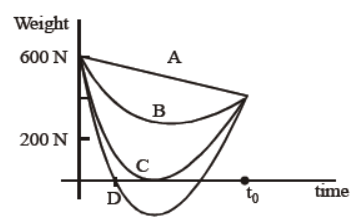
(a) A
(b) B
(c) C
(d) D
Answer: C
Question. Kepler's third law states that square of period of revolution (T) of a planet around the sun, is proportional to third power of average distance r between sun and planet i.e. T2 = Kr3 here K is constant. If the masses of sun and planet are M and m respectively then as per Newton's law of gravitation force of attraction between them is F =GMm/r2 , here G is gravitational constant. The relation between G and K is described as
(a) GMK = 4π2
(b) K = G
(c) K = 1/G
(d) GK = 4π2
Answer: A
Question. A remote - sensing satellite of earth revolves in a circular orbit at a height of 0.25 × 10⁶ m above the surface of earth. If earth's radius is 6.38 × 10⁶ m and g = 9.8 ms–2, then the orbital speed of the satellite is:
(a) 8.56 km s–1
(b) 9.13 km s–1
(c) 6.67 km s–1
(d) 7.76 km s–1
Answer: D
Question. A projectile is fired vertically from the Earth with a velocity kve where ve is the escape velocity and k is a constant less than unity. The maximum height to which projectile rises, as measured from the centre of Earth, is
(a) R/k
(b) R/k-1
(c) R/1-k2
(d) R/1+k2
Answer: C
Free study material for Physics
Exam Preparation Worksheet for Class 11 Physics Chapter 07 Gravitation
Chapter Practice Questions for Class 11 Physics
Review targeted practice exercises for Class 11 Physics Chapter 07 Gravitation. Curated to match official CBSE guidelines, these downloadable PDF sheets support daily revision and core concept reinforcement.
Expert Practice Material for Class 11 Physics
Cross-reference your completed exercises with comprehensive NCERT solutions for Class 11 Physics to ensure absolute clarity across all sub-topics in this chapter.
Complete Your Chapter Revision
Follow up your worksheet practice by attempting the interactive online Physics MCQ test for this chapter to evaluate your execution speed. All platform resources are free to access.
FAQs
You can download the teacher-verified PDF for CBSE Class 11 Physics Gravitation Worksheet Set 01 from StudiesToday.com. These practice sheets for Class 11 Physics are designed as per the latest CBSE academic session.
Yes, our CBSE Class 11 Physics Gravitation Worksheet Set 01 includes a variety of questions like Case-based studies, Assertion-Reasoning, and MCQs as per the 50% competency-based weightage in the latest curriculum for Class 11.
Yes, we have provided detailed solutions for CBSE Class 11 Physics Gravitation Worksheet Set 01 to help Class 11 and follow the official CBSE marking scheme.
Daily practice with these Physics worksheets helps in identifying understanding gaps. It also improves question solving speed and ensures that Class 11 students get more marks in CBSE exams.
All our Class 11 Physics practice test papers and worksheets are available for free download in mobile-friendly PDF format. You can access CBSE Class 11 Physics Gravitation Worksheet Set 01 without any registration.