

Practice MCQs for Class 7 Science Chapter 13 Motion and Time
Explore reliable objective questions for Chapter 13 Motion and Time tailored for Class 7 learners. Utilizing these Science multiple-choice formats ensures thorough preparation and strengthens problem-solving speed for upcoming school assessments.
Access Chapter 13 Motion and Time Questions and Solutions
View or download the dedicated Chapter 13 Motion and Time MCQ resource below. Practicing these 50 objective questions regularly builds familiarity with standard exam patterns and helps secure higher marks in final Science evaluations.
Question. Which of the following relations is correct?
(a) Speed = Distance X Time
(b) Speed = Distance/Time
(c) Speed = Time/Distance
(d) Speed = 1/Distance X Time
Answer: B
Question. A horse pulling a cart has:
(a) oscillatory motion
(b) circular motion
(c) linear motion
(d) none of these
Answer: A
Question. The basic unit of speed is
(a) Km/min
(b) m/min
(c) km/h
(d) m/s
Answer: D
Question. A car moves with a speed of 80 km/h for 15 minutes and then with a speed of 60 km/h for the next 15 minutes. The total distance covered by the car is
(a) 100km
(b) 50km
(c) 35km
(d) 70km
Answer: C
Question. The value of 2km/hr is equal to
(a) 4/9 m/s
(b) 5/9m/s
(c) 13/9m/s
(d) 7/9m/s
Answer: B
Question. The meter that measures the distance moved by a vehicle is ( )
(a) Speedometer
(b) Odometer
(c) Anemometer
(d) Thermometer
Answer: B
Question. The meter that is used to measure speed of a vehicle is ( )
(a) Speedometer
(b) Odometer
(c) Anemometer
(d) Thermometer
Answer: A
Question. The speedometer of a vehicle measures the speed in ( )
(a) m/sec
(b) m/min
(c) km/hr
(d) km/min
Answer: C
Question. An ancient Time measuring device SUNDIAL at JantarMantar is in ( )
(a) Ahmedabad
(b) Bombay
(c) Delhi
(d) Lucknow
Answer: C
Question. The time taken by a pendulum of given length to complete one oscillation is ( )
(a) Different at different times
(b) Same at all times
(c) Increases at different times
(d) Decreases at different times
Answer: B
Question. An example of Oscillatory motion is ( )
(a) Motion of a cycle wheel
(b) Movement of a car on a straight road
(c) Motion of earth around the sun
(d) Motion of a swing.
Answer: D
Question. A device used to measure the distance moved by a vehicle:
(a) odometer
(b) speedometer
(c) both
(d) none of these
Answer: A
Question. If the speed of an object along a straight line keeps changing, its motion is said to be
(a) uniform motion
(b) non-uniform motion
(c) linear motion
(d) none of these
Answer: B
Question. Which of the following motion is circular motion:
(a) motion of a child over see saw
(b) motion of a car running on a straight road
(c) motion of an electric bell hammer
(d) motion of a child in a merry go round
Answer: D
Question. A bus travels 54 km in 90 minutes. The speed of the bus is
(a) 0.6 m/s
(b) 10 m/s
(c) 5.4 m/s
(d) 3.6 m/s
Answer: B
Question. The rate of change of displacement with time is called
(a) Speed
(b) Velocity
(c) Both of these
(d) None of these
Answer: B
Question. Swami walks to his school which is at a distance of 4 km from his home in 30 minutes. On reaching he finds that the school is closed and comes back in his friend’s vehicle to home in 10 minutes. His average speed in km/h is
(a) 8 km/h
(b) 24 km/h
(c) 16 km/h
(d) 20 km/h
Answer: C
Question. If an object covers equal distance in equal intervals of time, then the object is said to have:
(a) non-uniform motion
(b) uniform motion
(c) oscillation
(d) none of these
Answer: B
Question. If the velocity of a body does not change with time, its acceleration is
(a) zero
(b) infinite
(c) unity
(d) None of these
Answer: A
Question. The correct symbol to represent the speed of an object is:
(a) 5 m/s
(b) 5 mp
(c) 5 m/s-1
(d) 5 s/m
Answer: D
Question. A simple pendulum is an example of:
(a) periodic motion
(b) circular motion
(c) linear motion
(d) none of these
Answer: A
Question. The distance travelled by the vehicles is recorded by
(a) monometer
(b) odometer
(c) speedometer
(d) motometer
Answer: B
Question. When the motion of the object is not along a fixed path with changing direction
(a) Random motion
(b) Oscillatory motion
(c) Periodic motion
(d) Circular motion
Answer: A
Question. The times taken by a pendulum to complete one oscillation is:
(a) oscillation period
(b) 1 second
(c) time period
(d) frequency
Answer: C
Question. The motion of the spikes in the wheels of a moving cycle is
(a) rectilinear motion
(b) circular motion
(c) oscillatory motion
(d) none of these
Answer: B
Question. Watch used to measure short interval of time is
(a) Stop watch
(b) Pendulum watch
(c) Atom watch
(d) Quartz watch
Answer: A
Question. Which of the following is correct statements:
(a) the basic unit of time is second
(b) every object moves with a constant speed
(c) distance between two cities is measured in metres
(d) the time period of a given pendulum is not constant
Answer: A
Question. A car covers 40 km in first hour, 115 km in next two hours and 45 km in next one hours. Find out its averages speed:
(a) 100 km/h
(b) 66.6 km/h
(c) 50 km/h
(d) none of these
Answer: C
Question. The standard unit of mass is:
(a) ‘kg’
(b) mg
(c) g
(d) none of these
Answer: A
Question. A simple pendulum executes a
(a) periodic motion
(b) oscillatory motion
(c) both (a) and (b)
(d) none of these
Answer: C
Question. Physical quantity which we can't obtain from a distance- time graph is
(a) speed
(b) time taken
(c) change in position
(d) change in weight
Answer: D
Question. A simple pendulum takes 42 sec. to complete 20 oscillations. What is its time period?
(a) 2.1 s
(b) 4.2 s
(c) 21 s
(d) 8.40 s
Answer: A
Question. 72 km/h m/s:
(a) 72 m/s
(b) 20 m/s
(c) 36 m/s
(d) 12 m/s
Answer: B
Question. The speed of a car is 40 km/h. What is time taken to reach from one city to another city if the distance between the two cities is 480 km:
(a) 10 hours
(b) 11 hours
(c) 14 hours
(d) 12 hours
Answer: D
Question. If a pendulum is vibrating at 10 Cycles−1, its time period is
(a) 1 sec
(b) 0.1 sec
(c) 0.5 sec
(d) 0.01 sec
Answer: B
Question. All oscillatory motions are
(a) rotatory motions
(b) rectilinear motions
(c) circular motions
(d) periodic motions
Answer: D
Question. Students wanted to find out if an empty barrel would roll down a ramp faster than one filled with sand. For their results to be valid, they should further ensure all of these, EXCEPT ONE. Which one need they NOT ensure?
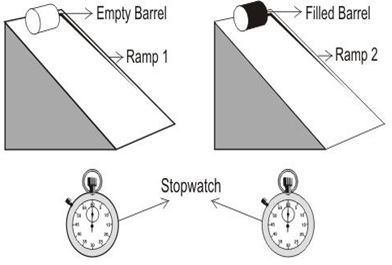
a) That the barrels used are identical (when empty).
b) That the ramps used are identical.
c) That the barrels are released simultaneously.
d) That the barrels are released from the same point.
Answer : C
Question. If in a car race, the timekeeper forgets to note the time at which the race starts, which of the following can he definitely NOT determine?
a) The order in which the participants finished the race.
b) The time difference between the winner and the runner up.
c) The time taken by the winner to complete the race.
d) The number of participants who did not qualify among the first three.
Answer : C
Question. In which of these arrangements will the solid block of wood and piece of paper shown reach the ground at the same time when dropped together?

Answer : B
Question. Which of these could be the width of a person's little finger?
a) 1m
b) 0.1m
c) 0.01m
d) 0.001m
Answer : C
Question. The picture shows a parachutist falling at a steady speed. Which of the arrows represents the force of gravity on the parachutist?

a) A
b) B
c) C
d) D
Answer : C
Question. If the earth is rotating, why cannot we get on to an air balloon, rise in the air and watch different parts of the earth move under us?
a) We can do it - it will work.
b) This is because the earth has an atmosphere.
c) This is because the earth has a gravitational pull.
d) This is because the balloon will also move with the earth.
Answer : D
Question. In military codes, different letters are assigned to different time zones. The letters assigned to four time zones are given below:
Which of these zones is furthest WEST?
| Time zone | Code |
| -4 | Q |
| +7 | G |
| -10 | W |
| +11 | L |
a) Q
b) G
c) W
d) L
Answer : C
Question. Spring Meadows School is organizing a sports meet. Which is the correct method of arranging the start and finish line for the tracks events? (Note the direction of running shown by the arrow.
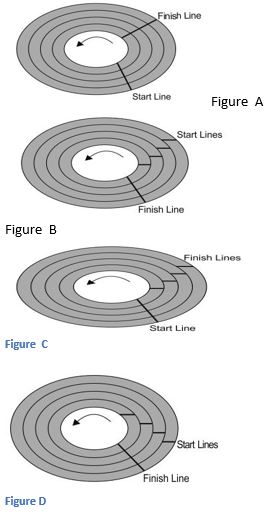
a) A
b) B
c) C
d) D
Answer : B
Question. About how far away is the post box from the boy on the real street?
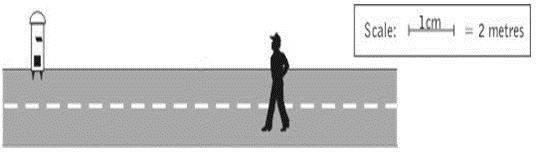
a) 5 metres
b) 10 metres
c) 15 metres
d) 20 metres
Answer : C
Question. The 'cubit' is among the first recorded units of length used by ancient people. One cubit is equal to the length from the elbow to the tip of the longest finger of a person. If this measure (cubit) was used by some students of a school to measure the length of a 30 metre long corridor, how much would it measure?
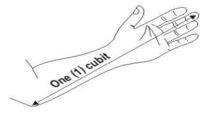
a) 15 cubits
b) 30 cubits
c) 120 cubits
d) will vary from student to student
Answer : D
Question. Chandrasekhar has to move up a load and is considering three different ways of doing it, as shown in the figure. Which one will require the least force?
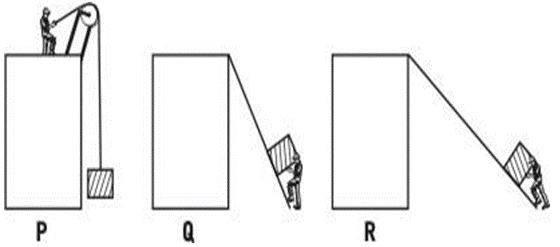
a) P
b) Q
c) R
d) All will require the same force.
Answer : C
Question. The United Nations Committee for the Transport of Dangerous Goods has specified symbols to be used while transporting dangerous goods. Which of the following would carry this sign while being transported?

a) aviation fuel
b) sodium chloride
c) glucose
d) Water
Answer : A
Question. How much MORE time will a CAR that was travelling at 60 km/h take to travel from P to T due to the 4 speed breakers?
a) 15 seconds
b) 45 seconds
c) 1.5 minutes
d) 2 minutes
Answer : B
Question. Which arrow, in the figure shown below, represents the force that allows the parachutist to land slowly and safely?
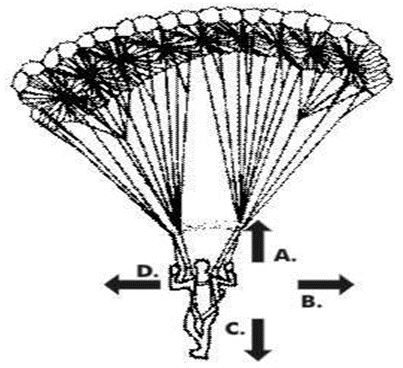
a) A
b) B
c) C
d) D
Answer : A
Question. Many gates at railway crossings are operated manually. A typical gate consists of a rod usually made of iron, consisting of a heavy weight at one end as shown.What is the need for the heavy weight at one end of the rod?
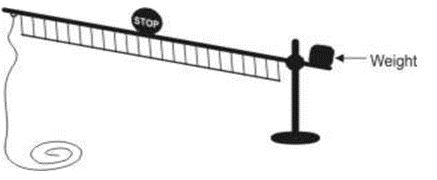
a) to help close the gate at the railway crossing
b) to help open the gate at the railway crossing
c) to strengthen the gate in case of any accident
d) to make unauthorized opening of the gate difficult
Answer : B
Attempt Mock Tests on this topic
Free study material for Science
Practice MCQs for Class 7 Science Chapter 13 Motion and Time
Chapter MCQs with Answers for Class 7 Science
Explore reliable practice questions for Chapter 13 Motion and Time tailored for Class 7 Science learners. Use these multiple-choice formats to evaluate preparedness and strengthen problem-solving skills.
Expert Practice Material for Class 7 Science
Cross-reference your completed choices with comprehensive NCERT solutions for Class 7 Science to ensure absolute clarity across all sub-topics in this chapter.
Complete Your Chapter Revision
Follow up your worksheet practice by attempting the interactive online Science MCQ test for this chapter to evaluate your execution speed. All platform resources are free to access.
FAQs
You can get most exhaustive CBSE Class 7 Science Motion and Time MCQs for free on StudiesToday.com. These MCQs for Class 7 Science are updated for the 2026-27 academic session as per CBSE examination standards.
Yes, our CBSE Class 7 Science Motion and Time MCQs include the latest type of questions, such as Assertion-Reasoning and Case-based MCQs. 50% of the CBSE paper is now competency-based.
By solving our CBSE Class 7 Science Motion and Time MCQs, Class 7 students can improve their accuracy and speed which is important as objective questions provide a chance to secure 100% marks in the Science.
Yes, Science MCQs for Class 7 have answer key and brief explanations to help students understand logic behind the correct option as its important for 2026 competency-focused CBSE exams.
Yes, you can also access online interactive tests for CBSE Class 7 Science Motion and Time MCQs on StudiesToday.com as they provide instant answers and score to help you track your progress in Science.