

Multiple Choice Questions (MCQs) for Class 7 Science: NSO Olympiad
Review structured MCQ sets for Class 7 Science NSO Olympiad. Built according to official CBSE guidelines, these downloadable questions support daily revision and core concept reinforcement.
Practice NSO Olympiad MCQs for Class 7 Science
Access the complete set of multiple-choice questions for NSO Olympiad below. This focused format allows students to isolate specific topics for thorough review and uninterrupted practice alongside official CBSE textbooks.
LOGICAL REASONING
Question. Find the missing number, if a certain rule is followed either row-wise or column-wise.
| 5 | 12 | 4 | 8 |
| 9 | 15 | 3 | 12 |
| 8 | 20 | 4 | ? |
A. 16
B. 14
C. 12
D. 15
Answer : C
Question. Count the number of squares in the given figure.

A. 25
B. 26
C. 20
D. None of these
Answer : D
Question. Select a figure from the options in which the given figure is exactly embedded as one of its parts.
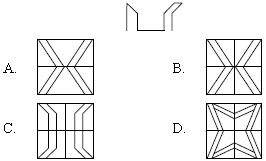
Answer : C
Question. Sumit is fourteenth from the right end in a row of 35 boys. If first two boys from the left end leave the row, then what is Sumit’s position from the left end?
A. 20th
B. 19th
C. 21st
D. 18th
Answer : A
Question. Which of the following Venn diagrams best represents the relationship amongst, “Stationery, Pen, Scale”?
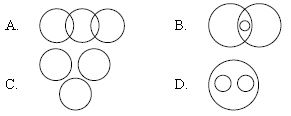
Answer : D
Question. Select the correct water image of the given figure.
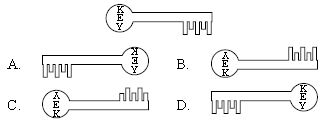
Answer : B
Question. If in a certain code language, ‘546’ is written as ‘you are best’, ‘538’ is written as ‘you can do’ and ‘692’ is written as ‘all are good’, then which digit is written as ‘best’?
A. 5
B. 4
C. 6
D. Can’t be determined
Answer : B
Question. Select a figure from the options which satisfies the same condition of placement of the dots as in the given figure.
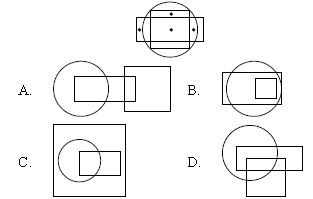
Answer : D
Question. If ‘K’ denotes ‘×’, ‘B’ denotes ‘÷’, ‘T’ denotes ‘–’ and ‘M’ denotes ‘+’, then 40 B 8 T 6 M 3 K 4 = ?
A. 19
B. 11
C. –31
D. 23
Answer : B
Question. Two positions of a dice are shown below. When number 5 is at the bottom, then which number will be on the top?

A. 2
B. 3
C. 4
D. Can’t be determined
Answer : A
SCIENCE
Question. A speed-time (v-t) graph of an object is shown in the figure.
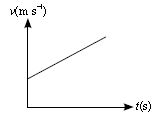
Which of the following best describes the graph?
A. The object drops through vacuum.
B. The object drops through air.
C. The object is being thrown downwards through vacuum.
D. The object is being thrown downwards through air.
Answer : C
Question. An object O is placed in front of a plane mirror MN as shown in the diagram. A student moves her eye along the line XY to observe the image of O. Identify the point(s) on the line XY where the image of O can be seen.
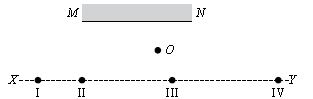
A. I, II and III only
B. I, III and IV only
C. II and III only
D. IV only
Answer : A
Question. A train leaves a station X at 5:00 pm and reaches another station Y at midnight. Its speed is 90 km h–1.
What is the distance between X and Y?
A. 480 km
B. 630 km
C. 800 km
D. 830 km
Answer : B
Question. Aparna heated a bi-metallic strip made of two different types of metals for some time.
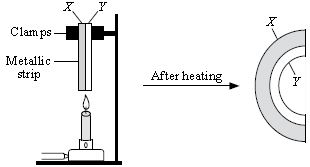
After heating it, she observed that the metallic strip curved as shown in the figure. Which of the following would best explain the conclusion derived by Aparna about the experiment she had done?
A. Metal X is a better conductor of heat than metal Y.
B. Metal X is a poorer conductor of heat than metal Y.
C. Metal X is of better quality than metal Y.
D. Metal X is more flexible than metal Y.
Answer : A
Question. A car travels 40 km at an average speed of 80 km/h and then travels 40 km at an average speed of 40 km/h.
The average speed of the car for this 80 km trip is
A. 40 km/h
B. 45 km/h
C. 48 km/h
D. 53 km/h
Answer : D
Question. A student used the stroking method to magnetise a steel bar as shown in the figure.
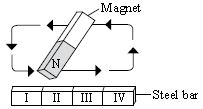
If the steel bar was divided into parts I, II, III and IV, which of these parts would be the north-pole?
A. I
B. II
C. III
D. IV
Answer : A
Question. Match column I with column II and select the correct option from the given codes.
| Column I | Column II |
| P. Shadow of the moon falling on the earth | (i) Reflection |
| Q. Pinhole camera | (ii) Solar eclipse |
| R. Full moon day | (iii) Inverted image |
| S. Bouncing back of light | (iv) Lunar eclipse |
A. P - (i), Q - (ii), R - (iii), S - (iv)
B. P - (ii), Q - (iii), R - (iv), S - (i)
C. P - (iv), Q - (iii), R - (ii), S - (i)
D. P - (i), Q - (iii), R - (ii), S - (iv)
Answer : B
Question. Read the given statements and select the correct option.
Statement 1 : Circular motion is the motion along a curve traced out by a moving object such that its distance from a fixed point is constant.
Statement 2 : The motion of a wheel of a moving bicycle is same as the motion of a mark on the blades of a moving electric fan.
A. Both statements 1 and 2 are true and statement 2 is the correct explanation of statement 1.
B. Both statements 1 and 2 are true but statement 2 is not the correct explanation of statement 1.
C. Statement 1 is true but statement 2 is false.
D. Statement 1 is false but statement 2 is true.
Answer : C
Question. Five lamps L1, L2, L3, L4 and L5 and three different types of materials M1, M2 and M3 are used in the circuit shown.
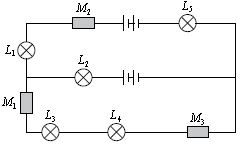
If L2, L3 and L4 are the only lamps that light up, then which one of the following conclusions can be made?
A. Only M2 and M3 are insulators of electricity.
B. Only M1 and M3 are insulators of electricity.
C. Only M1 and M3 are conductors of electricity.
D. Only M1 and M3 are conductors of electricity.
Answer : D
Question. Following are the precautions one must take in case a storm is accompanied by lightning.
(i) Do not take shelter under a tree.
(ii) Do not take shelter under an umbrella with a metallic end.
(iii) Do not take shelter in open garages, storage sheds, etc.
(iv) Do not take shelter in a bus in the open field.
Which one of these is not correct?
A. (i)
B. (ii)
C. (iii)
D. (iv)
Answer : D
Question. A class 7 science teacher arranged the following set of test tubes.

Which of the following observations is correct when these solutions were tested with different indicators?
A. In test tubes 1 and 3, turmeric solution remains yellow.
B. In test tubes 2 and 4, China rose indicator turns magenta.
C. Methyl orange turns red in test tubes 1 and 3.
D. Phenolphthalein turns pink in test tubes 2 and 4.
Answer : B
Question. Which of the following changes (i - vi) from the given list cannot be reversed?
(i) Breaking of an earthen pitcher
(ii) Freezing of ice-cream
(iii) Falling of trees during storm
(iv) Filling of bucket with water
(v) Rusting of a bicycle
(vi) Digestion of food
A. (i), (iii), (v) and (vi) only
B. (i), (iii) and (vi) only
C. (ii) and (iv) only
D. (v) and (vi) only
Answer : A
Question. Which of the following statements is incorrect?
A. Carbon dioxide turns lime water milky.
B. Breaking down of ozone is a chemical change.
C. Production of biogas from animal waste is a physical change.
D. For rusting, the presence of both oxygen and water is essential.
Answer : C
Question. Read the given statements and select the correct option.
Statement 1 : A salt is produced when an acid is neutralised by a base.
Statement 2 : A salt can be acidic, basic or neutral.
A. Both statements 1 and 2 are true and statement 2 is the correct explanation of statement 1.
B. Both statements 1 and 2 are true but statement 2 is not the correct explanation of statement 1.
C. Statement 1 is true and statement 2 is false.
D. Both statements 1 and 2 are false.
Answer : B
Question. Which of the following statements is/are correct?
I. The process of sedimentation can be made slower by loading.
II. Centrifugation is used in laboratories for separating plasma and platelets from blood.
III. A solution in which some more solute can be dissolved at fixed temperature is called a saturated solution.
IV. Winnowing is used to separate husk and hay from grains.
A. II only
B. II and IV only
C. IV only
D. I and III only
Answer : B
Question. Match column I with column II and select the correct option from the given codes.
Column I (Salts) Column II (Uses)
P. Baking soda (i) In making fire-works
Q. Nitre (ii) As a fungicide
R. Blue vitriol (iii) In purification of water
S. Phitkari (iv) In fire extinguishers
A. P-(iii), Q-(ii), R-(iv), S-(i)
B. P-(iv), Q-(iii), R-(i), S-(ii)
C. P-(iv), Q-(i), R-(ii), S-(iii)
D. P-(ii), Q-(i), R-(iv), S-(iii)
Answer : C
Question. A few changes are given below :
a. Making almirah from wood
b. Galvanisation of an iron pot
c. Making an aeroplane from a paper
d. Formation of acid rain from air pollutants
e. Photosynthesis
f. Breaking of vase
Classify these changes into :
I. Irreversible-physical change
II. Chemical change
III. Reversible-physical change
A. I - a, f II - b, d, e III - c
B. I - a, b, e II - d, f III - c
C. I - a II - b, d III - c, e, f
D. I - f II - c, e III - a, b, d
Answer : A
Question. Namita was given four liquids, 1, 2, 3 and 4. These liquids were added to four beakers filled with water separately and stirred. She recorded her observations as follows :
Liquid 1 + water → Immiscible liquids
Liquid 2 + water → Miscible liquids
Liquid 3 + water → Immiscible liquids
Liquid 4 + water → Miscible liquids
What could liquids 1, 2, 3 and 4 respectively be?
| 1 | 2 | 3 | 4 | |
| A | Glycerine | Lemon juice | Shampoo | Dye colour |
| B | Diesel | Alcohol | Sugar syrup | Mustard oil |
| C | Vegetable oil | Honey | Petrol | Ink |
| D | Milk | Glucose solution | Tomato juice | Kerosene |
Answer : C
Question. Pick the odd one out from each series given below and select the correct option.
(i) Muga, Kosa, Cashmere, Tussar
(ii) Larva, Pupa, Silk moth, Tadpole
(iii) Patanwadi, Marwari, Pashmina, Lohi
(i) (ii) (iii)
A. Muga Pupa Patanwadi
B. Cashmere Tadpole Pashmina
C. Cashmere Larva Marwari
D. Kosa Sheep Lohi
Answer : B
Question. Observe the given figure representing substances (P, Q, R and S) taken in or given out during photosynthesis and select the incorrect option regarding them.
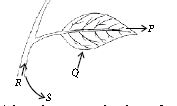
A. Q could be the gas which is fixed through photosynthesis to form carbohydrates whereas P could be the gas which is used by plants in respiration.
B. P is the gaseous by-product of photosynthesis whereas S is carbohydrate formed by plants through photosynthesis.
C. Q is taken up by plant leaves directly from atmosphere through minute stomata present in them whereas R represents water absorbed from soil through plant roots.
D. R and S show unidirectional movement within the plant body, i.e., from source to sink.
Answer : D
Question. Varun got his gall bladder removed surgically as he was diagnosed with stone in his gall bladder. Which of the following problems is Varun most likely to face after surgery?
A. Varun would not be able to digest carbohydrates and proteins properly because gall bladder stores bile which consists of amylase and pepsin enzymes.
B. Varun would not be able to digest fats properly because gall bladder stores bile juice which helps in emulsification of fats.
C. Varun would not be able to digest fats properly because gall bladder secretes bile juice which helps in digestion of fats.
D. Varun would not be able to absorb vitamin B and C properly because gall bladder secretes bile which helps in absorption of these vitamins.
Answer : B
Question. Taru wanted to test the quality of fabric of her muffler.
She pulled a small strand of yarn from the muffler and burned it. It smelled like a burning hair. She inferred that the muffler is made up of
A. Cotton
B. Silk
C. Wool
D. Polyester.
Answer : C
Question. Refer to the given figure showing life cycle of an insect and statements associated with it.
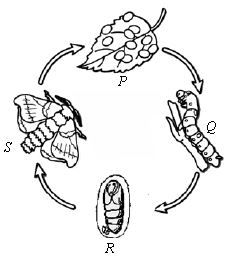
(a) Commercial silk is obtained from ___(_i_)___ stage.
(b) ___(_ii)___ stage undergoes four moults to become ___(_iii_)___.
Select the option which correctly fills blanks (i), (ii) and (iii).
(i) (ii) (iii)
A. S Q P
B. P S Q
C. R Q R
D. Q R S
Answer : C
Question. Refer to the given graph representing temperature gradient through different regions of Earth.
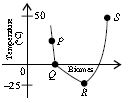
Identify labelled parts P-S and select the correct statement regarding them.
A. Animals inhabiting S possess blubber.
B. Animals inhabiting R may have small body appendages to reduce the exposed surface area.
C. Animals inhabiting P do not drink water and use only metabolic water to fulfill their water requirements.
D. Animals inhabiting Q undergo aestivation whereas animals inhabiting S undergo hibernation.
Answer : B
Question. Which of the following options contains only complete flowers?
A. Papaya, Gulmohar, Mulberry
B. Mustard, Date palm, Cucurbit
C. Hibiscus, Mustard, Petunia
D. Mulberry, Coconut, Castor
Answer : C
Question. A large area of forest was cleared by burning. Which of the following statements is/are correct regarding the consequences of this activity?
(i) Increase in soil erosion as soil is directly exposed to wind and rain.
(ii) The land will have more fresh air as there are lesser trees to take in oxygen.
(iii) Wildlife will easily thrive in the cleared area because more space is available now.
(iv) New trees will grow faster and replace the burnt forest soon as the ash of the burnt trees will make the soil more fertile.
A. (i) only
B. (i) and (iv) only
C. (i), (ii) and (iv) only
D. (i), (ii), (iii) and (iv)
Answer : A
Question. Consider the following statements and select the option which correctly identifies true (T) and false (F) ones.
(i) In cockroaches, air enters the body through spiracles.
(ii) During heavy exercise, we get cramps in the legs due to accumulation of carbon dioxide.
(iii) Normal range of breathing rate per minute in an average adult person at rest is 12-18.
(iv) During exhalation, the ribs move upwards.
(i) (ii) (iii) (iv)
A. F T F T
B. T T F T
C. T F T F
D. T T T F
Answer : C
Question. Observe the given figure.

What will be the condition of the given structures when we breathe in air?
| Rib cage | Diaphragm | Lung pressure | |
| A | Down and in | Contracts | High |
| B | Up and out | Relaxes | High |
| C | Up and out | Contracts | Low |
| D | Down and in | Relaxes | Low |
Answer : C
Question. Refer to the given relationship based on mode of seed dispersal.
Hiptage : Xanthium : Coconut
Select the option which satisfies the same relationship.
A. Urena : Balsam : Castor
B. Acer : Calotropis : Lotus
C. Pea : Dandelion : Water lily
D. Drumstick : Urena : Lotus
Answer : D
Question. Refer to the given experimental set-up.

Which of the following is correct regarding the volume of liquid in beaker (X) and volume of salt solution in tube (Y)?
X Y
A. Decreases Increases
B. Increases Increases
C. Decreases Decreases
D. Increases Decreases
Answer : A
Question. Refer to the given table and select the correct option regarding P-U.
| Plant part | Function | Example |
| Root | (i) Climbing (ii) Storage | P Q |
| Stem | (i) Climbing (ii) Protection | R S |
| Leaf | (i) Climbing (ii) Reduction in water loss | T U |
A. P could be betel, S could be Bougainvillea and U could be Opuntia.
B. Q could be ginger, R could be grapevine and T could be pea.
C. P could be ivy, R could be spinach and T could be orchid.
D. P could be tapioca, S could be rose and U could be Bougainvillea
Answer : A
Question. Refer to the given table representing three different types of soils X, Y and Z and their respective percolation rates of water.
| Type of soil | Percolation rate |
| X | 4 mL/min |
| Y | 10 mL/min |
| Z | 7 mL/min |
Identify soils X, Y and Z and select the incorrect statement regarding them.
A. Soil X could be the most suitable soil for growing paddy.
B. Soil Z could be the most suitable soil for growing cotton
C. Soil Y could be ploughed easily whereas soil X would be difficult to plough.
D. None of these
Answer : D
Question. Read the given passage.
There are 3 types of blood cells, X, Y and Z. X is biconcave disc shaped and contains haemoglobin.
Y protects us from many diseases and helps fight infection. Z helps in blood clotting.
Select the incorrect option regarding X, Y and Z.
A. People living in higher altitudes have higher X count as compared to people living in plains.
B. High Y count indicates some infection in the body.
C. Decrease in Z count also indicates infections like dengue.
D. People with very low X count continue to bleed even from minor injury as their blood does not clot.
Answer : D
Question. Read the given passage carefully.
The organisms P and Q occur on the forest floor. They convert the dead organic waste generated in forest into simpler substances which can be then reused by organisms R for their growth and development.
Identify P, Q and R and select the correct statement.
A. P and Q could be bacteria and fungi respectively whereas R could be plants.
B. P and Q could be bacteria and plants respectively whereas R could be fungi.
C. P and Q could be plants and animals respectively whereas R could be bacteria.
D. P and Q could be herbivores whereas R could be a detritivore.
Answer : A
Question. Which of the following is not a reflex action?
A. Blinking of eyes
B. Sneezing on entry of some dust or foreign particles in respiratory system
C. Learning to play guitar
D. Withdrawal of hand on touching some hot object
Answer : C
ACHIEVERS SECTION
Question. Leena had set up the experiment as shown in the figure.
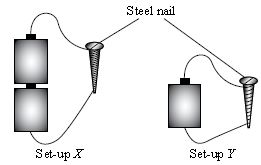
She found out that the steel nail in set-up X had attracted more iron pins than the steel nail in set-up
Y. What could be the reason for this?
I. The batteries used in set-up X are more expensive.
II. There are more batteries used in set-up X.
III. The number of turns of coil around the nail in set-up Y is fewer than in set-up X.
IV. A longer wire was used in set-up X.
A. I and III only
B. II, III and IV only
C. II and III only
D. I, II, III and IV
Answer : C
Question. Refer to the given food chain
Plant → Insect → Bird → Hawk
In an operation to eradicate disease spreading insects, insecticide was sprayed in this locality on a large scale.
Select the graph that correctly depicts the population changes of different species involved here, with time.
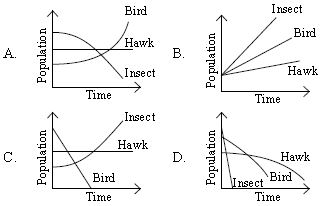
Answer : D
Question. Observe the given figure carefully.
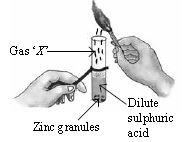
Read the given passage and fill in the blanks by selecting an appropriate option.
In the given figure, (i) reaction takes place which is a chemical change. (ii) being more reactive than (iii) produces gas ‘X’ which is (iv) and it burns with a (v)
| (i) | (ii) | (iii) | (iv) | (v) | |
| A | Oxidation | Zn | H | SO2 | dazzling light |
| B | Displacement | H | Zn | H2 | pop sound |
| C | Displacement | Zn | H | H2 | pop sound |
| D | Reduction | Zn | S | SO2 | rotten egg smell |
Answer : C
Question. Refer to the given dichotomous key.
I. (a) It can synthesise its own carbohydrates. -Go to II
(b) It cannot synthesise its own carbohydrates. -Go to III
II. (a) It grows in nitrogen deficient soil. – P
(b) It depends on living host for water and mineral. -Go to IV
III. (a) It is a stem parasite. – Q
(b) It is a root parasite. – R
IV. (a) It is a stem parasite. – S
(b) It is a root parasite. – T
Select the option which correctly identifies P – T.
| P | Q | R | S | T | |
| A | Mistletoe | Rafflesia | Cuscuta | Pseudomonas | Nepenthes |
| B | Rafflesia | Pseudomonas | Dionaea | Cuscuta | Sandalwood |
| C | Nepenthes | Mistletoe | Rafflesia | Pseudomonas | Cuscuta |
| D | Dionaea | Cuscuta | Rafflesia | Mistletoe | Sandalwood |
Answer : D
Question. Refer to the given Venn diagram and select the incorrect option
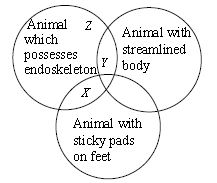
Animal Characteristics
A. Y - Penguin • Wings modified into flippers • Possesses blubber
B. Z - Chameleon • Long sticky tongue • Prehensile tail
C. X - Octopus • Bears eight arms • Squirts ink to escape predators
D. Z - Pangolin • Armoured shell as outer body covering for protection • Ability to curl into a ball when threatened
Answer : C
Free study material for Science Olympiad NSO
Multiple Choice Questions (MCQs) for Class 7 Science NSO Olympiad
Chapter MCQs with Answers for Class 7 Science
Explore reliable practice questions for NSO Olympiad tailored for Class 7 Science learners. Use these multiple-choice formats to evaluate preparedness and strengthen problem-solving skills.
Expert Practice Material for Class 7 Science
Built using the official NCERT book for Class 7, these Science objective sets provide reliable academic guidance. Pair your practice with our recommended NCERT solutions to master optimal problem-solving approaches.
Complete Your Chapter Revision
Explore our broader library of printable assignments, chapter notes, and mock tests designed to support continuous revision and secure higher marks in CBSE assessments.
FAQs
You can get most exhaustive CBSE Class 7 Science NSO Olympiad MCQs with Answers Set 09 for free on StudiesToday.com. These MCQs for Class 7 Science are updated for the 2026-27 academic session as per CBSE examination standards.
Yes, our CBSE Class 7 Science NSO Olympiad MCQs with Answers Set 09 include the latest type of questions, such as Assertion-Reasoning and Case-based MCQs. 50% of the CBSE paper is now competency-based.
By solving our CBSE Class 7 Science NSO Olympiad MCQs with Answers Set 09, Class 7 students can improve their accuracy and speed which is important as objective questions provide a chance to secure 100% marks in the Science.
Yes, Science MCQs for Class 7 have answer key and brief explanations to help students understand logic behind the correct option as its important for 2026 competency-focused CBSE exams.
Yes, you can also access online interactive tests for CBSE Class 7 Science NSO Olympiad MCQs with Answers Set 09 on StudiesToday.com as they provide instant answers and score to help you track your progress in Science.